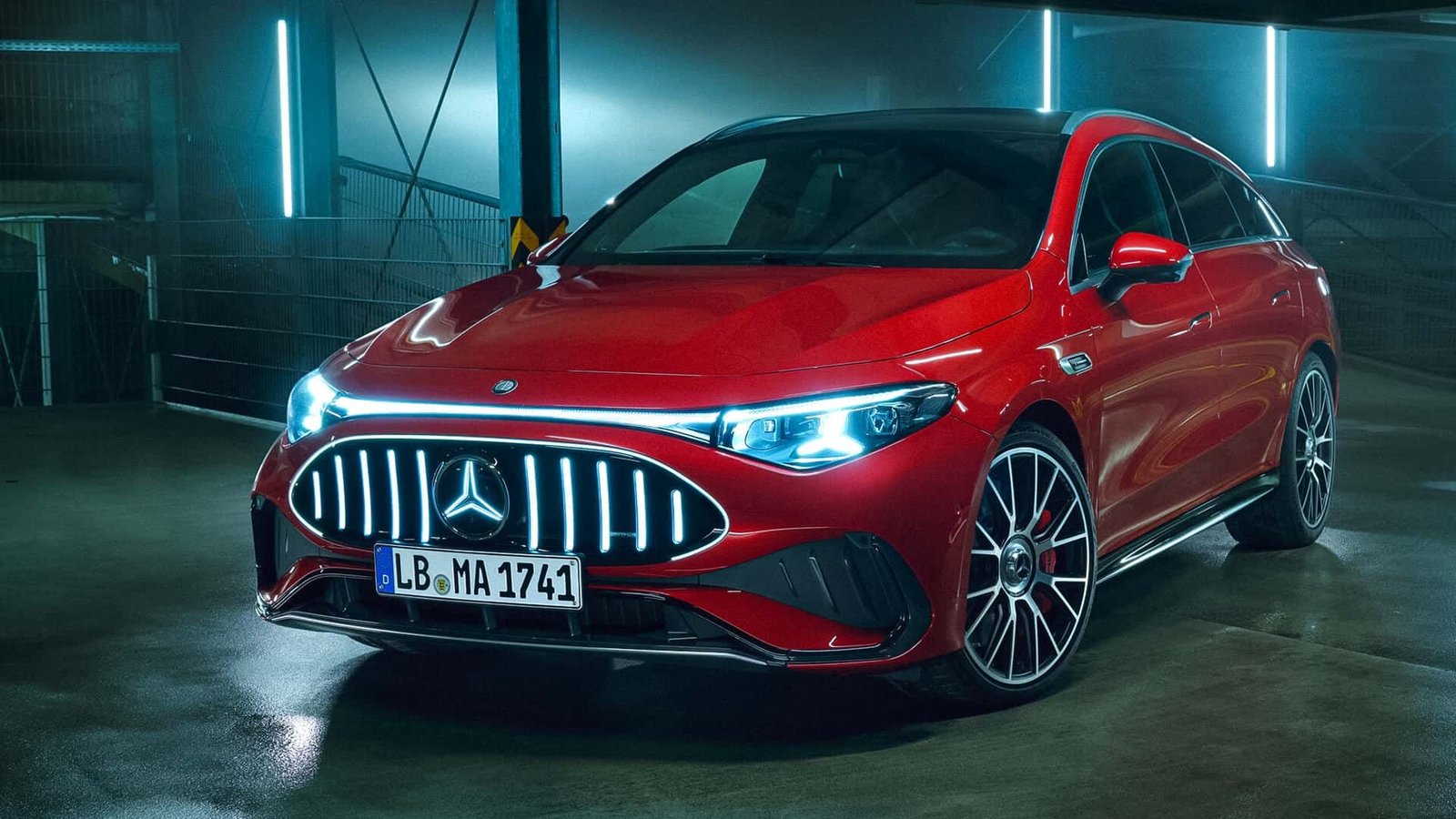
The electric AMG CLA 45 has arrived with Mercedes CEO Ola Källenius proclaiming it the “best V8” he’s ever driven, a bold declaration that challenges everything enthusiasts thought they knew about electrified performance.
- CEO’s Verdict: Ola Källenius calls the tri-motor CLA 45 the “best V8 I’d ever driven” with more power and torque than the real thing
- Power Output: Tri-motor setup delivers 612 hp continuous output, matching the E63’s twin-turbo V8
- Nürburgring Time: 7:32.07 lap time beats the Audi RS3 and nearly matches the BMW M2 CS
- US Availability: Not confirmed for American market; estimated $75,000 price tag if it arrives
- Performance Limitation: Power de-rates below 25% battery charge, reducing output significantly
- Simulation Tech: AMG Force S+ uses seat shakers, vibration actuators, and bespoke audio
- Weight Penalty: Estimated 4,400+ lbs curb weight versus 3,800 lbs gas predecessor
- No More Gas CLA 45: Another internal combustion CLA 45 isn’t happening, but larger AMGs will retain V8 options
The AMG CLA 45 returns with a radical transformation. The gas engine is gone, replaced by three electric motors generating astonishing power. Mercedes claims the EV delivers “combustion engine emotion at the touch of a finger” through a dedicated drive mode. With AMG Force S+ mode engaged, the system simulates four-cylinder engine sounds and artificial gear changes to recreate the ICE experience drivers have loved for decades.
While marketing materials suggest the new AMG 45 is simply the electric equivalent of its four-cylinder predecessor, Källenius goes much further. Speaking with Autocar, the CEO described the not-so-compact CLA as “the best V8 I’d ever driven: it had all the feeling of a V8 but with more power and torque.” He added that he felt “like a born-again Christian” after driving the car for the first time.
These are extraordinary claims from someone who has piloted virtually every high-performance Mercedes-AMG model produced during his tenure. The statement carries weight, but it also demands scrutiny. Mercedes-AMG’s official CLA 45 page details the technical specifications, while Autocar’s complete interview with Källenius provides additional context on his driving experience.
The Numbers That Matter: Nürburgring, Power, and Weight
The tri-motor powertrain represents AMG’s most ambitious electric architecture yet. The setup generates a continuous 612 horsepower, precisely matching the output of the E63’s twin-turbo 4.0-liter V8 engine. That’s remarkable for a CLA-class vehicle, regardless of its power source.
Mercedes has already put the electric CLA 45 through its paces at the Nürburgring, where it lapped the famous Nordschleife in 7:32.07. That time beats the Audi RS3 (7:33.5) and comes within striking distance of the BMW M2 CS (7:28.0). For a four-door sedan weighing significantly more than its rivals, that’s an impressive achievement that validates Källenius’s enthusiasm.
However, there’s a catch. The tri-motor system’s full 612 hp output is only available when the battery charge exceeds 25 percent. Below that threshold, the powertrain de-rates to protect battery health and thermal management, meaning drivers won’t get peak performance on longer track sessions or extended spirited drives. This limitation could be a dealbreaker for enthusiasts who plan to use the car as intended.
Weight is another critical factor. Industry estimates place the electric CLA 45 at approximately 4,400 pounds curb weight—over 600 pounds heavier than its 3,800-pound gas predecessor. That extra mass is the inevitable consequence of battery technology, but it raises serious questions about brake fade, tire wear, and overall agility compared to lighter combustion alternatives.
The Technology Behind the Illusion: AMG Force S+ Explained
AMG Force S+ mode is the centerpiece of Mercedes’ strategy to replicate the combustion experience. It’s not merely a sound generator—it’s a comprehensive sensory simulation system that engages multiple physical and digital channels to create an authentic performance feel.
The system uses seat shakers and vibration actuators mounted in the chassis to transmit engine-like vibrations through the cabin structure. These aren’t simple bass transducers; they’re carefully tuned to mimic the frequency and intensity patterns of AMG’s V8 engines at different RPM ranges. The result is a physical feedback loop that complements the synthetic audio soundtrack.
Mercedes has also programmed simulated gear shifts into the powertrain calibration. During hard acceleration, the system momentarily reduces torque delivery to mimic the interruption of a gear change, creating the characteristic “shift shock” that performance drivers instinctively associate with rapid progress. The effect is reinforced through the artificial audio track, which produces a corresponding change in engine note during each simulated upshift.
The sound engineering itself is proprietary AMG technology, not borrowed from other Mercedes models. Engineers recorded multiple AMG V8s in various conditions and digitally mapped the acoustic characteristics to the electric motor’s input. Unlike rivals that use generic synthesized noise, AMG’s audio evolves dynamically with driving style, becoming more aggressive under hard acceleration and softening during cruising.
This layered approach—physical vibrations, simulated shifts, and dynamic audio—represents the most sophisticated effort yet to bridge the gap between electric and combustion performance cars. Whether it’s enough remains an open question.
Will Enthusiasts Accept an Electric AMG?
The skepticism surrounding electric performance cars is justified. Outright power has never been the sole reason people bought an AMG. The sound, throttle response, mechanical drama, and sense of occasion all played crucial roles in the ownership experience. Simulation, no matter how sophisticated, isn’t the same as authenticity.
Independent test drivers who have experienced the CLA 45 offer a mixed verdict. Some praise the immediate torque delivery and track capability, noting that the tri-motor setup provides cornering grip that no front-engined V8 can match. Others describe the experience as “impressive but disconnected,” noting that even the best simulation can’t replicate the mechanical rawness of a naturally aspirated engine under full load.
The enthusiast community has responded with cautious skepticism. Online forums and social media discussions reveal deep skepticism about the “fake V8” approach, with many fans questioning whether AMG is losing its identity. The “born-again Christian” comment has become a meme among some circles, with critics suggesting the CEO is overhyping a compromised product.
Mercedes faces the same challenge every legacy performance brand encounters during electrification: preserving heritage while embracing progress. The CLA 45 is a test case for whether customers will accept simulation as a substitute for the real thing. Early indications suggest the answer depends heavily on the driver’s perspective—new EV converts may find the experience thrilling, while longtime AMG loyalists may feel something essential has been lost.
US Market Absence and Pricing Reality
Here’s the bitter pill for American enthusiasts: the electric AMG CLA 45 isn’t confirmed for the United States market. Mercedes has signaled that the CLA 45 will initially launch in Europe, with US availability uncertain due to supply chain constraints and the company’s EV production priorities.
If the car does arrive stateside, pricing estimates suggest a $75,000 starting figure—a significant premium over the gas CLA 45’s approximately $60,000 price tag. That would put it in direct competition with the Tesla Model 3 Performance ($54,000), BMW i4 M50 ($70,000), and Porsche Taycan base model ($90,000).
At $75,000, the CLA 45 faces a challenging value proposition. The Tesla offers comparable performance at a lower price point with superior charging infrastructure. The BMW i4 M50 provides a more established EV platform with proven daily usability. And the Taycan, despite its higher price, delivers brand cachet and driving dynamics that have won critical acclaim.
Mercedes may ultimately decide that the US market’s preference for larger vehicles makes the CLA 45 a poor fit, especially when the more spacious EQE and EQS sedans are already available. For now, American buyers should temper their expectations—this “best V8” may never reach our shores.
Competitor Comparison: How the CLA 45 Stacks Up
| Model | Power | 0-60 mph | Est. Weight | Starting Price | US Availability |
|---|---|---|---|---|---|
| AMG CLA 45 EV | 612 hp | ~3.0 sec | 4,400+ lbs | ~$75,000 | Unconfirmed |
| Tesla Model 3 Perf. | 510 hp | 2.9 sec | 4,050 lbs | $54,000 | Yes |
| BMW i4 M50 | 536 hp | 3.7 sec | 4,900 lbs | $70,000 | Yes |
| Porsche Taycan | 402 hp | 5.1 sec | 4,500+ lbs | $90,000 | Yes |
The comparison reveals the CLA 45’s competitive strengths and notable weaknesses. Its 612 hp output leads the segment, and the estimated sub-3.0-second sprint to 60 mph would make it among the quickest four-door production cars available. The Nürburgring time of 7:32.07 demonstrates genuine track capability that justifies the AMG badge.
However, the weight disadvantage is significant. At 4,400+ pounds, the CLA 45 is heavier than the Tesla Model 3 Performance and comparable to the much larger Taycan. That mass will affect brake performance, tire longevity, and the nimble handling that made the gas CLA 45 so engaging on B-roads. Tesla’s established Supercharger network and BMW’s proven EV platform also present practical advantages.
Price is another critical factor. The $75,000 estimated starting price puts the CLA 45 in a difficult position—substantially more expensive than the Tesla, slightly above the BMW, and approaching Porsche territory without the Taycan’s brand prestige or proven track record. If the car doesn’t come to the US, the point becomes academic, but for European buyers, the value calculation will require careful consideration.
Mercedes’ EV Strategy and MB.OS Integration
The CLA 45 isn’t just about performance—it’s a showcase for Mercedes’ broader technology strategy. The car runs on the MB.OS operating system, which marks a fundamental shift in how Mercedes develops and delivers vehicle software. Unlike previous systems that relied on third-party suppliers for computing architecture, MB.OS is built in-house and designed for over-the-air updates and continuous improvement.
Källenius has emphasized that computing power—measured in TOPS (trillions of operations per second)—is becoming as important as horsepower for modern performance cars. The CLA 45’s MB.OS platform delivers the computing capability needed for advanced driver assistance, real-time telemetry, and the sophisticated simulation algorithms that power AMG Force S+.
This software-defined approach means the CLA 45 will improve over time. Mercedes can push updates that refine the simulated engine note, adjust shift patterns, or even add new driving modes. It’s a fundamental departure from the fixed-character mechanics of a combustion engine, where the engine note and response were determined by hardware choices made years before production.
Mercedes has also committed to vertical integration of its supply chain, mirroring the approach that has given Tesla and BYD their cost advantages. The company is developing its own electric motors, battery cells, and power electronics rather than relying on external suppliers. This strategy aims to reduce costs, improve quality control, and give Mercedes more control over the vehicle’s character—a critical factor for a brand that built its reputation on driving experience.
The Verdict: Will Simulated V8 Emotion Convert Purists?
The central tension of the CLA 45 is whether simulation can replace authenticity. Källenius argues that it can, citing the car’s superior power, torque, and lap times. Skeptics counter that driving is fundamentally about sensation, not data—and that no amount of software trickery can replicate the organic, visceral response of a naturally aspirated V8.
There’s evidence on both sides. The CLA 45’s Nürburgring time proves that the car is genuinely fast, faster than many respected combustion performance cars. The tri-motor system’s torque vectoring gives it cornering capabilities that no front-engined car can match. On paper, the electric AMG CLA 45 is a better performance car than its predecessor.
But paper doesn’t capture the experience of a V8 howling past 7,000 RPM, the vibration through the steering wheel, the metallic crackle on overrun. These are elements that define AMG’s heritage, and they’re precisely the elements that simulation attempts to reproduce. For some drivers, the illusion will be convincing enough. For others, the absence of mechanical authenticity will be a dealbreaker.
Industry observers note that AMG is competing for a changing audience. Younger buyers who grew up with digital experiences may be more receptive to simulated performance than those who remember AMG’s golden era of naturally aspirated engines. Mercedes is betting that the future belongs to the former group, and the CLA 45 is designed to win them over.
The practical considerations—weight, price, range, and US availability—may ultimately matter more than the philosophical debate. If the CLA 45 delivers on its track promise and offers a compelling daily driving experience, many buyers will overlook the simulation. If it falls short, the “born-again Christian” quote will become a symbol of marketing over substance.
Frequently Asked Questions
[faq]What is the AMG Force S+ mode?
AMG Force S+ is a dedicated drive mode that creates a simulated combustion engine experience. It uses seat shakers, vibration actuators, bespoke audio engineering, and simulated gear shifts to replicate the sensations of an AMG V8 engine. The system adjusts throttle response, steering weight, and suspension stiffness while layering in artificial sounds and physical feedback.
Does the electric AMG CLA 45 come to the United States?
US availability remains unconfirmed. Mercedes has suggested the car will launch first in Europe, and American market plans are uncertain due to supply chain constraints and production priorities. If it does arrive, estimated pricing is approximately $75,000.
What is the CLA 45’s Nürburgring lap time?
The electric AMG CLA 45 lapped the Nürburgring Nordschleife in 7:32.07. This beats the Audi RS3 (7:33.5) and nearly matches the BMW M2 CS (7:28.0), demonstrating competitive track capability despite the car’s significant weight.
How much does the electric AMG CLA 45 weigh?
Industry estimates place the electric CLA 45 at approximately 4,400 pounds curb weight, significantly heavier than its 3,800-pound gas predecessor. Mercedes has not officially confirmed the figure, but the additional mass is a consequence of the battery pack and tri-motor system.
Will there be another gas-powered AMG CLA 45?
No. Mercedes has confirmed that another internal combustion CLA 45 isn’t happening. The model line has gone fully electric. However, larger AMG models like the GT and S-Class will continue to offer V8 options for the foreseeable future.
How does the electric CLA 45 compare to the Tesla Model 3 Performance?
The CLA 45 offers more power (612 hp vs. 510 hp) and a faster estimated 0-60 time (~3.0 sec vs. 2.9 sec comparable). However, the CLA 45 is significantly heavier, more expensive (~$75,000 vs. $54,000), and may not be available in the US. Tesla also has a more established charging network and proven reliability.
Does the CLA 45’s performance de-rate with battery charge?
Yes. The tri-motor system’s full 612 hp output is only available above 25 percent battery charge. Below that threshold, power is reduced to protect battery health and thermal management, meaning drivers won’t get peak performance during extended track sessions.
What is MB.OS and why does it matter?
MB.OS is Mercedes’ proprietary operating system, developed in-house for the CLA 45 and future models. It delivers the computing power needed for advanced driver assistance, real-time telemetry, and AMG Force S+ simulation. The system supports over-the-air updates, meaning the car can improve over time.
Motor1’s Take on the Electric AMG CLA 45
Outright power has never been the only reason people bought an AMG. The sound, response, mechanical drama, and sense of occasion all played a role. Whether three electric motors, sophisticated simulation technology, and some clever software can recreate enough of that magic remains one of the biggest questions surrounding the new CLA 45.
We’re more skeptical than Källenius, and for good reason. Electric vehicles offer incredible performance potential, but the subjective experience matters enormously in the premium performance segment. Simulated sounds, no matter how well-engineered, are not the same as the visceral rumble of a genuine V8. Virtual shift points can’t replicate the connection between driver and machine that comes from a manual gearbox or even a well-tuned dual-clutch.
The Nürburgring time is impressive, but track numbers don’t tell the whole story. The 7:32.07 lap proves the car is fast, but fast isn’t the same as engaging. Many of the most beloved AMGs in history—the C63, the SLS, the original CLK Black Series—were celebrated as much for their character as their lap times. That character is precisely what the CLA 45 attempts to simulate, and simulation always involves compromise.
The weight and battery de-rating issues are real concerns. A 4,400-pound performance car faces inherent limitations in braking, tire wear, and long-term track durability. The power reduction below 25 percent charge means the CLA 45 isn’t a true track-day weapon—it’s a performance car that needs careful battery management to deliver its full potential.
That said, AMG has earned the benefit of the doubt. The brand has consistently delivered exceptional driving experiences, and the engineering team behind the tri-motor CLA 45 includes many of the same people who developed the iconic V8s enthusiasts revere. The AMG Force S+ system represents the most sophisticated attempt yet to bridge the gap between electric and combustion performance.
For now, Mercedes seems convinced it can persuade the ICE-loving audience to switch to EVs. If the company’s CEO genuinely felt “born again” after driving it, perhaps the electric AMG has a better shot at winning over skeptics than its specs alone would suggest. We’ll reserve final judgment until we’ve driven it ourselves—hopefully on US soil.