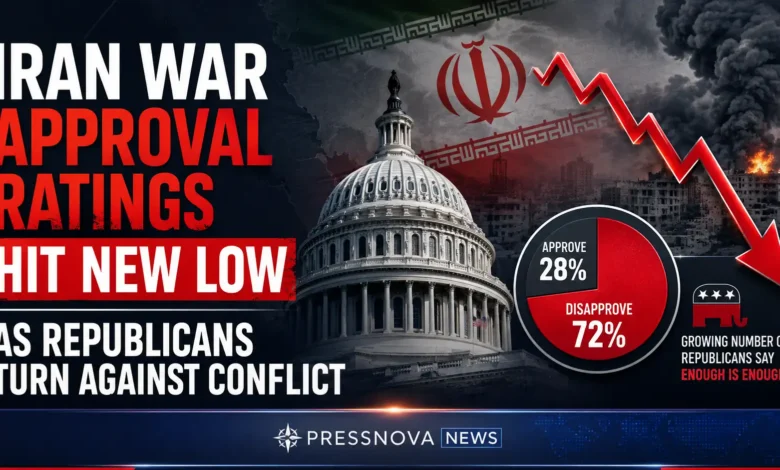
Iran war approval ratings have plummeted to their lowest point since the conflict began, with just 31% of Americans now supporting U.S. military operations against the Islamic republic, according to a new Reuters/Ipsos poll released Monday, Aug. 24. The latest finding represents a significant decline from 37% in March after President Donald Trump launched the conflict, and down from 34% earlier this month. The erosion of support is driven largely by Republicans turning against the war, with 69% of self-identified Republican respondents now backing the conflict compared with 77% in March.
- War Support at Record Low: 31% of Americans approve of U.S. military operations against Iran – down from 37% in March
- Republican Backing Erodes: 69% of Republicans support the war, compared with 77% in March – an 8-point drop
- Trump Approval Stuck at 33%: President’s approval rating holds at record-low level, tied with first-term nadir
- 83% Expect Prolonged Conflict: Overwhelming majority believes Iran war will drag on for an extended period
- Economic Fallout: Gasoline prices up more than $1 per gallon since war began, Strait of Hormuz remains blocked
- Midterm Warning Signs: Independent voters favor Democrats over Republicans 33% to 19% in congressional elections
Trump’s approval rating has also taken a hit amid the prolonged conflict, holding at just 33% for the second consecutive survey – the lowest level of his presidency in Reuters/Ipsos polling. The president’s public standing has been dragged down by surging gasoline prices, rising living costs, and widespread concern that the war will continue indefinitely, with 83% of Americans now believing the conflict will last for an extended period – up from 80% earlier this month.
The White House pushed back against the findings, with spokesperson Davis Ingle defending the president’s approach to Iran in a statement to USA TODAY. “What matters most to the American people is having a Commander-in-Chief who takes decisive action to eliminate threats and keep them safe, which is exactly what President Trump is doing,” Ingle said. Trump himself dismissed the polling results on Truth Social, writing that “The Radical Left Democrats are going CRAZY with Fake Polls. They’re putting them out at levels never seen before.”
The latest polling comes as the administration pivots to what Treasury Secretary Scott Bessent has termed “Operation Economic Outcast” – an unprecedented economic campaign against Iran’s financial networks. Bessent announced Monday that the U.S. has identified the networks Iran uses to move oil and circumvent sanctions, vowing to sever “every economic lifeline that sustains this tyrannical regime”. The Treasury Department has issued determinations against five sectors – digital assets, technology, gold, aviation and shipping – and imposed sanctions on nearly 60 entities, individuals and vessels. Meanwhile, U.S. troops remain stationed in the Middle East as Pentagon chief Pete Hegseth urges American arms manufacturers to ramp up production “to a wartime footing and build for victory.”
War Support Plunges as Republicans Shift Position on Iran Conflict
The four-day Reuters/Ipsos poll, conducted among 1,215 U.S. adults nationwide with a margin of error of 3 percentage points, reveals a stark decline in public backing for the military campaign. The 31% approval rating represents the lowest level of support since the war began in late February, when Trump and Israeli Prime Minister Benjamin Netanyahu launched strikes on Iran.
The erosion is particularly notable among Republicans, who have traditionally been the president’s most reliable supporters. GOP backing for the war has dropped from 77% in March to just 69% in the latest survey – an 8-point decline that signals growing unease within Trump’s own base about the direction and duration of the conflict. This shift has contributed to what the Washington Times described as a “damning verdict” from Republicans, with only 35% saying they “strongly approve” of Trump’s performance – down from 43% in May.
Trump has repeatedly criticized polls showing falling approval ratings, framing them as products of “Radical Left Democrats” in his Aug. 24 Truth Social post. However, the decline in support among self-identified Republicans suggests the discontent extends beyond partisan lines, with economic concerns and war fatigue cutting across traditional political allegiances.
Trump Approval Stuck at Historic Low Level Amid Economic Anxieties
For the second consecutive Reuters/Ipsos survey, President Trump’s approval rating has remained at 33% – the lowest level of his presidency in either his first or second term. The president’s disapproval rating stands at a staggering 64%, reflecting deep dissatisfaction with his handling of the economy, rising prices, and the Iran conflict.
Economic concerns have emerged as the primary driver of Trump’s declining popularity. The war has pushed gasoline prices more than a dollar higher per gallon than before the conflict began, with Iran’s blockade of oil exports through the Strait of Hormuz – through which approximately 20% of the world’s energy supply passes – exacerbating global price pressures. Only 26% of respondents approve of Trump’s handling of the economy, while an overwhelming 72% disapprove of his performance on rising prices.
Trump had campaigned in 2024 on a promise to control inflation and avoid prolonged military conflicts, making the current economic and military landscape particularly damaging to his political standing. The president has argued that paying “a bit more for gasoline” is worth ensuring Iran cannot obtain a nuclear weapon, but the latest polling suggests voters are increasingly unconvinced.
Vast Majority Expects Prolonged War as Exit Strategy Eludes Administration
Public expectations about the war’s duration have grown increasingly pessimistic, with 83% of Americans now believing the conflict will continue “for an extended period of time” – up from 80% earlier this month. That figure includes 71% of Republicans and 87% of Democrats, underscoring the bipartisan nature of war fatigue.
The numbers stand in stark contrast to Trump’s initial estimates when he launched the military campaign. The president told supporters that the operation against Iran would last four to five weeks, but the conflict is now approaching its six-month mark with no end in sight. Heavy fighting has subsided in recent months, but diplomatic efforts to end the conflict have stalled, and Iran continues to block oil and raw material shipping through the Strait of Hormuz.
Despite the military stalemate, the administration has ruled out an immediate withdrawal. Bessent announced “Operation Economic Outcast” on Monday, describing it as an “economic onslaught against Iran’s financial connections around the globe” and an “economic D-Day” aimed at severing every revenue source supporting the regime. The Treasury Secretary described the announcement as a “warning shot” giving countries a “cure period” to sever business ties with Iran before facing consequences, though he declined to provide specific timelines.
White House Defends Policy Amid Growing Public Skepticism
The White House has sought to counter negative polling by emphasizing the strategic necessity of confronting Iran. “President Trump campaigned proudly on his promise to deny the Iranian regime the ability to develop a nuclear weapon, and Americans are already safer because of his bold leadership,” Ingle said in a statement.
Trump himself has dismissed the polls as “fake,” a familiar refrain from a president who has long been skeptical of public opinion surveys. In an Aug. 24 Truth Social post, he wrote: “The Radical Left Democrats are going CRAZY with Fake Polls. They’re putting them out at levels never seen before”. When reached for comment by CNN, the White House also pointed to the 2024 election result, stating that “The ultimate poll was November 5th, 2024 when nearly 80 million Americans overwhelmingly elected President Trump to deliver on his popular and commonsense agenda”.
Administration officials have emphasized a transition from military operations to economic pressure. Bessent’s “Operation Economic Outcast” represents the centerpiece of this strategy, building on Trump’s previous warnings that countries providing financial, business, or government support to Tehran would face “tremendous economic consequences”. The Treasury Department has mapped every “node, facilitator, and network” Iran uses to smuggle oil and evade sanctions, with the goal of cutting off funding for the Islamic Revolutionary Guard Corps and the regime.
Political Fallout: Midterm Implications and Independent Voter Shift
The war has become a significant political liability for Republicans defending narrow congressional majorities in November’s midterm elections. Independent voters – a crucial swing demographic – now favor Democrats over Republicans by a margin of 33% to 19% when asked who they would vote for in congressional elections if the election were held today.
This shift is particularly alarming for Republicans, who historically have held an advantage with voters on the economy and national security – two areas now deeply affected by the Iran conflict. CNN’s chief data analyst Harry Enten has noted that Trump’s approval with the white working class has plummeted to -4 points from +34 in the 2024 election, flashing red warning signs for the Republican Party heading into the midterms.
Ipsos’s ongoing tracker provides further insight into public sentiment, asking Americans directly whether the war has been “worth it.” As of mid-June, only 25% said taking military action in Iran has been worth it, while 53% said it has not. The high cost of living, surging gasoline prices, and concerns about the war’s indefinite duration have all contributed to this skepticism, shaping a political environment that poses significant challenges for the president and his party as they approach the November elections.