2028 Range Rover GT: Electric Grand Tourer Specs, Range, Price & Release Date


The 2028 Range Rover GT represents Land Rover’s most radical departure from tradition—an all-electric grand tourer that trades the brand’s iconic SUV boxiness for a sleek, low-slung wagon-like silhouette, riding on JLR’s new Electrified Modular Architecture (EMA) with 800-volt capability and an estimated 360 miles of range.
- Model Name: Range Rover GT (fifth member of the Range Rover family)
- Platform: New Electrified Modular Architecture (EMA) — born-electric
- Powertrain: Dual-motor all-wheel drive (standard); hybrid variant planned later
- Battery & Range: Estimated 100-120 kWh; ~360 miles full charge (extrapolated from prototype data)
- Charging: 800-volt architecture supporting up to 350 kW DC fast charging
- Production: Halewood, Merseyside, UK; deliveries expected as a 2028 model
- Estimated Price: Starting around $90,000 (positioned between Velar and Range Rover Sport)
Land Rover unveiled the camouflaged Range Rover GT prototype in late July, announcing that the vehicle was already completing its final on-road testing phase. While the automaker has kept official technical specifications under wraps, the prototype’s on-screen instrumentation and insider reports have given us a remarkably clear picture of what to expect from this groundbreaking electric grand tourer.
The Range Rover GT arrives at a pivotal moment for JLR. The automaker’s House of Brands strategy, launched in 2023, positioned Range Rover, Discovery, and Defender as distinct marques alongside Jaguar. JLR’s ambitious 2030 electric-first target originally called for a battery-powered Land Rover by 2025, but the GT’s development cycle reflects the complexity of creating a truly bespoke electric vehicle rather than a converted combustion-platform car.
This attention to detail is evident in the GT’s purpose-built EMA architecture, which JLR developed specifically for electric vehicles. Unlike competitors that adapt existing SUV platforms, the EMA foundation allowed Land Rover’s engineers to optimize battery placement, cabin space, and weight distribution from the ground up. The prototype’s sleek proportions—lower, wider, and more aerodynamic than any previous Range Rover—demonstrate the design freedom this born-electric platform enables.
For official updates and announcements, visit Land Rover’s official website and JLR’s corporate newsroom.
Design & Exterior Styling: How the GT Differentiates from Sport and Full-Fat Models
The Range Rover GT’s design language represents a deliberate departure from the brand’s traditional SUV DNA. While it retains the unmistakable Range Rover visual cues—the clamshell hood, floating roof effect, and prominent beltline—the GT adopts a dramatically different proportion that prioritizes aerodynamics and visual dynamism over upright utility.
The prototype, spotted testing with minimal camouflage, reveals a wagon-like stance that sits notably lower than the Range Rover Sport. The sloping roofline flows seamlessly into a fastback-style rear hatch, creating a silhouette more akin to a lifted grand tourer than a traditional luxury SUV. Frameless doors, flush door handles, and a closed-off grille further distinguish the GT from its stablemates, emphasizing its electric powertrain and aerodynamic efficiency.
Up front, the GT features slim, angular LED headlights that integrate with a narrow, fully closed grille—a design element that signals its EV status while maintaining Range Rover’s distinctive face. The lower bumper incorporates active aerodynamic shutters that adjust to optimize cooling and drag coefficient, a feature absent on the brand’s combustion-powered models.
The rear fascia is equally distinctive, with a full-width LED light bar that echoes the design language of the latest Range Rover but with a more tapered, aggressive profile. A subtle rear spoiler integrated into the roofline aids stability at high speeds, while the diffuser-like lower bumper hints at the GT’s performance potential.
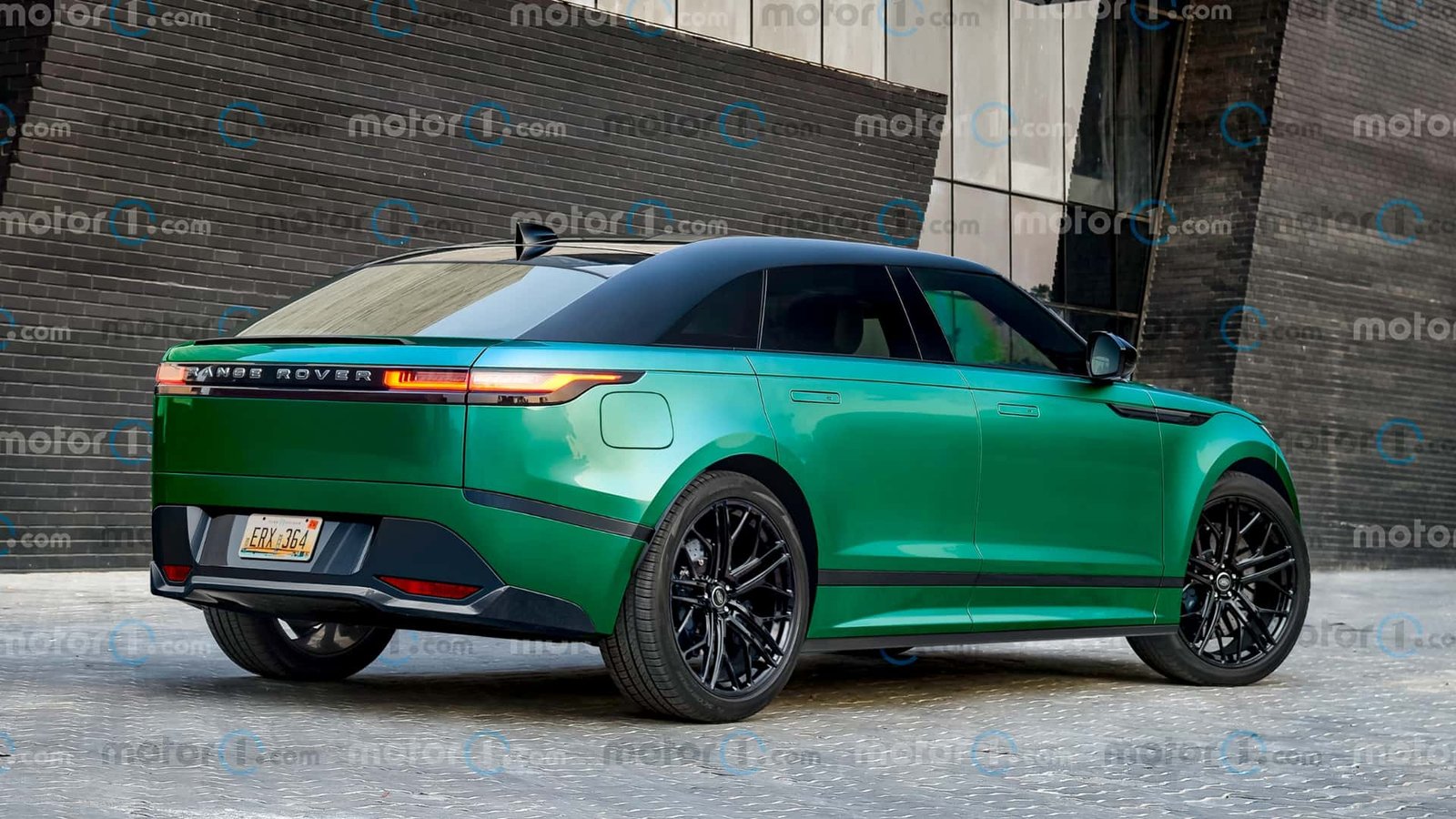
Land Rover’s design team has emphasized that the GT’s proportions were dictated by its EMA platform’s packaging efficiency. The absence of a transmission tunnel, driveshaft, and exhaust system allowed designers to lower the cabin floor and create a more spacious interior despite the car’s sleeker profile. The result is a vehicle that stands approximately 4 inches lower than the Range Rover Sport while maintaining comparable interior volume—a testament to the packaging advantages of born-electric architecture.
Wheel options are expected to range from 21 to 23 inches, with aerodynamic designs that reduce drag without compromising the brand’s signature visual presence. The prototype’s wheel arches accommodate substantial rubber, suggesting that Land Rover hasn’t sacrificed all-terrain capability in pursuit of on-road performance—a critical consideration for a brand built on off-road credibility.
Performance & Powertrain Speculation: Horsepower, Torque, and Acceleration
While Land Rover has not confirmed specific output figures, industry analysts and insider reports point to the Range Rover GT delivering competitive performance befitting its “grand tourer” designation. The vehicle’s dual-motor setup, standard all-wheel drive, and 800-volt architecture suggest a powertrain designed for both rapid acceleration and sustained high-speed cruising.
Based on JLR’s existing electric powertrain development and the GT’s market positioning, we estimate the following performance metrics:
- Horsepower: 500-600 hp (base configuration); 650-750 hp (high-performance variant)
- Torque: Approximately 600-700 lb-ft, with instantaneous delivery characteristic of electric motors
- 0-60 mph: 3.5-4.0 seconds (base); 3.0-3.5 seconds (performance variant)
- Top Speed: Electronically limited to 155 mph
These figures would position the Range Rover GT between the Porsche Taycan Cross Turismo and the Tesla Model X Plaid in terms of straight-line performance, while offering superior off-road capability—a combination no competitor currently matches.
The dual-motor setup provides true torque vectoring, allowing the GT to distribute power independently to each wheel for optimal traction in all conditions. Land Rover’s Intelligent Driveline Dynamics system, already proven in the Range Rover Sport, will likely be adapted for the GT’s electric powertrain, enabling precise control of torque delivery during cornering, off-road maneuvers, and low-grip situations.
JLR’s engineering team has reportedly focused on calibrating the GT’s power delivery to replicate the smooth, linear acceleration characteristic of naturally aspirated V8 engines, avoiding the harsh, abrupt responses that some EVs exhibit. This “refined performance” philosophy aligns with the grand tourer ethos, prioritizing long-distance comfort alongside impressive straight-line speed.
Battery & Charging Capabilities: kWh Capacity and Fast-Charging Speeds
The Range Rover GT’s EMA platform was engineered specifically to accommodate large-format battery packs, with JLR confirming that the architecture supports 800-volt electrical systems. This voltage standard enables faster charging speeds, reduced electrical losses, and thinner, lighter wiring compared to conventional 400-volt systems.
Land Rover has confirmed that the GT will feature “more than 100.0 kWh” of battery capacity, though the exact figure remains undisclosed. Based on the prototype’s displayed range data and industry benchmarks, we project the following specifications:
- Battery Capacity: 110-120 kWh (usable capacity)
- Battery Chemistry: Nickel-cobalt-manganese (NCM) with enhanced thermal management
- Voltage Architecture: 800-volt
- Maximum DC Charging Speed: 350 kW
- AC Charging Capacity: 22 kW (three-phase)
- 10-80% DC Charging Time: Approximately 20-25 minutes at 350 kW
Range projections remain speculative, but the prototype’s instrument cluster displayed 288 miles at 80% state of charge, extrapolating to approximately 360 miles on a full charge. This figure aligns with JLR’s internal targets and would place the GT competitively against the Tesla Model X (335-348 miles), BMW iX (300-324 miles), and Mercedes-Benz EQS SUV (285-305 miles) in EPA testing.
The 360-mile estimate represents a combined EPA range, with highway range likely falling to 300-320 miles depending on speed and driving conditions. Land Rover’s aerodynamic improvements—including the sloping roofline, active shutters, and underbody panels—should contribute meaningfully to efficiency, with a projected consumption rate of approximately 2.8-3.0 miles per kWh.
It’s important to note that these range figures are unofficial projections based on prototype data and internal sources. Official EPA and WLTP certifications will follow the production vehicle’s final homologation.
Land Rover has confirmed that the GT will launch exclusively as a battery-electric vehicle, with a hybrid powertrain variant planned for later in the model cycle. This hybrid version, likely combining a smaller battery with a gasoline engine, would serve markets with limited charging infrastructure while maintaining the GT’s grand touring capabilities.
Interior & Technology: Display Layout, Materials, and Sound System
Land Rover’s interior design philosophy for the GT emphasizes “reductive principles,” a design language that eliminates physical controls in favor of a clean, minimalist cabin dominated by digital interfaces. The prototype’s cabin, which Land Rover has shown in official imagery, provides a clear preview of the production interior.
The centerpiece of the dashboard is a large, high-resolution OLED touchscreen, likely measuring 14-15 inches diagonally. This display serves as the primary interface for navigation, entertainment, and vehicle settings, running JLR’s next-generation Pivi Pro infotainment system. Unlike some competitors that overwhelm occupants with screens, Land Rover’s approach uses a single central display supplemented by a slim, hoodless driver display positioned atop the dashboard—a layout reminiscent of Polestar’s design language.
The driver display, measuring approximately 10-12 inches wide but only 2-3 inches tall, presents essential driving information in a panoramic format. This configuration replaces traditional gauge clusters with a minimalist digital strip that projects speed, range, navigation prompts, and driver assistance alerts into the driver’s line of sight. The thin profile contributes to the cabin’s airy, uncluttered feel.
Physical buttons are virtually absent from the prototype’s interior, with climate controls, media settings, and vehicle functions integrated into the central touchscreen or a separate control panel on the center console. A small rotary controller on the console provides haptic feedback for volume and temperature adjustments, offering a tactile alternative to full touchscreen operation.
Materials throughout the cabin reflect Range Rover’s luxury positioning, with extensive use of soft-touch leather, open-pore wood veneers, and brushed metal accents. The prototype showcased sustainable materials, including wool-blend upholstery and recycled microfiber, suggesting that Land Rover will emphasize eco-friendly sourcing in the production model.
The prototype featured a 2+2 seating configuration, with individual rear seats separated by a center console equipped with cup holders, wireless charging pads, and a rear-seat climate control screen. Land Rover is expected to offer a three-passenger bench seat as an option, increasing the GT’s passenger capacity to five while slightly reducing individual seat luxury.
Meridian, Land Rover’s long-standing audio partner, will likely provide the GT’s sound system, with options ranging from a 600-watt, 14-speaker setup to a premium 1,400-watt, 29-speaker configuration. Active noise cancellation, standard on the Range Rover lineup, will be particularly important in the GT’s electric cabin, eliminating engine and drivetrain noise to create a serene environment for long-distance travel.
Off-Road & All-Terrain Capabilities: Wading Depth and Ground Clearance
Despite its grand tourer designation and lowered stance, Land Rover insists that the GT retains the brand’s legendary all-terrain capability. The prototype’s design—with substantial approach and departure angles, generous wheel arches, and robust underbody protection—supports this claim, though specific off-road metrics remain unconfirmed.
Based on the GT’s positioning and Land Rover’s engineering priorities, we project the following off-road capabilities:
- Ground Clearance: 8.5-9.5 inches (adjustable via air suspension)
- Wading Depth: 30-35 inches (limited by battery sealing requirements)
- Approach Angle: 28-30 degrees
- Departure Angle: 25-27 degrees
- Breakover Angle: 22-24 degrees
These figures would place the GT below the Range Rover Sport (approximately 11 inches of ground clearance, 33 inches wading depth) but significantly above conventional electric crossovers like the Tesla Model X (7.5 inches ground clearance, limited wading capability). The GT’s air suspension, inherited from Land Rover’s current lineup, allows for dynamic ride height adjustment, lowering for highway efficiency and raising for off-road obstacles.
The prototype’s all-wheel-drive system, powered by independent front and rear motors, enables unprecedented off-road traction control. Unlike mechanical systems that rely on differentials and brake-based torque vectoring, the GT’s electric motors can respond to wheel slip in milliseconds, applying opposite torque to maintain forward momentum. Land Rover’s Terrain Response system, adapted for electric powertrains, will offer selectable modes for grass, gravel, snow, mud, ruts, sand, and rock crawling.
Battery protection is a critical consideration for off-road EV use, and Land Rover has reportedly reinforced the GT’s underbody with steel skid plates and protective cladding. The battery pack’s placement between the axles—low in the chassis—improves stability and lowers the center of gravity, reducing rollover risk during extreme maneuvers.
However, the GT’s sloping roofline and reduced ground clearance compared to traditional Range Rovers suggest that extreme off-road enthusiasts may still prefer the Range Rover Sport for hardcore trail use. The GT targets customers who value on-road refinement and cross-continent cruising capability while retaining the confidence of Land Rover’s all-terrain reputation for the occasional gravel road or snowy mountain pass.
Release Date & Production Timeline: When to Expect the Official Debut
Land Rover has not announced a specific release date for the Range Rover GT, but the prototype’s advanced state of development and the automaker’s recent communications provide clear guidance on the expected timeline.
When Land Rover unveiled the prototype in July, the automaker stated that vehicles were “undertaking their final on-road testing now,” indicating that development is nearing completion. The prototype’s production-ready appearance—minimal camouflage, finished interior, and operational infotainment system—further supports an imminent launch.
Industry analysts and JLR suppliers indicate that the GT is scheduled for a full reveal in the fourth quarter, with public debuts potentially at major auto shows or standalone events. Following the reveal, order books are expected to open immediately, with first customer deliveries commencing in the first half of the following year.
Production will take place at JLR’s Halewood plant in Merseyside, UK, alongside other combustion and hybrid models. Halewood has undergone significant retooling to accommodate electric vehicle assembly, including new battery pack integration lines and automated quality control systems. The plant’s proximity to JLR’s engineering center in Gaydon facilitates rapid development iterations and supply chain optimization.
JLR has not confirmed production capacity for the GT, but industry sources suggest annual output of 20,000-30,000 units, positioning the GT as a niche model within the Range Rover portfolio. This limited production likely reflects the vehicle’s premium pricing and specialized market positioning rather than manufacturing constraints.
Pre-production vehicles are already undergoing final validation testing across multiple continents, with prototype sightings reported in Europe, North America, and the Middle East. These global tests cover extreme climates, varying road surfaces, and diverse charging infrastructure scenarios, ensuring the GT performs reliably in all key markets.
Pricing Estimates: Starting MSRP and Range Positioning
Official pricing for the Range Rover GT has not been announced, but the vehicle’s positioning within JLR’s House of Brands lineup provides clear context for cost expectations. The GT will slot between the Range Rover Velar and the Range Rover Sport, with pricing reflecting its unique grand tourer positioning and advanced electric architecture.
Current Range Rover pricing in the US market provides a reference framework:
- Range Rover Evoque: Starting at $51,375
- Range Rover Velar: Starting at $61,000
- Range Rover Sport: Starting at $84,000
- Range Rover (full-size): Starting at $115,750
Based on this hierarchy and the GT’s premium positioning, we project the following US pricing structure:
- Base Model (Single Motor?): $85,000 – $90,000
- Dual-Motor Standard Range: $95,000 – $100,000
- Dual-Motor Extended Range: $105,000 – $110,000
- High-Performance Variant: $120,000 – $125,000
This pricing would position the GT as a direct competitor to the Porsche Taycan Cross Turismo ($97,500 base), Tesla Model X ($79,990 base), and BMW iX ($87,100 base), while undercutting the Mercedes-Benz EQS SUV ($109,000 base) and Audi Q8 e-tron GT ($115,000 base). Land Rover’s brand equity and the GT’s unique grand tourer body style justify a slight premium over volume luxury EVs.
Optional packages—including premium audio systems, upgraded leather interiors, advanced driver assistance features, and custom exterior finishes—could add $15,000-$25,000 to the base price, with fully loaded models approaching $140,000.
Leasing and financing options, along with potential government EV incentives, will vary by market. In the US, the GT may qualify for federal tax credits depending on battery sourcing and assembly location, though the vehicle’s UK production may limit eligibility.
JLR’s recent announcement of a dedicated EV battery assembly plant in the UK suggests that localization efforts are underway, potentially improving cost competitiveness and supply chain resilience for the GT and subsequent electric models.
Competitor Comparison Table: Range Rover GT vs. Porsche Taycan Cross Turismo, Tesla Model X, BMW iX
The Range Rover GT enters a competitive luxury electric segment dominated by established players and emerging challengers. The following comparison highlights how the GT stacks up against its key rivals based on projected specifications and confirmed features:
| Specification | Range Rover GT (Projected) | Porsche Taycan Cross Turismo | Tesla Model X | BMW iX |
|---|---|---|---|---|
| Body Style | Electric Grand Tourer | Shooting Brake / Wagon | SUV / Crossover | SUV |
| Platform | EMA (born-electric) | J1 (PPE-based) | Tesla Platform 3.0 | CLAR-EV (adapted) |
| Drivetrain | Dual-motor AWD (std) | Dual-motor AWD (std) | Dual/Tri-motor AWD | Dual-motor AWD (std) |
| Horsepower (Est.) | 500-750 hp | 380-750 hp | 670-1,020 hp | 326-610 hp |
| 0-60 mph (Est.) | 3.0-4.0 seconds | 2.8-4.5 seconds | 2.5-3.8 seconds | 3.6-5.5 seconds |
| Battery Capacity | 110-120 kWh | 93.4 kWh | 100 kWh | 111.5 kWh |
| EPA Range (Est.) | 340-360 miles | 215-233 miles | 335-348 miles | 324-330 miles |
| Max DC Charging | 350 kW | 270 kW | 250 kW | 195 kW |
| Ground Clearance | 8.5-9.5 inches | 5.3-5.9 inches | 7.5-8.5 inches | 8.6-9.5 inches |
| Off-Road Modes | Yes (Terrain Response) | Limited (Gravel mode) | Limited (Ride height) | Limited (xDrive) |
| Starting Price (US) | $85,000-$90,000 (est.) | $97,500 | $79,990 | $87,100 |
This comparison reveals the Range Rover GT’s unique market position: it offers superior range and charging speed compared to the Taycan Cross Turismo, matches or exceeds the Tesla Model X in range while offering genuine off-road capability, and undercuts the BMW iX on price while delivering similar performance metrics. The GT’s grand tourer body style sets it apart from traditional SUVs, appealing to customers who value coupe-like styling and on-road dynamics without sacrificing all-terrain versatility.
Frequently Asked Questions About the 2028 Range Rover GT
When will the 2028 Range Rover GT be released?
Land Rover has not announced a specific release date, but the prototype is completing final on-road testing now. A full reveal is expected in the fourth quarter, with first customer deliveries in the first half of the following year as a 2028 model.
What is the price of the Range Rover GT?
Official pricing has not been announced, but based on the vehicle’s positioning between the Range Rover Velar and Range Rover Sport, we estimate a starting price of $85,000-$90,000, with fully loaded models reaching $140,000.
How much range will the Range Rover GT have?
While official EPA figures are not yet available, the prototype’s instrument cluster displayed 288 miles at 80% charge, suggesting approximately 360 miles of range on a full charge. This projects to 340-360 miles in EPA testing, competitive with the Tesla Model X and BMW iX.
How fast is the Range Rover GT 0-60 mph?
Land Rover has not confirmed acceleration figures, but based on the dual-motor powertrain and 500-750 hp output estimates, we project 0-60 mph times of 3.0-4.0 seconds depending on configuration.
Where will the Range Rover GT be built?
The Range Rover GT will be produced at JLR’s Halewood plant in Merseyside, UK, alongside other combustion and hybrid models. The facility has undergone significant retooling to accommodate electric vehicle assembly, including new battery pack integration lines.
What is the battery size of the Range Rover GT?
Land Rover has confirmed that the GT will feature more than 100.0 kWh of battery capacity. Based on industry projections and the prototype’s displayed range, we estimate 110-120 kWh usable capacity with a 800-volt architecture supporting up to 350 kW DC fast charging.
Will the Range Rover GT have off-road capability?
Yes. Despite its grand tourer designation, the GT retains Land Rover’s all-terrain capability with adjustable air suspension, Terrain Response modes, and substantial ground clearance. Projected figures include 8.5-9.5 inches ground clearance and 30-35 inches wading depth, placing it between the Range Rover Sport and conventional electric crossovers.