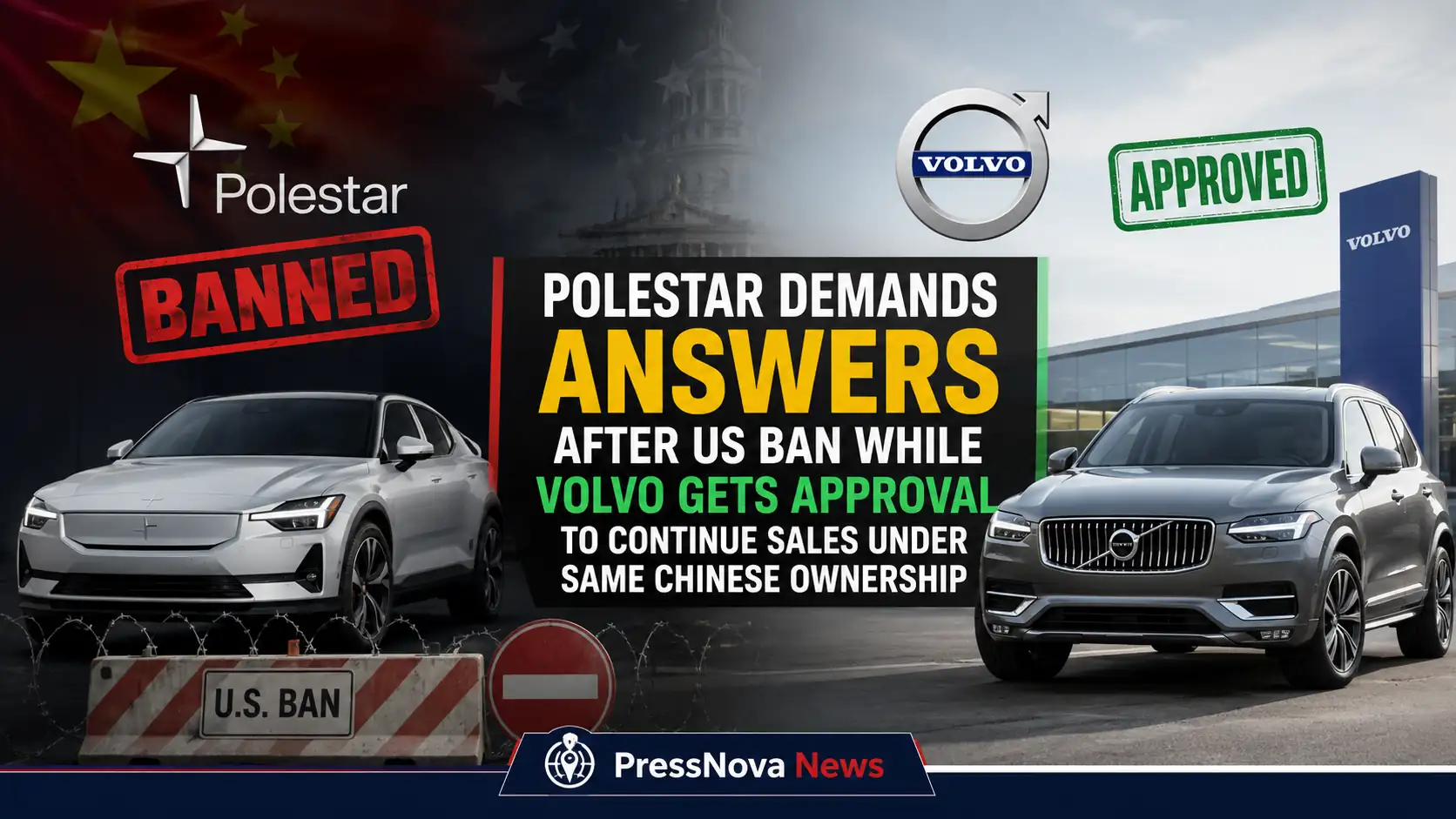
Polestar wants answers after its US sales ban was finalized, leaving the electric vehicle brand unable to sell new cars in America starting in 2027 while Volvo, which shares the same Chinese parent company, received approval to continue operations. The Swedish automaker, owned by China’s Geely, has decided not to appeal the Commerce Department’s ruling but is publicly questioning why its application was denied when Volvo’s was accepted under nearly identical circumstances.
- Ban Effective: Polestar will be prohibited from selling new vehicles in the US starting in 2027 under the Connected Vehicle Rule.
- Volvo Approved: Volvo, also owned by Geely, received authorization to continue US sales in May, leaving Polestar with questions.
- Disparate Treatment: Polestar alleges it received “disparate treatment” after officials reportedly suggested approval was likely.
- US Production: The Polestar 3 is assembled in South Carolina, yet the ban still applies due to Chinese ownership and technology ties.
- No Appeal: Polestar has chosen not to appeal, citing low chances of success based on discussions with officials.
According to documents obtained by the Wall Street Journal, Polestar had expected to receive approval after spending more than a year cooperating with the US Department of Commerce. The company submitted its initial application to the Bureau of Industry and Security in May 2025, seeking permission to continue selling connected vehicles in the US market. Throughout the review process, Polestar answered detailed questions from federal officials and implemented several measures to address national security concerns.
Polestar offered cybersecurity reviews, third-party audits, and operational changes designed to prevent China-linked entities from managing vehicle data. The automaker believed these concessions would satisfy the government’s requirements under the Connected Vehicle Rule, which restricts the sale of certain vehicles and components linked to China and Russia over national-security concerns.
The situation appeared promising when, according to Polestar, Commerce Department officials told the company’s outside counsel in January 2026 that they had received sufficient information and were preparing to recommend approval. Then, in April, an official reportedly told Polestar that approval would be reasonable to expect if Volvo received authorization under the same ownership structure and with similar hardware and software.
Volvo Approval Adds to Polestar’s Frustration
Volvo received its approval in May 2026, clearing the Swedish brand to continue selling vehicles in the US market. However, Polestar’s application was denied the following month, leaving the automaker confused and frustrated. The company has since used the term “disparate treatment” to describe the different outcomes, suggesting that the government applied inconsistent standards to two brands with the same ultimate owner.
Polestar has emphasized that it does not plan to appeal the Commerce Department’s decision, as discussions with officials led the company to believe an appeal would be unsuccessful. Instead, Polestar will shift its focus to other markets, particularly Europe, where it sees stronger growth opportunities. For American buyers, the immediate situation remains unchanged: Polestar will stop selling new vehicles after the 2026 model year, though dealers can continue selling remaining inventory.
The company has assured existing owners that it will continue supporting them, including warranty coverage, service, repairs, parts availability, and software updates. However, new customers will no longer have access to Polestar’s lineup, which includes the Polestar 2 sedan, Polestar 3 SUV, and Polestar 4 coupe-SUV.
Connected Vehicle Rule Targets Chinese Technology Ties
The dispute centers on the US government’s Connected Vehicle Rule, which was designed to restrict the sale of certain connected vehicles and components linked to China and Russia over national-security concerns. The rules aim to prevent foreign adversaries from accessing sensitive information collected by connected vehicles or remotely influencing vehicle systems through software and communications hardware.
This regulatory framework means that building a car in America does not necessarily exempt an automaker from the ban. Even though the Polestar 3 is assembled at a plant in South Carolina, its Chinese ownership and technology ties still subject it to government scrutiny. Volvo, despite having many of the same connections, received approval to continue selling vehicles in the US, raising questions about how the Commerce Department distinguishes between the two brands.
Polestar has argued that its software and hardware are comparable to Volvo’s, yet the government reached different conclusions. The automaker’s frustration is compounded by the fact that it made significant investments in US manufacturing and compliance efforts, expecting that these actions would demonstrate its commitment to operating within American regulatory frameworks.
Polestar’s Future Without the US Market
For Polestar, the US ban represents a significant setback. The American market has been a key growth driver for the brand, which positioned itself as a premium electric vehicle alternative to Tesla and established luxury automakers. Losing access to US customers will force Polestar to accelerate its expansion in Europe and other regions where regulatory environments are more favorable.
The company has already decided to concentrate its investments on Europe, where demand for electric vehicles remains strong and regulatory uncertainty is lower. Polestar’s decision not to appeal suggests that the brand sees limited value in continuing to fight a battle it believes it cannot win, preferring instead to allocate resources to markets where it can compete effectively.
Motor1’s Take: It’s easy to see why Polestar is frustrated. Polestar and Volvo aren’t identical companies, and there may be differences in how the two handle software; the Commerce Department has not publicly explained those differences. The lack of transparency from US officials leaves Polestar—and the broader automotive industry—wondering what specific factors led to the disparate outcomes and whether other Chinese-owned brands could face similar treatment in the future.