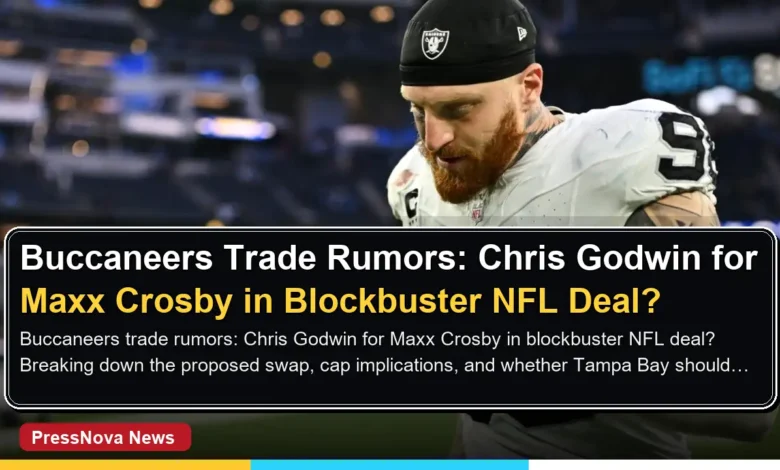
The Tampa Bay Buccaneers have emerged at the center of the NFL’s most polarizing offseason speculation: a blockbuster trade proposal that would send veteran wide receiver Chris Godwin and premium draft assets to the Las Vegas Raiders in exchange for five-time Pro Bowl edge rusher Maxx Crosby.
- Proposed Framework: ESPN’s Ben Solak suggests Tampa Bay would trade Chris Godwin, the No. 15 overall pick in the 2026 NFL Draft, and a 2027 second-round selection to the Raiders for Maxx Crosby and a 2027 fifth-round pick
- Crosby’s Resume: Five-time Pro Bowler with double-digit sacks in four consecutive full seasons; one of the NFL’s most disruptive defenders in pressures and tackles for loss
- Bucs’ Pass Rush Problem: Tampa Bay managed just 37 sacks in 2025 and hasn’t had a player reach 10 sacks since Shaq Barrett in 2021
- Godwin’s Value & Health: Limited to nine games and 33 receptions in 2025 due to injury; remains a reliable possession receiver but durability concerns are mounting
- Cap Implications: Crosby carries a $30+ million annual cap hit through 2027 after signing a three-year, $106.5 million extension in March 2025
- Compensation Debate: Analysts question whether Godwin plus first and second-round picks is sufficient for a player of Crosby’s elite caliber
The speculation has ignited intense debate across league circles, forcing analysts and fans alike to confront fundamental questions about Tampa Bay’s roster construction philosophy. At its core, the scenario pits offensive continuity against defensive transformation—a decision that could define the franchise’s trajectory for years to come.
ESPN’s Ben Solak first floated the conceptual framework that has since captured the NFL’s collective imagination. In his proposed construction, the Buccaneers would part with Godwin, their 2026 first-round selection (No. 15 overall), and a 2027 second-rounder. In return, Tampa Bay would secure Crosby along with a 2027 fifth-round compensatory pick. The underlying logic is immediately compelling: address a pass rush that has languished in mediocrity for half a decade by acquiring one of football’s premier edge defenders.
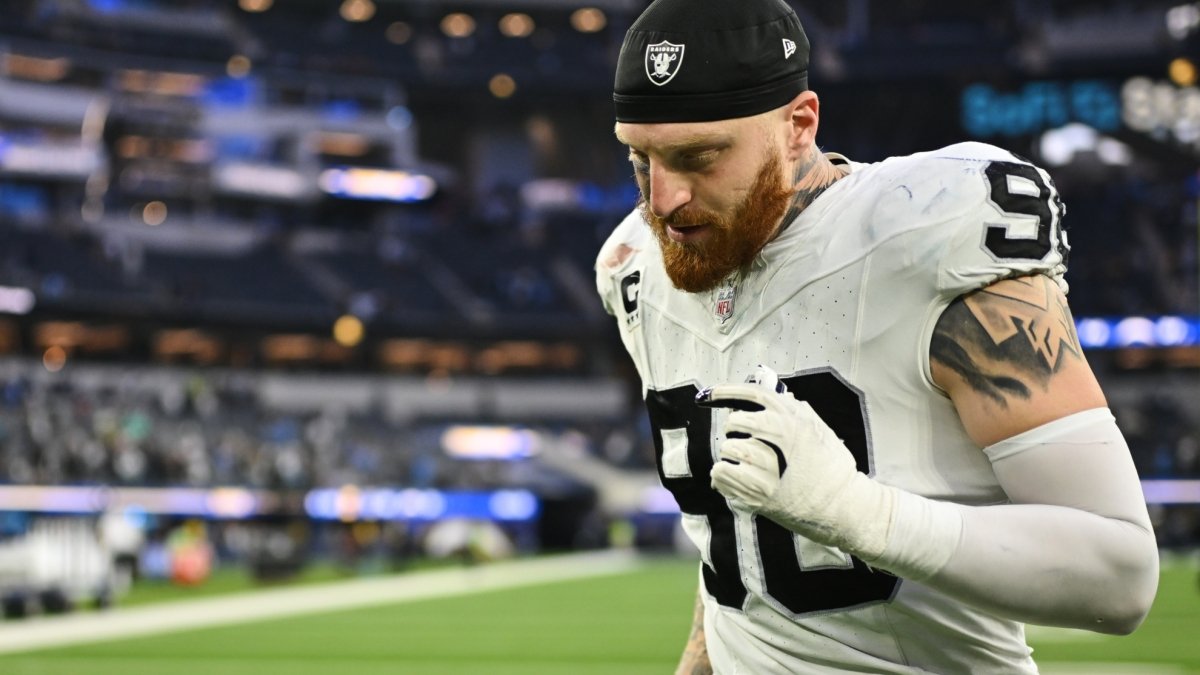
Crosby’s statistical profile demands attention. The five-time Pro Bowler has produced double-digit sack totals in four consecutive full campaigns and has established himself as arguably the league’s most relentless defensive lineman. Beyond the sack numbers, his impact manifests in quarterback pressures, hurries, and tackles for loss—categories where he consistently ranks among the NFL’s elite. He has accomplished this despite playing on Raiders defenses that rarely elevated his supporting cast.
For Tampa Bay, the defensive need is unmistakable. The Buccaneers generated only 37 sacks as a unit in 2025, a figure that ranked near the bottom third of the NFL. More troubling, no Tampa Bay defender has reached the 10-sack plateau since Shaquil Barrett accomplished the feat in 2021. That drought underscores a persistent inability to generate consistent edge pressure—a deficiency that has contributed to defensive volatility and playoff disappointment.
The Trade Framework: Breaking Down Solak’s Proposal
Solak’s vision for the Godwin-Crosby swap rests on a foundation of mutual benefit that aligns each franchise’s timeline and positional needs. For the Buccaneers, the acquisition of Crosby would immediately transform a defensive front that has too often failed to disrupt opposing quarterbacks. As Buccaneers trade rumors continue to circulate, the urgency to upgrade the pass rush has never been more apparent.
At 28 years old, Crosby remains squarely within his prime. His 2025 campaign underscored his durability and consistency—he played 17 games, recording 12.5 sacks and 38 quarterback hits while commanding constant double-teams and chip help from running backs. His motor and conditioning are legendary within league circles, making him a reliable three-down presence rather than a situational rusher.
The compensation Las Vegas would receive in this scenario is substantial, though the market for elite edge rushers suggests it may fall short. Recent trades for comparable talents have commanded compensation packages that included multiple first-round selections. The Raiders’ position is further complicated by Crosby’s contractual status—he signed a three-year, $106.5 million extension in March 2025, indicating the franchise viewed him as a foundational piece.
Chris Godwin: The Asset Tampa Bay Would Surrender
Chris Godwin’s value to the Buccaneers cannot be measured solely in statistical production. Since establishing himself as a premier slot-target receiver, Godwin has served as the ideal complement to Mike Evans’ downfield prowess. His route-running precision, contested-catch ability, and yards-after-catch production have made him one of the NFL’s most trusted third-down options.
However, the 2025 season raised legitimate durability concerns. Godwin appeared in just nine games and recorded 33 receptions—a stark decline from his typical production. Injuries have become an unfortunate pattern, with the wide receiver missing significant time in multiple seasons throughout his career. For the Raiders, acquiring Godwin would represent a calculated gamble on his health, banking that his production can rebound in a new offensive system.
From Tampa Bay’s perspective, moving Godwin would create a significant void in the receiving corps. The Buccaneers would be betting that younger options can absorb his targets, or that the offensive scheme can adapt to a reduced reliance on intermediate-passing concepts. However, the compensatory draft capital—a first and second-round selection—would provide ammunition to restock the position through the draft or veteran free agency.
Financial Considerations and Cap Implications
The financial mathematics of the proposed trade present perhaps the greatest obstacle. Crosby’s contract, which averages more than $35 million per season, would place significant strain on Tampa Bay’s salary cap structure. The Buccaneers have managed their cap carefully in recent years, but absorbing an additional $30-plus million annual commitment would necessarily impact other roster decisions.
Godwin’s contract, by comparison, offers more flexibility. His cap figure is manageable, and moving him would create space that could partially offset Crosby’s salary. However, the net effect would still require Tampa Bay’s front office to make difficult choices regarding other high-priced veterans and pending free agents.
Analysts have noted that the Buccaneers’ defense already features several highly-compensated players, including linebacker Lavonte David and defensive tackle Vita Vea. Adding Crosby to that mix would create a top-heavy payroll on one side of the ball—a departure from the balanced approach that has characterized the franchise’s recent roster construction.
Raiders’ Perspective: Why Las Vegas Might Consider Moving Crosby
For the Raiders, trading a player of Crosby’s stature would represent a philosophical pivot rather than a talent evaluation. Crosby has been the face of the franchise’s defense since his arrival, embodying the toughness and intensity that Las Vegas has sought to cultivate. His leadership within the locker room and commitment to the organization make him a difficult asset to part with.
However, the Raiders’ trajectory suggests that a significant reset may be warranted. The franchise has languished in mediocrity, failing to build a consistent winner around Crosby’s prime years. If Las Vegas believes that a comprehensive rebuild is necessary, accumulating premium draft capital and a productive veteran like Godwin could accelerate that process. The Tampa Bay Raiders trade conversations have gained traction precisely because both sides face uncertain futures that could be reshaped by bold moves.
Godwin’s skill set would translate well to the Raiders’ offensive scheme, providing a reliable security blanket for whichever quarterback ultimately leads the franchise. His presence would also create opportunities for complementary receivers, potentially maximizing the effectiveness of the entire passing attack.
What Analysts Are Saying About the Proposed Swap
The national media response to Solak’s proposal has been sharply divided. Some analysts view the trade as a rare win-win scenario that addresses each team’s most pressing needs. Others argue that the compensation package undervalues Crosby’s elite production, suggesting that the Raiders would require more significant draft capital to entertain a deal.
NFL Network’s Ian Rapoport has characterized the proposal as “intriguing but improbable,” noting that elite edge rushers of Crosby’s caliber rarely change hands. Insiders point to the 2023 trade market for similar talents, where defensive linemen commanded returns that included multiple first-round picks and additional compensation.
Another perspective emphasizes the Buccaneers’ timeline. Tampa Bay’s core, particularly quarterback Baker Mayfield and receiver Mike Evans, is operating in a competitive window that may not align with a multi-year rebuild. Acquiring Crosby would signal an aggressive pursuit of immediate contention—a strategy that aligns with the franchise’s recent win-now approach. Given the NFL blockbuster trade market heating up, the Buccaneers would face stiff competition from other franchises eager to land a difference-maker of Crosby’s caliber.
Potential Roadblocks and Alternative Scenarios
Several factors could prevent the Godwin-Crosby trade from materializing. The Raiders’ public commitment to Crosby, expressed through contract extension and consistent organizational messaging, suggests that Las Vegas views him as a cornerstone rather than a trade chip. Owner Mark Davis and general manager Tom Telesco have both emphasized Crosby’s importance to the franchise’s identity.
The Buccaneers face their own obstacles. Absorbing Crosby’s salary would require significant cap maneuvering, potentially including restructures and extensions that push money into future years. The draft capital surrendered—particularly the No. 15 overall pick—would represent a significant opportunity cost, removing Tampa Bay from the first round of a draft class that many evaluators believe is deep at offensive line and defensive back.
Alternative trade scenarios have circulated as well. Some analysts have suggested that Tampa Bay could pursue a less expensive edge rusher, preserving Godwin and draft capital while addressing the pass rush at a lower cost. Names like Haason Reddick and Brian Burns have been floated as potential Plan B options.
Conclusion: Will the Buccaneers Make the Move?
The proposed Godwin-for-Crosby trade remains speculative, but its existence signals important conversations happening within both organizations. For the Buccaneers, the question is whether defensive transformation outweighs the cost of losing a proven playmaker and valuable draft capital. For the Raiders, the calculus centers on whether Crosby’s prime years align with a realistic competitive window.
What is certain is that Tampa Bay must address its pass rush deficiency. Whether through a blockbuster trade, a mid-tier free agent addition, or draft investment, the Buccaneers cannot afford another season of defensive inconsistency. Crosby represents the gold standard of available solutions—but acquiring him requires conviction, creativity, and a willingness to reshape the roster’s financial architecture.
The 2026 NFL offseason has only just begun, and the landscape will continue to shift as free agency and the draft approach. For now, the Godwin-Crosby rumor serves as a fascinating thought experiment that illuminates both teams’ strategic priorities. Whether it becomes reality remains to be seen, but the conversation itself demonstrates the lengths franchises will consider to secure a competitive edge.