Tyreek Hill to Buffalo: What a Bold Signing Would Mean for the Bills’ Super Bowl Hopes

The Buffalo Bills’ pursuit of Tyreek Hill has sparked intense debate about whether the five-time All-Pro wide receiver is the missing piece for a franchise chasing its first Super Bowl title. Following another heartbreaking postseason exit—a 33-30 overtime loss to the Denver Broncos in the Divisional Round—the organization has undergone a dramatic transformation, firing head coach Sean McDermott after nine seasons and promoting offensive coordinator Joe Brady to lead a new offense-first era built entirely around maximizing quarterback Josh Allen’s prime years.
- Tyreek Hill Released: Miami Dolphins cut the 5-time All-Pro WR on February 16, 2026, saving $51.1M in cap space
- Buffalo’s Coaching Shakeup: Bills fired Sean McDermott after 9 seasons, promoted Joe Brady to head coach
- Injury Status: Hill suffered a torn ACL and dislocated knee in Week 4, 2025; currently rehabbing with “no power” in his left leg
- Career Stats: 819 receptions, 11,363 receiving yards, 83 TDs in 145 career games
- Super Bowl LIV Champion: Hill won his only ring with the Chiefs in the 2019 season
- AFC Arms Race: Signing Hill would instantly make Buffalo a Super Bowl favorite according to betting markets
The opportunity to land one of the most electrifying receivers in NFL history emerged when the Miami Dolphins released Hill on February 16, parting ways with the speedster after four seasons in South Beach. The decision was purely financial—Hill had been scheduled to count a staggering $51.1 million against the cap for the 2026 season, an untenable figure for a player coming off a devastating injury. In just four games during the 2025 campaign, Hill caught 21 passes for 265 yards and one touchdown before suffering a gruesome knee dislocation and torn ACL against the New York Jets, an injury so severe that doctors initially feared he might never walk normally again.
Sports Illustrated analyst Conor Orr first identified the Bills as a legitimate suitor, noting that Buffalo represents the kind of “team on the doorstep” willing to take a calculated risk on a high-upside veteran. “While I think the chase for Hill will be closer to the post-hype ‘chase’ for Odell Beckham Jr.—less of a drama and more about which team is willing to shell out even the slightest of guarantees—he is good enough to warrant the curiosity of a team on the doorstep,” Orr wrote. The timing aligns with Buffalo’s organizational reset, as new head coach Joe Brady has emphasized an aggressive, offense-first philosophy built around Allen’s generational arm talent.
From a financial standpoint, the Bills face a challenging cap situation. According to Over The Cap, Buffalo currently has approximately $12.8 million in effective salary cap space for the 2026 season, ranking 22nd in the NFL. This limited flexibility explains General Manager Brandon Beane’s cautious approach and the team’s need to restructure contracts or create additional room before any significant signing. The Bills have already made moves to create space, including the release of defensive back Taron Johnson and wide receiver Curtis Samuel, but landing Hill would require further financial maneuvering.
Tyreek Hill’s Injury Update: The $64 Million Question
The single most significant variable in any potential Tyreek Hill signing is the status of his surgically repaired left leg, and his recent Tyreek Hill injury update raised more questions than answers. In a YouTube video posted on July 22, 2026—approximately 10 months after the initial injury—Hill provided a sobering assessment of his recovery progress. “My left leg is the one that I injured. I have no power in my left leg at all, so I’m trying to regain all the power back in my left leg. But it’s one day at a time,” Hill said, adding that doctors had told him he “might not be able to walk again” following the operation.
The 32-year-old speedster declined to reveal a specific timeline for his return to the field, though he remained characteristically optimistic: “I ain’t going to tell you what my timeline is, but timeline looking real good right now, man”. Despite his encouraging words, the reality remains stark—Hill has undergone two surgeries on the same leg, and his game has always been predicated on the explosive acceleration that made “Cheetah” the most feared deep threat in the NFL.
His agent, Drew Rosenhaus, has maintained that the goal is to get Hill back into game shape before considering a landing spot, suggesting that a mid-season signing could be a realistic possibility. For the Bills, this creates a classic risk-reward calculation: sign a future Hall of Famer who may not be at full strength in 2026, or watch a division rival add a weapon that could haunt them for years to come.
What Tyreek Hill Brings to Buffalo’s Offense: Statistical Comparison
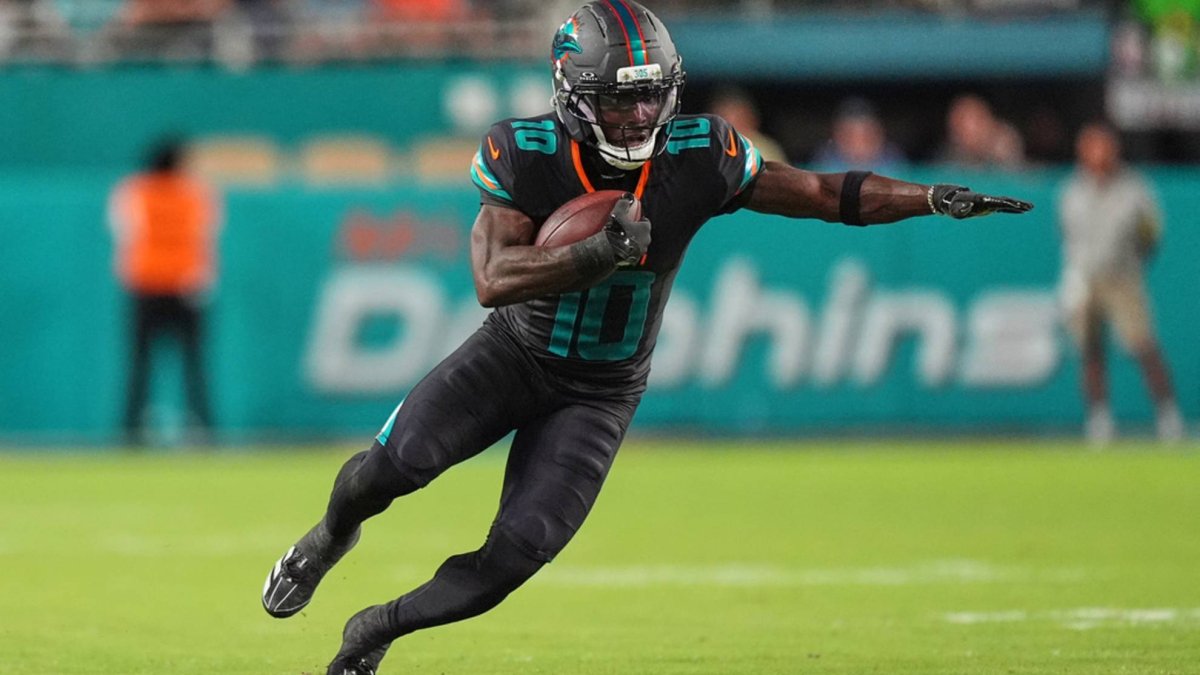
When fully healthy, Tyreek Hill represents a schematic nightmare for opposing defenses—the kind of weapon that fundamentally changes how teams game plan against the Bills. Over his first ten seasons, Hill amassed 11,363 receiving yards, the ninth-most in NFL history for that career stage, along with 28 touchdowns of 50 yards or more. His speed forces defensive coordinators to deploy two-high safety looks, which in turn opens up the run game and intermediate passing lanes for players like Khalil Shakir and tight end Dalton Kincaid.
To understand the magnitude of Hill’s potential impact on Buffalo’s offense, consider how his production compares to the Bills’ current receiving corps. In 2025, Buffalo’s leading wide receiver Khalil Shakir recorded 821 receiving yards and 6 touchdowns across 17 games—a solid but unspectacular season. By contrast, Hill’s career average of 78.4 yards per game would have made him Buffalo’s most productive receiver by a significant margin. Even in his injury-shortened 2025 campaign, Hill averaged 66.3 yards per game, which would have ranked second on the Bills behind only Shakir.
During his peak with the Kansas City Chiefs from 2018 to 2023, Hill averaged 106.3 yards per game and set franchise records with 1,799 receiving yards in 2023. His chemistry with elite quarterbacks is well-documented—Hill helped Patrick Mahomes win Super Bowl LIV and elevated Tua Tagovailoa to Pro Bowl status. Pairing him with Josh Allen, who led the NFL with 4,560 passing yards in 2025, would create vertical threats that defensive backs simply cannot match.
“Tyreek Hill’s speed changes defensive math in ways few players can. Even if he’s past peak production, his presence dictates coverage structures snap to snap,” noted NFL Network analyst Daniel Jeremiah. For a Bills offense that has lacked a true outside receiver since trading away Stefon Diggs, adding Hill would immediately recalibrate late-game play-calling and red-zone efficiency, areas where Buffalo has struggled in critical playoff moments.
The Front Office Perspective: Brandon Beane’s Calculated Caution
While fans and analysts have embraced the Tyreek Hill free agency narrative, Bills General Manager Brandon Beane has struck a decidedly cautious tone, prioritizing financial discipline over splashy headlines. Speaking to NBC Sports at the NFL Combine, Beane acknowledged Hill’s remarkable talent while emphasizing the team’s current cap constraints. “First thing is, I’ve got to get under the cap. We’re always doing due diligence. That guy is a heck of a player with what he’s done. I know he had a tough injury”.
Beane’s measured response reflects the broader reality of Buffalo’s salary cap situation. With only $12.8 million in effective cap space, the Bills would need to restructure multiple contracts or make additional roster moves to accommodate even a modest Hill contract. The Bills have already made significant moves this offseason, acquiring veteran wide receiver DJ Moore from the Chicago Bears in exchange for a 2026 second-round pick and releasing several veterans to create room. These moves signal that Buffalo is preparing for a major addition—but not at any cost.
Head coach Joe Brady echoed his general manager’s pragmatic approach, emphasizing that Buffalo evaluates all personnel options through the same process rather than prioritizing star names. “I think something with us in Buffalo is we are going to approach everyone the same way. If you’re a free agent, you’re a draft pick—I told the scouts in the draft room, let’s not eliminate anybody”. This philosophy suggests that while Hill remains on the radar, Buffalo won’t overextend financially for a player with significant medical question marks.
When pressed on the specific timeline for pursuing Hill, Beane indicated the team would evaluate his medical progress before making any commitment. “We’ll continue to monitor his recovery and have conversations with his camp,” Beane told reporters. “But we’re not going to rush into anything that compromises our long-term flexibility”. This cautious stance gives Buffalo leverage in negotiations and protects the franchise from overpaying for a player whose health remains uncertain.
Strategic Fit: Why Buffalo Makes Perfect Sense
Despite the front office’s caution, the strategic rationale for signing Tyreek Hill is compelling. The Bills have made a definitive philosophical shift under Joe Brady, transitioning from a defensive-oriented approach under Sean McDermott to an offense-first identity built entirely around Josh Allen. During the 2025 season, Brady-led offenses averaged 28.3 points per game, ranking fourth in the NFL. Adding Hill, even in a reduced role, would elevate that unit to elite status.
The immediate ripple effect of a Hill signing would be both tactical and symbolic. After moving on from McDermott, Buffalo needs to pacify a frustrated fan base and signal that the organization is committed to maximizing Allen’s championship window. Outbidding contenders like the Kansas City Chiefs—Hill’s former team—would send a powerful message about Buffalo’s ambitions in the unforgiving AFC arms race. With the Tyreek Hill Bills connection gaining traction, the stakes have never been higher for Buffalo’s front office.
From a schematic standpoint, Hill’s presence would create spacing underneath for Khalil Shakir and force defenses to respect vertical routes, opening the run game for James Cook. With tight ends Dalton Kincaid and Dawson Knox operating in the intermediate zones, Buffalo would have the most complete offensive arsenal in the AFC, capable of attacking defenses at every level.
There’s also a psychological dimension to this potential signing. The Bills have lost four consecutive playoff games to teams that made aggressive moves at the trade deadline or in free agency to improve their rosters. Adding Hill would signal that Buffalo is no longer content to simply compete—they intend to dominate. “The Bills have been the hunter for years, and they’ve come up short,” noted former NFL executive Michael Lombardi. “This is the move that makes them the hunted”.
The Risks: Injury History and Character Concerns
Any organization considering Tyreek Hill must weigh his extraordinary talent against a series of significant red flags, both medical and personal. His devastating knee injury in 2025 was the most severe of his career, and his recent admission that he has “no power” in his left leg raises serious questions about whether he can ever regain his game-changing speed. For a player whose entire identity is built on explosive acceleration, the loss of even a fraction of that ability could dramatically reduce his effectiveness.
Beyond the medical concerns, Hill’s off-field history has been a source of controversy throughout his career. He was arrested in 2014 and pled guilty to assault charges filed by his then-pregnant girlfriend, causing him to slide to the fifth round of the 2016 NFL draft. In 2019, he was investigated for an alleged child battery complaint, and in 2023, he faced an investigation for allegedly assaulting a male employee at the Haulover Marine Center. While no charges were filed in the latter cases, the pattern of incidents has given many teams pause.
For a Bills organization that has prided itself on character and culture under the previous regime, signing Hill would represent a departure from established norms. However, as one analyst noted, “Teams overlook a lot if it helps them win”. The question for Buffalo’s front office is whether Hill’s potential on-field impact outweighs the risks—and whether a team on the brink of a Super Bowl can afford to pass on a difference-maker of his caliber.
How Tyreek Hill Would Reshape the AFC East
The division rivalry element adds another layer of intrigue to the Tyreek Hill saga. The Dolphins’ decision to release their star receiver was driven primarily by financial necessity, but the prospect of Hill joining an AFC East rival would be a bitter pill for Miami fans and management. Adding Hill to a Bills team that already features Josh Allen, James Cook, and an upgraded receiving corps would make Buffalo the prohibitive favorite to win the division for a seventh consecutive season and reignite Buffalo Bills Super Bowl aspirations across the organization.
Miami Dolphins general manager Chris Grier declined to comment directly on the possibility of Hill joining a division rival, but sources close to the organization described internal anxiety about the scenario. “It would be a gut punch,” one team source told ESPN. “You don’t trade a player of his caliber and then watch him go to a team that you play twice a year”. The Dolphins, who have been retooling their roster around quarterback Tua Tagovailoa, would face the prospect of defending against Hill twice annually—a matchup nightmare for a secondary that already struggles with speed.
From a competitive standpoint, the AFC arms race is unforgiving. Buffalo’s 33-30 overtime loss to the Denver Broncos in the 2025 Divisional Round underscored how razor-thin the margins are in January. Every contending team in the conference is loading up, and standing pat is not a viable strategy. Hill’s presence would change defensive math in ways few players can, forcing opponents to allocate resources to contain him while leaving other weapons in single coverage.
Betting markets reflect this reality. After reports surfaced that the Bills had emerged as heavy favorites to sign Hill, their Super Bowl odds shortened from +1200 to +800 on FanDuel, signaling that the market believes Buffalo would become the team to beat in the AFC with Hill in the fold. While these markets don’t guarantee success, they reflect the perception that Hill remains a transformative talent despite the injury concerns.
Contract Structure: What a Realistic Deal Would Look Like
Any discussion of Tyreek Hill to Buffalo must address the financial architecture of such a deal. Given Hill’s age (32), recent injury history, and the Bills’ limited cap space, industry observers expect any contract to be structured with heavy protections for the team. Several contract scenarios have emerged in speculation, each reflecting different risk tolerances and timelines:
Scenario 1: One-Year Prove-It Deal
The most likely outcome, according to multiple cap analysts, would be a one-year contract in the range of $8-12 million with performance incentives. This approach would allow Buffalo to evaluate Hill’s health and production without long-term commitment, similar to the contract signed by Odell Beckham Jr. after his ACL injury. The Bills could fit this deal under their current cap by restructuring one or two existing contracts, a maneuver they have executed successfully in previous seasons.
Scenario 2: Two-Year Incentive-Laden Contract
A two-year deal worth $20-25 million total with heavy incentives for games played, yards, and touchdowns would provide Hill with security while giving Buffalo flexibility. This structure could include a team option after the first year, effectively making it a one-year commitment if Hill fails to regain his form. The guaranteed money would likely be limited to the first year’s base salary, protecting the team’s cap flexibility moving forward.
Scenario 3: Multi-Year Commitment with Void Years
A longer-term contract (3-4 years) with voidable years is a more aggressive approach that would allow Buffalo to spread the cap hit and reduce the immediate financial burden. However, this scenario carries significant risk—if Hill’s recovery stalls or he suffers a setback, the Bills could be saddled with dead money that hampers future roster construction. Given Beane’s cautious comments, this appears to be the least likely outcome.
Former NFL agent Joel Corry, now a cap analyst for CBS Sports, suggested that Hill’s market might be softer than expected due to the injury concerns. “Teams are going to be cautious. He won’t get anything close to his previous contract,” Corry said. “A one-year, prove-it deal is the most realistic path for Hill to re-establish his value”. This assessment aligns with Beane’s disciplined approach and suggests the Bills could land Hill at a price that fits their cap constraints.
Alternative Landing Spots and Market Dynamics
The Bills are not the only team interested in Tyreek Hill’s services, and the competitive landscape could drive up his price beyond what Buffalo is willing to pay. The Kansas City Chiefs, Hill’s original team, have been identified as a natural fit, where he already has established chemistry with Patrick Mahomes and Travis Kelce. The return of offensive coordinator Eric Bieniemy would make the transition seamless, and the Chiefs have sufficient cap flexibility to make a competitive offer.
Other potential suitors include the Los Angeles Chargers, who have $78.6 million in effective cap space and a quarterback in Justin Herbert whose strong arm suits Hill’s deep-threat profile. The Las Vegas Raiders, armed with $76.99 million in cap space and a new head coach in Klint Kubiak, could also make a play for Hill to provide a veteran presence for their expected rookie quarterback. The New England Patriots, Super Bowl runners-up in the 2025 season, remain a contender, needing vertical explosiveness behind Stefon Diggs, who faces legal issues and potential suspension.
For the Bills, this competition creates urgency but also risk. Outbidding multiple suitors would require significant financial commitment to a player with uncertain health, potentially hamstringing Buffalo’s ability to address other roster needs. The front office’s cautious approach suggests they are willing to walk away if the price exceeds their valuation—a prudent strategy for a team with championship aspirations beyond just the 2026 season.
However, the Bills possess one competitive advantage that may prove decisive: Josh Allen. Multiple reports indicate that Hill views playing with Allen as an attractive opportunity, potentially giving Buffalo leverage in negotiations even against teams with more cap space. “Allen is the kind of quarterback who can extend plays and throw accurately downfield—exactly what Hill needs to maximize his skillset,” noted ESPN’s Adam Schefter.
Alternative Paths: What If Buffalo Passes on Tyreek Hill?
Given the significant risks and financial constraints, there’s a realistic scenario where the Buffalo Bills decide to pass on Tyreek Hill entirely. This approach would require the front office to pivot to alternative strategies to improve the offense—a challenge they’ve already begun addressing through the acquisition of DJ Moore from the Chicago Bears.
Option 1: Continue Developing DJ Moore as WR1
The Bills invested a second-round pick to acquire Moore, who at 29 years old is in the prime of his career and carries a manageable $15 million cap hit through 2028. Moore posted 946 yards and 7 touchdowns in an inconsistent Bears offense in 2025, and Buffalo’s coaching staff believes his production could increase significantly with Allen throwing him the football. If Moore establishes chemistry with Allen, the Bills could effectively replace the production they lost when Stefon Diggs was traded without taking on the risk associated with Hill.
Option 2: Target the Draft for Receiver Help
The 2026 NFL draft is considered deep at the wide receiver position, with several prospects projected to be available when Buffalo selects at No. 22 overall. Names like Marvin Harrison Jr. (Ohio State) and Malik Nabers (LSU) have been mentioned as potential fits, though both could be gone by the time Buffalo picks. A trade-up scenario remains possible, though Beane has historically preferred to accumulate picks rather than move up.
Option 3: Pursue Secondary Free Agent Options
If Hill is deemed too risky, Buffalo could pivot to a secondary option like Michael Pittman Jr. (Colts) or Hunter Renfrow (Raiders), both of whom would command significantly less money while providing reliable production. Neither player offers Hill’s explosive upside, but both represent safer investments with manageable injury histories.
Option 4: Address Other Roster Needs Instead
Alternatively, the Bills could use their limited cap space and draft capital to address other positions of need, such as defensive line or offensive line, while relying on internal improvement from players like Khalil Shakir, Dalton Kincaid, and James Cook. This approach would represent a bet that continuity and coaching improvement can elevate the existing roster to championship levels—a bet that has failed in each of the past four seasons.
Ultimately, the decision will come down to how much risk Beane and the Bills organization are willing to tolerate. Passing on Hill would be a conservative move that protects long-term flexibility but risks another season of coming up short in the playoffs. Pursuing him would be a bold gamble that could either deliver the franchise’s first Super Bowl or set the team back significantly if his health fails to cooperate.
Conclusion: A Bold Gamble Worth Taking?
The Tyreek Hill-to-Buffalo scenario represents a classic risk-reward calculation that could define the Josh Allen era. On one hand, adding a five-time All-Pro receiver with Hall of Fame credentials would transform Buffalo’s offense into the most explosive unit in the NFL, providing Allen with the deep threat he has lacked since Stefon Diggs’ departure. The tactical and symbolic impact of such a signing would be immeasurable—a declaration that the Bills are all-in on winning a Super Bowl before Allen’s prime years begin to wane.
On the other hand, Hill’s devastating knee injury and recent admission that he has “no power” in his left leg raise legitimate questions about whether he can ever return to form. At 32 years old, with an extensive injury history and off-field concerns, he represents a significant financial gamble for a team operating with only $12.8 million in cap space. The Bills have already invested heavily in the position by acquiring DJ Moore, and pursuing Hill could limit their ability to address other pressing roster needs.
Ultimately, the decision may come down to how much risk the organization is willing to tolerate in pursuit of its first Super Bowl title. As one analyst noted, Buffalo is “no longer in evaluation mode—it’s in execution mode”. If Hill can regain even a fraction of his former explosiveness, he could be the difference between another playoff disappointment and the Lombardi Trophy. If not, the Bills will have tied up valuable resources in a player who never regains his form. For a franchise that has come so close and fallen short so many times, the temptation to swing for the fences may simply be too great to resist.
As the NFL offseason unfolds, all eyes will remain on Buffalo and whether Brandon Beane decides to make the boldest move of his tenure as general manager. The decision will shape not only the 2026 season but potentially the entire trajectory of the Allen era and the Bills’ quest for their first Super Bowl championship.