Dillon Gabriel Browns Future in Jeopardy as Trade Rumors Swirl Around QB Depth Chart

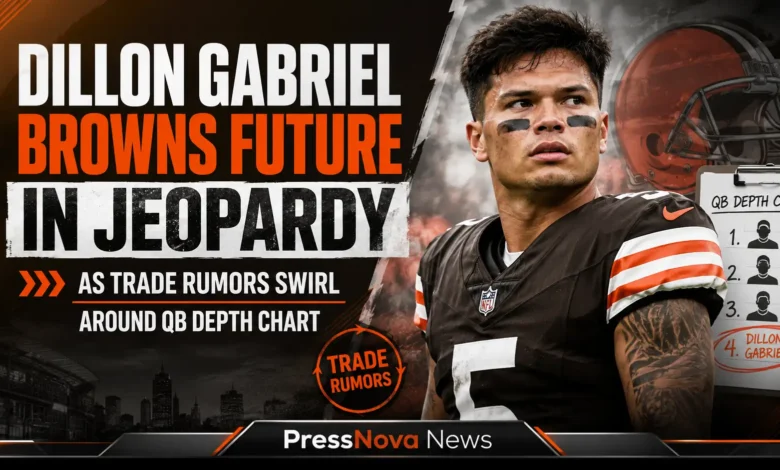
Dillon Gabriel’s future with the Cleveland Browns has never been more uncertain, as the franchise actively explores quarterback options in the upcoming draft that could directly threaten the third-year passer’s roster spot and potentially end his tenure in Ohio before the regular season begins.
- Trade Rumors Intensify: The Athletic’s Zac Jackson predicts the Browns will trade Gabriel and draft a quarterback in the 30-60 range.
- Draft Threat: Penn State’s Drew Allar has emerged as a prime developmental target for Cleveland in the middle rounds.
- Limited Production: Gabriel posted a 1-5 record as a starter with 937 passing yards and 7 touchdowns in his rookie campaign.
- New Regime: Head coach Todd Monken and his staff have no ties to Gabriel, making the previous third-round investment less relevant.
- Watson Factor: Deshaun Watson’s return from injury and massive contract complicate the quarterback room dynamics.
- Contract Savings: Trading or cutting Gabriel would save the Browns approximately $1.2 million in cap space with minimal dead money.
The Browns enter the draft armed with two first-round selections and ten total picks, giving them significant flexibility to address multiple needs across the roster. While an early quarterback selection appears unlikely, league observers widely expect Cleveland to target a passer in the middle rounds as a developmental project behind Deshaun Watson and Shedeur Sanders.
Penn State’s Drew Allar has emerged as a name frequently linked to the Browns, with his prototypical size and arm talent making him an appealing option despite projections that place him outside the first round. Allar’s potential availability in the second or third round aligns with Cleveland’s draft capital and developmental timeline.
Beat reporter Mary Kay Cabot has weighed in on the possibility, stating, “As for drafting Allar, I’m all for taking developmental quarterbacks and seeing where it might lead.” Cabot further suggested that if the Browns find a quarterback they like, “perhaps they’d want to see what they could get for 2025 third-rounder Dillon Gabriel.”
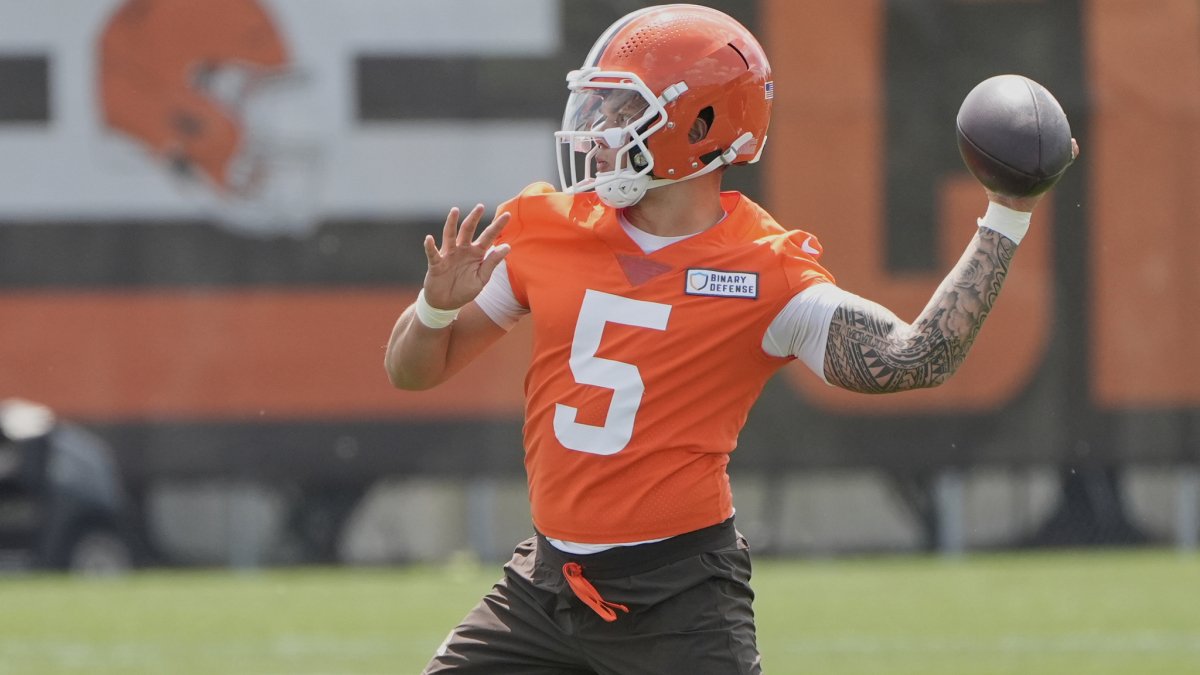
Why Dillon Gabriel’s Roster Spot Is Under Threat
The Athletic’s Zac Jackson offered an even more definitive take on Gabriel’s future, telling The Athletic, “I believe the Browns will trade Dillon Gabriel and then draft a quarterback somewhere in the 30-60 range. They will go forward with Shedeur, Deshaun Watson and that third quarterback.”
Gabriel’s limited performance during the previous season has done little to secure his role with the organization. He posted a 1-5 record as a starter, throwing for 937 yards while managing seven touchdowns against just two interceptions. While his ability to protect the football was commendable, his conservative approach rarely threatened defenses vertically, and his yards per attempt ranked near the bottom of the league.
Complicating matters further, the coaching staff that supported drafting Gabriel in the third round is no longer in place. With head coach Todd Monken and his new regime evaluating talent from a fresh perspective, prior investments carry significantly less weight when roster decisions are made. The new staff has no emotional or professional attachment to Gabriel as a draft asset.
According to NFL.com analyst reports, Gabriel’s skill set does not naturally fit Monken’s offensive scheme, which emphasizes vertical passing, aggressive downfield throws, and quarterback mobility in the pocket. This philosophical mismatch further diminishes Gabriel’s value to the organization.
Gabriel’s College Pedigree vs. NFL Reality
Gabriel arrived in the NFL with an impressive college resume that included stops at Oklahoma and Oregon. At Oklahoma, he threw for 3,660 yards with 30 touchdowns and 6 interceptions in 2023, showcasing the accuracy and decision-making that made him a third-round prospect. His 2024 season at Oregon saw similar production with 3,358 yards, 28 touchdowns, and 4 interceptions.
However, the transition to the NFL has exposed limitations that were masked by college offensive systems. Gabriel’s arm strength, while adequate, does not consistently threaten NFL secondaries. His average depth of target in college was significantly deeper than his 2025 NFL average, indicating he has struggled to process defenses quickly enough to push the ball downfield at the professional level. This contrasts sharply with his performance against college competition, where his anticipation and touch were considered elite traits.
Scouts who evaluated Gabriel pre-draft noted concerns about his ability to make tight-window throws against NFL coverage. Those concerns have materialized, as Gabriel’s completion percentage under pressure dropped significantly compared to his college numbers, and his yards per attempt in clean pockets still ranked among the lowest in the league.
Practice Squad Eligibility: An Alternative Path
One option the Browns could consider is assigning Gabriel to the practice squad if he clears waivers. However, this scenario has significant hurdles. As a third-round pick with six NFL starts, Gabriel would likely be claimed by another team before reaching the practice squad. Additionally, practice squad rules allow teams to protect up to four players per week, but Gabriel would be exposed to other teams signing him to their active roster at any point.
If Gabriel were to clear waivers and sign to the practice squad, he would be eligible for elevation to the active roster up to three times during the season without being signed to the 53-man roster. This flexibility could provide the Browns with an insurance policy, but the risk of losing him to another team makes this option less attractive than a trade that yields draft compensation.
The Draft Factor: Which Quarterbacks Could Replace Gabriel?
Beyond Drew Allar, the Browns have been linked to several mid-round quarterback prospects who fit Monken’s offensive vision. The team’s evaluation criteria appear to prioritize arm strength, pocket presence, and the ability to push the ball downfield—areas where Gabriel has struggled.
Top Mid-Round QB Prospects Linked to Cleveland
- Drew Allar (Penn State): Possesses elite size at 6-foot-5 and a cannon arm, though his accuracy and decision-making remain developmental areas. His ability to make throws outside the numbers fits Monken’s scheme.
- Jaxson Dart (Ole Miss): Offers mobility and a strong arm, with experience in a pro-style system that could translate well. Dart’s aggressiveness as a passer aligns with Monken’s philosophy.
- Michael Pratt (Tulane): A polished passer with solid mechanics and the ability to make all the throws required in an NFL offense. Pratt’s experience in a vertical passing attack makes him an appealing option.
The Browns’ front office has historically valued quarterback depth, and using a Day 2 or early Day 3 pick on a passer would align with their roster-building philosophy. With two first-round picks already addressing other needs, Cleveland can afford to take a calculated flier on a developmental quarterback without sacrificing immediate impact players.
Comparative Analysis: Gabriel vs. Developmental QB Prospects
When evaluating Gabriel’s 2025 performance against other recent developmental quarterbacks, the numbers highlight significant concerns. Among quarterbacks who started at least five games in their rookie season, Gabriel ranked 28th in yards per attempt (5.1) and 30th in passer rating (72.4). His completion percentage of 59.5% placed him 25th among qualifying rookies.
Comparatively, Brock Purdy’s rookie season (2022) saw him complete 67.1% of his passes with a 107.3 passer rating. Even quarterbacks who struggled in their rookie campaigns, such as Justin Fields (58.9% completion, 73.2 rating) and Zach Wilson (55.6% completion, 69.7 rating), showed flashes of elite arm talent that Gabriel has yet to demonstrate at the NFL level.
What distinguishes Gabriel’s struggles is the lack of big-play ability. His 5.1 yards per attempt is significantly below the league average of 7.2, indicating a fundamental limitation in his ability to stretch the field. This statistical profile makes him a poor fit for an offense that requires vertical threats to function effectively.
New Regime, New Evaluation: How Coaching Changes Impact Gabriel
Head coach Todd Monken has been clear about his vision for the quarterback position since taking over. During a recent press conference, Monken outlined the team’s quarterback hierarchy, emphasizing the development of young players while acknowledging the potential of veteran Deshaun Watson.
“You’ve got two young players that still have a long way to go in terms of development,” Monken said. “And that’s part of the learning curve in the NFL. And then you’ve got a player like Deshaun, who’s coming back from injury and at one time was a Pro Bowl player, and an elite player in this league, that we would love to tap back into that, let alone with Dillon and Shedeur.”
Monken’s comments reveal a clear pecking order: Watson is viewed as the veteran presence with upside, Sanders and Gabriel are the developmental projects, but the new coaching staff has made no public commitment to Gabriel’s long-term future. The absence of specific praise for Gabriel’s skillset or potential speaks volumes about his standing within the organization.
The new regime’s evaluation process has reportedly focused on quarterback traits that align with Monken’s offensive philosophy: arm strength, downfield accuracy, and the ability to operate under pressure. Gabriel’s 2025 tape, while turnover-free, showcased a player who often opted for the safe check-down rather than taking calculated risks downfield—a tendency that does not fit the aggressive offensive identity Monken is building.
Monken’s Offensive Philosophy: A Deep Dive
Monken’s offensive system is predicated on vertical concepts that attack the deep third of the field. His scheme, refined during his tenure as offensive coordinator for the Georgia Bulldogs and later with the Tampa Bay Buccaneers, relies on quarterbacks who can deliver the ball with velocity and accuracy to all levels of the field. The system frequently employs four-vertical routes, deep crossing patterns, and play-action concepts designed to create explosive plays.
This philosophy presents a challenge for Gabriel, whose arm strength is considered average by NFL standards. His average depth of target in 2025 was 7.2 yards, significantly below the 10.2-yard average Monken’s quarterbacks achieved at Georgia. The mismatch between Gabriel’s conservative tendencies and Monken’s aggressive scheme makes Gabriel a square peg in a round hole, further diminishing his value to the organization.
The Deshaun Watson Variable: A Complicating Factor for Gabriel
The biggest unknown in Cleveland’s quarterback equation remains the health and performance of Deshaun Watson. Watson missed the entire previous season while recovering from two Achilles surgeries, only returning to limited practice late in the year. His recovery trajectory and on-field performance will significantly impact roster decisions.
Financial considerations loom large, as Cleveland remains committed to Watson’s sizable contract regardless of playing time. Watson’s five-year, $230 million fully guaranteed contract, signed in 2022, carries cap hits of $63.97 million in 2025 and $72.94 million in 2026. The team’s investment in Watson creates pressure to maximize his return, potentially at the expense of developmental quarterbacks like Gabriel.
Watson’s contract includes $46 million in guaranteed salary for 2025 and $46 million guaranteed for 2026, making a release financially prohibitive. This reality creates a unique dynamic: the Browns are incentivized to maximize Watson’s production given the significant investment. If Watson’s recovery falters or his performance declines, the team may need to rely on Sanders or a rookie, further diminishing Gabriel’s role.
However, despite his long-expired pedigree from the Houston Texans, Watson’s production in Cleveland has been inconsistent. He has posted a losing record with modest passing totals since arriving, raising questions about whether he can recapture his elite form. If Watson struggles or suffers further injury setbacks, the Browns would need a reliable backup plan—one that may not include Gabriel, given his performance struggles.
This uncertain landscape complicates Gabriel’s situation. If Watson is fully healthy and performs well, the Browns may feel comfortable with only two quarterbacks on the active roster, making Gabriel expendable. If Watson’s health remains a concern, the team might prefer to carry three quarterbacks, but a rookie draft pick could fill that role more effectively than Gabriel.
Trade Scenarios and Potential Landing Spots for Gabriel
If the Browns decide to trade Gabriel, several teams could emerge as potential landing spots based on their quarterback situations and need for developmental depth.
Potential Trade Destinations
- Las Vegas Raiders: With uncertainty surrounding their quarterback room, the Raiders could view Gabriel as a low-cost option with starting experience.
- Tennessee Titans: In need of quarterback depth behind their starter, the Titans might offer a late-round pick for Gabriel’s services.
- Pittsburgh Steelers: Always in the market for quarterback depth, the Steelers could see Gabriel as a developmental project behind their veteran starter.
- New York Giants: With quarterback questions looming, the Giants could consider Gabriel as a backup option who has shown the ability to protect the football.
Trade Value Projection
Given Gabriel’s third-round pedigree and limited but turnover-free NFL tape, the Browns could reasonably expect a Day 3 pick in return. Teams seeking a low-cost backup with starting experience might view Gabriel as a worthwhile project. Historical precedent suggests that quarterbacks with similar profiles typically yield a sixth or seventh-round pick in trade.
The return could be higher if multiple teams express interest, but the Browns’ limited leverage—Gabriel’s roster spot is clearly in jeopardy—could suppress the trade value. The Browns may ultimately accept the best offer available rather than risk releasing Gabriel for nothing in return.
Historical Precedent: Browns Moves with Young Quarterbacks
The Browns have a history of moving on from young quarterbacks when new regimes take over. In 2018, the team traded DeShone Kizer to the Green Bay Packers after one season, receiving cornerback Damarious Randall in return. Similarly, the Browns moved on from Johnny Manziel after two seasons, ultimately releasing him despite his first-round pedigree.
More recently, the team traded Josh Dobbs to the Pittsburgh Steelers in 2020 for a fifth-round pick after he showed limited promise in limited action. These precedents suggest that the Browns are not afraid to cut ties with quarterback investments when new coaching staffs determine they do not fit the long-term vision.
What’s Next for Gabriel: Trade, Cut, or QB3 Role?
As the draft approaches and training camp looms, several scenarios exist for Dillon Gabriel’s future with the Browns. The decision timeline is clearer with specific dates in mind: the NFL Draft takes place from April 24-26, mandatory minicamp occurs in mid-June, training camp opens in late July, and final roster cuts are due by August 29.
Scenario 1: Trade Before or During the Draft
The most likely outcome, according to multiple reports, is that the Browns trade Gabriel to a quarterback-needy team before or during the draft. This scenario allows Cleveland to recoup draft capital while clearing approximately $1.2 million in cap space. The receiving team would acquire Gabriel under his rookie contract, which still has two years remaining, making him an affordable depth option.
From a financial perspective, trading Gabriel before the draft is advantageous for the Browns. His remaining guaranteed money is minimal, and the cap savings could be used to sign undrafted free agents or make in-season roster moves. The receiving team would inherit Gabriel’s contract, which carries no guaranteed money beyond the current season, providing them with flexibility.
Scenario 2: Released During Final Roster Cuts
If the Browns cannot find a trade partner, Gabriel could be released during final roster cuts. This outcome would allow him to sign with another team as a free agent, though he would lose the benefit of being a controllable asset under his rookie contract. The Browns would save the same cap space as a trade but receive no draft compensation in return.
This scenario becomes more likely if Gabriel performs poorly in training camp or if the Browns simply prefer to move on without the distraction of trade negotiations. Teams with quarterback injuries during the preseason could claim Gabriel off waivers, providing an alternative path for him to find a new team.
Scenario 3: Retained as QB3
If the Browns decide against drafting a quarterback and prefer to keep Gabriel as the third option behind Watson and Sanders, he could survive the roster cuts. However, this scenario appears increasingly unlikely given the persistent draft rumors, the new regime’s apparent desire to reshape the quarterback room, and Monken’s offensive scheme mismatch with Gabriel’s skill set.
To retain his spot, Gabriel would need to demonstrate significant improvement in training camp, particularly in his downfield accuracy and willingness to push the ball vertically. He would also need to show chemistry with the offensive staff that the team has not yet witnessed.
Final Assessment: Gabriel’s Odds of Remaining in Cleveland
Based on the current trajectory, Gabriel’s chances of opening the season with the Browns are slim. The combination of a new coaching staff with no ties to him, a clear depth chart ahead of him, persistent trade rumors, and a philosophical mismatch with Monken’s scheme makes his departure almost inevitable.
For a young quarterback who entered the league with promise, Gabriel’s situation serves as a reminder of the NFL’s unforgiving nature. Without a strong performance to cement his role, and with a new coaching staff evaluating him without bias, Gabriel faces an uphill battle to remain in Cleveland. The upcoming draft will provide the clearest indication of his future, with the team’s selection—or lack thereof—at quarterback serving as the definitive signal of their intentions. As Browns trade rumors continue to swirl, the pressure on the quarterback room only intensifies.
📊 What Do You Think About Gabriel’s Future?
We want to hear from you! Cast your vote on what you believe will happen to Dillon Gabriel:
- ✅ Traded before or during the draft – Browns recoup draft capital
- ✅ Released during roster cuts – No trade partner found
- ✅ Retained as QB3 – Wins the job over a drafted rookie
Share your prediction in the comments below!
The timeline for a decision is clear: the NFL Draft will provide the first major indicator of Gabriel’s future. If the Browns select a quarterback, Gabriel’s departure becomes nearly certain. If they pass, he may get a reprieve—at least until training camp, where the competition will intensify and the new coaching staff will make its final evaluations. With the Cleveland QB depth chart already shifting, Gabriel’s window to prove his worth is rapidly closing.