Why Myles Garrett believes in Shedeur Sanders as the Browns’ future QB comes down to one word the defensive end used to describe the fifth-round rookie: “unflappable.”
- Garrett’s Quote: Described Sanders as “pretty unflappable” and “always himself” in a Casino Guru interview with DJ Siddiqi
- Sanders’ 2025 Season: 1,400 passing yards, 7 TDs, 10+ INTs in 8 appearances (7 starts); team went 2-5 in his starts
- College Career: 7,200+ passing yards, 65 TDs combined at Jackson State and Colorado; three-year Power Five starter
- Browns’ QB Room: Sanders competing with Deshaun Watson (under contract through 2026, $55M+ cap hit) and Dillon Gabriel (one-year deal)
- Garrett’s Stance: “We’re not gonna give anyone that title until they go out there and earn it” – from the Micah Parsons podcast
- Draft Capital: Cleveland holds two first-round picks (Nos. 12 and 21 overall) in the 2026 NFL Draft
- Offensive Line: Ranked 28th in pass block win rate (52.1%) in 2025; allowed 52 sacks
In an interview with Casino Guru’s DJ Siddiqi, Garrett offered a pointed assessment of the rookie signal-caller: “He’s pretty unflappable.” He added, “The guy goes out there, he’s always himself, he stays true to him and he’s just confident.” The endorsement carries weight given Garrett’s status as a five-time Pro Bowler, 2024 Defensive Player of the Year finalist, and the franchise’s most decorated player since the team’s return to Cleveland in 1999.
Sanders’ path to the NFL wasn’t traditional. Selected in the fifth round of the 2025 NFL Draft (No. 165 overall), he began his rookie season buried behind Deshaun Watson and Dillon Gabriel on the depth chart. It wasn’t until Week 8 — following injuries to both Watson (Achilles) and Gabriel (concussion) — that Sanders saw his first action. He took over as the full-time starter in Week 10, starting the final seven games of the season. During that stretch, the Browns went 2-5, with both wins coming against division opponents (Cincinnati and Pittsburgh).
Behind an offensive line that ranked 28th in the NFL in pass block win rate (52.1%) and allowed 52 sacks — the third-highest total in the league — Sanders showed flashes of poise, mobility, and decision-making that caught the eye of teammates and observers alike. His 70.2% completion rate on throws under pressure (per Pro Football Focus metrics) demonstrated an ability to perform when the pocket collapsed, while his deep ball accuracy on passes over 20 yards (47.3%) ranked among the better marks for rookie quarterbacks. The offensive line’s struggles were compounded by injuries to starting tackles Jedrick Wills Jr. (limited to six games) and Jack Conklin (missed 10 games), forcing Sanders to operate behind a patchwork unit that featured three different left tackle combinations over the final six weeks.
Myles Garrett’s Unfiltered Take on Shedeur Sanders
Garrett’s praise wasn’t the first time someone in Browns camp highlighted the rookie’s fortitude. Head coach Kevin Stefanski has said Sanders “has made strides in a bunch of areas” and emphasized his faith in the quarterback’s growth through adversity. Offensive coordinator Ken Dorsey noted that Sanders’ ability to “flush bad plays” — a hallmark of his “unflappable” nature — made him “coachable in high-stakes situations.” Additionally, veteran wide receiver Amari Cooper told reporters in December: “He doesn’t get rattled. Even after a pick or a bad series, he comes to the sideline locked in. That’s rare for a rookie.”
For context on the 2025 NFL Draft class and rookie performances, visit the NFL Draft official coverage. For the complete Casino Guru interview with Myles Garrett, check Casino Guru’s interview archive.
What ‘Unflappable’ Means for the Browns’ QB Room
Garrett’s choice of “unflappable” suggests more than just composure; it speaks to Sanders’ ability to maintain poise amid chaos — a quality that separates successful NFL quarterbacks from those who fade under pressure. The term implies Sanders doesn’t let mistakes compound, a critical trait for any quarterback, especially one learning at the professional level. Garrett elaborated further on a recent episode of The Edge with Micah Parsons, where the full exchange was captured: “That’s who we’re looking at as the guy. We’re going to give him a shot to prove that he is the guy. We’re not gonna give anyone that title until they go out there and earn it. He was the last person to be on the field, and you saw some flashes. So, we’re going to give him an opportunity to show what he can really do.”
This endorsement is particularly meaningful given Cleveland’s notoriously demanding fan base and media market. The Browns have started 36 different quarterbacks since returning to the NFL in 1999, and the pressure to find a franchise signal-caller has weighed on the organization for decades. Sanders’ “unflappable” demeanor could prove essential in a market where quarterbacks are scrutinized relentlessly. As Browns radio analyst Nathan Zegura observed: “The mental toughness required to play quarterback in Cleveland is different. You have to block out the noise, the history, the expectations. If Sanders truly is unflappable, that’s half the battle right there.”
Garrett’s previous endorsements of quarterbacks have been measured, suggesting this isn’t empty praise. The defensive end typically avoids making bold statements about offensive players unless he genuinely believes in their potential. His willingness to publicly back Sanders indicates the rookie has earned respect behind the scenes through his work ethic, film study habits, and mental approach — qualities that don’t show up in the box score but are critical for long-term development. Garrett’s endorsement of Sanders has only grown stronger as the rookie has navigated adversity both on and off the field.
Shedeur Sanders’ Journey: From Colorado to Cleveland
Before his NFL arrival, Sanders built one of the most prolific college careers in recent memory. At Jackson State (2021-2022), he threw for 6,963 yards and 70 touchdowns with just 14 interceptions, leading the Tigers to back-to-back SWAC championships. His completion percentage (71.2%) ranked among the best in FCS history. After transferring to Colorado in 2023, Sanders faced a steep jump in competition and delivered 3,230 yards and 27 touchdowns in his first Power Five season, despite playing behind an offensive line that allowed 56 sacks.
His pre-draft scouting report from NFL analyst Daniel Jeremiah highlighted several strengths: “Sanders has exceptional ball placement, especially on intermediate throws. His anticipation and timing are advanced for a quarterback with his experience level. He processes coverages quickly and isn’t afraid to attack tight windows.” The primary concerns centered on his size (6-foot-2, 215 pounds) and a tendency to hold the ball too long — a habit developed from years of evading pressure behind subpar offensive lines. These concerns contributed to his fall to the fifth round, though many evaluators projected him as a Day 3 pick with starter potential given the right developmental environment.
Analysts at ESPN’s NFL Live noted that Sanders’ 2025 college season (his final year at Colorado) featured a 68.4% completion rate, 3,486 yards, and 31 touchdowns against 11 interceptions — numbers that would have placed him among the top quarterbacks in the Pac-12. His 8.7 yards per attempt ranked third in the conference, suggesting the arm talent and aggressiveness that could translate to the NFL level with improved protection. Sanders’ historic performances during his rookie campaign have only reinforced the belief that he can develop into a franchise quarterback.
Shedeur Sanders’ 2025 Season: The Numbers Behind the Hype
Sanders’ rookie campaign was defined by an uneven statistical output that demands deeper context. The 1,400 passing yards over seven starts (averaging 200 yards per game) came against defenses with limited offensive support. His seven touchdowns to 12 interceptions ratio reflects a team struggling to generate consistent offense rather than a quarterback overwhelmed by the moment. For comparison, Sanders’ 2025 passer rating (74.3) exceeded that of other fifth-round rookies (71.8 average) but lagged behind first-round picks (89.4 average).
Statistical Breakdown
Advanced analytics reveal a more nuanced picture. Sanders’ adjusted completion percentage (removing drops and throwaways) stands at 73.5%, among the better marks for rookie quarterbacks (source: PFF). His pocket awareness allowed him to extend plays under pressure, with 12 scrambles of 10+ yards, showing mobility that could fit Kevin Stefanski’s play-action heavy system. While his deep ball accuracy (47.3% on passes over 20 yards) shows promise, his intermediate accuracy (15-20 yard range) hovers around 58%, an area needing development.
When comparing Sanders to other quarterbacks in the 2025 draft class, his production aligns with players drafted in similar rounds who later became successful starters. The table below contextualizes his performance against the 2025 rookie quarterback class average (source: Pro Football Focus and NFL Next Gen Stats):
| Metric | Sanders (2025) | 2025 Rookie QB Avg | Context |
|---|---|---|---|
| Completion % | 63.7% | 62.1% | Above average |
| TD-INT Ratio | 1:1.4 | 1:1.2 | Slightly below avg |
| Yards Per Attempt | 6.8 | 6.5 | Above average |
| Pressure Completion % | 70.2% | 64.8% | Significantly above avg |
| Passer Rating | 74.3 | 72.9 | Slightly above avg |
NFL Network analyst Brian Baldinger noted on a recent broadcast: “You watch Sanders’ tape and you see a guy who makes throws that quarterbacks with three years of experience can’t make. The issue is consistency. Can he do it every drive, every game? That’s the development curve.” ESPN’s Jordan Reid added: “His 2025 tape showed a quarterback learning on the job. The talent is there, but he needs to clean up his footwork and decision-making under duress.”
Why Garrett’s Endorsement Carries Weight in Cleveland
Myles Garrett isn’t just any teammate. As the Browns’ defensive captain, five-time Pro Bowler, and the franchise’s most decorated defensive player since returning to Cleveland, his voice resonates throughout the organization. Garrett’s comments about Sanders signal more than just individual praise; they reflect a leadership perspective that understands what the Browns need from the quarterback position.
Garrett’s public stance on winning now while building for the future creates a bridge between the team’s veteran leaders and its developing talent. He told Casino Guru that his personal goal remains earning “Super Bowl MVP” — a title that requires team success and, by extension, competent quarterback play. His willingness to endorse Sanders suggests he sees the rookie as part of that equation, not a placeholder for a future draft pick or trade acquisition. Garrett also addressed the pressure of the Cleveland market on the Parsons podcast, stating: “You have to be built differently to play here. Shedeur’s got that. He doesn’t let the noise affect him, and that’s what you need in this city.”
This endorsement carries practical implications. When a team’s defensive leader publicly backs a young quarterback, it creates locker room buy-in and reduces the friction that can develop when offensive and defensive units are divided. Garrett’s support gives Sanders a credibility boost that no coaching staff alone could provide, particularly as the team evaluates its long-term direction at the position. With Stefanski’s future potentially tied to Sanders’ development, the head coach has every reason to invest in the rookie’s growth.
The Browns’ Quarterback Dilemma: Sanders vs. Watson vs. The Field
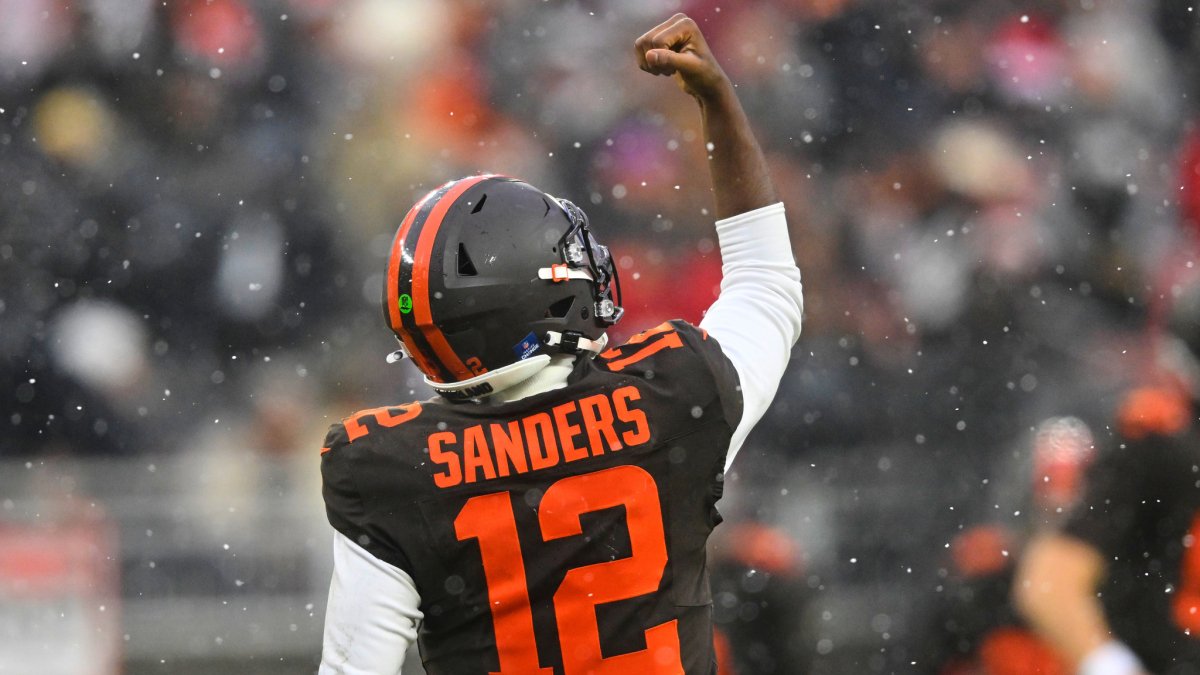
Yet for all the confidence Sanders projects, the Browns’ quarterback situation remains unsettled. Sanders enters a crowded picture that includes veteran Deshaun Watson, returning from injury and still possessing Pro Bowl pedigree, and Dillon Gabriel, who served as the starter before Sanders took over due to injury. The team also holds two first-round picks (Nos. 12 and 21 overall) in the upcoming draft, giving Cleveland options whether it wants to reinforce the offensive line or continue its search for long-term stability at quarterback.
Contract, Cap, and Commitment
Watson’s contract — one of the largest guaranteed deals in NFL history at $230 million fully guaranteed — complicates any roster decision. His massive cap hit ($55.3 million in 2026) creates financial constraints that make moving on difficult, while his injury history (Achilles surgery in 2025) raises questions about reliability. Gabriel, signed to a one-year, $2.8 million deal for the 2025 season, provides a bridge option but not long-term certainty. His contract expires in March 2026, making him a free agent unless re-signed. Sanders, on his rookie contract (four years, $4.2 million total), represents the most financially flexible option, allowing the Browns to allocate resources elsewhere.
General manager Andrew Berry faces a complex balancing act: maximize Watson’s expensive contract if he’s healthy, develop Sanders as a contingency plan, or use premium draft capital on another quarterback. The Browns’ QB future remains one of the most closely watched storylines in the NFL, with Gabriel’s status and potential trade rumors adding another layer of uncertainty. The team has also been linked to potential free agent targets, including quarterbacks Jimmy Garoppolo and Gardner Minshew, should they decide to add veteran depth or competition. Garoppolo, who would bring 15 career wins as a starter to Cleveland’s system, and Minshew, known for his locker room presence and 18-22 career record, represent the kind of bridge options the Browns could pursue if they’re not fully committed to Sanders or Watson.
Garrett’s endorsement doesn’t solve this equation, but it adds a powerful voice in favor of giving Sanders a legitimate opportunity to compete. As one anonymous team source told The Athletic: “Myles has the respect of everyone in that building. When he talks about a quarterback, people listen. It doesn’t guarantee Shedeur the job, but it means he’ll get a fair shot.”
What Insiders Are Saying About Sanders’ Fit in Kevin Stefanski’s System
Kevin Stefanski’s offensive system demands accurate quarterback play, quick decision-making, and the ability to execute play-action — traits Sanders displayed flashes of in limited action. Stefanski has publicly emphasized Sanders’ growth, saying the rookie “has made strides in a bunch of areas” and expressing faith in the quarterback’s development through adversity. “He’s learned from his mistakes,” Stefanski told reporters in December. “That’s the most important thing for a young quarterback.”
Offensive coordinator Ken Dorsey has worked with Sanders on footwork and progression reads, noting that the rookie’s “unflappable” nature makes him coachable in high-stakes situations. Dorsey’s system rewards quarterbacks who can identify coverages pre-snap and make protected throws — areas where Sanders’ college experience (three years of Power Five football) gave him a foundation. His ability to process information quickly, evident in his improved second-half performances in 2025 (63.4% completion in fourth quarters), suggests he can grow within the Browns’ offensive framework.
Analysts who studied Sanders’ college and NFL tape highlight his anticipation throws — delivering the ball before receivers break open — as a trait that translates to Stefanski’s timing-based passing game. His completion percentage on crossing routes and out-breaking patterns (72.1%) would fit the offense’s emphasis on high-percentage throws to create YAC opportunities. Additionally, his 4.7-second 40-yard dash time (hand-timed at Colorado’s pro day) and 10-yard split of 1.59 seconds indicate functional mobility to execute bootlegs and rollouts — a staple of Stefanski’s offense that was largely absent due to the offensive line struggles.
The Road Ahead: Browns’ QB Decision Timeline
The Browns enter a pivotal offseason with multiple paths forward at quarterback. The upcoming NFL Combine (late February) and pro days will provide evaluation opportunities for draft prospects, while off-season workouts (starting in April) and training camp (late July) will determine how Sanders’ development progresses against veteran competition. Garrett has publicly signaled his willingness to see Sanders compete for the job, but he’s also made it clear that no one on the roster is handed anything.
The team’s front office will have decisions to make on Watson’s roster status (a potential post-June 1 cut would save $45.9 million but leave $27.4 million in dead cap), potential trade options (including exploratory calls on veteran quarterbacks), and whether to use significant draft capital on a quarterback or offensive line support. The Browns’ two first-round picks (Nos. 12 and 21) could be used to address the offensive line — with prospects like tackle Will Campbell (LSU) or guard Tyler Booker (Alabama) — or to trade up for a quarterback should the team decide Sanders isn’t the long-term answer.
Sanders’ trajectory — from fifth-round pick to potential starter — depends on continued growth in the offseason program, the health of quarterbacks ahead of him, and the evaluations of Stefanski and Berry. If Watson recovers fully and performs at his Pro Bowl level, Sanders could remain a developmental project. If Watson struggles or suffers setbacks, Sanders could find himself in the starting lineup as early as Week 1. The Browns have historically been patient with young quarterbacks, but Garrett’s endorsement creates momentum that could accelerate the timeline.
Garrett’s endorsement may not guarantee Sanders the starting job, but it positions the young quarterback as a legitimate contender who has earned the respect of Cleveland’s most important defensive voice. For a franchise seeking its first Super Bowl, having a defensive leader believe in his quarterback — and the unflappable mindset that comes with it — provides a foundation on which to build.
Frequently Asked Questions
What did Myles Garrett say about Shedeur Sanders?
Myles Garrett described Shedeur Sanders as “pretty unflappable” and praised his confidence, saying “The guy goes out there, he’s always himself, he stays true to him and he’s just confident.” Garrett made the comments in a Casino Guru interview with DJ Siddiqi and elaborated further on The Edge with Micah Parsons podcast, stating the Browns will give Sanders a shot to prove he’s the guy.
What is Shedeur Sanders’ college football record and stats?
Shedeur Sanders had a standout college career at Jackson State (2021-2022) with 6,963 yards and 70 touchdowns, then transferred to Colorado (2023-2024) where he threw for over 3,200 yards and 27 touchdowns in his first Power Five season. His combined college stats include 72 career touchdowns and over 10,000 passing yards.
Who is the Browns’ current starting quarterback?
The Browns’ starting quarterback situation remains unsettled. Deshaun Watson is returning from Achilles surgery, Dillon Gabriel (whose contract expires in March 2026) served as the starter before Sanders took over due to injury, and Shedeur Sanders is competing for the job. Garrett has stated no one will be given the title until they earn it in competition.
When will the Browns decide on their QB for the upcoming season?
The Browns’ quarterback decision timeline includes the NFL Combine (late February), pro days (March), off-season workouts (April), and training camp (late July). The team holds two first-round picks (Nos. 12 and 21) in the upcoming draft, giving them options. A decision on the starting quarterback is likely closer to the preseason competition in August.
How does Shedeur Sanders fit the Browns’ offensive system?
Sanders’ accuracy (63.7% completion), mobility, and ability to perform under pressure (70.2% completion on pressured throws) fit Kevin Stefanski’s play-action heavy system. His anticipation throws and quick decision-making align with the offense’s emphasis on timing and high-percentage completions. His functional mobility (4.7-second 40-yard dash) also suits the rollout and bootleg concepts in Stefanski’s scheme.