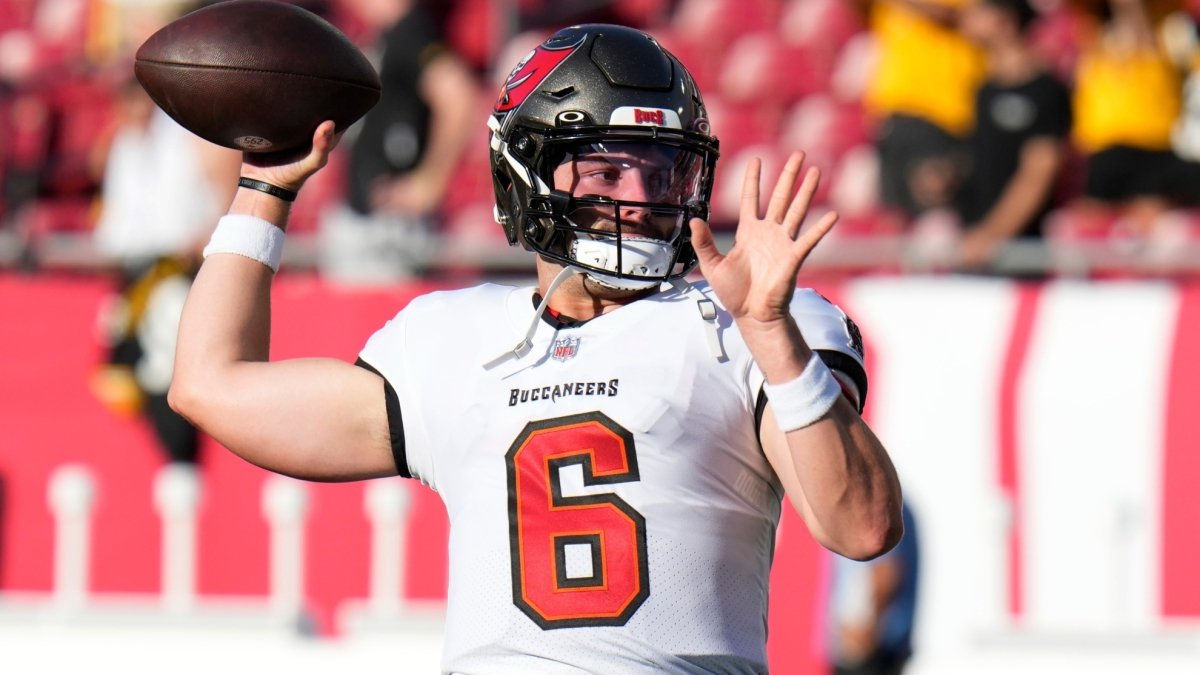
Baker Mayfield has addressed his relationship with Atlanta Falcons head coach Kevin Stefanski, clarifying that the tension between them stems from competitive fire rather than lingering personal animosity. The Tampa Bay Buccaneers quarterback generated headlines after posting a pointed social media message following Stefanski’s hire, but Mayfield has since walked back the feud narrative, reframing the dynamic as a professional rivalry now amplified by NFC South divisional stakes.
- Mayfield’s Clarification: “There’s stuff there, but it’s not like it’s beef. We’ve worked together, anytime you know somebody, you want to beat them whether it’s a good or bad relationship.”
- The Viral Social Post: Mayfield wrote: “Still waiting on a text/call from him after I got shipped off like a piece of garbage. Can’t wait to see you twice a year, Coach.”
- Divisional Motivation: “Not a revenge game in the sense of Atlanta, but we lost the division for the first time since four or five years, so any divisional game will be a revenge game, I guess.”
Mayfield’s social media activity in January 2026, responding to an Atlanta Journal-Constitution reporter’s post about Stefanski’s hiring, reignited memories of his abrupt exit from the Cleveland Browns following the 2021 season. The quarterback’s comment—”Still waiting on a text/call from him after I got shipped off like a piece of garbage. Can’t wait to see you twice a year, Coach”—fueled speculation about unresolved tension between the two. However, in a subsequent interview, Mayfield downplayed the idea of a feud, emphasizing that the relationship is defined by competition, not hostility.
“There’s stuff there, but it’s not like it’s beef,” Mayfield explained. “We’ve worked together, anytime you know somebody, you want to beat them whether it’s a good or bad relationship.” If anything, those remarks suggest a competitor’s mentality rather than personal animosity—a quarterback who uses every slight, real or perceived, as fuel for performance. But the context of their shared history in Cleveland adds layers to the narrative that go beyond simple competitive banter.
For a deeper look at Mayfield’s career resurgence in Tampa Bay, visit NFL.com’s official Baker Mayfield stats page for comprehensive career statistics and game logs. Additionally, Pro Football Reference offers detailed analytical data on Mayfield’s performance metrics across all six of his NFL seasons.
The Tweet That Started It All: Mayfield’s ‘Piece of Garbage’ Comment
The current chapter of the Mayfield-Stefanski saga opened on January 27, 2026, when D. Orlando Ledbetter of the Atlanta Journal-Constitution posted on social media that Kevin Stefanski would be introduced as the Falcons’ new head coach. Mayfield, who had been relatively quiet about his Cleveland departure since finding stability in Tampa Bay, responded with a message that instantly went viral:
“Still waiting on a text/call from him after I got shipped off like a piece of garbage. Can’t wait to see you twice a year, Coach.”
The comment resonated deeply with NFL fans who remembered Mayfield’s unceremonious exit from the Browns. It suggested wounds that had never fully healed—a quarterback who felt abandoned by the organization and specifically by the head coach who had once guided him to the playoffs. Mayfield’s phrasing—”shipped off like a piece of garbage”—referenced the Browns’ trade that sent him to the Carolina Panthers for a conditional fifth-round pick, a deal widely viewed as a salary dump after Cleveland had committed to Deshaun Watson with a fully guaranteed $230 million contract.
But was the tweet a genuine expression of hurt, or a calculated message designed to set a competitive tone for the upcoming season? In subsequent interviews, Mayfield suggested the latter was closer to the truth. The tweet served its purpose: it signaled to Stefanski, to the Falcons, and to the NFC South that Mayfield would bring maximum intensity to their twice-annual meetings.
Revisiting the Cleveland Breakup: What Really Happened Between Mayfield and Stefanski
To understand the Mayfield-Stefanski dynamic, one must revisit the 2020 season, when the partnership seemed destined for long-term success. After being selected No. 1 overall in the 2018 NFL Draft, Mayfield became the face of the Browns franchise, enduring three head coaches in his first two seasons. Stefanski arrived in 2020 and brought stability, implementing a scheme that maximized Mayfield’s strengths while minimizing his weaknesses. The result: Mayfield threw 26 touchdown passes against eight interceptions, posted a 95.9 passer rating, and guided the Browns to an 11-5 record and their first playoff victory since 1994—a 48-37 win over the Pittsburgh Steelers.
That magical season, however, was followed by a nightmare. The 2021 campaign began with expectations of a Super Bowl run but quickly unraveled due to injuries, dysfunction, and regression. The defining moment came when Mayfield suffered a torn labrum in his non-throwing shoulder during Week 2 against the Houston Texans. Rather than shutting him down for surgery, the Browns allowed Mayfield to continue playing—a decision that would define his final season in Cleveland and create lasting friction between the quarterback and the organization.
The 2021 Season: Injury, Dysfunction, and the Fractured Relationship
Mayfield played through the shoulder injury for the remainder of the season, a testament to his toughness but also a decision that would drastically impact his performance. The numbers told the story of a compromised quarterback: 17 touchdown passes against 13 interceptions, a career-low 60.5% completion rate, and a 91.1 passer rating that represented a significant drop from 2020. The Browns finished 8-9, missing the playoffs in a season that many believed was Super Bowl or bust.
Behind the scenes, the relationship between Mayfield and the coaching staff deteriorated. Sources indicated that Mayfield felt the organization had mishandled his injury, prioritizing short-term competitiveness over his long-term health. There were also reports of tension regarding offensive play-calling, with Mayfield privately expressing frustration that the scheme had become too conservative. Stefanski, for his part, faced criticism for failing to adapt to Mayfield’s limitations and for not taking a more active role in managing the quarterback’s health.
The breaking point came after the season. Rather than committing to Mayfield’s future, the Browns pursued a blockbuster trade for Deshaun Watson, signaling to Mayfield and the league that they had moved on. Mayfield requested a trade, and the Browns obliged, sending him to Carolina in a deal that netted Cleveland only a conditional fifth-round pick. The swift and dismissive nature of the trade left Mayfield feeling betrayed—a sentiment that would linger for years and eventually resurface in his response to Stefanski’s Falcons hire.
The Aftermath: How Cleveland Moved On and Mayfield Found His Groove in Tampa
Mayfield’s post-Cleveland journey was anything but linear. He spent the 2022 season with the Carolina Panthers, where he struggled mightily before being waived midseason. A brief stop with the Los Angeles Rams followed, providing a glimpse of his potential in a functional offense. But it wasn’t until he signed with the Tampa Bay Buccaneers in March 2024 that Mayfield found a true home.
Under offensive coordinator Dave Canales and head coach Todd Bowles, Mayfield resurrected his career. In his first full season as Tampa Bay’s starter, he threw for over 4,000 yards and 28 touchdowns while posting a career-best completion percentage above 64%. The Buccaneers won the NFC South and advanced to the divisional round of the playoffs, re-establishing Mayfield as a franchise-caliber quarterback. Meanwhile, the Browns imploded amid the Watson controversy, validating Mayfield’s contention that Cleveland had made a significant error in judgment. The organization’s dysfunction was later underscored by criticism from the team’s former CEO, who took shots at the franchise’s direction while notably excluding certain quarterbacks from the future plans.
The contrast between Mayfield’s resurgence and the Browns’ dysfunction added another layer to the narrative. When Stefanski left Cleveland for Atlanta in January 2026, it wasn’t just a coach changing jobs—it was a reminder of everything that had gone wrong in the final year of their partnership and everything that Mayfield had overcome since.
Stefanski’s New Chapter: Taking the Falcons Job and What It Changes
Stefanski’s decision to leave Cleveland for Atlanta represented a fresh start for the coach, who had guided the Browns to two playoff appearances but had also endured the public fallout from the Watson trade and the criticism surrounding Mayfield’s departure. In Atlanta, Stefanski inherits a roster with offensive talent—including running back Bijan Robinson and wide receiver Drake London—but quarterback uncertainty remains the franchise’s biggest question mark.
The Falcons have cycled through quarterbacks since Matt Ryan’s departure, with Marcus Mariota, Desmond Ridder, and Taylor Heinicke each failing to provide stability. Stefanski’s reputation as a quarterback-friendly coach—evidenced by Mayfield’s career-best season in 2020—makes him an attractive hire for a franchise desperate to end its playoff drought. But the timing of the move puts Stefanski in direct competition with his former quarterback, now entrenched as the face of the Buccaneers’ franchise.
Stefanski has publicly addressed the situation with diplomacy, telling reporters: “Baker is a great competitor. I have a ton of respect for what he’s accomplished and how he’s handled his career. Those comments, I think, come from a place of passion and wanting to win, which is what you want in a quarterback.” Notably, Stefanski did not address Mayfield’s claim about waiting on a text or call—a silence that speaks volumes about the unresolved nature of their relationship.
Mayfield Sets the Record Straight: ‘It’s Not Beef, Just Competition’
As the narrative of a lingering feud gained traction, Mayfield stepped forward to clarify his position. In a March 2026 interview, he addressed the tweet and the larger question of his relationship with Stefanski, offering his most candid comments on the subject to date.
“There’s stuff there, but it’s not like it’s beef,” Mayfield said. “We’ve worked together, anytime you know somebody, you want to beat them whether it’s a good or bad relationship. You want to beat them. That’s what competition is.”
The comment represented a significant shift in tone from his January tweet, suggesting that Mayfield had either reconsidered his initial reaction or had always intended the message as competitive fuel rather than genuine hostility. He emphasized that his motivation stemmed not from personal grievances but from the competitive nature of football and the reality of divisional rivalries. This marked a clear pivot from his earlier remarks about seeking revenge against Stefanski, as Mayfield redirected his focus toward the broader challenge of divisional supremacy.
Breaking Down the ‘Competition’ Mindset: What Mayfield Actually Means
Mayfield’s definition of “competition” goes beyond the typical athlete cliché. For him, it manifests in specific ways: extra film study before games against Stefanski’s defenses, heightened intensity in practice during weeks leading up to Falcons matchups, and a refusal to give an inch when the two teams meet on the field. Competition is personal, even when the relationship itself isn’t characterized by animosity.
“When you know somebody, you know their tendencies, you know how they think,” Mayfield explained. “It’s not about revenge. It’s about proving that you’re the best, that you can beat the guy across from you. That’s what drives me.”
This mindset is consistent with Mayfield’s career-long approach to external motivation. Throughout his career, he has used perceived slights—from being overlooked in high school recruiting to being doubted in the NFL—as fuel for performance. Stefanski’s hire in Atlanta created another source of motivation, albeit one that Mayfield frames as competitive rather than vindictive.
In practical terms, Mayfield’s approach to the Falcons games will involve detailed preparation focused on Stefanski’s defensive tendencies. Even though Stefanski is an offensive-minded coach, his game planning will influence how the Falcons’ defense approaches the Buccaneers, particularly in terms of the play-action concepts that Stefanski favors. Mayfield, intimately familiar with those concepts from their Cleveland days, will be uniquely positioned to exploit weaknesses in the Falcons’ scheme.
Division Rivals: What to Expect When the Falcons and Buccaneers Meet
Mayfield made it clear that his focus centers on divisional outcomes rather than personal redemption. “Not a revenge game in the sense of Atlanta, but we lost the division for the first time since four or five years, so, any divisional game will be a revenge game, I guess,” he explained.
For Mayfield, who threw for over 4,000 yards and 28 touchdowns last season while posting a career-best completion percentage above 64%, sustaining that production will be critical if Tampa Bay hopes to reclaim control of the NFC South. The Buccaneers won the division in 2023 and 2024 before ceding the crown to the New Orleans Saints in 2025, a regression that Mayfield has taken personally.
Meanwhile, Stefanski arrives in Atlanta with a reputation for quarterback-friendly schemes. During his tenure in Cleveland, the Browns ranked among the league leaders in rushing efficiency and play-action usage, structures that often eased pressure on the quarterback. How that translates to the Falcons—and how Mayfield adjusts when facing a familiar system—will add tactical intrigue to the division matchups.
The two teams are scheduled to meet twice during the upcoming season. The first matchup will take place at Mercedes-Benz Stadium in Atlanta, with the second scheduled for Raymond James Stadium in Tampa Bay. Both games carry significant implications for the NFC South race, but they also offer Mayfield an opportunity to make a statement against the coach who once guided his career and then watched from a distance as he was cast aside.
Expert Takes: Is This a Distraction or Fuel for Both Sides?
The Mayfield-Stefanski dynamic has drawn analysis from across the NFL media landscape, with opinions divided on whether the relationship will serve as a positive motivator or a distraction for both parties.
“When you have a quarterback with Mayfield’s competitive nature, you want him motivated,” said former NFL quarterback and analyst Dan Orlovsky. “The issue isn’t whether he wants to beat Stefanski—it’s whether he can compartmentalize that motivation and execute the game plan. Mayfield has shown he can do that in Tampa. He’s been a more disciplined player than he was in Cleveland.”
Other analysts have noted that Stefanski’s presence in Atlanta could actually benefit Mayfield by sharpening his focus during games that matter most. “Mayfield thrives on external motivation,” noted ESPN’s Mina Kimes. “The Stefanski angle gives him a storyline to latch onto, but the real motivation is winning the division and proving that he’s a top-tier quarterback. Stefanski is just the vehicle for that narrative.”
From Stefanski’s perspective, the Mayfield comments represent a manageable subplot in a larger coaching challenge. “Kevin has to balance the emotional element with the practical reality of building a winning culture in Atlanta,” said former NFL executive Michael Lombardi. “He can’t get caught up in the Mayfield stuff because it distracts from what he needs to do with the Falcons. But he also can’t ignore it entirely because the players will be watching how he handles it.”
Ultimately, the experts agree that the on-field product will determine the narrative. If the Buccaneers sweep the Falcons and Mayfield performs at an elite level, the storyline will be one of redemption and validation. If the Falcons prevail, the “beef” narrative will resurface, suggesting that Mayfield allowed emotions to cloud his execution.
The ‘Burger’ Quote: Mayfield’s Final Word on the Relationship
Despite the competitive subtext, Mayfield closed the door on any notion of lingering hostility with an unexpected quip about sharing a postgame meal. “Maybe we will have one after the game in Atlanta, I don’t know. I have two opportunities to see next year if we are going to share a burger.”
The burger comment is significant not because it’s funny, but because it reveals the true temperature of the relationship. Mayfield isn’t nursing a grudge so deep that he’d refuse to break bread with his former coach. He’s not holding onto bitterness that would prevent basic human interaction. Rather, the comment suggests that while competition will be fierce, there’s no personal hatred driving the rivalry.
Mayfield’s willingness to joke about sharing a meal stands in stark contrast to his January tweet, which conveyed genuine hurt and frustration. The evolution from “shipped off like a piece of garbage” to “maybe we’ll share a burger” represents a shift from raw emotion to measured reflection, from grievance to professional perspective. It suggests that time and success have healed the wounds of Cleveland, leaving only the competitive fire that Mayfield channels into every game.
After all, the twice-annual meetings between the Buccaneers and Falcons will be decided on execution, not past grievances. Mayfield and Stefanski will design game plans, adjust in real time, and compete for victory—all while knowing that the relationship, whatever it is, has moved beyond the bitterness of the past.
Conclusion: The Real Story Behind the Headlines
Baker Mayfield’s relationship with Kevin Stefanski is not the simple “beef” that social media narratives initially suggested. It’s a layered dynamic characterized by shared history, unresolved grievances, and competitive intensity—all of which now play out in the context of an NFC South rivalry. Mayfield has clarified his position, emphasizing competition over animosity, while Stefanski has taken the diplomatic path of respecting his former quarterback’s talent without feeding into the drama.
The real story is not about a feud but about two competitors who know each other intimately, who have experienced the highs of playoff success and the lows of organizational dysfunction, and who will now face each other twice a year with playoff implications on the line. It’s a story of how professional relationships evolve, how time and success can heal wounds, and how competition—even when it feels personal—is ultimately about the game, not the individual.
For Mayfield, the motivation is clear: win the division, prove his critics wrong, and show that the Buccaneers are the team to beat in the NFC South. For Stefanski, the goal is to build a winner in Atlanta and establish a culture that endures beyond any single season. Their paths will cross twice a year, but the outcome will be determined by execution, not emotion.
As Mayfield himself put it: “We’ve worked together, anytime you know somebody, you want to beat them whether it’s a good or bad relationship. You want to beat them. That’s what competition is.” The “beef” narrative has been replaced by something more authentic—a quarterback and a coach who are now rivals, not enemies, and who will compete with everything they have because that’s what the game demands.