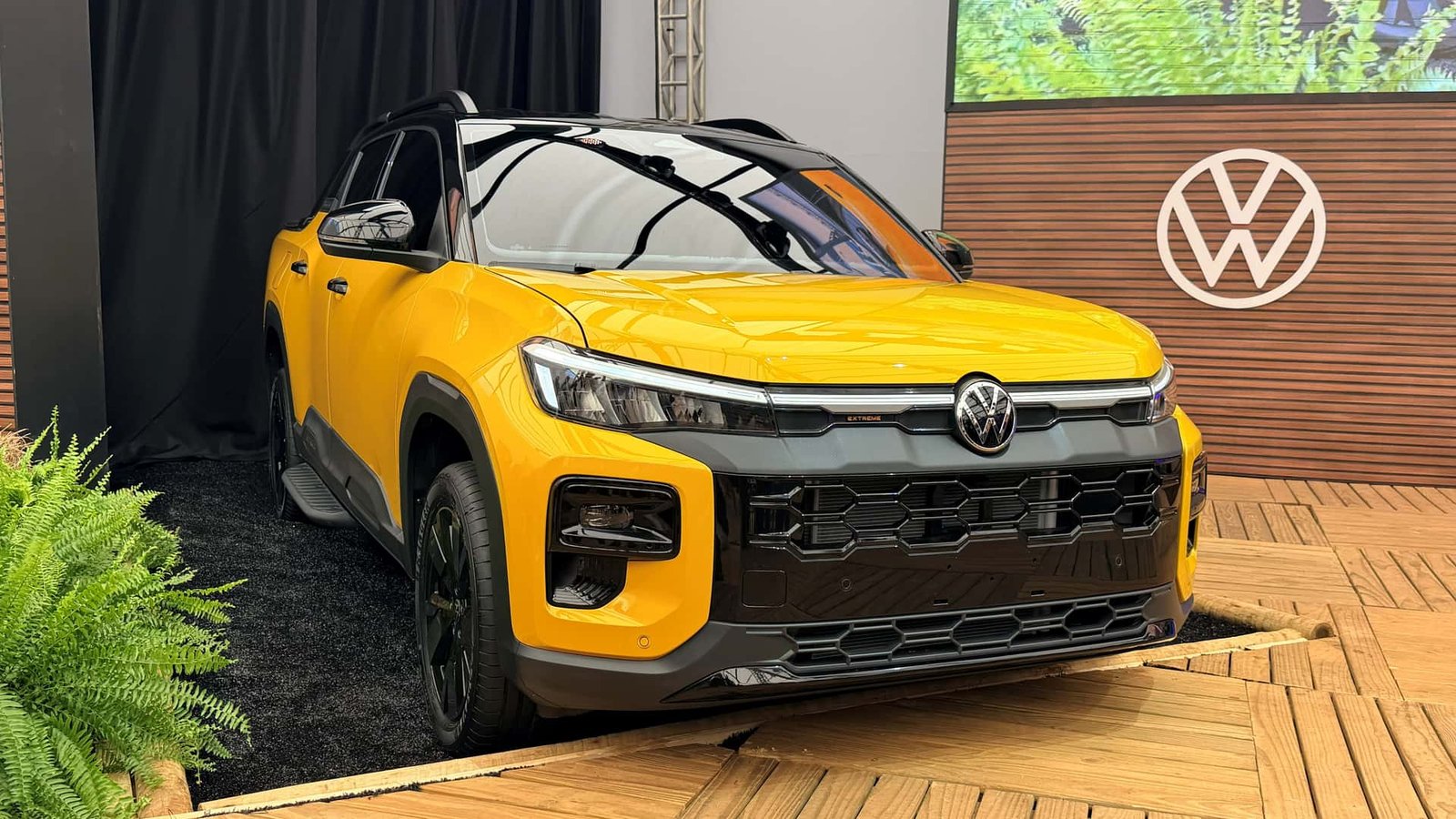
The 2027 Volkswagen Tukan has been officially revealed without camouflage in Brazil, debuting at the Barretos Rodeo Festival in São Paulo state as the long-awaited replacement for the iconic Saveiro pickup.
- Official Debut: Volkswagen Tukan unveiled at Barretos Rodeo Festival in Brazil with single-cab and double-cab body styles
- Market Position: Larger and more modern than Saveiro, directly targeting the segment-leading Fiat Strada
- Production: Built in São José dos Pinhais, Paraná, on the MQB platform with solid rear axle and leaf springs
- Engine Options: Confirmed 1.6 MSI (entry), 1.0 TSI turbo (mid-range), and 1.5 TSI Evo2 with 48V mild-hybrid (top trims)
- Transmissions: Manual for base models; six-speed or new eight-speed automatic for turbocharged versions
- Design Signature: Slim headlights connected by horizontal strip, E-shaped rear LED lighting across the tailgate
- Saveiro Retirement: Production ends Q4 2026 after more than four decades on the market
- On-Sale Date: Sales launch scheduled for early 2027, pricing and full specs to be announced closer to launch
- Investment: Part of VW’s R$20 billion Brazilian investment plan with 2 million km of testing completed
Developed specifically for the Brazilian market, the Volkswagen Tukan will be produced at the São José dos Pinhais plant in Paraná, taking over from the Saveiro after more than four decades of continuous production. The unibody pickup arrives to challenge the dominant Fiat Strada in one of South America’s most competitive automotive segments.
Volkswagen has confirmed both single-cab and double-cab body styles for the Tukan, suggesting a comprehensive lineup that spans work-oriented commercial vehicles and better-equipped personal-use configurations. The company has not yet released official dimensions, payload capacity, or detailed trim-level specifications, though the reveal provides significant insight into what buyers can expect.
The Tukan represents a significant evolution from the Saveiro, moving to Volkswagen’s versatile MQB platform shared with models like the Polo, Nivus, Tera, and T-Cross. At the rear, engineers have opted for a solid axle with leaf springs—a common setup in cargo-focused vehicles and the same configuration used by the rival Fiat Strada. This layout prioritizes hauling capability and commercial durability, suggesting the Tukan will maintain the workhorse credentials that made the Saveiro a Brazilian institution while adding modern refinement.
According to Volkswagen Brazil’s official announcement, the Tukan represents a R$20 billion investment in the Brazilian automotive sector, with the pickup undergoing over 2 million kilometers of rigorous testing across diverse terrain conditions. This extensive development program underscores Volkswagen’s commitment to delivering a durable, reliable product capable of withstanding the demanding conditions of Latin American commercial use.
Tukan Dimensions and Market Positioning
While initial speculation suggested the Volkswagen Tukan would compete directly with the Fiat Toro, the new pickup appears closer in size to the Chevrolet Montana. Industry sources indicate the Tukan measures approximately 4.9 meters in length, with a wheelbase around 2.9 meters—positioning it strategically between the compact Strada and midsize Toro. The single-cab configuration is expected to offer a bed length of roughly 2.3 meters, providing substantial cargo capacity for commercial users.
The single-cab body style will challenge the more affordable versions of the Fiat Strada, offering a larger bed and stronger emphasis on cargo hauling. The double-cab model, conversely, is expected to concentrate the turbocharged, automatic, and more generously equipped configurations—expanding Volkswagen’s appeal among buyers who use their pickup as both a work tool and a personal vehicle. This dual-purpose strategy mirrors the successful formula that has propelled the Strada to market leadership since 2021.
Volkswagen’s priority with the Tukan is to increase its share of the Brazilian pickup segment, currently dominated by the Fiat Strada. The Strada has led the Brazilian market since 2021, the year after its current generation arrived, building its advantage through a broad lineup spanning work-oriented versions and premium double-cab configurations. The Tukan follows a similar formula but adds turbocharged engines, automatic transmissions, and electrification in the upper trims—potentially offering advantages the Strada currently lacks.
Design and Visual Identity
The Volkswagen Tukan adopts the visual identity established by the brand’s latest global launches. Up front, slim LED headlights are linked by a horizontal strip, while the bumpers feature rugged, sculpted shapes that emphasize the body’s width. This front-end treatment echoes design cues seen on recent VW models, giving the Tukan a contemporary, cohesive appearance.
At the rear, the taillights incorporate a distinctive E-shaped lighting signature, connected by a full-width light bar that spans the tailgate. This rear design not only reinforces the Tukan’s visual width but also creates a recognizable nighttime signature, an important consideration for a model aimed at both commercial and retail buyers.
Between these bookends, the Tukan’s bodywork uses clean, taut surfacing with pronounced wheel arches and strong shoulder lines. The overall impression is of a sturdy, purposeful compact pickup that bridges the gap between work vehicle and lifestyle accessory—exactly the positioning Volkswagen needs to attract both traditional Saveiro buyers and new customers migrating from rivals.
The Barretos Rodeo Festival was strategically chosen for the Tukan’s debut due to its cultural significance in Brazil’s agricultural heartland. The event, one of the largest rodeo festivals in Latin America, attracts thousands of potential pickup buyers from farming and ranching communities—precisely the audience Volkswagen is targeting with the Tukan’s commercial-focused configurations. This venue selection demonstrates Volkswagen’s understanding of its core customer base and its commitment to meeting the needs of Brazilian agricultural workers.
Engines and Powertrain Options
Volkswagen has confirmed multiple powertrain options for the Tukan, with the lineup stratified across different trim levels. Entry-level configurations will retain the familiar naturally aspirated 1.6 MSI engine with manual transmission—a simpler, more affordable combination aimed at fleet buyers and small business operators who prioritize cost-effectiveness over performance. This engine has been a mainstay of Volkswagen’s Brazilian portfolio for decades, ensuring parts availability and service familiarity.
Midrange versions will receive the proven 1.0 TSI flex-fuel engine paired with a six-speed automatic transmission, or potentially the new eight-speed gearbox recently introduced in the T-Cross. This combination delivers a meaningful step up in refinement and driving ease compared to the outgoing Saveiro, which has never offered an automatic transmission or turbocharged engine in its Brazilian-market career. The 1.0 TSI provides responsive performance while maintaining competitive fuel economy.
At the top of the lineup, the Volkswagen Tukan will debut the company’s new 1.5 TSI Evo2 with 48-volt mild-hybrid technology in Brazil. This advanced powertrain could later be extended to other locally produced VW models, making the Tukan a showcase for the brand’s electrification strategy in South America. The mild-hybrid system provides enhanced efficiency and reduced emissions while offering a competitive differentiator against the Strada. The 1.5 TSI Evo2 delivers approximately 150 horsepower, positioning the Tukan as one of the most powerful vehicles in its segment.
Volkswagen’s component strategy for the Tukan includes the Robust and Extreme trim designations, which will differentiate the work-oriented and lifestyle-focused versions respectively. The Robust trim emphasizes durability and cargo capacity, while the Extreme configuration adds sportier styling and premium equipment.
Saveiro Retirement After Four Decades
The arrival of the Volkswagen Tukan will also mark the end of the Saveiro, the last survivor of the original Gol family. Launched in 1982, the Saveiro pickup remained in production for more than four decades, undergoing several generations while remaining a staple of Volkswagen’s Brazilian lineup.
However, the Saveiro has relied on an older architecture for years, offered only with a naturally aspirated 1.6-liter engine and manual transmission. This aging powertrain and platform have made the Saveiro increasingly uncompetitive against newer rivals like the Fiat Strada and Chevrolet Montana.
Production of the Saveiro is expected to end in the final quarter of 2026, making room in the lineup for the new Tukan. The Saveiro is currently sold in Robust, Trendline, and Extreme trims, with single-cab and double-cab options—a legacy that the Tukan will carry forward while introducing modern mechanicals and technology. The departure of the Saveiro closes a significant chapter in Volkswagen’s Brazilian history, but the Tukan promises to write a new one with contemporary engineering and competitive capability. For those interested in Volkswagen’s broader pickup strategy, the company has also been developing larger truck offerings, with the VW Amarok camouflaged truck teased with 464 HP PHEV power for 2027 launch representing a different approach in the global pickup segment.
Production Timeline: Saveiro Discontinuation and Tukan Ramp-Up
| Milestone | Date | Details |
|---|---|---|
| Saveiro Production End | Q4 2026 | Final production run of the iconic pickup after 44 years |
| Tukan Production Start | Q1 2027 | Ramp-up at São José dos Pinhais plant begins |
| Sales Launch | Early 2027 | First deliveries to Brazilian customers |
| Pricing Announcement | Late 2026 | Full pricing and equipment details revealed |
| Full Production Capacity | Mid-2027 | Plant reaches maximum output for Tukan |
Production and Brazilian Market Strategy
The Volkswagen Tukan will be built at the São José dos Pinhais plant in Paraná, the same facility that currently produces the Saveiro and has long been a center of VW’s Brazilian manufacturing operations. This localized production ensures the Tukan can be priced competitively against the Fiat Strada, which is also produced domestically.
VW’s approach with the Tukan mirrors the strategy that has worked so effectively for the Strada: a broad lineup spanning entry-level work trucks to premium family-oriented double-cabs. However, the Tukan aims to differentiate itself through more advanced powertrain options, including the 1.5 TSI mild-hybrid, which would be a segment first.
While the Tukan is confirmed for Brazilian production and sale, Volkswagen has not announced plans to export the model to other markets. The pickup will not be sold in the United States, where Volkswagen’s truck strategy remains focused on the larger Amarok and the potential for a more substantial offering through its Scout brand. The Tukan is, like the Saveiro before it, a Latin America-specific model developed to meet the unique requirements of the region’s compact pickup segment.
Tukan Pricing and On-Sale Date
Volkswagen has confirmed that the Tukan’s sales launch is scheduled for early 2027, with pricing and full equipment details to be announced closer to that date. In the meantime, the display at the Barretos Rodeo Festival provides the first opportunity to see the Brazil-developed pickup without disguise, offering a preview of the design and configurations buyers can expect.
Pricing will be a critical factor in the Tukan’s success, as the Fiat Strada has established a dominant position through competitive pricing combined with strong value proposition. Volkswagen will need to price the Tukan aggressively to attract both fleet buyers and retail customers, particularly given the growing competition in the compact pickup segment. Industry analysts project entry-level pricing around R$120,000, positioning the Tukan competitively against the Strada while offering superior powertrain technology in higher trims.
Key details yet to be announced include official dimensions, payload capacity, towing capacity, ground clearance, and exact trim-level configurations. These specifications will be critical in establishing the Tukan’s competitive positioning against the Fiat Strada, Chevrolet Montana, and other rivals. As the early 2027 launch approaches, Volkswagen will gradually release more information about the Tukan’s capabilities and pricing structure.
Tukan vs Fiat Strada vs Chevrolet Montana: Comparison Table
| Specification | Volkswagen Tukan (2027) | Fiat Strada (Current) | Chevrolet Montana (Current) |
|---|---|---|---|
| Length (approx.) | 4,900 mm | 4,474 mm | 4,717 mm |
| Wheelbase (approx.) | 2,900 mm | 2,737 mm | 2,800 mm |
| Cab Configurations | Single-cab, Double-cab | Single-cab, Double-cab | Double-cab only |
| Base Engine | 1.6 MSI (naturally aspirated) | 1.3 Firefly | 1.2 Turbo |
| Mid-Range Engine | 1.0 TSI (turbo) | 1.3 Firefly Turbo | 1.2 Turbo |
| Top Engine | 1.5 TSI Evo2 mild-hybrid | 1.3 Firefly Turbo | 1.2 Turbo |
| Transmission Options | Manual, 6-speed auto, 8-speed auto | Manual, CVT | Manual, 6-speed auto |
| Platform | MQB (unibody) | Unibody | Unibody |
| Rear Suspension | Solid axle, leaf springs | Solid axle, leaf springs | Torsion beam |
| Estimated Starting Price | R$120,000 | R$119,990 | R$125,000 |
| Mild-Hybrid Available | Yes (top trim) | No | No |
Expert Analysis: Why the Tukan Matters
Motor1’s Take: The new Tukan represents a compelling evolution for Volkswagen’s Brazilian pickup strategy. Unlike the Saveiro, which had become increasingly dated, the Tukan brings modern MQB architecture and advanced powertrain technology to a segment that has been dominated by the Fiat Strada through sheer market momentum. The introduction of the 1.5 TSI Evo2 mild-hybrid is particularly significant—it offers a genuine technological advantage that competitors currently cannot match.
However, the Tukan faces several challenges. The Fiat Strada’s market leadership is built not just on product merit but on extensive dealer networks, brand loyalty, and a reputation for durability that has been earned over years. Volkswagen will need to demonstrate that the Tukan can match the Strada’s reliability while offering superior performance—a tall order in the value-conscious Brazilian market.
For the United States, the Tukan remains a non-starter. Volkswagen has consistently stated that its North American truck ambitions are focused on the Amarok and potentially other larger offerings. The Tukan’s compact dimensions and powertrain choices—optimized for Brazilian conditions and flex-fuel compatibility—would not translate well to the American market. The Scout Terra, while a different vehicle entirely, represents a more appropriate direction for VW’s US truck strategy.
Ultimately, the Tukan’s success will be determined by execution. If Volkswagen can deliver competitive pricing, reliable performance, and a compelling value proposition, the Tukan could finally break the Strada’s market stranglehold. If not, the Strada’s dominance will likely continue—and Volkswagen will have to wait for its next opportunity to challenge Brazil’s best-selling vehicle.
2027 Volkswagen Tukan: What We Still Don’t Know
While the Barretos Rodeo Festival reveal has answered many questions about the Tukan’s design and direction, several important details remain under wraps:
- Official dimensions – Length, width, height, wheelbase, and bed sizes not yet published
- Payload and towing capacity – Critical specifications for commercial buyers
- Ground clearance – Important for rural and agricultural applications
- Complete trim-level breakdown – Full differentiation between Robust, Trendline, and Extreme configurations
- Fuel economy figures – Both flex-fuel and mild-hybrid efficiency ratings
- Safety features – ADAS packages and standard equipment levels
- Cargo volume – Interior storage and bed capacity details
- Warranty details – Coverage terms and conditions
The Tukan’s success in the Brazilian market will ultimately depend on how these details stack up against the competition. If Volkswagen can deliver a compelling blend of modern design, advanced powertrains, competitive pricing, and the durability expected by commercial buyers, the Tukan could finally challenge the Fiat Strada’s dominance. If not, the Strada’s market leadership will likely continue.
Frequently Asked Questions About the Volkswagen Tukan
[faq]Will the Volkswagen Tukan be sold in the United States?
No. The Volkswagen Tukan is a Brazil-specific model developed for the Latin American market. It will be produced at the São José dos Pinhais plant and sold exclusively in South American markets. Volkswagen’s US truck strategy remains focused on the larger Amarok and potential offerings through its Scout brand.
What is the expected price of the Volkswagen Tukan?
Industry analysts project entry-level pricing around R$120,000 for the base single-cab version with the 1.6 MSI engine. Higher-tier configurations with turbocharged engines, automatic transmissions, and the mild-hybrid system will command premium pricing. Volkswagen has not yet confirmed official pricing, with details expected closer to the early 2027 launch.
What engines will the Volkswagen Tukan offer?
The Tukan will offer three powertrain options: a naturally aspirated 1.6 MSI for entry-level versions, a 1.0 TSI turbocharged engine for mid-range configurations, and a 1.5 TSI Evo2 with 48-volt mild-hybrid technology for top-tier trims. Transmissions include manual, six-speed automatic, and a new eight-speed automatic gearbox.
When will the Volkswagen Tukan go on sale?
Volkswagen has confirmed that the Tukan’s sales launch is scheduled for early 2027. Pricing and full equipment details will be announced closer to that date. Production of the outgoing Saveiro will end in Q4 2026 to make room for the Tukan’s manufacturing ramp-up.
Is the Volkswagen Tukan based on the MQB platform?
Yes. The Volkswagen Tukan rides on the MQB platform, which is shared with models like the Polo, Nivus, Tera, and T-Cross. However, the Tukan uses a solid rear axle with leaf springs—a configuration optimized for cargo capacity and commercial durability, similar to the rival Fiat Strada.
What does the ‘Tukan’ name mean?
The ‘Tukan’ name references the toucan bird native to South America. Volkswagen has a tradition of naming its Brazilian-market models after animal or geographic elements, continuing with this distinctive and recognizable name that reinforces the model’s Latin American identity.