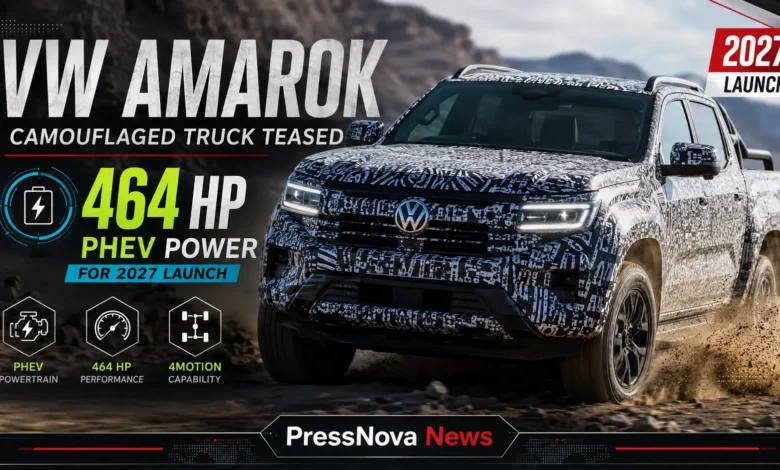
The next-generation VW Amarok camouflaged truck has broken cover at Brazil’s Festa do Peão de Barretos on August 23, 2026, revealing an electrified midsize pickup that promises over 464 horsepower, 590 lb-ft of torque, and a 2027 launch timeline.
- Reveal Event: Presented at Brazil’s Festa do Peão de Barretos rodeo festival on August 23, 2026, alongside the all-new VW Tukan
- Powertrain: Plug-in hybrid (PHEV) with 800 TSI badging, exceeding 464 hp and 590 lb-ft (800 Nm) torque
- Platform Origin: Based on SAIC Maxus Interstellar X architecture with VW-specific calibration
- Production Location: General Pacheco, Argentina, with 4 billion reais investment in local operations
- Rivals Targeted: Toyota Hilux, Ford Ranger, Chevrolet S10, Mitsubishi Triton
- SUV Variant: Three-row “Atacama Project” SUV expected to follow with hybrid powertrain
- Estimated Towing: Expected to exceed 7,716 lbs (current generation rating)
- PHEV Charging: Estimated 2-3 hours (Level 2), 6-8 hours (standard outlet) – official figures pending
By [Author Name] | PressNova News Auto Desk
Published: August 25, 2026 | Updated: August 25, 2026
Volkswagen chose the opening night of the 2026 Festa do Peão de Barretos, Brazil’s premier rodeo and country music festival, to showcase its pickup offensive in spectacular fashion. Just hours after revealing the all-new Tukan, the brand officially presented the next-generation Amarok, still covered in an artistic camouflage wrap that celebrates South American culture. The midsize pickup will launch in 2027 and will come from Argentina to take on the Toyota Hilux, Ford Ranger, Chevrolet S10, Mitsubishi Triton, and other segment leaders.
VW shared few technical details during the event, but it did confirm one important point: this will be the most powerful Amarok ever produced. The automaker also acknowledged that the new generation will be electrified, supporting earlier exclusive reporting by Motor1 Brazil on the future Amarok 800 TSI, a plug-in hybrid version expected to exceed 464 hp and deliver 590 lb-ft (800 Nm) of peak torque. This represents a quantum leap over the current model’s 3.0-liter V6 turbodiesel, which produces 254 hp and 427 lb-ft.
Choosing Barretos to present both the Tukan and the camouflaged Amarok puts these products in front of an especially important audience for the pickup segment. Brazil’s largest sertanejo country music and rodeo event serves as one of the auto industry’s key showcases for farmers, business owners, and consumers tied to agribusiness, a sector that accounts for a significant share of pickup sales in Brazil.
The Tukan was revealed in Robust and Extreme versions, with single- and double-cab body styles, respectively. Built in São José dos Pinhais, Paraná, it will arrive in the first half of 2027 to replace the Saveiro and compete with everything from work-oriented Fiat Strada configurations to more expensive double-cab versions. The Amarok will sit above it in VW’s lineup, maintaining the brand’s presence in the competitive midsize pickup segment.
The Amarok project will be built in General Pacheco, Argentina, the same plant responsible for the current generation since 2010. Units destined for the Brazilian market will continue to be imported from the neighboring country, maintaining the established production and supply chain relationships that have served the brand well for over a decade. The facility has produced 800,000 Amaroks since 2010, making the pickup the most-produced vehicle in VW Argentina’s history. Of that total, more than 465,000 units have been exported to more than 100 markets.
For authoritative context on the Amarok’s development, Motor1 Brazil’s original exclusive reporting first revealed the 800 TSI powertrain details and the SAIC Maxus platform connection. Additionally, Volkswagen’s official press release on the 20 billion-real South American investment confirms the regional commitment through 2028.
Electrified Powertrain: The Amarok 800 TSI PHEV Explained
VW has not yet disclosed engine details, battery capacity, or electric driving range. The brand only confirmed that the new Amarok will combine electrification, technology, and the highest power output ever offered by the model. The information officially previewed so far, however, lines up with exclusive reports published by Motor1 Brazil in recent months.
According to the exclusive reporting by Fábio Trindade of Motor1 Brazil, the most powerful configuration will be called the Amarok 800 TSI. The name refers to the plug-in hybrid system’s combined 590 lb-ft (800 Nm) of torque. Output is expected to exceed 464 hp, with four-wheel drive and 0–62 mph (0-100 km/h) acceleration in under five seconds. These figures place the electrified pickup in performance territory previously reserved for sports sedans and high-performance SUVs.
Performance Figures and Torque Specs
Those figures are far beyond the current Amarok, which uses the familiar 3.0-liter V6 turbodiesel engine. In Extreme trim, the setup delivers 254 hp and 427 lb-ft (580 Nm) of torque, paired with an eight-speed automatic transmission and permanent all-wheel drive. Despite the project’s age, performance and drivability remain among the pickup’s main strengths, but the new generation will elevate these attributes to an entirely new level.
With more than 464 hp, the new Amarok should outgun every midsize rival currently sold in Brazil. During a meeting with journalists in Peru, Alexander Seitz, executive chairman of VW South America, made a bold claim about the future pickup’s performance: “The new Amarok will keep up with a Porsche Panamera under acceleration.” Seitz’s comparison underscores the remarkable performance potential of a vehicle designed primarily for work and off-road capability.
What This Means for Buyers: Real-World Value
For prospective Amarok buyers, the impressive specs translate into tangible benefits. The estimated towing capacity is expected to match or exceed the current generation’s 7,716-pound rating, making it suitable for hauling livestock trailers, construction equipment, and recreational boats. The plug-in hybrid configuration also offers potential fuel savings for daily commuting, with electric-only range expected to cover short trips without consuming gasoline.
VW has not yet announced warranty details for the PHEV system. However, industry standards for plug-in hybrids typically include 8-year/100,000-mile coverage for battery components. Buyers should also consider battery degradation concerns – a factor common to all electrified vehicles. VW’s extensive testing program across South American climates aims to validate the battery’s durability in heat, cold, and high-altitude conditions before the 2027 launch.
Fuel economy estimates remain unconfirmed, but the PHEV configuration is expected to deliver significant improvements over the current V6 diesel. Based on similar plug-in hybrid trucks in the segment, combined fuel economy could reach 20-25 mpg-equivalent when operating in hybrid mode, with substantially better figures during electric-only operation for short trips.
Latin America Focus: Why Brazil and Argentina Matter
VW will invest 4 billion reais in its Argentine operations as part of a 20 billion-real program earmarked for South America through 2028. The investment includes modernization of the General Pacheco plant, assembly-line updates, and new processes required to build the electrified generation. This significant capital injection demonstrates VW’s commitment to the region as a manufacturing hub and key market for pickup sales.
The plant will continue supplying Brazil and other countries in the region when the new generation enters production. Until then, the current Amarok will remain on sale with a V6 turbodiesel engine, keeping alive for a while longer a mechanical combination that will likely lose ground to electrification in the future lineup. This transitional period allows VW to maintain sales momentum while preparing for the technological shift.
Production Plans and Investment Details
The General Pacheco facility has been the heart of Amarok production since the model’s introduction in 2010. The 4 billion-real investment will modernize assembly lines, introduce new manufacturing processes for electrified vehicles, and expand production capacity to meet anticipated demand for the new generation. The investment forms part of VW’s broader regional strategy to strengthen its position in Latin America’s growing pickup market.
VW is also focusing its presentation on the involvement of its South American design, engineering, testing, and validation departments. The company emphasizes that the pickup will retain dynamic traits associated with the German brand, even as it adopts a platform developed in partnership with a Chinese manufacturer. This localization strategy aims to deliver a product that feels distinctly Volkswagen while benefiting from global engineering resources.
Dual Strategy: Two Amaroks for Different Markets
The statement released in Barretos does not mention the origin of the architecture used for the new Amarok. In practice, however, the new generation will be directly related to the Maxus Interstellar X, a pickup developed by China’s SAIC. Spy shots published by Motor1 Brazil have already shown prototypes with bodywork, headlights, bumpers, doors, and proportions very similar to the Asian-market model.
VW and SAIC have a long-running partnership in the Chinese market, where they have operated jointly since the 1980s. That cooperation will now allow the German automaker to reduce development time and costs by using a modern architecture designed from the outset for combustion engines, hybrid systems, and fully electric powertrains. This efficient approach enables VW to bring the new Amarok to market faster and at a lower cost than developing a completely new platform.
The dual-track strategy means VW will effectively sell two Amarok pickup trucks globally. One, based on the Ford Ranger architecture, will continue in markets outside Latin America – including Europe, Australia, and select Asian markets. The other, derived from the SAIC Maxus platform, will serve Latin American markets as the replacement for the first-generation Amarok. VW does not expect the two to coexist in the same country, ensuring clear market positioning without internal competition.
Ford-Ranger Based vs. Chinese-Origin Pickup
At the same time, VW is looking to increase its engineering input to better differentiate the Amarok from the Interstellar X. Suspension, steering, driving dynamics, electronic-system calibration, and part of the design will be tailored to South American use conditions while preserving the drivability that helped establish the current generation. The goal is to deliver a distinct driving character, even with structural and technological sharing with the Maxus Interstellar X.
The Interstellar X architecture uses a reinforced unibody structure combined with elements similar to those of a ladder frame. The solution aims to deliver car-like comfort and torsional rigidity without sacrificing the durability needed to carry up to 2,205 pounds and tackle rough terrain. This hybrid construction approach represents a middle ground between traditional body-on-frame trucks and unibody SUVs.
First Look: VW Amarok Camouflaged for 2027 Debut
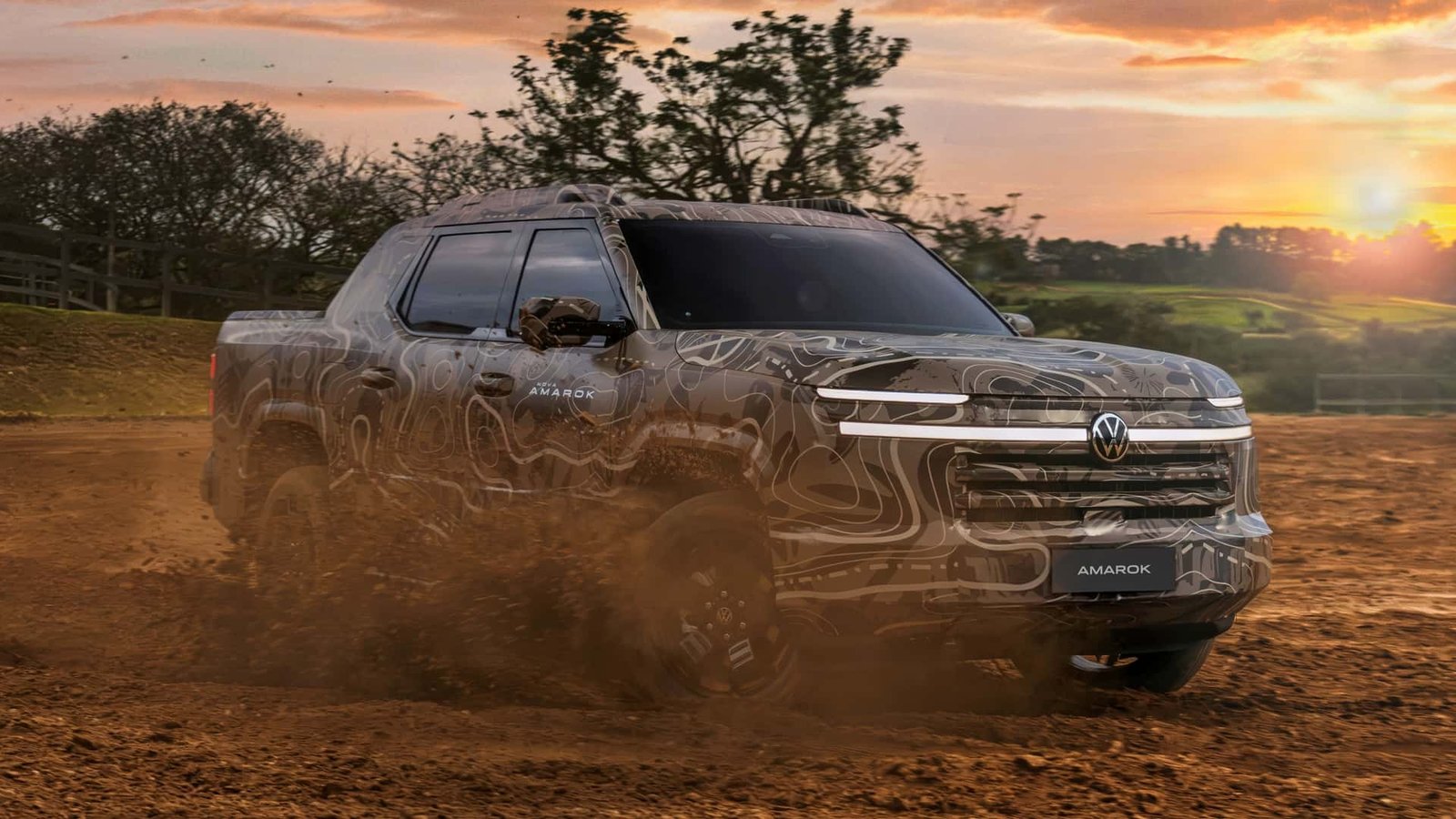
The first two official images show the Amarok completely camouflaged. The regional design team created the wrap, which brings together references to different South American landscapes and cultures, including Monte Fitz Roy, Iguazu Falls, the Amazon, the Nazca Lines, the Copacabana sidewalk pattern, and the Moai statues of Easter Island. Elements tied to rural life and regional culture also appear, including boots, a hat, an ox, cacti, cordel-style artwork, and topographic lines.
According to VW, some of these drawings will become “easter eggs” on the final bodywork, but their location and appearance remain secret. This playful approach to the camouflage design reflects VW’s confidence in the product while building anticipation among enthusiasts and potential buyers. The artistic wrap also serves to obscure key design details that would otherwise reveal the connection to the Maxus Interstellar X.
What the Artistic Wrap Hides – Design Clues Revealed
Despite the camouflage, the connection to the Maxus is visible in the cabin’s general shape, the window line, and the body proportions. The front end should receive the biggest visual changes, with a redesigned grille, bumper, and lighting signature to bring the pickup closer to the identity of VW’s latest launches. The differences in design language will be crucial to establishing the Amarok’s distinct identity in the Latin American market.
The Maxus Interstellar X gives a good indication of the next Amarok’s size. The Chinese model measures approximately 216.5 inches long, 79.1 inches wide, and 73.2 inches tall, with a 129.9-inch wheelbase. By comparison, the current pickup is 210.6 inches long and has a 122.0-inch wheelbase. The roughly 7.9-inch difference between the axles should translate mainly into more cabin space, an area where the current generation already trails newer designs. The wider body should also better accommodate three passengers in the rear seat, while increasing the feeling of space for front occupants.
US and European Market Implications
For North American and European buyers, the new Amarok’s Latin American focus raises important questions about availability. VW has confirmed that the Ford Ranger-based Amarok will continue to serve global markets, including Europe and Australia. However, the US market remains a question mark – the current Amarok has never been sold in the United States, and there are no confirmed plans for either the Ford-based or SAIC-based versions to enter the US market.
European buyers should note that the SAIC-based Amarok will not be offered in the region. Instead, the Ford Ranger-based Amarok will continue to be the sole Amarok variant available in European showrooms. This two-pronged approach allows VW to comply with regional preferences, emissions regulations, and consumer expectations while maintaining the Amarok nameplate globally.
The plug-in hybrid powertrain of the Latin American Amarok could potentially influence future electrification strategies for VW’s global pickup lineup. If the 800 TSI proves successful in South America, similar PHEV configurations could eventually make their way to other markets, though VW has not confirmed any such plans.
Competitive Landscape: Amarok vs. Hilux, Ranger, S10, Triton
The new Amarok enters a highly competitive midsize pickup segment dominated by established players. The Toyota Hilux remains the benchmark for durability and reliability globally, while the Ford Ranger has gained significant market share with its refined driving dynamics and modern features. The Chevrolet S10 and Mitsubishi Triton offer strong alternatives with loyal customer bases in Latin America.
With its plug-in hybrid powertrain delivering over 464 hp, the new Amarok will have a significant power advantage over its rivals. The Hilux currently offers up to 201 hp, the Ranger reaches 270 hp, the S10 peaks at 200 hp, and the Triton delivers up to 178 hp in most markets. Even the most powerful diesel variants of these competitors fall short of the Amarok’s projected output, positioning the VW as a performance leader in the segment.
Market Share and Segment Positioning
The midsize pickup segment has experienced significant growth in Latin America, driven by strong agricultural activity and the increasing popularity of lifestyle-oriented trucks. The new Amarok’s combination of performance, electrification, and utility could appeal to both commercial buyers seeking reduced operating costs and private customers desiring a powerful, capable vehicle with modern technology.
VW’s dual-platform strategy allows the brand to offer competitive pricing while maintaining the premium positioning associated with the Amarok name. The partnership with SAIC reduces development costs, potentially enabling more aggressive pricing than would be possible with a fully proprietary platform. This cost advantage, combined with the performance credentials of the 800 TSI powertrain, could make the new Amarok a compelling choice for Latin American buyers.
Comparison Table: Amarok 800 TSI vs. Key Rivals
| Model | Horsepower | Torque (lb-ft) | Powertrain | 0-62 mph (est.) |
|---|---|---|---|---|
| VW Amarok 800 TSI | 464+ hp | 590 lb-ft | PHEV | Under 5.0 sec |
| Toyota Hilux (top trim) | 201 hp | 369 lb-ft | Diesel | ~9.0 sec |
| Ford Ranger (top trim) | 270 hp | 310 lb-ft | Diesel | ~8.0 sec |
| Chevrolet S10 (top trim) | 200 hp | 369 lb-ft | Diesel | ~8.5 sec |
| Mitsubishi Triton (top trim) | 178 hp | 317 lb-ft | Diesel | ~9.5 sec |
Customer Testing Across South America
As with the Tukan’s development, VW is evaluating the new Amarok in real-world use. Prototypes are running in cities, on highways, across rural properties, and on unpaved roads in several South American countries. The program includes testing in heat, cold, altitude, and high-dust conditions. The variety of terrain is being used to calibrate the suspension, steering, cooling, sealing, and electronic systems, as well as to verify the pickup’s behavior with different loads.
This stage will be especially important in adapting the Chinese platform to the demands of the Brazilian and Argentine markets. The goal is to deliver a distinct driving character, even with structural and technological sharing with the Maxus Interstellar X. The extensive testing program reflects VW’s commitment to ensuring the new Amarok meets the high standards expected by customers in the region.
Community Sentiment and Owner Reactions
Early reactions from Amarok owner forums and enthusiast groups have been mixed but largely optimistic. Long-time Amarok owners have expressed cautious enthusiasm about the performance figures, though some have raised concerns about the Chinese platform origins and the shift away from the proven V6 diesel. Online discussions on platforms like Reddit’s r/Volkswagen and dedicated Amarok forums show that buyers are waiting for final pricing and driving impressions before forming definitive opinions.
The most common concerns raised in community discussions include battery longevity in hot climates, resale value of PHEV trucks versus diesel models, and the availability of charging infrastructure in rural areas. VW’s extensive testing program in South American conditions appears designed to address these very concerns, with prototypes being evaluated across the diverse climates and terrains where customers will actually use the vehicles.
Launch Timeline and Availability
VW has not yet said when in 2027 it will begin selling the new Amarok. Versions, equipment, final dimensions, and plug-in hybrid powertrain details will be revealed gradually over the coming months. The company is expected to release additional information as development progresses and the launch date approaches.
The first appearance in Barretos does confirm the positioning chosen for the pickup. The new Amarok will be larger, electrified, and significantly more powerful, even though it starts from an architecture shared with SAIC. If the reporting on the 800 TSI is confirmed, VW will have a pickup with performance that is virtually unheard of today among midsize trucks sold in Brazil.
An Amarok SUV Is Increasingly Likely
Reports from Motor1 Brazil indicate that VW has also green-lit an SUV version of the new Amarok. It’s expected to feature three rows and seven seats, enabled by a massive wheelbase reportedly stretching to an unconfirmed 130 inches (3.3 meters). This body style would compete in the growing three-row SUV segment while leveraging the Amarok’s chassis and powertrain technology.
Known internally as the “Atacama Project,” the SUV could borrow the Amarok’s hybrid powertrain. However, VW remains tight-lipped about the model, so its market launch likely won’t happen shortly after the new truck arrives next year. The extended development timeline suggests VW is taking a measured approach to expanding the Amarok family.
2026-2027 Roadmap
VW’s pickup offensive in Latin America follows a clear roadmap. The Tukan arrives in the first half of 2027 as a replacement for the Saveiro, targeting the compact pickup segment. The new Amarok follows later in 2027, bringing electrified performance to the midsize segment. The Amarok SUV, if confirmed, would arrive after these launches, expanding the Amarok family to three distinct models.
This coordinated product launch strategy demonstrates VW’s commitment to the Latin American pickup market. By introducing multiple models across different segments, VW aims to capture a larger share of the region’s growing pickup sales while establishing a presence in emerging categories like electrified trucks and SUV derivatives.
Frequently Asked Questions About the VW Amarok Camouflaged Truck
[faq]When will the new VW Amarok be revealed without camouflage?
VW has confirmed the new Amarok will launch in 2027, with full design and specification details revealed gradually over the coming months. The camouflage will likely be removed closer to the production launch.
What is the horsepower of the new Amarok 800 TSI?
The Amarok 800 TSI is expected to exceed 464 horsepower from its plug-in hybrid powertrain, making it the most powerful Amarok ever produced.
Is the new Amarok a hybrid or plug-in hybrid?
The new Amarok will be a plug-in hybrid (PHEV), combining a combustion engine with an electric motor and battery pack for combined output exceeding 464 hp.
Where will the new Amarok be manufactured?
The new Amarok will be built at VW’s General Pacheco plant in Argentina, the same facility that has produced the current Amarok since 2010.
Will the new Amarok be sold in the United States?
The new Amarok based on the SAIC Maxus architecture is primarily intended for Latin American markets. The Ford Ranger-based Amarok will continue in other global markets, but US availability for either version remains unconfirmed.
What is the difference between the two Amarok models?
VW will sell two different Amarok pickups: one based on the Ford Ranger architecture for global markets, and another based on the SAIC Maxus Interstellar X platform for Latin America, replacing the first-generation Amarok.
How much will the new Amarok cost in Brazil and Argentina?
VW has not announced pricing yet. However, the use of the SAIC platform should help keep costs competitive compared to rivals like the Toyota Hilux and Ford Ranger.
What competitors does the new Amarok target?
The new Amarok will compete directly with the Toyota Hilux, Ford Ranger, Chevrolet S10, and Mitsubishi Triton in the midsize pickup segment.
Does the new Amarok have a fully electric version planned?
The SAIC Maxus platform is designed to accommodate combustion, hybrid, and fully electric powertrains. While a fully electric Amarok has not been confirmed, the architecture supports potential EV variants in the future.
What is the towing capacity of the 2027 Amarok?
VW has not yet released towing capacity figures. However, the current Amarok can tow up to 7,716 pounds, and the new generation is expected to maintain or improve this capability.
How long does it take to charge the Amarok PHEV?
Official charging times have not been announced. Based on similar PHEV trucks, Level 2 charging is estimated at 2-3 hours, while standard household outlets may require 6-8 hours. VW will release official figures closer to launch.
What is the electric-only range of the Amarok PHEV?
VW has not disclosed electric-only range figures. However, typical PHEV trucks in this segment offer 20-30 miles of electric driving. Official EPA or Inmetro ratings will be released closer to the 2027 launch.