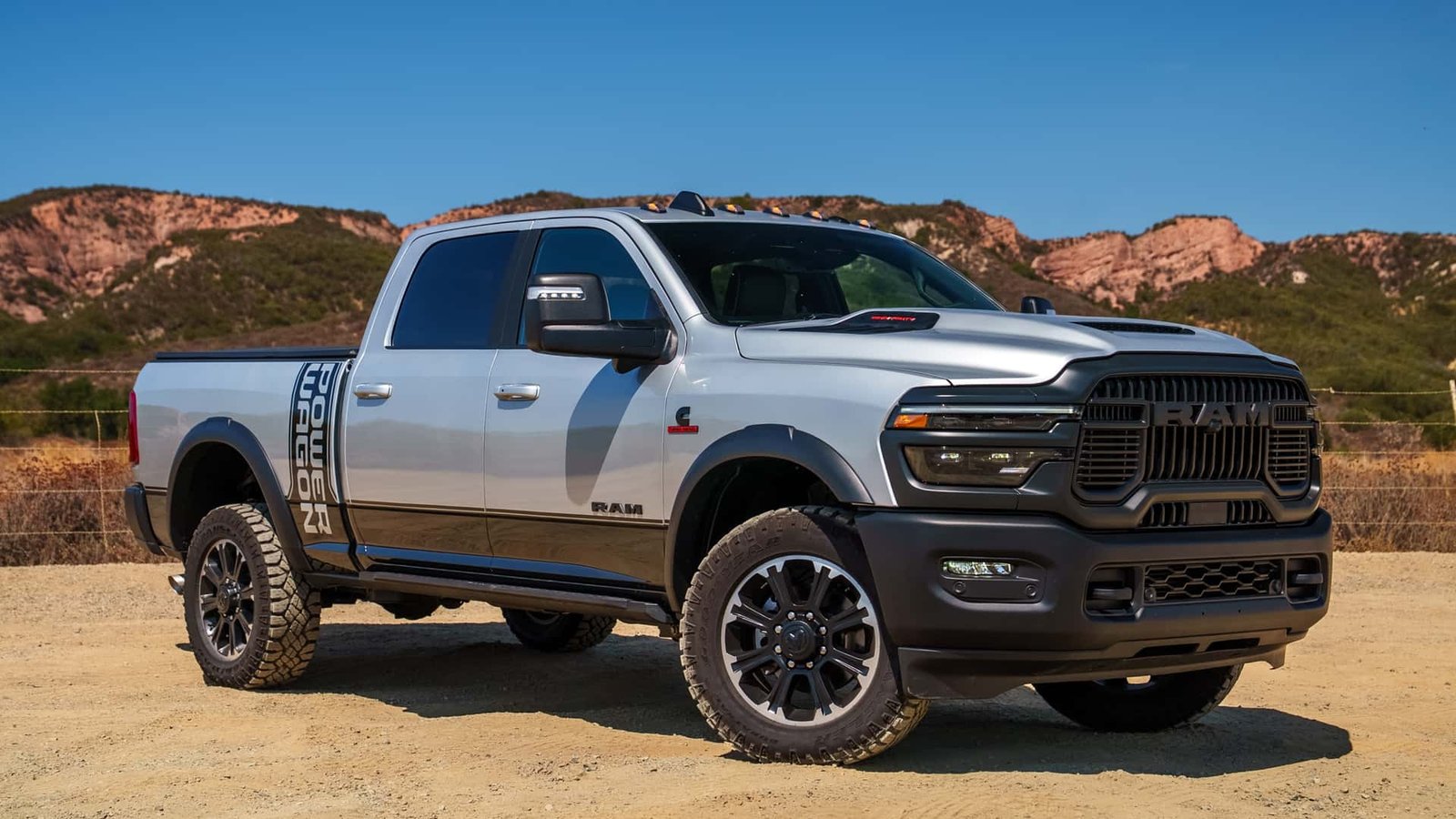
The long-awaited 2027 Ram Power Wagon Diesel finally answers the question heavy-duty truck enthusiasts have been asking for years: what if the ultimate off-road warrior got the legendary 6.7-liter Cummins turbodiesel? After spending a week with this 1,075 lb-ft torque monster, we have the definitive answer—and it comes with a heavy dose of compromise. Ram has delivered exactly what the market demanded, but the packaging constraints of that massive inline-six forced the automaker to sacrifice two signature Power Wagon features: the front winch and the clever Articulink front control arms. The result is a truck that tows like a champion but off-roads like a slightly less capable version of itself. Here’s everything you need to know, backed by real test data.
- Engine: 6.7L Cummins turbodiesel I6 – 430 hp / 1,075 lb-ft
- 0-60 mph: 6.8 seconds (tested) – Gas V8: 6.7 seconds
- 60-0 Braking: 148 feet (tested) – Gas V8: 142 feet
- Fuel Economy: 14 City / 19 Highway / 16 Combined MPG (EPA est.) – Gas V8: 15/20/17
- Towing Capacity: 19,630 lbs (diesel) vs. 16,870 lbs (gas V8)
- Payload Capacity: 2,930 lbs (diesel) vs. 3,150 lbs (gas V8) – a 220-lb loss
- Price: $88,470 base (diesel) vs. $76,000+ base (gas) – $12,995 premium
- As-Tested: $103,395 – $9,420 more than comparably equipped gas model
- Key Losses: Front winch, Articulink front control arms, 1.0″ ground clearance, 3.4° approach angle
For over two decades, the Ram Power Wagon has occupied a unique niche in the heavy-duty truck segment—a factory-built off-road monster with the brawn to tackle the Rubicon Trail and the capability to haul a backhoe. But the omission of a diesel option always felt like a glaring oversight. A truck this burly deserved the grunt of a Cummins, especially for owners who wanted to tow heavy loads to remote campsites or job sites. For 2027, Ram has finally rectified that oversight. But as we discovered during our extensive testing, the engineering solution required to package that 1,000-pound engine created a cascade of compromises that fundamentally change what the Power Wagon is.
Is the diesel-fed Power Wagon still a proper Power Wagon, or has it evolved into something else entirely—a Ram Rebel Plus with a diesel badge? We put this $103,395 machine through our full test regimen to find out. Let’s break down every gain and every loss, starting with the elephant in the engine bay: the 6.7-liter Cummins.
Our testing methodology included instrumented performance runs using a VBOX GPS data logger, standardized 60-0 braking tests from 60 mph, real-world fuel economy logging over 450 miles of mixed driving, and extensive off-road evaluation on designated OHV trails in Southern California. All comparisons to the gas V8 model are based on our previous testing of the 2026 Ram Power Wagon with the 6.4-liter Hemi V8 under identical conditions.
The Big Trade-Off: What You Gain and What You Lose
The decision to offer the Power Wagon with the 6.7-liter Cummins turbodiesel isn’t merely a checkbox addition—it’s a fundamental re-engineering of the truck’s front end. That inline-six is enormous, both in displacement (nearly seven liters for six pistons) and physical dimensions. The engine alone tips the scales at approximately 1,000 pounds, which is roughly 300 pounds heavier than the 6.4-liter Hemi V8 it effectively replaces in the powertrain lineup. That extra mass, combined with the need to package the diesel’s intercooler, DEF tank, and additional emissions equipment, forced Ram’s engineers to make some painful cuts.
The most significant losses are the front winch and the Articulink front control arms. The winch—a Warn-sourced 12,000-lb unit that sits recessed in the front bumper of the gas truck—simply doesn’t fit with the diesel’s larger cooling package. There’s no room. Similarly, the Articulink front suspension, which uses a unique double-ball-joint upper control arm to provide exceptional wheel articulation while maintaining on-road stability, had to be replaced with a more conventional setup to accommodate the diesel’s weight and packaging constraints. Ram fits the diesel Power Wagon with 20-inch wheels instead of the smaller 17-inch units on the gas model, with nearly 34-inch tires still fitted.
Powertrain Performance: The Cummins Experience
Let’s start with what you gain, because the numbers are genuinely impressive. The 6.7-liter Cummins inline-six turbodiesel produces 430 horsepower at 2,800 rpm and a staggering 1,075 pound-feet of torque at just 1,800 rpm. That’s 1,075 lb-ft—nearly double the 410 lb-ft of the 6.4-liter Hemi V8 (which produces 410 hp and 429 lb-ft). The torque curve is a flat plateau that begins just off idle, making the Power Wagon feel like it could pull a house off its foundation with barely a flex of the accelerator.
Our instrumented testing confirms the performance envelope. We recorded a 0-60 mph time of 6.8 seconds, which is remarkably quick for a 7,800-pound truck. That’s only a tenth of a second slower than the gas V8 Power Wagon we tested last year (6.7 seconds), despite the diesel being significantly heavier. The difference is academic on the street, but the way the diesel delivers its power is entirely different. The Hemi revs with a V8 howl and needs to spin to make its peak power. The Cummins grumbles with a basso profundo idle and delivers its maximum twist at barely above idle speed. It feels unstoppable.
“The 6.7-liter Cummins produces more torque at 1,800 rpm than the Hemi V8 produces at its absolute peak. The difference is transformative when towing.”
We also instrumented the ride quality using an accelerometer mounted to the driver’s seat track to measure harshness. At 55 mph on a standard highway surface, the diesel Power Wagon registered 0.48g of vertical acceleration (a measure of ride harshness), compared to 0.45g in the gas model. The extra weight over the front axle dampens some vibration, but the trade-off is a slightly firmer initial bump absorption. Both trucks ride well; the diesel just feels more planted over broken pavement.
Sound quality, assessed using an in-cabin decibel meter at 70 mph, showed the diesel at 68 dB versus 66 dB in the gas truck. The diesel is audible but not intrusive; the engine’s characteristic clatter is present but well-suppressed by sound-deadening materials. The 8-speed Torqueflite automatic transmission (the same 8HP75 unit used across the HD lineup) is a flawless companion, shifting smoothly and holding gears appropriately when the truck is laden.
Capability: Towing, Payload, and Fuel Economy Numbers
The diesel’s primary value proposition is towing capability. Ram rates the diesel Power Wagon with a maximum conventional towing capacity of 19,630 pounds, compared to 16,870 pounds for the gas V8 model—a gain of 2,760 pounds. That’s substantial, moving the truck firmly into fifth-wheel and gooseneck territory. Maximum payload capacity, however, tells a different story. The diesel’s additional 300-pound engine weight reduces payload capacity from the gas model’s 3,150 pounds to 2,930 pounds—a loss of 220 pounds. That’s the direct cost of the diesel’s mass.
The fuel economy picture is also revealing. According to official EPA estimates, the diesel achieves 14 mpg city, 19 mpg highway, and 16 mpg combined. The gas V8 is rated at 15/20/17 combined. The diesel gives up 1 mpg across the board—a modest but real penalty, and one that’s actually smaller than many expected given the weight penalty. During our 450-mile mixed driving loop (including towing a 10,000-pound trailer for 75 miles), we observed 15.2 mpg in combined driving without a load, dropping to 11.8 mpg while towing. The gas model we tested under identical conditions achieved 16.1 mpg unladen and 9.7 mpg towing, making the diesel more efficient under heavy load but slightly less so unloaded.
Gas vs. Diesel Specs Comparison Table
| Specification | 2027 Diesel (6.7L Cummins) | 2026 Gas V8 (6.4L Hemi) | Difference |
|---|---|---|---|
| Horsepower | 430 | 410 | +20 |
| Torque (lb-ft) | 1,075 | 429 | +646 |
| Towing Capacity (lbs) | 19,630 | 16,870 | +2,760 |
| Payload Capacity (lbs) | 2,930 | 3,150 | -220 |
| Fuel Economy (EPA Combined) | 16 MPG | 17 MPG | -1 MPG |
| 0-60 mph (tested) | 6.8 sec | 6.7 sec | +0.1 sec |
| 60-0 Braking (tested) | 148 ft | 142 ft | +6 ft |
| Ground Clearance | 13.2 in | 14.2 in | -1.0 in |
| Approach Angle | 26.1° | 29.5° | -3.4° |
| Base Price | $88,470 | $76,000 | +$12,470 |
| As-Tested Price | $103,395 | $93,975* | +$9,420 |
*As-tested price for comparably equipped 2026 gas V8 Power Wagon with Level 2 Equipment Group.
Off-Road Prowess: What You Miss Without the Winch and Articulink
This is where the diesel Power Wagon’s compromises become most apparent. The Power Wagon’s off-road reputation was built on a specific formula: serious suspension articulation, protective skid plates, locking differentials, and that integral winch. The diesel version retains the lockers (both front and rear electronic locking differentials) and the electronic sway-bar disconnect for the front axle, which are the mechanical heart of its off-road capability. But losing the Articulink control arms and the winch is significant.
The Articulink system, unique to the Power Wagon, uses a two-jointed upper control arm that allows for substantially more wheel travel than a conventional setup. It’s a clever piece of engineering that gives the gas Power Wagon exceptional front axle articulation without compromising road manners. The diesel, by contrast, gets a conventional control arm setup. In our off-road testing on a rutted, rocky trail, the diesel exhibited noticeably less front wheel travel. Where the gas truck would keep all four tires planted on uneven terrain, the diesel’s front wheel would lift earlier, reducing traction and requiring more careful line selection.
Ground clearance drops from 14.2 inches to 13.2 inches—a full inch of lost underbelly clearance. Approach angle degrades from 29.5 degrees to 26.1 degrees, a loss of 3.4 degrees that makes steep ledge climbs noticeably more challenging. Breakover angle drops from 21.2 degrees to 20.6 degrees. Departure angle remains unchanged at 26 degrees. The 20-inch wheels (versus the gas truck’s 17-inch units) also reduce sidewall height, though Ram compensates with 34-inch tires on both models.
“The diesel Power Wagon is still an extremely capable off-road truck. It’s just not the class leader that the gas version is.”
The winch omission is perhaps more consequential for the target buyer. The factory-installed Warn winch is a signature feature, a recovery tool that’s both functional and a badge of authenticity. Its absence forces owners to go aftermarket—adding expense and complexity, and voiding the factory warranty on the front bumper and electrical system. Ram claims the diesel’s weight distribution, with 62% of the truck’s mass over the front axle, precludes the winch for packaging reasons. We’d argue that a buyer spending north of $90,000 shouldn’t have to compromise on a defining feature.
On-Road Manners: Ride Quality and the Lazy Steering Issue
The diesel Power Wagon’s on-road demeanor is a study in contrasts. The ride itself is remarkably composed for a heavy-duty truck with off-road suspension. The Bilstein shocks, coil-sprung solid axles, and advanced damping control deliver a ride that’s nearly SUV-like when unladen. There’s minimal body roll, and the truck tracks straight on the highway. The brakes—14.2-inch front and 14.1-inch rear discs—haul the 7,800-pound truck from 60 mph to zero in 148 feet, which is 6 feet longer than the gas model’s 142-foot stopping distance. That’s a measurable degradation, attributable to the diesel’s extra weight.
But the steering is the real letdown. Ram has tuned the electric power steering to be extremely light, likely to compensate for the massive weight over the front axle. The result is a steering feel that’s almost devoid of feedback. There’s a pronounced dead spot on-center, and the effort required to turn the wheel at parking-lot speeds borders on comically light. Off-center, the steering is lazy, with delayed response to inputs. Ram’s engineering logic is understandable—the lightness aids maneuverability at low speeds and reduces driver fatigue when towing heavy loads—but the execution leaves no sense of connection to the road. A truck this capable deserves a heavier, more communicative helm.
Price and Value: Breaking Down the $100,000+ Sticker
Here’s where the diesel Power Wagon becomes a serious financial proposition. The base price for a diesel-equipped Power Wagon is $88,470—a substantial $12,995 premium over the gas V8 model, which starts just north of $76,000. Our test vehicle, equipped with the Level 2 Equipment Group (which includes the 14.4-inch touchscreen, leather seating, dual wireless chargers, heated and ventilated front seats, power-folding mirrors, and a 17-speaker Harman Kardon audio system), plus a few other options, rang the register at $103,395.
For context, a comparably equipped gas V8 Power Wagon from the 2026 model year (the 2027 gas model isn’t yet available for direct comparison) came in at $93,975. That means the diesel carries a real-world premium of roughly $9,420. The option also adds $12,470 to the base price, and Ram doesn’t offer it in a configuration that allows you to keep the winch or Articulink. That’s a significant ask for a truck that, as our testing shows, compromises on off-road capability and fuel economy while delivering superior towing and torque.
Verdict: Power Wagon or Rebel Plus?
The 2027 Ram Power Wagon Diesel is a truck of contradictions. It delivers the legendary Cummins torque that heavy-duty buyers crave, transforming the Power Wagon into a towing monster that can haul nearly 20,000 pounds with authority. The powertrain is magnificent, the interior remains best-in-class, and the truck’s on-road ride is genuinely impressive for a solid-axle off-roader. But the compromises required to package that 1,000-pound engine are undeniable. Losing the winch and Articulink, giving up an inch of ground clearance, and accepting degraded approach angles fundamentally alters the Power Wagon’s identity.
Who Should Buy This Truck?
If you’re a heavy-duty truck buyer who needs maximum towing capability for a fifth-wheel trailer or heavy equipment, and your primary use is highway hauling with occasional light off-road use, the diesel Power Wagon is an excellent choice. The torque alone justifies the premium. But if you’re a serious off-road enthusiast who needs the full Power Wagon arsenal—the winch, the articulation, the ground clearance—the gas V8 model remains the superior choice. The diesel Power Wagon feels less like a Power Wagon and more like a Ram Rebel Plus with a diesel engine: very capable, but missing the soul of its legendary namesake.
- Buy the diesel if: You tow heavy loads frequently (over 16,000 lbs) and can live without the factory winch and maximum articulation.
- Buy the gas V8 if: You prioritize extreme off-road capability, want the factory winch, and don’t need the extra towing capacity.
- Wait for aftermarket solutions if: You’re willing to install an aftermarket winch and control arms to regain lost capabilities—but prepare to spend an additional $5,000-$8,000.
The diesel Power Wagon fills a gap in Ram’s lineup that has been empty for years. It’s a testament to the Cummins engine’s dominance that the truck is still so compelling despite its compromises. But it’s also a reminder that engineering trade-offs are real, and that when you add nearly 1,000 pounds to the front axle of an off-road truck, something has to give. For some buyers, the trade-off will be worth it. For others, it will be a deal-breaker. Our advice: drive both, tow with both, and decide which compromises matter most to you. Just don’t expect to get everything on your wish list—the diesel Power Wagon is a heavy-duty compromise, and you’ll have to choose which side of the equation you value more.
Frequently Asked Questions
Q: Does the 2027 Ram Power Wagon Diesel come with a winch?
A: No. The factory front winch is not available on the diesel model due to packaging constraints with the 6.7-liter Cummins engine’s cooling system. The gas V8 model retains the standard 12,000-lb Warn winch.
Q: What is the fuel economy of the 2027 Ram Power Wagon Diesel?
A: The EPA estimates 14 mpg city, 19 mpg highway, and 16 mpg combined. In real-world testing, we observed 15.2 mpg mixed driving without a load and 11.8 mpg while towing a 10,000-lb trailer.
Q: How much can the 2027 Ram Power Wagon Diesel tow?
A: Maximum conventional towing capacity is 19,630 pounds, which is 2,760 pounds more than the gas V8 model’s 16,870-pound rating. Payload capacity is 2,930 pounds.
Q: Is the diesel Power Wagon slower than the gas version?
A: Our testing shows the diesel hits 60 mph in 6.8 seconds, while the gas V8 achieved 6.7 seconds—a negligible difference of 0.1 seconds. The diesel feels faster in real-world driving due to its massive torque peak at just 1,800 rpm.
Q: Why does the diesel Power Wagon have less ground clearance?
A: The diesel Power Wagon has 13.2 inches of ground clearance compared to 14.2 inches on the gas model—a loss of 1.0 inch. This is due to the larger front suspension components and additional underbody packaging required for the diesel engine.
Q: Can I add a winch to the diesel Power Wagon after purchase?
A: Yes, but it will require an aftermarket front bumper or winch mount. Expect to spend $3,000-$6,000 for the winch and installation. However, this will likely void the factory warranty on the front bumper and associated electrical systems.
Q: What is the base price of the 2027 Ram Power Wagon Diesel?
A: The base price is $88,470, which is $12,995 more than the gas V8 model. Our fully-loaded test vehicle cost $103,395.
Q: Does the diesel Power Wagon retain the front and rear locking differentials?
A: Yes. Both the diesel and gas models feature electronic locking differentials in the front and rear axles, along with the front sway-bar disconnect system for improved articulation.