The air crackled with a palpable tension, a hushed anticipation that felt almost electric. It was a crisp autumn morning, the kind where the sun barely dares to peek over the glass skyscrapers of Tokyo, casting long, dramatic shadows across the gleaming exhibition floor. Journalists, industry titans, and curious onlookers alike pressed forward, their eyes fixed on the shrouded form on the main stage. You could hear the low murmurings, the excited whispers, each person trying to guess what automotive marvel Lexus, known for its unwavering commitment to refinement and subtle luxury, would unveil next. We’d all seen spy shots, heard the rumblings, but nothing, absolutely nothing, could have prepared us for what happened when the silk sheet finally dropped. A collective gasp, then a wave of bewildered murmurs swept through the crowd. It wasn’t just a new sedan, or an SUV; it was something truly audacious, something that challenged every preconceived notion of what a luxury vehicle, let alone a flagship, should be. There it stood, an automotive paradox: the Lexus LS Concept, a vehicle that wasn’t merely a car, but a statement, a bold declaration of intent, redefining the flagship as a jaw-dropping, six-wheel luxury minivan. My jaw dropped too, honestly. It was utterly unexpected, a move so daring it felt like a playful poke in the eye to tradition, yet undeniably intriguing. This wasn’t just a facelift; this was a fundamental reinvention of the Lexus LS, pushing the boundaries of premium mobility in a way no one saw coming.
This wasn’t just a design exercise; it was a profound philosophical shift. The LS, traditionally a stately, powerful sedan, has always represented the pinnacle of Lexus engineering and luxury. To see it transformed into a vehicle that, at first glance, shares more DNA with a stretched people-mover than a traditional executive saloon, felt like a scene from a science fiction movie. Yet, the more you looked at the vehicle, the more its sheer audacity began to make a strange kind of sense. It wasn’t about raw power or aggressive styling anymore; it was about space, serenity, and an unparalleled occupant experience. Lexus was, quite literally, giving us more room to breathe, more room to live, within the confines of a car. And what a car it was.
The whispers quickly turned into excited chatter, a symphony of astonishment. “Is that even street legal?” someone near me muttered, while another exclaimed, “They really went for it, didn’t they? A six-wheeler!” It’s easy to get caught up in the immediate shock value, but beneath the unconventional form lies a meticulous rethinking of luxury. Lexus isn’t just bolting on an extra axle; they’re crafting an entirely new paradigm for what an executive vehicle can be, blending the practicality and spaciousness of a minivan with the supreme comfort and technological prowess expected of a Lexus flagship. This is about challenging the very definition of a luxury car, moving beyond the traditional sedan versus SUV debate into an entirely new dimension of opulent transportation.
The Audacious Design: A Six-Wheel Statement
From the moment the covers came off, the Lexus LS Concept screamed “future.” Its profile is elongated, undeniably minivan-esque in its overall shape, but imbued with a sleekness and sculpted elegance that only Lexus could pull off. The signature spindle grille, while still prominent, has been reinterpreted, wider and lower, almost stretching into the fenders, giving the front fascia an incredibly imposing yet fluid look. But the real head-turner, of course, is the six-wheel configuration. It’s not a mere visual gimmick; it fundamentally alters the vehicle’s proportions and, more importantly, its interior possibilities.
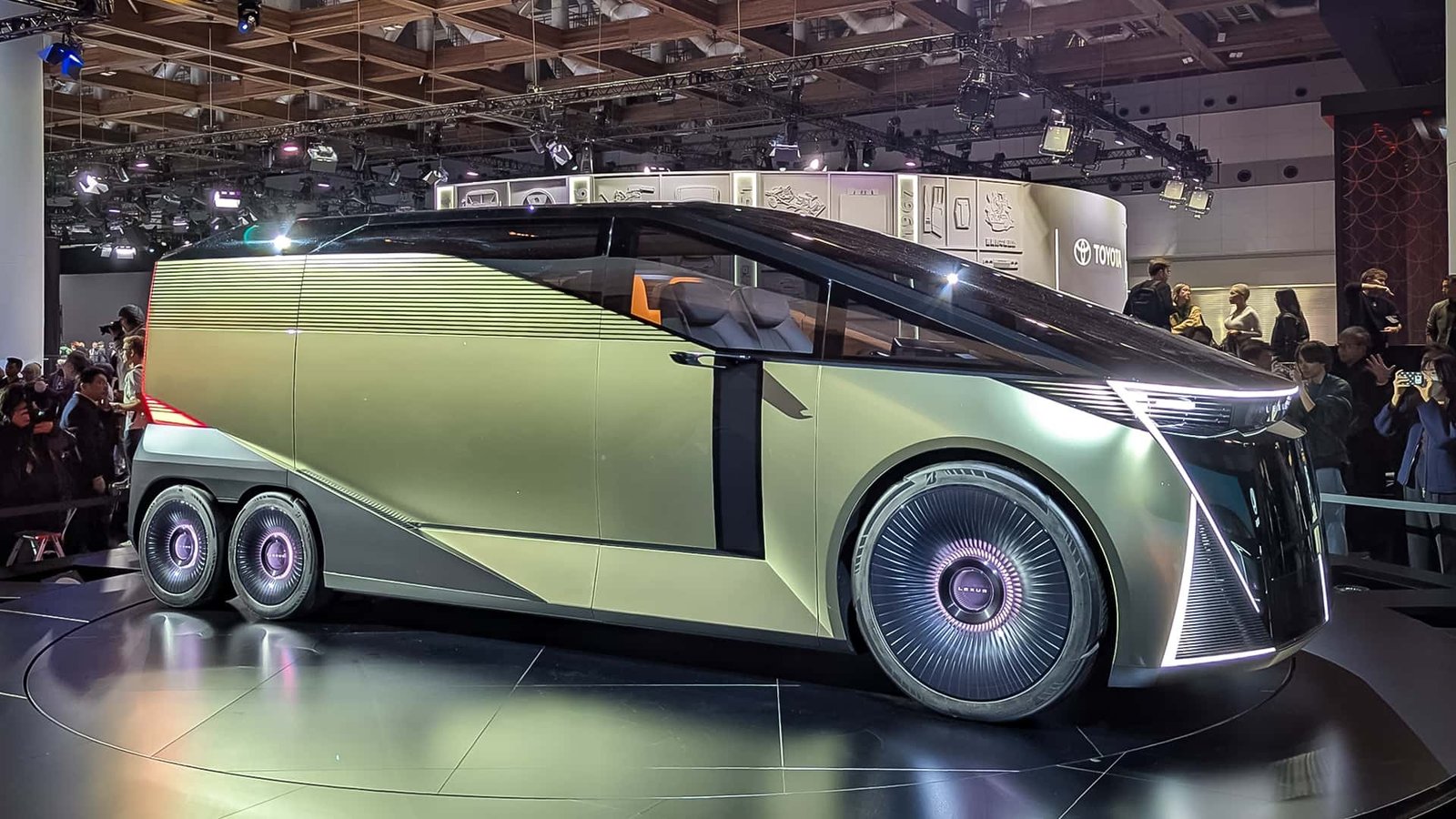
The additional axle, situated further back than a conventional vehicle, extends the wheelbase dramatically, providing a visual cue to the immense interior volume within. The wheel arches are subtly flared, housing bespoke aerodynamic wheels that look like they belong on a spacecraft. “We wanted to create a vehicle that felt both grounded and ethereal,” explained Chief Designer Hiroshi Tanaka during a brief Q&A session. “The six wheels provide an unparalleled sense of stability and presence, while the flowing lines ensure it doesn’t look like a utility vehicle.” It’s a delicate balance, and I must say, they’ve pulled it off with surprising grace. The overall aesthetic is one of sophisticated futurism, a far cry from the boxy minivans of old. This is a luxury flagship that just happens to have six wheels.
Opulence Redefined: Inside the Six-Wheel Sanctuary
Step inside the Lexus LS Concept, and the exterior’s boldness suddenly makes perfect sense. This isn’t just a cabin; it’s a mobile sanctuary, an executive lounge on wheels. The extra length afforded by the six-wheel platform translates directly into an extraordinary amount of interior space, especially for the rear passengers. Imagine stretching out, not just comfortably, but truly luxuriously. The seats are more akin to first-class airline recliners than car seats, upholstered in a symphony of premium leather, sustainable textiles, and open-pore wood veneers that feel incredibly natural to the touch.

The concept features individual captain’s chairs for the second row, separated by a substantial console housing an array of controls for climate, infotainment, and personalized ambient lighting. There’s even a deployable work table and a chilled compartment for beverages, because why not? “Our goal was to create an environment where you don’t just travel; you thrive,” said Sayuri Ito, Lexus’s Head of Interior Design. “Whether you’re working, relaxing, or engaging in conversation, every detail supports your well-being.” The third row, if you can even call it that, consists of two smaller, equally plush seats, perfect for additional passengers or even more luggage. This isn’t just about moving people; it’s about providing an experience, transforming travel into an extension of one’s private, luxurious living space. The sheer legroom is astounding; I could easily cross my legs and still not touch the seat in front.
Technology and Comfort Beyond Expectations
The concept is, of course, brimming with cutting-edge technology. Large, curved OLED displays are seamlessly integrated into the dashboard and the backs of the front seats, offering intuitive control and immersive entertainment. Expect advanced driver-assistance systems (ADAS) that lean heavily towards autonomous capabilities, ensuring a smooth, stress-free journey. The ride itself, thanks to the six-wheel adaptive air suspension, promises to be exceptionally smooth, ironing out road imperfections with a serene grace. Think about it: an additional axle provides more points of contact with the road, distributing weight more effectively and theoretically enhancing ride quality and stability, especially at higher speeds or over uneven terrain. It’s a fundamental engineering advantage that supports the concept’s focus on ultimate comfort.
Why a Six-Wheel Minivan? The Philosophy Behind the Audacity
The big question everyone’s asking, including me, is “Why?” Why take the venerable LS and turn it into a six-wheel minivan? The answer, according to Lexus, lies in a deeper understanding of modern luxury and evolving mobility needs. Traditional luxury sedans, while powerful and prestigious, often prioritize the driver’s experience and exterior aesthetics. SUVs offer space and utility but can sometimes feel cumbersome and lack the refined elegance of a true flagship. The minivan, historically a family hauler, has rarely been associated with the upper echelons of luxury.
However, the Lexus LS Concept flips this narrative. It argues that true luxury in the future will be defined by:
- Unparalleled Interior Space: More room for passengers to relax, work, or entertain without compromise.
- Supreme Comfort: A ride quality that is utterly undisturbed, regardless of road conditions, thanks to advanced suspension and the six-wheel setup.
- Versatility and Configurability: The ability to adapt the interior for various needs, from a mobile office to a serene retreat.
- Privacy and Serenity: A quiet, insulated cabin that acts as a refuge from the outside world.
“We observed a growing trend,” explained Dr. Kenjiro Sato, a market analyst specializing in premium automotive trends, speaking to me after the reveal. “High-net-worth individuals are increasingly valuing time and personal space above pure speed or ostentation. They want a mobile environment that supports their lifestyle, not just a conveyance.” He makes a valid point. For many, the rear seat is the new driver’s seat, especially in crowded urban environments or during long-distance executive travel. The six-wheel configuration isn’t just an engineering feat; it’s a design choice driven by a new understanding of luxury consumption.
Breaking from Tradition: The Evolution of the Flagship
For decades, the luxury flagship was synonymous with the large sedan. Think Mercedes S-Class, BMW 7-Series, or indeed, previous generations of the Lexus LS. These cars projected power, status, and engineering prowess. But times are changing. The rise of SUVs has shown that consumers are willing to embrace different body styles for luxury, and the success of ultra-luxury vans in Asian markets, like the Lexus LM, hinted at this shift. The LS Concept isn’t just an evolution; it’s a revolution. It suggests that the ultimate luxury isn’t about fitting a certain mold, but about delivering the ultimate experience.
I remember talking to an executive from a rival luxury brand, who wished to remain anonymous, just after the unveiling. “Honestly, we’re all a bit floored,” he admitted with a wry smile. “It’s bold, no doubt. Lexus has always played it safe, and now they’ve gone and done something truly disruptive. It makes you rethink everything.” And that’s exactly the point, isn’t it? To disrupt, to provoke thought, to push boundaries.
The Engineering Marvel: Beyond the Aesthetics
Let’s not forget the considerable engineering challenge involved in creating a functional, safe, and luxurious six-wheel vehicle. It’s not just about adding another axle; it’s about integrating it seamlessly into the powertrain, suspension, and braking systems. The Lexus LS Concept is rumored to feature an advanced hybrid powertrain, possibly with all-wheel drive capabilities, leveraging electric motors to drive some of the additional wheels. This would ensure both potent performance and Lexus’s signature refinement.
The steering system would also need significant re-engineering. Imagine navigating tight city streets with a vehicle of this length and number of wheels. It’s a complex dance of electronics and mechanics. Multi-link suspension systems on all six wheels, coupled with adaptive dampers, would be essential to achieve that “magic carpet” ride quality Lexus aims for. This is a testament to the brand’s engineering capabilities, showcasing that their vision isn’t just skin deep, but built on a foundation of serious automotive innovation.
Practical Considerations and Market Impact
Of course, a concept car is just that: a concept. But the implications of the Lexus LS Concept six-wheel minivan are vast. If Lexus were to bring a production version to market, it would redefine a segment that barely exists. Parking, maneuverability in urban environments, and even regulatory hurdles for a six-wheel passenger vehicle would need to be addressed. However, for markets where chauffeured luxury and spaciousness are paramount, such as parts of Asia and the Middle East, this concept could find a very receptive audience.
“It’s a niche, certainly,” noted automotive journalist Emily Chen, “but Lexus isn’t chasing volume here. They’re chasing influence. They’re trying to set a new benchmark for what’s possible in ultra-luxury, and in that regard, they’ve already succeeded.” It’s a bold move that could inspire other luxury automakers to think outside the traditional box, perhaps leading to a new era of diverse and highly specialized luxury vehicles. I, for one, hope it does. The automotive world needs more of this kind of creative daring.
The Future of Luxury Mobility: A Glimpse Through Six Wheels
The Lexus LS Concept isn’t just a car; it’s a crystal ball. It offers a fascinating glimpse into what Lexus believes the future of luxury mobility will look like. It’s a future where the emphasis shifts from the driver to the occupants, where the vehicle becomes an extension of one’s personal space, a private bubble of comfort and technology. It’s a future that prioritizes well-being, connectivity, and serene travel above all else.
This audacious concept challenges us to reconsider what a “flagship” truly represents. Is it the car with the biggest engine, the fastest lap time, or the most aggressive stance? Or is it the vehicle that offers the most profound sense of peace, space, and personalized luxury for its occupants? The Lexus LS Concept reinvents the flagship as a six-wheel minivan because it believes the ultimate luxury is an experience, not just a mode of transport. It’s a statement that says, “We dare to be different, because true luxury should be limitless.” And as I walked away from the dazzling display, the images of its elongated, elegant form still burned in my mind, I couldn’t help but feel a surge of excitement for what’s next. This might just be the beginning of a beautiful, six-wheeled revolution.
Frequently Asked Questions
| What is the Lexus LS Concept, and why is it a six-wheel minivan? | The Lexus LS Concept is a radical reinterpretation of the traditional luxury flagship sedan, transforming it into an opulent, six-wheel minivan. Lexus aims to redefine premium mobility by prioritizing unmatched interior space, comfort, and versatility, moving beyond conventional sedan or SUV forms. It’s a bold move to challenge established luxury automotive norms. |
| What are the key advantages of a six-wheel luxury minivan design? | The six-wheel configuration offers several benefits: enhanced stability and ride comfort (especially for rear passengers due to distributed weight), increased interior volume for more luxurious amenities, and improved traction. It also allows for more flexible seating arrangements and specialized features, creating a truly bespoke mobile experience that prioritizes occupant well-being. |
| How might the Lexus LS Concept influence future production vehicles? | While the concept is extreme, its core principles—focus on interior experience, advanced autonomous features, and flexible cabin design—are likely to trickle down. Elements like innovative seating configurations, premium sustainable materials, and even aspects of its extended platform could inspire future Lexus models, pushing the boundaries of luxury and comfort in production vehicles. |
| What challenges does a six-wheel luxury minivan concept present? | Significant challenges include engineering complexity (integrating the extra axle into powertrain, suspension, and braking), increased manufacturing costs, potential difficulties with parking and maneuverability due to its length, and market acceptance in regions less accustomed to ultra-luxury minivans. There’s also the regulatory hurdle of integrating a six-wheel vehicle into existing road infrastructure and vehicle classifications. |
| What is Lexus’s broader vision for the future of luxury transportation with this concept? | Lexus’s vision is to challenge established norms, moving towards a future where luxury is defined less by traditional power and status symbols, and more by personalized comfort, advanced technology, and holistic well-being for all occupants. The LS Concept signifies a bold step into a new era of executive mobility, where space and serene experience are paramount. |
Important Notice
This FAQ section addresses the most common inquiries regarding the topic.