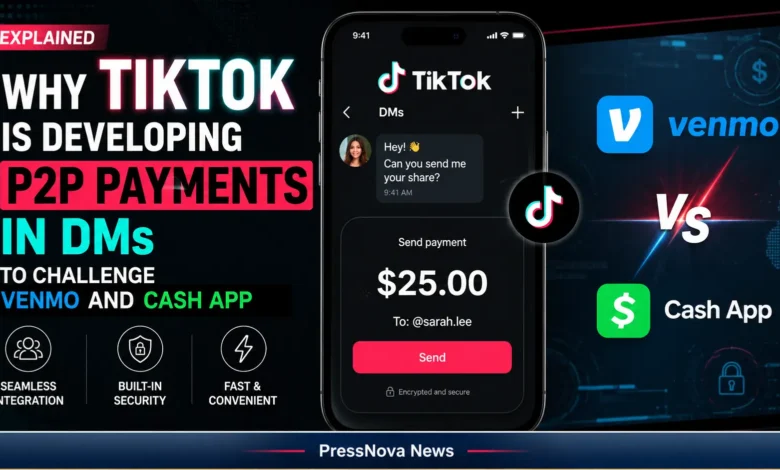
TikTok is developing a peer-to-peer payment feature embedded directly within direct messages, positioning the social video giant to challenge established mobile payment leaders like Venmo, Cash App, and Zelle by enabling users to exchange funds without ever leaving the conversation thread. The discovery, based on hidden code strings uncovered in the latest US iPhone application build, reveals that parent company ByteDance is preparing to extend its financial services footprint into the competitive American fintech landscape.
- Feature Discovery: Hidden code in TikTok’s US iOS app reveals P2P payment functionality in early development
- How It Works: Users can send money with captions, recipients tap to accept before expiration, and both parties receive real-time notifications
- Platform Backend: Feature would run on TikTok Pay, already operational in Vietnam, Malaysia, and Thailand
- Official Status: TikTok spokesperson confirms feature is in early development and not yet tested in any market
- Super App Strategy: Move aligns with ByteDance’s broader push toward an all-in-one digital ecosystem with fintech, e-commerce, and travel services
The in-development payment functionality represents a significant evolution for the platform, which has already transformed from a short-form video app into a comprehensive digital ecosystem encompassing e-commerce, hotel bookings, and now financial services. Bloomberg first reported the discovery, noting that TikTok’s push into peer-to-peer transfers could capture financial transactions that currently flow off-platform to external payment links posted in creator bios, further entrenching user activity within the app’s expanding commerce ecosystem. This move signals the company’s broader ambition to build a super app strategy that consolidates multiple digital services into a single destination.
How TikTok’s DM Payment Feature Would Work
The uncovered code strings reveal a user flow modeled after modern digital wallets, designed to make financial transactions as seamless as sending a message. Senders would initiate transfers directly from within a chat window and attach customized text notes or captions, mirroring the familiar social transaction feed popularized by Venmo. Recipients would receive transfers with a designated expiration window, requiring them to tap an on-screen confirmation button to accept incoming funds before the deadline passes.
Both parties would receive real-time transaction updates through push notifications and system inbox alerts, allowing them to track whether a transfer has been completed, declined, or expired. The feature appears to be designed with user experience in mind, eliminating the friction of switching between multiple applications to split bills, repay friends, or complete transactions.
According to Bloomberg’s code analysis, TikTok’s P2P payment functionality includes the ability to add messages to transfers, a feature that mirrors Venmo’s social transaction feed where users can comment on payments. This social element could prove crucial in driving adoption, as it maintains the platform’s core strength of social interaction while expanding into financial services. For context, this development follows the broader trend of social media platforms evolving into comprehensive fintech ecosystems.
A TikTok spokesperson confirmed to Bloomberg that the feature is currently in early development and has not been tested in any market, indicating that significant work remains before any potential public rollout. The interaction design, however, appears already well-developed based on code evidence, suggesting that ByteDance is moving deliberately toward bringing this functionality to US users.
The Super App Strategy Behind ByteDance’s Fintech Push
Integrating peer-to-peer capabilities into TikTok Pay represents a major step toward building a unified super-app ecosystem that consolidates multiple digital services into a single destination. ByteDance already operates a proven digital wallet ecosystem in China through Douyin Pay, allowing users to tip creators, settle livestream orders, and manage bank-linked transfers. Bringing similar functionality to international TikTok users would allow the platform to capture financial transactions that currently flow off-platform to external payment links posted in creator bios.
The expansion goes beyond simple money transfers. In March 2026, Reuters reported that TikTok applied to Brazil’s central bank for two fintech licences, one to offer prepaid accounts where users can store funds and make payments, and another to operate as a direct credit provider. Brazil, where TikTok reaches approximately 131 million users aged 18 and above, would be the first market where the platform handles money directly, serving as a critical testbed for the company’s broader financial ambitions.
TikTok has also introduced hotel booking facilities, expanded TikTok Shop’s e-commerce presence, and added sports hubs, casual games, and microdramas to its platform. The company appears to be replicating elements of China’s highly successful super app model, where platforms like WeChat combine messaging, payments, ride-hailing, government services, and e-commerce into one ecosystem with more than a billion monthly active users.
The financial services push also positions TikTok to compete directly with X (formerly Twitter), which has already integrated cryptocurrency transaction capabilities into its platform. As social media platforms increasingly evolve into multi-purpose digital destinations, the battle for user attention is shifting toward which app can serve the most daily needs without requiring users to navigate elsewhere. This strategic direction is part of a larger shift in how social media companies approach digital commerce and financial services integration.
TikTok Pay: The Technical Backbone
The DM payments feature is designed to run on TikTok Pay, the company’s proprietary financial backend, which already operates natively across select Southeast Asian markets including Vietnam, Malaysia, and Thailand. While TikTok Shop in major Western markets currently relies on third-party payment gateways such as PayPal, Apple Pay, Google Pay, Klarna, and standard debit or credit cards, TikTok Pay’s expansion would represent a significant transition toward financial self-sufficiency.
TikTok Pay functions in Southeast Asia with the same capabilities as Douyin Pay in China, processing transactions for TikTok Shop purchases and now potentially handling peer-to-peer transfers. The system is designed to handle user funds, process payments, and maintain transaction records, creating a comprehensive financial infrastructure within the app.
ByteDance continues to recruit for financial services roles in both the United States and international markets, indicating that this expansion is a sustained strategic priority rather than a fleeting experiment. The company is also exploring prepaid account services and credit provision in Brazil, suggesting that TikTok Pay could eventually evolve into a full-service digital bank operating within the platform.
With consumers spending billions annually on TikTok digital coins, creator gifts, and TikTok Shop goods, the addition of peer-to-peer transfers inside direct messages represents a natural evolution for the platform. By turning DMs into transactional hubs, TikTok stands to increase user engagement, streamline creator tipping, and retain transaction volume within its expanding commerce ecosystem.
The Competitive Landscape: TikTok Pay vs. Established Players
TikTok’s entry into peer-to-peer payments would place it in direct competition with well-established mobile payment giants that have dominated the US market for years. Venmo, Cash App, and Zelle have built substantial user bases, with Venmo alone processing over $300 billion in annual payment volume. The news of TikTok’s development was received negatively in the market, with shares of existing payment firms like PayPal and Western Union tumbling following the Bloomberg report.
However, the competitive dynamics may favor TikTok in unexpected ways. Unlike traditional payment apps, TikTok already has over 150 million monthly active users in the United States, a massive installed base that could accelerate adoption of its payment features. The integration of payments directly within direct messages eliminates a significant friction point for users who currently leave TikTok to complete financial transactions through other applications.
The social element of TikTok’s payment feature could also prove decisive in building a competitive advantage. By attaching notes and captions to transactions, similar to Venmo’s social feed, TikTok can leverage its existing social graph and network effects to drive adoption. Users already trust the platform for social interactions, and extending that trust to financial transactions could provide a significant competitive edge over standalone payment apps.
X’s integration of cryptocurrency transactions adds another dimension to the competitive landscape, as both platforms race to become the dominant super app in the Western market. The success of these platforms will ultimately depend on whether users are willing to consolidate their digital lives into a single application, a shift that has already occurred in China but remains an open question in the United States and Europe. Industry analysts are watching closely to see how this fintech competition between social media platforms will reshape the digital payments landscape.
Regulatory Challenges and Security Concerns
TikTok’s expansion into financial services in the United States faces significant regulatory hurdles, particularly given the company’s previous national security reviews and ongoing scrutiny from US officials. The platform has faced potential forced sale or bans due to concerns over Chinese ownership through ByteDance, and entering the regulated financial services sector would intensify this oversight.
The regulatory mountain includes navigating state-by-state money transmission licenses, compliance with federal financial regulations, and scrutiny from agencies including the Treasury Department, Federal Reserve, and Consumer Financial Protection Bureau. Each state has its own licensing requirements for money transmitters, creating a complex compliance landscape that has challenged many fintech startups. Brazil’s fintech license applications provide a testing ground for navigating international financial regulation, offering lessons that could inform the US strategy.
Privacy and security concerns are equally significant. TikTok’s direct messages currently lack end-to-end encryption, which would be problematic for handling sensitive financial data and transaction information. The company would need to implement robust security measures to protect user financial data, a complex technical undertaking that would require significant infrastructure investment. Additionally, TikTok previously imposed restrictions on creators promoting cryptocurrency, and expanding into financial services could create conflicts with existing platform policies.
The intersection of data collection, financial services, and national security concerns presents unique challenges for TikTok’s financial expansion. US regulators have historically scrutinized companies that handle both user data and financial transactions, and TikTok’s ownership structure makes it a particularly sensitive case. Whether the company can successfully navigate these challenges while competing against established financial players remains to be seen.
What This Means for Users and the Future of Social Commerce
For TikTok users, the potential arrival of P2P payments inside DMs would transform the app from a social and entertainment platform into a comprehensive digital hub that handles financial transactions. Splitting bills with friends, paying creators directly for content, and completing commerce transactions without leaving the app would become seamless, reducing the need to switch between multiple applications.
The feature also represents an opportunity for creators, who could receive tips and payments more directly from their audiences, bypassing external payment links that currently direct users away from the platform. Creator tipping is already a significant activity on TikTok, with digital coins generating billions in revenue, and P2P transfers would provide a more direct and flexible payment mechanism.
However, the expansion of financial services into social platforms raises important considerations about data privacy, financial security, and the concentration of digital activity within a single company. Western users have historically resisted consolidating their digital lives into a single platform, and regulators are more likely to scrutinize a company that handles shopping, payments, travel, entertainment, and social networking under one roof.
TikTok is betting that the habit of opening one app for everything can be built incrementally, one feature at a time, rather than arriving fully formed. Whether this strategy succeeds will depend on user trust, regulatory approval, and the company’s ability to execute on its ambitious fintech vision. For now, the discovery of in-development code suggests that TikTok’s super app ambition is accelerating, even as significant hurdles remain before any public rollout.