Trump Slams ‘Fake Polls’ as ‘Demoralization Operations’ Amid Record-Low Approval Ratings

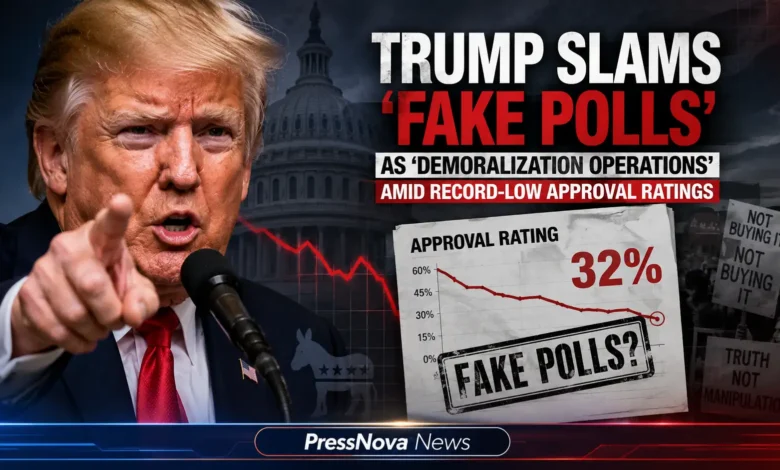
President Trump, battling low approval ratings that have reached historic lows, is now dismissing unfavorable polling as part of Democratic “demoralization operations” designed to suppress Republican voter turnout in the upcoming midterm elections.
- Trump’s Claim: Called polls “Fake Polls” and “Demoralization Operations” in Aug. 24 Truth Social post
- Current Approval: RealClearPolitics average: 39.5% approve, 57.2% disapprove
- State-Level Data: YouGov/Economist shows negative net approval in 47 of 50 states
- Only Positive States: Wyoming (+14), Idaho (+9), West Virginia (+6)
- Reuters/Ipsos (Aug. 17): 33% approval, tied with his worst first-term rating
- Historical Context: Only Nixon had comparable ratings at this stage—and resigned days later
- Midterm Warning: GOP on defense in key House and Senate districts
“The Radical Left Democrats are going CRAZY with Fake Polls. They’re putting them out at levels never seen before,” Trump said in an Aug. 24 Truth Social post. “They’re called ‘Demoralization Operations,’ where they try to demoralize Republicans so that they don’t go out and vote — But the actual Polls are tremendous, and the Spirit in our Country has never been higher.”
The president’s post came just days after a YouGov/Economist projection revealed his net job approval rating in the negatives in all but three states, marking one of the most devastating polling assessments of his presidency. According to The Economist and YouGov poll released last week, more people disapprove than approve of Trump’s job performance in 47 out of 50 states and in the District of Columbia.
The three states where the majority of respondents still approve are Wyoming (+14), Idaho (+9), and West Virginia (+6)—all states that went for Trump in the 2016, 2020, and 2024 presidential elections. In the Aug. 24 post, Trump struck an optimistic tone, saying the United States was “winning against EVERYONE, including Iran, whose Country is in Economic and Military Death Spiral.”
RealClearPolitics polling average shows Trump’s approval rating at 39.5% against 57.2% disapproval. FiveThirtyEight’s approval tracker similarly reflects the president’s continued struggles with the electorate.
Trump’s Approval Rating Hits Historic Lows
The Numbers Behind the Decline
Major polling averages paint a consistently grim picture for the president. RealClearPolitics’ average showed 39.5% approval against 57.2% disapproval. The New York Times average recorded 38% approval and 59% disapproval, while Nate Silver’s Silver Bulletin showed 38.4% approve and 57.9% disapprove.
The Reuters/Ipsos poll released Aug. 17 showed only one in three Americans approved of Trump’s job performance—33%—marking the lowest approval rating he has seen since returning to the White House and tying his worst rating during his first term. The YouGov/Economist poll conducted Aug. 7-10 among 1,589 American adults found even broader disapproval, with 60% of Americans refusing to consider Trump “honest and trustworthy.”
The polling decline has been dramatic over time. At this point in Trump’s first term, his net approval rating was 9.3 points higher at -11.3. His current net approval of approximately -20 is lower than at any point during his first presidency, when he bottomed out at -19 after the Jan. 6 insurrection.
State-by-State Breakdown Shows Limited Support
The state-level data reveals just how confined Trump’s support has become. In critical battleground states, the numbers are devastating:
| State | Net Approval (YouGov/Economist) | 2024 Result |
|---|---|---|
| Wyoming | +14 | Trump |
| Idaho | +9 | Trump |
| West Virginia | +6 | Trump |
| Pennsylvania | -8 | Trump |
| Michigan | -12 | Trump |
| Wisconsin | -11 | Trump |
| Arizona | -16 | Trump |
| Georgia | -10 | Trump |
Historical comparison reveals the severity of Trump’s current standing. At this point in their presidencies, Barack Obama had a net approval of -2.3, George W. Bush -0.8, Ronald Reagan +0.2, and Bill Clinton +2.3. Only Richard Nixon, who resigned days after reaching a comparable -20 net approval, ranks lower among modern presidents.
‘Demoralization Operations’: Deconstructing Trump’s Claims
The ‘Fake Polls’ Narrative
Trump’s “demoralization operations” claim represents the latest iteration of a pattern stretching back to his first campaign. The phrase echoes his 2016 complaints about “rigged” polls and his 2020 assertions that polling was being manipulated to hurt Republicans.
Polling experts note that while individual polls can have methodological flaws, the consistency across multiple independent pollsters makes systematic manipulation unlikely. Major pollsters including YouGov, Reuters/Ipsos, and Quinnipiac all show Trump in negative territory, using different methodologies and sample sizes. These findings align with broader trends in public opinion on Trump’s handling of Iran and other key issues.
The Median Strategies fake poll scandal—where a Republican-linked firm allegedly manipulated polling data—may have provided fuel for Trump’s claims. However, the polls he criticizes come from established, nonpartisan organizations with transparent methodologies and long track records.
A History of Dismissing Unfavorable Data
Trump’s relationship with polling has been contentious throughout his political career. In a resurfaced 2021 CPAC clip, Trump admitted to lying about polls, saying: “I would say, ‘We’re number one in the polls.’ But we weren’t. But I said it anyway.” The admission underscores a long pattern of dismissing any data that reflects negatively on his performance.
During his first term, Trump frequently attacked the same pollsters he now criticizes. The RealClearPolitics average during his first term was consistently lower than he claimed publicly, and he regularly dismissed any poll showing him below 50% approval.
What’s Driving Trump’s Polling Collapse?
The Iran War Factor
The ongoing conflict with Iran has significantly impacted Trump’s approval numbers. While he claims the U.S. is “winning” against Iran, public perception appears disconnected from that narrative. The prolonged engagement, troop deployments, and economic costs have eroded support even among some Republican voters who initially backed his foreign policy approach.
The USS Abraham Lincoln returning to port after 250 days at sea symbolizes the extended nature of the military commitment, which has drawn comparisons to the Afghanistan and Iraq conflicts that presidents have historically struggled to maintain public support for over time.
Economic Concerns and Affordability
Trump’s “I don’t want to hear about affordability” remark has become a flashpoint for critics, highlighting a disconnect between the president and voters struggling with everyday costs. While he has focused on the Iran conflict and foreign policy wins, domestic economic concerns continue to drive voter dissatisfaction.
The disconnect between Trump’s optimistic rhetoric and voters’ lived experiences has contributed to the erosion of support among independent voters and even some Republicans. The affordability issue has proven particularly damaging in suburban districts where the party is already vulnerable.
Midterm Implications: A Warning Sign for Republicans
The Generic Ballot and Key Senate Races
For Republicans, Trump’s polling numbers translate directly into electoral vulnerability. The generic congressional ballot shows Democrats with a consistent lead, and in key Senate races, the president’s unpopularity threatens to drag down GOP candidates.
Historically, presidents with approval ratings below 45% have faced significant midterm losses. At Trump’s current levels, Republicans could be facing a “wave” election that threatens their narrow majorities. The party is already on defense in multiple House districts and Senate seats in states where Trump’s approval has collapsed. The administration’s recent demoralization operations during the government shutdown have further complicated the political landscape for vulnerable GOP incumbents.
Republican strategists are increasingly concerned about turnout among their base. If Trump’s “demoralization operations” narrative fails to energize Republican voters, the party could face significant losses. Conversely, if Trump’s claims successfully motivate his supporters to vote, the damage may be limited.
Frequently Asked Questions
What is Trump’s current approval rating?
Trump’s approval rating stands at approximately 39.5% approve and 57.2% disapprove according to RealClearPolitics’ average. The Reuters/Ipsos poll showed 33% approval, tying his worst rating from his first term, while YouGov/Economist found his net approval negative in 47 states.
What are ‘demoralization operations’?
Trump used the term “demoralization operations” to describe what he claims are Democratic efforts to suppress Republican voter turnout by releasing “fake polls.” The term has military and psychological operations connotations, suggesting coordinated efforts to demoralize opponents.
Which states still approve of Trump?
According to YouGov/Economist data, only three states have net positive approval of Trump: Wyoming (+14), Idaho (+9), and West Virginia (+6). All other states and the District of Columbia show more disapproval than approval of his job performance.
How does Trump’s approval rating compare to other presidents?
At this point in their terms, Trump’s net approval is lower than Obama (-2.3), Bush (-0.8), Reagan (+0.2), and Clinton (+2.3). Only Richard Nixon, who resigned days after reaching a -20 net approval, ranks lower among modern presidents.
What is the Median Strategies poll controversy?
The Median Strategies controversy involved a Republican-linked firm allegedly manipulating polling data, which may have provided context for Trump’s current claims about “fake polls.” However, the major polls Trump criticizes come from established, nonpartisan organizations with transparent methodologies.
How could low approval ratings affect the midterms?
Historically, presidents with approval ratings below 45% face significant midterm losses. At Trump’s current levels, Republicans could face a wave election threatening their congressional majorities, particularly in suburban districts and key Senate races where the president’s unpopularity is a liability.