Tim Curry’s Frank-N-Furter in The Rocky Horror Picture Show remains one of the most iconic and transformative performances in cinematic history, a role that transcended its cult origins to become a defining symbol of queer liberation and self-expression. More than just a mad scientist in drag, Curry’s creation was a blueprint for outsiders everywhere, a character whose swagger, vulnerability, and defiant cry of “Don’t dream it, be it” has resonated for half a century. In the wake of the legendary actor’s passing at age 80, it is time to dissect not just the character, but the masterful performance that birthed him, exploring why Curry’s Frank-N-Furter has only grown in significance in a world still grappling with issues of identity and acceptance.
- Cultural Milestone: Tim Curry’s performance as Dr. Frank-N-Furter in The Rocky Horror Picture Show (1975) became the definitive blueprint for the character, influencing all future stage and screen portrayals.
- Audition Story: Curry landed the iconic role after a chance encounter with creator Richard O’Brien on the street and an audition O’Brien didn’t even attend, singing “Tutti Frutti” by Little Richard.
- Enduring Legacy: The character’s mantra, “Don’t dream it, be it,” has served as a powerful battle cry for the LGBTQ+ community and marginalized individuals worldwide for 50 years.
- Political Relevance: The film’s themes of sexual freedom and defiance against societal norms feel more urgent than ever, with the film’s star Barry Bostwick noting it is “as apropos today and in some ways more.”
- Performance Nuance: Curry infused Frank-N-Furter with a rare combination of menacing theatricality and raw, heartbreaking emotion, most notably in the ballad “I’m Going Home.”
I first encountered Curry’s creation in my parents’ basement during the COVID-19 pandemic, one of those lockdown evenings when classic movies became a lifeline. But unlike many discoveries made in isolation, this one felt like uncovering a secret that had been waiting for me. The alluring, gender-bending, sexually liberated creature that was Tim Curry’s Frank-N-Furter wasn’t just entertaining — he was liberating, a figure who seemed to understand something fundamental about what it means to exist outside society’s expectations. Even now, years later, that initial spark of recognition hasn’t faded; it has only deepened as I’ve come to understand the cultural weight of what Curry accomplished.
In the 1975 cult-classic, Frank is a Frankenstein-esque mad scientist creating a monster, but this creature is an Adonis-level hunk designed for his own pleasure. The egomaniacal, sexually charged character’s experiment wreaks havoc amongst the inhabitants of his castle, while an unsuspecting couple, Brad and Janet, find themselves trapped in his web of seduction and self-discovery. It’s a film that defies easy categorization — part horror, part musical, part comedy, and wholly revolutionary, a cinematic cocktail that shouldn’t work but somehow achieves pure magic.
Curry, whose death was announced on Aug. 26, managed to give this intimidating, performative presence a raw, emotional depth that became the blueprint for everyone who stepped into the fishnets and high heels after him, not only in stage versions but in audience-participation screenings at movie theaters worldwide. That emotional resonance comes from Curry’s fundamental understanding of Frank-N-Furter as a misunderstood creature from another planet, an alien who yearns for connection even as he dominates everyone around him. As the official Rocky Horror website notes, the film’s enduring appeal lies in its celebration of “sexual freedom and self-expression,” themes that Curry embodied with every fiber of his being. The British Film Institute has also recognized the film’s significance, placing it among the most important British films ever made for its groundbreaking approach to gender and sexuality.
The Rocky Horror Picture Show official website continues to celebrate the film’s legacy, hosting fan events and commemorating the 50th anniversary of its release. Additionally, the British Film Institute has preserved the film in their archive, recognizing its cultural and historical significance as a landmark of British cinema that challenged conventions and inspired generations.
The Blueprint of an Icon: Dissecting Curry’s Frank-N-Furter
The sheer power of Curry’s performance is that it feels less like acting and more like a complete possession. For generations of fans, his Frank-N-Furter is the definitive version, the measure against which all others are judged. It’s nigh-on impossible to imagine anyone else embodying the role with such a potent mix of lasciviousness, menace, and pathos, ensuring every actor who has since donned the fishnets has been, whether they admit it or not, performing a version of Curry’s creation. Richard O’Brien, the show’s creator, even credited Curry with the musical’s astonishing longevity, stating, “I often think, if it had been anybody other than Tim, I wonder whether it would have had the legs that it’s had.”
As I revisited the film for this tribute, I found myself noticing new layers in Curry’s performance that I had missed before. The way he holds his gaze just a beat too long, the subtle shifts in his posture between scenes of dominance and moments of vulnerability — these weren’t accidents. This was a master craftsman at work, building a character from the inside out, ensuring that every gesture served a purpose.
The Audition That Changed Cinema History
The origin of this legendary performance is as delightfully eccentric as the character himself. The role was forged not through a grueling, high-stakes casting process, but through a chance encounter. Richard O’Brien, who had known Curry from their time performing together in the musical Hair, bumped into him outside a London theatre. O’Brien mentioned the role of Frank-N-Furter, and Curry was immediately intrigued. But in a twist that seems almost too perfect, O’Brien wasn’t even present for Curry’s actual audition. The actor walked into the room, sang “Tutti Frutti” by Little Richard with unbridled charisma, and won the role on the spot — though he had to be told later that the song wasn’t even in the show. As Curry recalled in interviews, he simply performed the most outrageous number he could think of, and the casting directors were utterly captivated.
“I just went in and sang ‘Tutti Frutti’ as loud and as outrageously as I could. I thought, if they don’t like this, they won’t like anything I do.” — Tim Curry
What Curry brought to the role was not just a performer’s skill but a deep understanding of theatricality. His background in classical theatre at the University of Birmingham and his work in London’s West End had honed his ability to command a stage. But it was his willingness to embrace the character’s excess — the corsets, the makeup, the heels — that made the performance transcendent. He didn’t just play Frank-N-Furter; he inhabited a space where gender, sexuality, and power could be performed and questioned simultaneously.
The Embodiment of a ‘Sweet Transvestite’
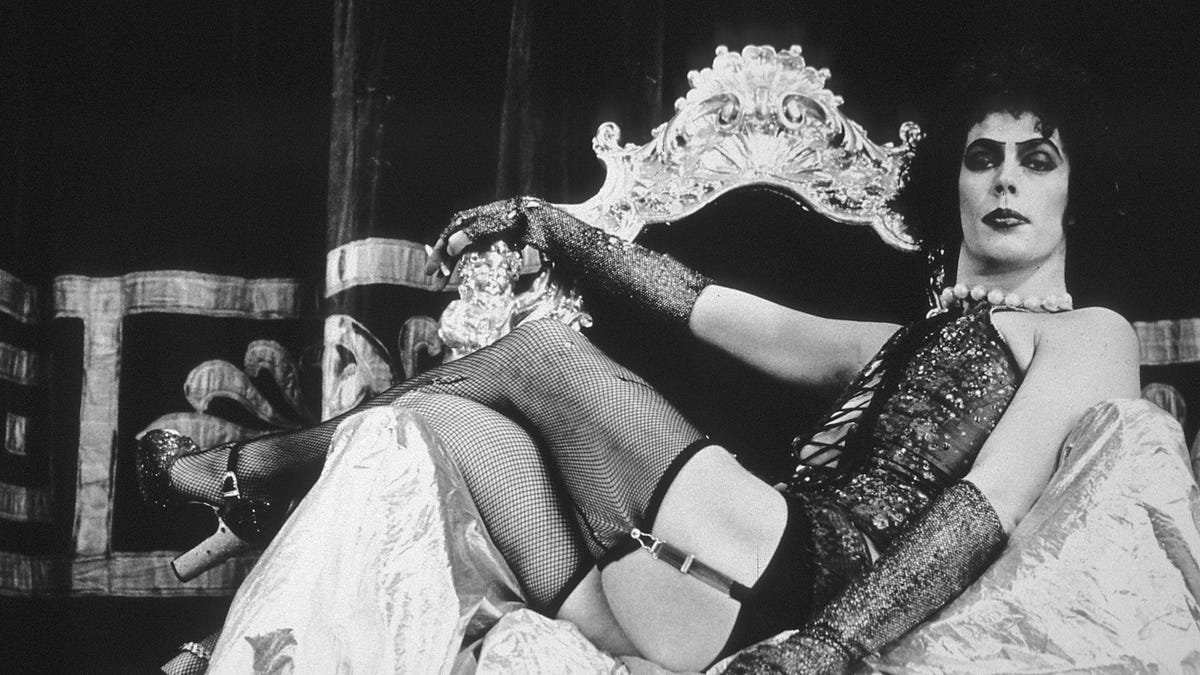
Few entrances in cinema history are as iconic as Frank-N-Furter’s descent in the Paternoster elevator. Curry uses every muscle in his face to convey a dizzying range of emotions — arrogance, seduction, playfulness, and threat. His Cheshire accent oozes confidence and swagger as he struts past his Transylvanians in a silky black vampire cape, singing about being an alien from another planet. That feeling of otherness, of being an outsider, is something many in the LGBTQ+ community can relate to, and Curry harnessed that resonance with breathtaking precision.
When he sings the words “I’m just a sweet transvestite,” he launches the cape backward from his shoulders to reveal his legendary sequined lingerie ensemble, showing off for his minions and the unsuspecting couple Brad and Janet. The moment is electric, a declaration of selfhood that refuses apology. Curry’s physicality in this scene is extraordinary — the way he moves, the way he holds his body, the confidence that radiates from every gesture. He wasn’t just playing a character; he was offering a vision of what liberation could look like.
Finding the Heart in the Monster: Frank’s Vulnerability
But Curry’s genius was in understanding that Frank-N-Furter could not simply be a spectacle. He needed heart. He needed the capacity for pain. And Curry delivered that most devastatingly in “I’m Going Home,” a sweeping rock ballad that reveals the softer side of this often-misjudged character. Frank-N-Furter has one last opportunity to sing his heart out to the audience, proclaiming that he sees “blue skies through the tears” as he realizes he has to go back to his home planet. The tragedy is that he doesn’t actually make it home; his supposedly trustworthy henchmen, Riff Raff and Magenta, shoot him and his creation, Rocky, with a laser gun.
This sequence is where Curry’s performance becomes truly transcendent. His voice cracks with emotion, his eyes glisten with tears, and for a moment, the mask of the theatrical mad scientist slips away to reveal someone desperately lonely. It’s a line that feels like a knife to the heart, especially as Curry himself suffered from health issues and struggled with mobility after a 2012 stroke. The echo of his own pain in the character’s lament gives it an even greater poignancy, a reminder that even the most flamboyant exteriors can conceal profound vulnerability.
The Rocky Horror Revolution: More Than Just a cult classic legacy
To understand Frank-N-Furter’s enduring significance, we must understand the film’s journey from box office flop to cultural phenomenon. When The Rocky Horror Picture Show premiered in 1975, it was met with confusion and indifference. Audiences didn’t know what to make of its blend of horror, comedy, musical, and explicit sexuality. The film initially bombed, disappearing from theaters after a brief run. But then something remarkable happened.
Midnight screenings began to emerge in cities like New York and Los Angeles, where audiences — largely queer, largely misfit — gathered to experience the film together. They shouted lines back at the screen, dressed as the characters, and transformed the viewing experience into a communal ritual. The film became a gathering place for those who felt like outsiders in mainstream society. As time went on, shadow casts performed alongside the film, live actors mimicking the characters on stage below the screen. It was participatory theatre, a celebration of queer identity, and a rebellion against conformity.
This transformation from failure to phenomenon is unique in cinema history. It wasn’t critics or studio marketing that saved Rocky Horror; it was the people. The film spoke to something deep in the cultural psyche, a need for spaces where rules could be broken and identities could be fluid. And at the center of it all was Curry’s Frank-N-Furter, the icon who made it possible. The 50th anniversary of the film’s release has seen a resurgence of interest, with special screenings, retrospectives, and a new generation discovering the film’s magic for the first time.
A Legacy Forged in Fishnets: Frank as a Queer Hero
For the LGBTQ+ community, Frank-N-Furter became more than a character. He became a symbol. In a time when queer representation on screen was either nonexistent or deeply negative, here was a figure who was unashamedly sexual, gender-bending, and powerful. He didn’t ask for permission to exist. He demanded attention. He commanded spaces that were not made for him and remade them in his image.
Curry himself understood the weight of this representation. While he was a straight actor playing a queer icon, he approached the role with profound respect and a willingness to embrace its significance. In interviews, he spoke about how the character resonated with audiences who felt different, who felt like aliens in their own world. He recognized that Frank-N-Furter was a fantasy of liberation, a vision of what it might look like to be completely free.
“Frank-N-Furter is about being yourself, no matter what anyone thinks. That’s a message that never goes out of style.” — Tim Curry
The character’s influence extends far beyond the film itself. Frank-N-Furter has been referenced in countless TV shows, music videos, and pop culture moments. From Glee’s tribute to the character’s enduring presence in drag culture, the legacy is everywhere. But perhaps the most powerful testament is the audience participation that continues to this day. Fifty years after its release, people still dress up, still shout lines, still find community in a film that tells them they don’t have to fit in.
The Enduring Relevance of ‘Don’t Dream It, Be It’
Curry’s performance has only grown in significance in politically fraught times, as politicians continue to sow division between those who fit within a certain mold and those who don’t. His character’s line “Don’t dream it, be it” remains a battle cry not only for the LGBTQ+ community but for anyone who feels marginalized. It is a reminder that existence itself is an act of resistance, that being authentic in a world that wants you to conform is a radical choice.
Barry Bostwick, who played Brad in the film, has noted that Rocky Horror feels “as apropos today and in some ways more” than it did in 1975. The battles over identity, over who gets to define what is “normal,” are as fierce as ever. And in that context, Frank-N-Furter’s defiance is not just nostalgic — it’s necessary. He teaches us that we can choose our own paths, that we can embrace our strangeness and build communities around it.
Both Curry and Dr. Frank-N-Furter taught generations of queer people to defy societal expectations and choose their own paths in life. The character’s journey from alien invader to tragic hero mirrors the struggles of so many who have felt like outsiders. And Curry’s performance, with all its complexity and humanity, made that journey unforgettable.
Revisiting the Castle: Tim Curry’s Performance in a Modern Light
Looking back at Curry’s performance today, one is struck by how prescient it was. Frank-N-Furter’s fluidity — his refusal to be boxed in by gender or sexuality — feels remarkably contemporary. The character is a celebration of complexity, a rejection of binary thinking. In an era of culture wars and identity politics, Frank-N-Furter stands as a testament to the possibility of being multiple things at once: menacing and vulnerable, masculine and feminine, alien and deeply human.
The contrast with more recent adaptations only underscores Curry’s uniqueness. In 2016, a remake of Rocky Horror aired on television starring Laverne Cox as Frank-N-Furter. While Cox brought her own talents to the role, and her casting was a milestone for transgender representation, the performance inevitably drew comparisons. Curry’s version remains the gold standard because it was the original — the one that broke the mold before anyone knew a mold could be broken. Cox herself has spoken with immense respect about Curry’s legacy, noting that he paved the way for performers like her to even exist in such roles.
The differences between the performances are instructive. Curry’s Frank-N-Furter was an alien, an outsider who performed gender as an act of cosmic defiance. His portrayal emphasized the character’s otherworldliness, his fundamental strangeness, which made his vulnerability all the more poignant. Cox’s interpretation, by contrast, grounded the character more firmly in human experience, emphasizing the lived reality of gender nonconformity. Both approaches have merit, but Curry’s remains the definitive version because he created the character from nothing, imbuing it with a sense of discovery and danger that can never be replicated.
But Curry’s legacy is not just about one performance. It’s about what that performance made possible. It opened doors for queer representation, for gender-bending performance, for the celebration of difference. And it did so with wit, style, and an understanding that liberation should be joyful. The impact of Curry’s performance extends far beyond Rocky Horror itself. It has shaped how we think about performance, identity, and representation. It has influenced artists from David Bowie to Lady Gaga, from drag queens to theatre performers. It has given generations of outsiders a language for their own experience, a way to articulate what it feels like to be different.
Frequently Asked Questions About Tim Curry and Frank-N-Furter
What made Tim Curry’s performance as Frank-N-Furter so iconic and distinct from other portrayals?
Curry’s performance combined theatrical grandeur, raw vulnerability, and a profound understanding of the character’s otherness. He played Frank-N-Furter as both a menacing figure and a deeply lonely alien, creating a complexity that no other actor has matched. His physicality, voice work, and emotional range made the role unforgettable.
How did Curry’s background in theater shape his performance?
Curry trained in classical theatre at the University of Birmingham and performed in London’s West End before taking on Rocky Horror. His theatrical training gave him the vocal power, physical confidence, and stage presence necessary to command the role. He approached Frank-N-Furter as a Shakespearean villain mixed with a rock star, a combination that proved electrifying.
Why is Dr. Frank-N-Furter considered such an important figure in LGBTQ+ history?
Frank-N-Furter was one of the first mainstream film characters to explicitly celebrate gender nonconformity and sexual liberation. In an era when queer representation was largely negative, the character offered a vision of unapologetic selfhood. He became a symbol for LGBTQ+ audiences of what freedom might look like.
How did Rocky Horror transition from a box-office flop to a massive cult phenomenon?
The film found its audience through midnight screenings, where audiences began to participate by shouting lines and dressing as characters. The communal experience transformed the film into a ritual of self-expression and belonging, and the fan base grew over time. The film’s embrace of outsider identity resonated deeply with marginalized audiences, ensuring its longevity.
In what ways is the film’s message relevant to the political and social climate of today?
Rocky Horror’s themes of sexual freedom, gender expression, and defiance against societal norms continue to resonate in a world where those issues remain contested. The film’s call to “Don’t dream it, be it” is a powerful reminder that authenticity and resistance are intertwined, and that building communities around shared difference is an act of political significance.
What other roles is Tim Curry known for?
Beyond Rocky Horror, Curry had a prolific career in film, television, and theatre. He played Dr. Frank-N-Furter (original 1973 London stage production), Pennywise in the 1990 miniseries It, the villain in Legend, and memorable roles in Home Alone 2, The Three Musketeers, and Muppet Treasure Island. His voice work was equally celebrated, including roles in The Wild Thornberrys and The Adventures of Jimmy Neutron. Curry also performed extensively on stage in productions of My Fair Lady, Amadeus, and The Rocky Horror Show revival.
How does Curry’s legacy extend beyond his performance in Rocky Horror?
Curry’s influence extends far beyond any single role. He was a versatile performer who brought the same theatrical commitment to every project, whether on stage, screen, or voice work. His willingness to embrace challenging, unconventional roles paved the way for actors to take risks and break away from typecasting. He was also a beloved figure in the theatre community, known for his generosity and mentorship of younger performers. His legacy is one of courage, creativity, and an unwavering commitment to authenticity — values that resonate far beyond the world of entertainment.
What is the significance of the film’s 50th anniversary?
The 50th anniversary of Rocky Horror’s release has prompted a global celebration of its enduring legacy. Special screenings, retrospectives, and fan events have highlighted the film’s continued relevance and its impact on multiple generations. The anniversary serves as a reminder that Rocky Horror is not just a film, but a cultural institution that has provided solace, community, and inspiration to millions of people around the world.