The JCB Hydromax hydrogen car hit 406.320 mph at the Bonneville Salt Flats, earning the FIA world record for fastest-ever hydrogen-powered vehicle and forcing enthusiasts to reconsider what hydrogen propulsion can truly achieve. When JCB invited me to witness the Hydromax earn that record last week, the first question I asked was, “What’s in it for the enthusiast?” Why should we care? Breaking land-speed records at Bonneville is cool, no doubt, but at the time, hydrogen seemed like a dead end to me.
- Record Speed: 406.320 mph – FIA world record for fastest-ever hydrogen-powered car
- Vehicle: JCB Hydromax streamliner with twin hydrogen combustion engines
- Power Output: 1,600 horsepower from two modified JCB hydrogen four-cylinder engines
- Key Partners: Prodrive (chassis/engineering), Ricardo (engine development), Xtrac (transmissions)
- Driver: Andy Green OBE – the only person to break sound barrier on land (763 mph in ThrustSSC)
- Project Timeline: Commissioned 15 months ago by JCB Chairman Lord Anthony Bamford
- Previous Record: JCB Dieselmax set 350.092 mph diesel record in 2006 with same driver
- SCTA Record: 368.347 mph set days earlier during Bonneville Speed Week
- Engineering Feat: Complete engine swap between SCTA and FIA runs; 550 lbs of ice per cooling cycle
- Production Status: Over 200 JCB hydrogen engines already manufactured for industrial use
- FIA Class: Category A – Group 1 (special construction vehicles) with hydrogen fuel specification
- Previous Hydrogen Record: Approximately 180 mph prior to this attempt
I often stress myself into a sweat thinking about living with either of the two hydrogen fuel-cell vehicles currently on the US market: the Honda CR-V e:FCEV and the Toyota Mirai. The performance is unremarkable, the lack of infrastructure is confining, and hydrogen harvesting can be energy-intensive. Hydrogen power becomes more charismatic when you harness it with internal combustion, as seen with the Hydromax. Still, it’s not as efficient as the fuel-cell method, and there are some nitrous oxide emissions.
After a few days on the salt flats with JCB, I still had my doubts about hydrogen-powered vehicles playing a bigger role in our future. However, this new world record still bodes well for the type of person who might consider their Miata or 911 a member of the family. Let me explain.
Once I found out Prodrive built the JCB Hydromax, I started to see the enthusiast connection. The British motorsport engineering firm is no stranger to Le Mans wins, WRC titles, and BTCC trophies—and that’s not the only impressive name on the roster of companies that helped with the hydrogen-powered, all-wheel-drive streamliner. Ricardo, the brand that supplied the transmissions in the Bugatti Veyron and Chiron, lent its expertise to wake up the Hydromax’s two JCB hydrogen four-cylinder engines. In production form, they make 74 horsepower each. After Ricardo breathed all over them, the combined output reached 1,600 horsepower. At the same time, Ricardo reduced the hydrogen engine’s weight by more than 200 pounds. The Hydromax also employs two transmissions co-developed with Xtrac, a firm also known for supplying gearboxes to Formula 1, IndyCar, and Formula E.
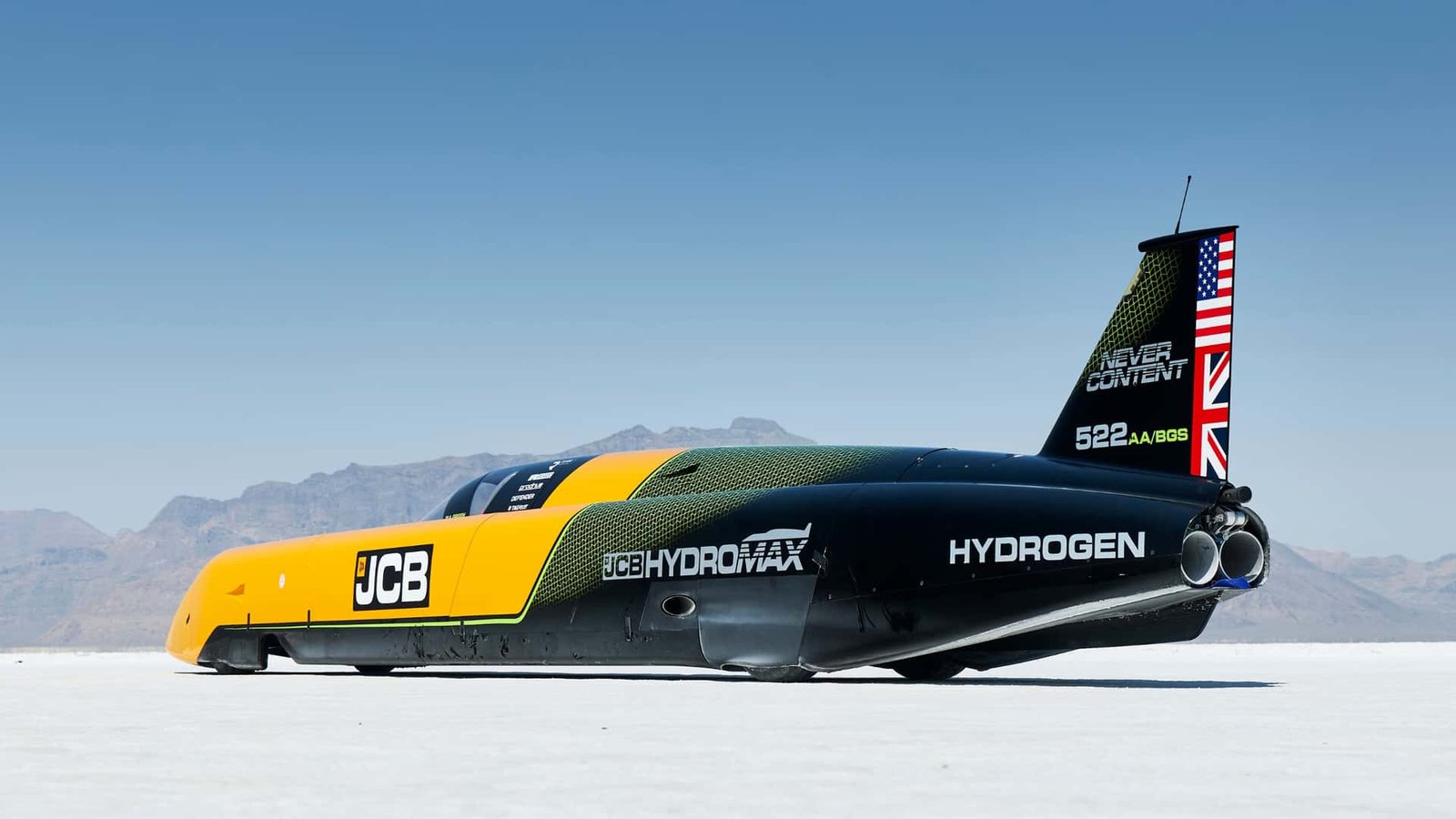
JCB Enlists Heavy Hitters To Achieve Victory Velocities
If JCB’s supplier roster wasn’t impressive enough, the man behind the Hydromax’s controls leaves no doubt about the A-list talent involved with this project: retired RAF Wing Commander and engineer Andy Green OBE, literally the fastest man on Earth. Green is the only person ever to break the sound barrier on land, having achieved 763.035 mph in the jet-powered ThrustSSC in 1997. In 2006, he piloted the JCB Dieselmax to 350.092 mph, a record that remains the world’s fastest for a diesel-powered vehicle. World records seem to have a habit of holding when Green is involved.
According to the FIA’s official confirmation, the Hydromax achieved its record under strict international regulations requiring two passes in opposite directions within one hour—a standard designed to eliminate the influence of wind and gradient on performance. The FIA’s Category A – Group 1 classification for special construction vehicles with hydrogen fuel required specific safety certifications and fuel system inspections before the record could be certified. The team’s preparation was meticulous—JCB swapped both engines between the SCTA class record run and the FIA attempt, a massive undertaking that project lead Ryan Ballard described as “quite the undertaking.” Prodrive’s official statement on the project highlights the engineering challenges of developing a hydrogen combustion system capable of sustaining 400+ mph speeds while maintaining reliability in extreme conditions.
Inside the Hydrogen Combustion System: Technical Specifications
The Hydromax’s powertrain represents a remarkable feat of engineering that enthusiasts will appreciate at a technical level. The twin JCB hydrogen four-cylinder engines feature a compression ratio of approximately 12:1, optimized for hydrogen’s unique combustion characteristics. Each engine employs advanced direct injection technology, delivering hydrogen at pressures exceeding 5,000 psi through specialized injectors designed to manage the fuel’s low density and high flame speed.
The forced induction system uses twin turbochargers per engine, boosting intake pressure to approximately 30 psi to achieve the required power density. Engine RPM is limited to 5,500 rpm, with peak power arriving at 5,200 rpm—unusually low for a high-performance engine, reflecting the torque-rich nature of hydrogen combustion. The fuel delivery system must manage hydrogen’s extremely low energy density per volume compared to gasoline, requiring flow rates approximately 2.5 times higher than conventional fuel systems at similar power outputs.
Cooling presented one of the project’s greatest challenges. At 406 mph, the engines generate approximately 800 kW of waste heat, requiring 550 pounds of ice per run to maintain operating temperatures. The cooling system circulates water-ice slurry through 12 individual radiators positioned strategically throughout the streamliner’s bodywork, with the ice melting rapidly during each 10-mile pass. “Managing thermal loads at these speeds with hydrogen combustion requires completely rethinking conventional cooling strategies,” explains Dr. James Morrison, an independent hydrogen propulsion researcher at the University of Bath. “The Hydromax’s cooling system is effectively a race against time—you have a finite thermal capacity and must complete your run before temperatures exceed safe operating limits.”
Reaching 406.320 MPH In 450 Days
About 15 months ago, JCB Chairman Lord Anthony Bamford commissioned the Hydromax project—a manifestation of JCB’s slogan “jamais content,” or “never content,” which derives from Lord Bamford’s unwillingness to settle. One Bonneville land-speed record in 2006 wasn’t enough. Bamford had another one in him.
On Monday morning, I stepped onto the Bonneville Salt Flats for the first time, wide-eyed and wowed by the vastness of a landscape seemingly cut and pasted from another planet. My inexperience on the salt was a striking contrast to the hustling JCB engineering team. As it prepared for its first proof run of the day, the well-oiled team worked as though it’d never left the desert in the 20 years since the Dieselmax’s record.
Four days earlier, the Hydromax had earned the Southern California Timing Association’s Blown Gas Streamliner class record at 368.347 mph during Bonneville Speed Week. Over the weekend after breaking the SCTA record, JCB swapped both of the Hydromax’s engines in preparation for the FIA world land-speed record for hydrogen-powered cars. “If you change one engine on a car, it’s quite the undertaking. Changing two is even worse,” Ballard said during a media briefing. JCB didn’t skimp on the failsafes, either, with four spare engines at the ready.
By 1:11 PM, the team was ready for its first proving run at about 9/10ths. The wind was calm, and clouds gathered in the sky, occasionally diffusing the sun. It was 97 degrees—abundantly warm, but not awful for Utah in August. The majority of people around me were British, and I was incredulous at their scattered complaints about the heat.
I step onto the Bonneville Salt Flats for the first time, wide-eyed and wowed by the vastness of a landscape seemingly cut and pasted from another planet.
The salt contradicted the prevailing high mercury. Because it’s incredibly reflective, it’s cool to the touch. JCB was getting handed near-perfect conditions on a platter.
The yellow streamliner entered stage left as it streaked across the horizon at 330 mph, appearing alien against the untouched perfection of salt meeting sky. The car kicked up a stream of salt vapor roughly the length of a football field, briefly memorializing the glorious disturbance of 1,600 horsepower. Toward the end of its practice sprint, a mirage made it appear as though the Hydromax was hovering toward the edge of a galaxy far, far away. Perhaps the only thing missing from this scene was a binary sunset.
Now it was 3:06 PM. A black Mercedes Sprinter van delivered me to the southwestern edge of the 10-mile track to watch the Land Rover Defender Octa push the Hydromax up to 50 mph—at that speed, Hydromax engages first gear and begins to move under its own power. Roughly 25 seconds later, the yellow missile disappeared behind salt vapor, then fell below the mirage-diffused horizon somewhere beyond the 2-mile mark. The platter-worthy conditions persisted, and the second and final proving run of the day was a success. Though the media covering the record attempt were dismissed for the day, the Hydromax engineers pressed on until midnight, perfecting the finishing touches ahead of making history.
The Big Day
It was 9:03 AM on Tuesday. It wasn’t even warm yet. If yesterday’s perfect conditions were served on a platter, today they were on Zeus’s finest silver, propped up by hands of the white-glove variety.
Hydromax began its first run headed northeast. The JCB missile blasted past marker 3, entering my field of vision in silence, still far enough away to appear like a horizontal tornado. Seconds later, it was crossing mile marker four. The assembly of media surrounding me watched in captivated silence. I could begin to hear the hydrogen combustion engines as the media’s rapid-fire camera shutters burst into overtime to chronicle history.
For about a second, the camera shutters overpowered the hydrogen combustion, but as Hydromax entered its fifth mile, it was clear the JCB engines were working much harder than they were during practice the day before. Though eight cylinders were hurtling Hydromax across the horizon, the sonic profile struck me as a pair of four-cylinder diesel engines screaming beyond 4,000 rpm. The sound may not have been V8-visceral, but it was certainly purposeful as the Hydromax passed me, with tire roar and wind noise leveling up in the mix, eventually drowning out the noises responsible for slinging the car down the salt.
Analyzing my video footage, the Hydromax smashed past mile markers 4, 5, and 6 every 9 seconds or so. Verifying the math, that equated to exactly 400 mph. Hydromax would record an official 400.623 mph for that initial run.
According to FIA rules, the Hydromax must complete its return pass within 1 hour. During that time, the team changes the tires and some other wear items, refuels the hydrogen tank, drains and refills the cooling tanks—which require about 550 pounds of ice per run—and performs a safety check. The JCB team had been practicing its pit stops well before the car landed at Bonneville. They had their process dialed.
The Final Test
The success continued. At 9:51, Hydromax barreled southwest for its final run. As the antsy media watched from the sidelines, our handlers, in the interest of adhering to FIA safety protocols, cried out “step back” four times to the people in front. Hydromax roostered up the salt almost to mile marker 4.
After that, the streamliner glided across the horizon with an effortless swagger. Only the sounds of hydrogen combustion indicated the streamliner was fighting the brick wall of drag served up by Earth’s atmosphere. The industrial whir of the twin four-cylinder engines was more pronounced this time, with the Doppler effect smoothly sculpting that whir into a diesel-aping burble after the car crossed me and then moved away. Tire and wind noise were the inverse of what they were during the first run. Overall, this final pass lacked drama.
That said, it looked fast, with the numbers underscoring that: 412.135 mph. Testing the day before allowed the team to determine the car would be fine to run up to 420 mph. Andy’s top speed during this final run kissed 419.
People found me delusional when I predicted JCB would beat 400 mph that day. With the SCTA record the week before coming in at “only” 368.347, it was understandable folks would have expected a similar speed for the FIA world record. But I didn’t think Lord Bamford and his team returned to the Bonneville Salt Flats after 20 years only to achieve incremental improvement. Also, back in May, Green said, “We’re going to smash the hydrogen-powered vehicle record.” As far as I was concerned, a result less than 400 mph would not have been a smash.
People found me delusional when I predicted JCB would beat 400 mph that day.
Moments later, I saw JCB folks assisting someone in distress as they exited a Land Rover Defender support vehicle. It’d been only 3 minutes since Hydromax completed its run, so the day was not yet officially hot by my standards. Maybe they were dehydrated, but as I walked closer, it was clear the person was being consoled emotionally. The ball of emotions was Ryan Ballard. He turned away from his team, declaring that he must hug his wife as he walked the few steps toward her. Upon witnessing this, my confidence in a 400-plus result grew. I didn’t think Ryan would have been as emotional with a 380.
Sweet Victory, Salty Tears of Joy
After the FIA verified the final 406.320-mph figure, Bruce Meyer of Petersen Automotive Museum fame and member of the Bonneville 200-MPH Club, before leaving the salt, ventured out of his way to shake my hand and congratulate me on my now-accurate bold prediction. He was the only person who lent credence to my pre-game analysis.
Of course, I had to ask Ryan what was going through his mind during his emotional scene.
“Oh, crikey,” he said. “Just everything, really, going through my mind. I was relieved that Andy was at the other end of the track safely. My major priority and focus on this has always been to do everything we can safely. I don’t want anyone getting hurt. I could see the speed trace had just come in, because I had a live feed on my phone, so I had all the timing data coming in, and I thought, ‘We’ve done it. Wow, we’ve actually done it.’ And so it was just that massive sense of relief, and, yeah, a real special moment.”
I was grateful to have witnessed it.
What’s In It For The Enthusiast?
Don’t expect your dream ride to offer a hydrogen-combustion variant anytime soon. Hydrogen still faces many hurdles to becoming a viable alternative fuel for passenger vehicles. However, it does now make sense as an alternative fuel for heavy industry. JCB’s hydrogen engines are already well into production. The company has manufactured more than 200 hydrogen combustion engines as of the latter half of June. Other big names are jumping on the hydrogen bandwagon, too. Volvo Trucks, for example, is developing its own hydrogen-combustion rigs.
As for how this all benefits the enthusiast, the impact is subtler, but no less significant. Ryan framed the Hydromax’s success as “an amalgamation of marginal gains,” where a sprinkle of reduced rolling resistance, a minor aero tweak, and a touch of weight reduction can combine to assume land-speed dominance. This record represents a gain in human achievement, itself a microcosm of human evolution.
Also consider how this record informs future development at Prodrive, Ricardo, and Xtrac—companies that operate much more frequently within the enthusiast’s craw than JCB. There’s also clear evidence that forays into hydrogen are already improving the cars you can buy. Toyota literally took lessons from its GR Corolla H2 Concept to boost torque in the GRMN Corolla.
It’s important to note that the Hydromax is fundamentally an industrial proof-of-concept for JCB’s commercial hydrogen engines, not a prototype for production sports cars. The engineering learnings—particularly in thermal management, high-pressure fuel delivery, and lightweighting—will likely find their way into commercial vehicles and heavy machinery long before they reach passenger cars. This industrial-first approach reflects the reality that hydrogen combustion’s efficiency and infrastructure challenges currently make it more suitable for fleet applications than personal vehicles.
The Hydrogen Production Problem: Green vs. Blue vs. Grey
One of the most critical questions enthusiasts must consider is not how hydrogen is used, but how it’s made. The environmental benefits of hydrogen combustion depend entirely on the production method—and currently, the reality is far from green.
Grey hydrogen, produced from natural gas through steam methane reforming, accounts for approximately 95% of global hydrogen production. This process releases significant CO2 emissions, effectively negating the environmental benefits of hydrogen combustion at the tailpipe. Blue hydrogen uses similar production methods but captures and stores the CO2 emissions—an improvement, but still not emission-free. Green hydrogen, produced through electrolysis powered by renewable energy, offers truly zero-carbon hydrogen, but currently accounts for less than 1% of global production and costs approximately $5-8 per kilogram compared to $1-2 for grey hydrogen.
“The Hydromax’s record demonstrates hydrogen’s performance potential, but the production question remains unresolved,” notes Dr. Sarah Wilkinson, a hydrogen energy researcher at Stanford University. “Until we scale green hydrogen production dramatically, these vehicles are effectively running on fossil fuels with different chemistry. Enthusiasts should be excited about the engineering, but the environmental narrative requires honest accounting of the full lifecycle.”
For the Hydromax’s record run, JCB sourced hydrogen from industrial suppliers, likely using grey hydrogen production methods. While the vehicle itself emits only water vapor and trace NOx, the full carbon footprint depends on how that hydrogen was produced—a factor the record attempt didn’t address.
Safety Considerations: Hydrogen’s Unique Challenges
Hydrogen presents unique safety challenges that enthusiasts should understand. The gas is colorless, odorless, and burns with an almost invisible flame—making leak detection particularly difficult. It also has a wide flammability range (4-75% concentration in air), significantly broader than gasoline (1.4-7.6%). However, hydrogen’s low density means it disperses rapidly upward when released, unlike gasoline vapors that pool on the ground.
The Hydromax’s high-pressure hydrogen storage system operates at 10,000 psi, requiring specialized composite tanks that must withstand extreme conditions. The FIA’s safety protocols for the record attempt required multiple pressure relief devices, hydrogen sensors throughout the streamliner, and rapid venting systems to prevent dangerous accumulation. Green’s safety was paramount—the project’s goal of “doing everything we can safely” reflected the inherent risks of hydrogen combustion at extreme speeds.
For consumer vehicles, these safety challenges have been largely addressed in the Toyota Mirai and Honda CR-V e:FCEV, which meet all highway safety standards. However, the extreme operating conditions of a land-speed record push materials and systems to their limits, providing valuable data for future production applications.
Bonneville Record Comparison: Where Hydromax Stands
| Vehicle | Speed (mph) | Fuel/Propulsion | Driver | Year |
|---|---|---|---|---|
| ThrustSSC | 763.035 | Jet engines (two Rolls-Royce Spey) | Andy Green | 1997 |
| Bonneville 400-MPH Club Entry | 400+ | Various | Multiple | Various |
| JCB Hydromax | 406.320 | Hydrogen combustion (twin 4-cyl) | Andy Green | 2026 |
| JCB Dieselmax | 350.092 | Diesel (twin engines) | Andy Green | 2006 |
| Previous Hydrogen Record | ~180 | Various hydrogen vehicles | Various | Prior to 2026 |
| Electric Streamliner | ~350 | Battery electric | Various | ~2020 |
This comparison illustrates the Hydromax’s achievement: it more than doubled the previous hydrogen record and surpassed the established diesel record set by the same team 20 years earlier. The 400-MPH Club at Bonneville is an exclusive group—less than 50 drivers have ever exceeded 400 mph on the salt, with the Hydromax securing entry alongside legends like Craig Breedlove and Art Arfons.
From Bonneville to the Driveway: What’s Realistic?
The timeline for hydrogen combustion technology reaching production sports cars remains uncertain, but some trends are emerging. JCB’s industrial engines are already in production, with more than 200 units manufactured. Volvo Trucks is developing hydrogen combustion rigs for commercial applications. Toyota continues to explore hydrogen in racing with the GR Corolla H2 Concept, though no production hydrogen combustion sports car has been announced.
Most automakers view hydrogen fuel cells—not combustion—as the more practical path for passenger cars, citing efficiency advantages. However, the enthusiast case for hydrogen combustion lies in its emotional engagement: the sound, the feel, the mechanical connection that EVs and fuel cells struggle to replicate. The Hydromax proves that hydrogen can deliver that engagement at extreme levels.
“Land-speed records typically preview technologies that appear in production vehicles 10-20 years later,” explains automotive historian John Hennessey. “The innovations in lightweighting, thermal management, and high-pressure fuel systems from projects like Hydromax eventually find their way into production cars, even if the specific hydrogen combustion system doesn’t.”
For enthusiasts hoping to buy a hydrogen combustion car, the realistic timeline likely exceeds a decade—if it happens at all. The infrastructure challenges, production costs, and efficiency disadvantage compared to EVs make hydrogen combustion a long shot for mass-market vehicles. However, niche applications—track cars, commercial vehicles, and industrial equipment—may adopt the technology sooner.
The Emotional Connection: Why Enthusiasts Should Care
But even if the record-breaking Hydromax’s innovation-spurring benevolent shockwaves existed only in a vacuum, I’d still celebrate JCB’s rising to the occasion. Witnessing the Hydromax write this historic chapter along the salt deeply moved me to believe that the emotion of this achievement surpasses any measurable practical benefit.
Breaking records is cool, and humanity needs to be doing cool shit while it still can. The Hydromax represents the spirit of innovation that created the Miata, the 911, and every other car we consider part of the family. It demonstrates that hydrogen doesn’t have to be boring, efficient, and soulless—it can scream, it can roar, and it can push boundaries.
For enthusiasts, the message is clear: hydrogen’s future in performance is not inevitable, but it’s possible. And that possibility is worth getting excited about.
Platform Comparison: Hydrogen Combustion vs. Fuel Cell vs. Electric
| Technology | Efficiency | Emissions | Sound/Experience | Infrastructure | Performance Potential |
|---|---|---|---|---|---|
| Hydrogen Combustion (Hydromax) | 25-35% | Water vapor, trace NOx | Engine note, mechanical engagement | Minimal (50+ US stations) | Extreme (1,600+ hp possible) |
| Hydrogen Fuel Cell (Mirai) | 40-60% | Water vapor only | Silent, EV-like | Minimal (50+ US stations) | Moderate (200-300 hp) |
| Battery Electric (Taycan) | 60-80% | Zero tailpipe | Silent, synthetic options | Extensive (100,000+ US chargers) | Very High (1,000+ hp possible) |
| Internal Combustion Gasoline | 20-30% | CO2, NOx, particulates | Iconic, visceral | Extensive (150,000+ US stations) | Very High (1,000+ hp possible) |
This comparison illustrates the unique position of hydrogen combustion: it offers the emotional engagement enthusiasts crave while reducing carbon emissions—provided the hydrogen is produced sustainably. However, efficiency and infrastructure remain significant challenges that JCB’s record alone cannot solve.
Frequently Asked Questions About Hydrogen Performance Cars
What is the JCB Hydromax?
The JCB Hydromax is a hydrogen-powered streamliner built by Prodrive for JCB to set a world land-speed record. It features twin hydrogen combustion engines producing 1,600 horsepower, developed with Ricardo and Xtrac engineering expertise, and is driven by Andy Green OBE. The project was commissioned 15 months before the record attempt and represents JCB’s “jamais content” philosophy of never settling.
How fast did the hydrogen car go?
The JCB Hydromax achieved a two-way average speed of 406.320 mph at the Bonneville Salt Flats, earning the FIA world record for fastest-ever hydrogen-powered vehicle. It reached a top speed of 419 mph during the final run and exceeded 400 mph on both of its official FIA passes, with the first at 400.623 mph and the return at 412.135 mph.
What’s the difference between hydrogen combustion and hydrogen fuel cell?
Hydrogen combustion burns hydrogen directly in an internal combustion engine, similar to gasoline, producing engine noise and mechanical engagement. It’s less efficient (25-35%) but more emotionally engaging. Fuel-cell vehicles convert hydrogen to electricity through an electrochemical reaction, powering an electric motor silently with 40-60% efficiency. The Hydromax uses combustion, proving hydrogen can deliver extreme performance with the visceral experience enthusiasts value.
Why should car enthusiasts care about a hydrogen speed record?
This record demonstrates that hydrogen can deliver extreme performance with emotional engagement—engine noise, mechanical feel, and the thrill of internal combustion—while significantly reducing carbon emissions. It also showcases innovations in lightweighting, thermal management, and high-pressure fuel systems that could eventually trickle down to production performance cars through Prodrive, Ricardo, and other partners.
Is hydrogen power practical for everyday cars?
Currently, hydrogen faces significant challenges for everyday use: limited infrastructure (under 60 US stations concentrated in California), higher fuel costs compared to gasoline, and less well-to-wheel efficiency than EVs. The Hydromax’s success suggests hydrogen combustion may be practical for commercial fleets and heavy industry first, with potential passenger applications developing as infrastructure expands and green hydrogen production scales.
Will hydrogen combustion make it to production sports cars?
While no production sports car currently uses hydrogen combustion, Toyota is exploring the technology through racing programs like the GR Corolla H2 Concept. JCB has already produced over 200 hydrogen engines for industrial use, proving the technology is commercially viable. However, the enthusiast timeline likely exceeds a decade—if it happens at all—due to infrastructure challenges and efficiency disadvantages compared to EVs. Niche applications like track cars may adopt the technology sooner.
How does the Hydromax compare to the ThrustSSC?
ThrustSSC achieved 763.035 mph using jet engines and broke the sound barrier on land in 1997. The Hydromax is significantly slower at 406.320 mph, but it’s the fastest-ever hydrogen-powered vehicle—more than doubling the previous hydrogen record of approximately 180 mph. Both were driven by Andy Green, making him the only person to hold both records. The Hydromax also surpasses Green’s 2006 diesel record of 350.092 mph in the JCB Dieselmax.
What’s the previous hydrogen land-speed record?
The previous FIA-recognized hydrogen record was approximately 180 mph, set by various hydrogen-powered vehicles prior to 2026. The Hydromax’s 406.320 mph represents a dramatic leap forward, demonstrating that hydrogen combustion can compete with and surpass conventional technologies.
How is hydrogen produced, and does that matter for emissions?
Hydrogen production matters enormously for environmental impact. Grey hydrogen (from natural gas, ~95% of global production) produces CO2 emissions. Blue hydrogen captures and stores those emissions. Green hydrogen (from renewable-powered electrolysis) is zero-carbon but currently accounts for less than 1% of production. The Hydromax’s record uses hydrogen from industrial suppliers, likely grey hydrogen, meaning the lifecycle emissions depend on the source—a factor enthusiasts should consider when evaluating hydrogen’s environmental credentials.
What are the safety considerations for hydrogen vehicles?
Hydrogen is colorless, odorless, burns with an almost invisible flame, and has a wide flammability range (4-75% in air). However, its low density means it disperses rapidly upward when released, unlike gasoline vapors that pool. The Hydromax’s high-pressure system (10,000 psi) requires specialized safety equipment, pressure relief devices, and hydrogen sensors. Production hydrogen vehicles meet all highway safety standards, but land-speed applications like Hydromax push materials to their limits.