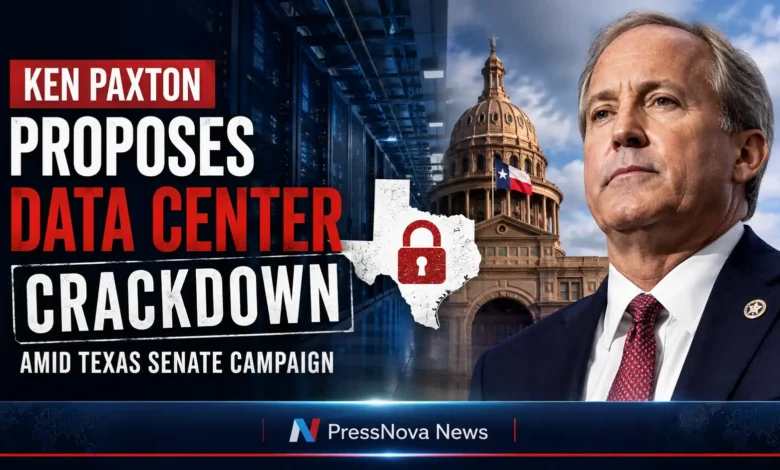
Texas Attorney General Ken Paxton has unveiled his Texas First Data Center Plan, a four-point proposal aimed at addressing growing concerns over the rapid expansion of data centers across the state as part of his Republican campaign for the U.S. Senate.
- Plan Pillars: Ban Chinese technology in data centers, hold companies criminally liable for AI chatbot harm, co-sponsor the DATA Act, and back Governor Abbott’s state-level data center policies.
- Paxton vs. Talarico: Democratic opponent James Talarico accuses Paxton of flipping his stance after taking nearly $500,000 from the data center industry and voting for tax exemptions in 2013.
- Statewide Backlash: Data centers have become politically toxic in Texas, with a University of Texas poll showing 56% of residents oppose construction in their communities.
- Governor’s Freeze: Abbott’s August 3 directive paused data center interconnection approvals pending a comprehensive audit, halting roughly 1,800 projects.
- Resource Strain: Texas data centers already consume 25 billion gallons of water annually, with projections reaching up to 161 billion gallons by 2030.
Announced on August 24, the plan comes as data centers have emerged as a rare issue uniting both political parties in Texas, with voters expressing growing concerns about the facilities’ impact on electricity costs, water resources, and quality of life. “Texans deserve a fighter to lead and represent them as we address the growing presence of data centers in Texas and stop their negative impact on our neighborhoods,” Paxton said in a statement.
“There’s no doubt in my mind that the United States will beat the Chinese Communist Party in the AI race,” Paxton continued. “This plan will ensure that happens while putting Texas first, protecting our culture and land, and safeguarding our families and communities. My plan will also work to ensure that data centers are not utilized to power AI platforms that endanger our children.”
The plan includes four primary pillars, with the first three focused on federal action Paxton would pursue if elected to the Senate. He would author legislation prohibiting the use of Chinese technology to power American data centers or be used in infrastructure, and introduce another bill holding data center companies criminally liable if their facilities empower AI chatbots that undermine children’s safety. Paxton also committed to co-sponsoring the DATA Act of 2026 — Senate Bill 3585 authored by U.S. Sen. Tom Cotton, R-Arkansas — which aims to eliminate outdated federal regulations and create new power systems ensuring data centers do not raise electricity costs for Texans.
The fourth pillar backs Texas Governor Greg Abbott’s state-level data center plan, which has effectively frozen data center construction pending a statewide audit. Abbott’s August 3 directive ordered the Public Utility Commission of Texas (PUCT) and the Electric Reliability Council of Texas (ERCOT) to conduct a comprehensive verification and audit of all data centers advancing through ERCOT’s interconnection process before any project can proceed.
What’s in Paxton’s Texas First Data Center Plan
Paxton’s four-point proposal combines national security concerns, child safety protections, federal deregulation, and support for Abbott’s state-level initiatives. The Republican nominee emphasized that the plan would “put Texans first” and protect communities from the negative impacts of data center growth.
Point 1: Banning Chinese Technology
Paxton would introduce first-of-its-kind legislation prohibiting the “use of Chinese technology to power American data centers” or be used in critical infrastructure. This pillar reflects growing bipartisan concerns in Washington about Chinese influence in American technology supply chains, particularly as AI development becomes a national security priority.
Point 2: Criminal Liability for AI Chatbots
Paxton’s plan would hold data center companies criminally liable if their facilities empower AI chatbots that “undermine children’s safety.” This provision aligns with broader conservative concerns about the impact of generative AI on minors, though details about how liability would be determined remain unspecified. Critics have noted that the plan appears to shift responsibility from AI platform developers to the infrastructure providers powering them.
Point 3: The DATA Act
Paxton committed to co-sponsoring the DATA Act of 2026, legislation introduced by Senator Tom Cotton that would create a new federal category allowing data centers to produce their own independent power away from preexisting power grids. The bill aims to eliminate “outdated red tape and federal regulations” while ensuring data centers do not raise electricity costs for Texans.
Point 4: Backing Abbott’s State-Level Policies
Paxton pledged to support and champion Governor Abbott’s data center plan at the state level, which includes:
– Prohibiting the building of AI data centers in rural Texas neighborhoods
– Requiring best practices to reduce local impacts like setbacks, noise-reduction technology, light controls, traffic improvements, and emergency coordination during high-stress grid scenarios
– Repealing sales tax exemptions and other outdated incentives
– Overhauling infrastructure priorities, including requiring data centers to fund their electricity and ensure they are adding to Texas’ electric capacity, and mandating closed-loop water systems for cooling.
Talarico and Democrats Respond to Paxton’s Plan
Democratic U.S. Senate nominee James Talarico, a Texas state representative, quickly criticized Paxton’s announcement, pointing to the attorney general’s record on data center policy and campaign finance disclosures.
“Ken Paxton has taken nearly half a million dollars from the data center industry, voted to flood Texas with data centers by giving them billions in tax handouts, and has refused to use his power as attorney general to respond to Texans’ requests to block data center development in their communities,” Talarico said in a statement.
Talarico’s campaign also noted that two rural counties in Texas asked Paxton’s office early this year if they could halt local data center construction, but the attorney general’s office has still not weighed in on the request. The Democratic nominee has already released his own “Hold Data Centers Accountable Plan,” which includes ending tax breaks for data centers, lowering energy costs by forcing data centers to pay for their own infrastructure, requiring closed-loop water systems to reduce consumption, and enacting minimum federal standards for data center projects.
Texas Democratic Party spokesperson Ryan Martin also condemned Paxton’s proposal. “Ken Paxton voted to flood Texas with data centers by giving them billions in tax breaks with no regulations, and now he is trying to erase history,” Martin said in a statement. “Paxton had the authority as attorney general to stop data centers, but did nothing because he is in the pocket of his data center donors.”
Paxton’s campaign has countered by pointing to Talarico’s own campaign donors, noting that his Lone Star Rising PAC has received approximately $10 million from LinkedIn co-founder Reid Hoffman, an advocate for data centers who has argued about their value in the AI arms race against China. “While James Talarico and his campaign infrastructure accept millions of dollars from data center-affiliated donors and put their interests first, I will lead with Texans at the forefront,” Paxton said.
Texas Data Center Backlash and Abbott’s Freeze
The political battle over data centers in Texas has intensified as the facilities have shifted from being viewed as economic development prizes to becoming politically toxic in many communities. A University of Texas poll conducted in June found 56% of Texans opposed the construction of a data center in their community, with 42% “strongly” opposed. Only 29% supported construction, with just 9% saying they strongly supported it.
Governor Greg Abbott has taken the most significant action at the state level. On August 3, 2026, he ordered a comprehensive verification audit of all data centers advancing through ERCOT’s interconnection process, effectively pausing data center approvals until the audit is complete. ERCOT is currently considering approximately 474 gigawatts of requests to connect to the Texas grid — more than five times the state’s record peak electricity demand — with roughly 90% of those new power requests coming from data centers.
Abbott’s directive requires data centers to disclose information across five categories:
– Financial assistance, including all state and local tax incentives, grants, and abatements
– Projected annual and peak electricity consumption, and plans for on-site generation
– Projected annual and peak water consumption, anticipated water sources, and cooling technology details
– Community impact mitigation measures, including noise controls, light controls, setbacks, and traffic improvements
– Ownership and controlling interests in the project
According to Abbott, his directive has halted roughly 1,800 data center projects in the Lone Star State. The governor has also called on lawmakers to repeal the data center sales tax exemption that has been used to attract them to Texas. The Texas Tribune reports that the exemption will cost the state more than $3 billion in sales tax revenue over the next two years.
Major tech companies have signaled willingness to comply with Abbott’s standards. Meta and OpenAI announced they would follow Texas’ new data center guidelines, joining Google and Amazon in committing to the new requirements. Abbott touted these commitments, stating that “these guidelines are now the universally applied standard in Texas.”
The industry is responding to the rapidly shifting regulatory environment. Holland & Knight’s Texas Government Advocacy Team has established the Texas Data Center Association to “effectively represent the industry before Texas policymakers and help ensure that data center companies have a coordinated voice in the debates already underway.” Meanwhile, Texas House Committee on State Affairs members have indicated they intend to carry legislation that would fully repeal the sales tax exemption currently available for data centers.
Data Center Impact on Texas Resources
The data center boom in Texas has placed enormous strain on the state’s already stretched energy and water resources. Texas is home to more than 400 data centers as of September 2025, clustered in major hubs like Dallas-Fort Worth, Houston, Austin, San Antonio, and West Texas.
Data centers in Texas already require more than 9,500 megawatts of electricity, and ERCOT forecasts demand could reach 77,965 MW by 2030 — an eightfold increase. At the same time, Texas data centers consume an estimated 25 billion gallons of water per year, a figure that could rise to 29-161 billion gallons annually by 2030, accounting for up to 2.7% of the state’s total annual water use.
By 2040, data centers in Texas could consume 9% of the state’s water — more than mining, livestock, and steam-electric generation combined. The Houston Advanced Research Center notes that Texas’ State Water Plan does not currently account for data center growth, meaning the state’s primary tool for funding new water projects is blind to one of the fastest-growing sources of water demand.
Paxton’s plan also includes repealing sales tax exemptions for data centers, despite his vote supporting the 2013 law that created those exemptions. Back in 2013, when he was serving as a freshman state senator in the Texas Legislature, Paxton voted in favor of 100% sales tax exemptions for data centers. While that exemption required a $200 million ground-floor investment and employment requirements to receive, it also sparked the present-day boom in data centers.
Data center developers, investors, utilities, and host communities are assessing the impact of the new regulatory landscape on project timing, interconnection strategy, and cost allocation. ERCOT has already announced it will postpone its Batch Zero transmission planning study while conducting the audit, meaning projects expected to advance through the Batch Zero evaluation process could face uncertain delays.
For additional context on Texas data center policy, visit the Office of the Texas Governor’s official website and the Electric Reliability Council of Texas (ERCOT) website.