Apple’s viral Mac mini commercial behind-the-scenes video has broken the internet, revealing that the tech giant ditched generative AI entirely in favor of handcrafted stop-motion animation and practical effects to showcase its new M6-powered desktop. Following the rollout of its refreshed M6 and M5 Pro Mac mini, Apple released a production video demonstrating how the hit commercial was brought to life through tangible human craftsmanship rather than synthetic AI-generated footage or heavy CGI. The 43-second spot, which transforms the compact desktop into a bodybuilder, race car, and rocket, has generated over 15 million views across platforms, with the behind-the-scenes footage alone accumulating more than 8 million Instagram views within its first 48 hours.
- Zero AI, 100% Handmade: Apple’s 43-second Mac mini commercial was created entirely using traditional stop-motion animation with hand-sculpted clay models and practical sets.
- Viral BTS Video: The behind-the-scenes footage released on Apple’s Instagram account @helloapple has sparked widespread applause across social media and the creative community, amassing over 8 million views.
- The Team Behind It: Animators Justin Rasch and Scott DaRos, alongside art director Josh Mahan, led the painstaking frame-by-frame production process.
- Creative Direction: Directed by Nicos Livesey, produced by Blinkink and Stoopid Buddy Stoodios for TBWA\Media Arts Lab.
- Strategic Shift: The campaign marks a deliberate departure from the controversial “Crush” iPad Pro ad, embracing human artistry over industrial metaphors.
- Cultural Context: Arrives amid growing consumer backlash against “AI slop” in corporate marketing, positioning Apple as a champion of human creativity.
- Watch the Ad: The full commercial and behind-the-scenes footage are available on Apple’s official YouTube channel and Instagram @helloapple.
The internet erupted in celebration as viewers realized the impossible-looking scenes—depicting massive computing power squeezed into a tiny 5-inch footprint—were achieved through physical cinematography rather than AI prompts. Social platforms flooded with praise for Apple championing human artists, physical set designers, and camera operators at a time when the broader tech industry is increasingly relying on synthetic marketing materials. Commentators and digital creators lauded the company for taking the exact opposite approach to its competitors, proving that thoughtful creative direction will always resonate more deeply than cheap, automated rendering.
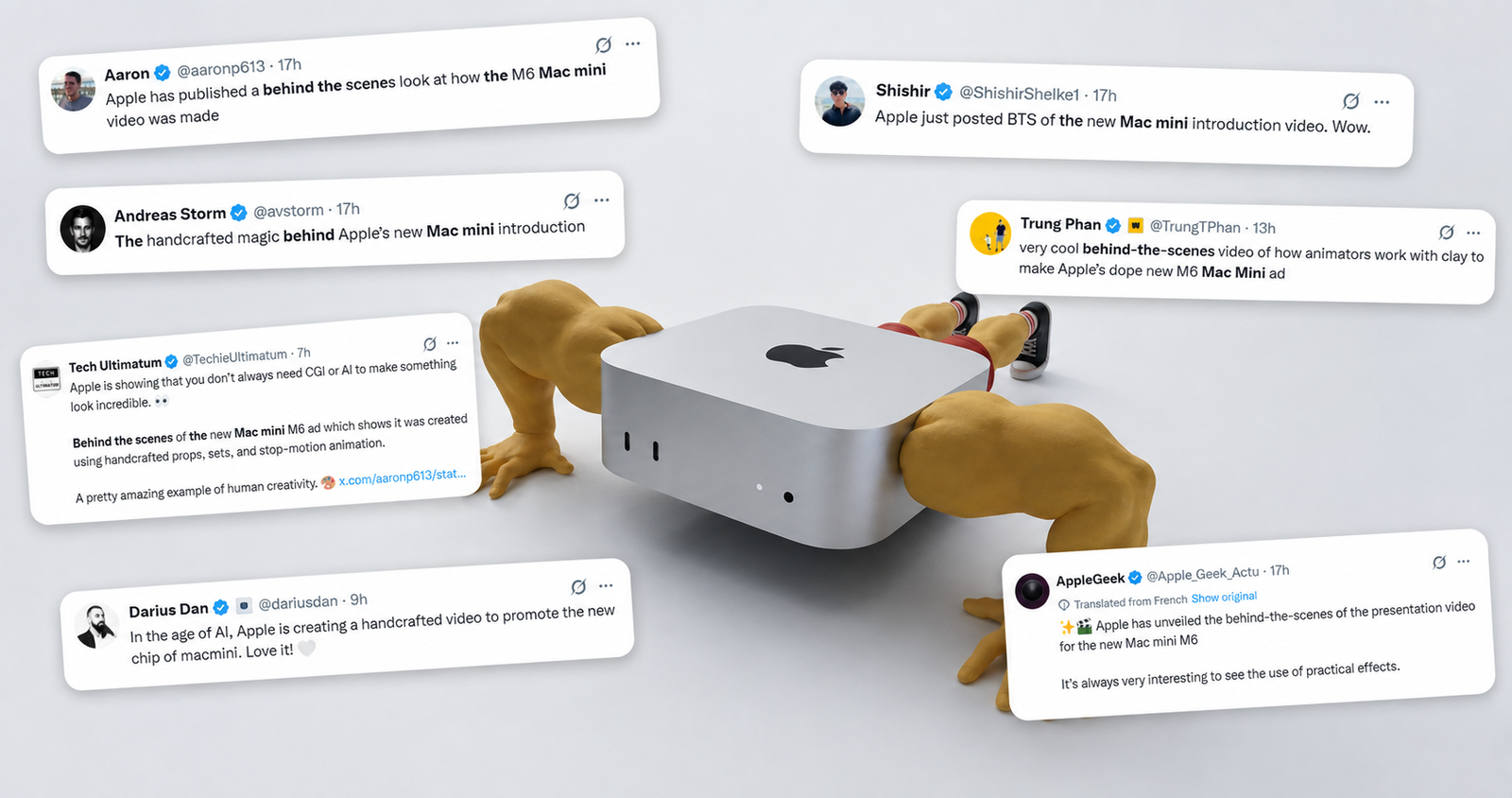
What makes this campaign particularly significant is the creative irony that hasn’t gone unnoticed across tech forums. While the new Mac mini is marketed heavily as an edge-computing hub built for local AI processing, Apple chose human artistry and manual cinematography to convey that message. The behind-the-scenes breakdown reveals how physical sliding stages, miniature props, and real-time on-set grading allowed the crew to execute complex visual metaphors in single in-camera takes. According to The Drum’s Ad of the Day coverage, the decision to construct intricate, oversized sets and physical scale models proved that human-driven creative direction will always outperform synthetic alternatives.
Creative Bloq’s analysis highlighted that the ad represents a departure from Apple’s traditional aesthetic while retaining the usual minimal style across background and product. The animated components—beginning with a yellow, Hulk-style strongman bursting out of the Mac mini—are more whimsical, less corporate, and less polished, aligning with Apple’s current marketing direction while adding extraordinary craft depth.
Behind-the-Scenes: How Apple’s Mac Mini Claymation Ad Was Made
Apple’s @helloapple Instagram account published a short reel showcasing the extensive work behind the Mac mini commercial, featuring animators Justin Rasch and Scott DaRos, alongside art director Josh Mahan. The footage reveals sketches, props, sculptures, techniques, and materials used throughout production, alongside stop-motion time-lapses and behind-the-scenes footage showing how several animations came together.
“We have to sculpt and craft everything by hand. There’s no shortcuts,” the team explains in the video, emphasizing that every element visible on screen was physically constructed before animation even began. The painstaking process involves moving elements minutely between each frame capture to create the illusion of movement when assembled—a technique nearly as old as cinema itself that requires immense patience for mere seconds of animation.
Animator Justin Rasch offered a glimpse into the creative concept behind the commercial: “To show off the power and speed of the Mac mini, we turned it into a character capable of anything. So you got rocket ships, freaking race cars, buff dudes, and super complex robots doing multitasking.” The team’s dedication to physical craft is evident in every frame, with Rasch holding a paintbrush to add finishing touches and Scott DaRos emphasizing that everything had to be sculpted and created by hand.
Key production details revealed in the BTS footage include:
- Motion-Controlled Camera Systems: The production utilized advanced motion-controlled camera rigs capable of executing precise, repeatable sweeps to capture the fluid transitions between scenes. This technology allowed the crew to composite multiple in-camera elements seamlessly without relying on CGI.
- Hand-Drawn Storyboards: Every sequence was meticulously planned through traditional illustration before production commenced.
- Sculpting and Painting: All characters and props—from the bodybuilder’s muscles to the racing car’s spoilers—were hand-sculpted and hand-painted by the creative team.
- Practical Sets: Miniature environments, sliding stages, and physical sets were constructed to enable in-camera visual effects.
- Frame-by-Frame Animation: The stop-motion technique required thousands of individual frames, with each subtle movement captured photographically.
- Post-Production Polish: While primarily practical, final sequences received computer refinement through post-production house Trafik.
The ad transforms the Mac mini through several playful visual metaphors: a bodybuilder flexing its muscles to represent CPU power, a racing car for speed, a robot with multiple arms for multitasking, and a rocket blasting into the stratosphere for performance. Every visual metaphor is well-worn—muscles for power, a racing car for speed, multiple arms for multitasking—yet in Apple’s hands, they feel fresh and relevant. The stop-motion technique turns geeky spec-sheet details (4x faster AI, 40% faster CPU, 2x faster graphics) into benefits viewers understand at a glance.
The Creative Team Behind Apple’s Viral Mac Mini Commercial
The commercial represents a collaboration between some of the industry’s most respected creative talents. Apple’s long-standing bespoke agency, TBWA\Media Arts Lab, led the campaign, with production handled by Blinkink and Stoopid Buddy Stoodios.
The team’s creative vision was guided by Director Nicos Livesey, with animators Justin Rasch and Scott DaRos bringing the claymation characters to life through meticulous frame-by-frame work. Art Director Josh Mahan oversaw the visual design, ensuring every element aligned with Apple’s aesthetic while embracing the handmade texture that defines the campaign.
Post-production was handled by Trafik, with sound design and music by Racket Club featuring the track “Pili Pili” by Polo & Pan. The production company Stoopid Buddy Stoodios, known for their expertise in stop-motion animation and claymation, brought their specialized knowledge to execute the complex visual sequences.
Art director Josh Mahan explained the production’s scale: “We built everything from scratch. The sets, the props, the characters—all of it was physically constructed, painted, and animated by human hands. When you see that flash of light or that perfect camera move, that’s real. That’s practical.” The team’s commitment to authenticity extended to every element, with Rasch noting that the decision to avoid CGI and AI was deliberate from the project’s inception.
The ‘ANAL POWERHOUSE’ Font Controversy Explained
Adding an unexpected layer of virality to the campaign, eagle-eyed viewers spotted an amusing typographical detail that quickly became a trending topic. In one frame of the commercial, the word “POWERHOUSE” appears with the letters P-O-W-E-R aligned above H-O-U-S-E. However, the letter arrangement inadvertently highlighted “ANAL” when viewers read the descending diagonal, sparking widespread social media commentary and meme creation.
The typographical quirk generated its own wave of engagement, with users across Twitter and TikTok sharing screenshots and playful reactions. “Who at Apple designed the ANAL POWERHOUSE font and thought no one would notice?” one user quipped. Another commented: “Apple’s Mac mini ad is so powerful it even types itself.” The controversy, while lighthearted, contributed significantly to the campaign’s viral momentum, with the hashtag #ANALPOWERHOUSE trending briefly across multiple platforms.
This unintentional humor stands in stark contrast to the carefully crafted stop-motion animation, yet it demonstrates how even meticulous productions can spawn unexpected engagement. Apple has not officially commented on the typographical discovery, but the moment has become part of the commercial’s cultural footprint—a reminder that virality often comes from the most unplanned places.
Why Apple Chose Human Craftsmanship Over AI Slop
The decision to create an AI-free commercial comes at a pivotal moment in marketing history. Major corporations are facing severe consumer backlash for relying on synthetic, algorithmic marketing materials—colloquially dubbed “AI slop”—as audiences increasingly crave authentic, human-made content. Apple’s approach stands in stark contrast to competitors rushing headlong into AI-generated campaigns, which are often criticized as soulless, frictionless, and cheap.
Tor Myhren, Apple’s vice-president of marketing communications, articulated the company’s philosophy at the Cannes Lions International Festival of Creativity 2025: “Creativity is changing fast. Machines are working, and algorithms are making decisions for us because they are highly logical. But logic isn’t the best way to connect with the consumer. Consumers have to feel something, and people are better at doing that than machines.”
Myhren carefully avoided dismissing AI outright, calling it “mindblowing, revolutionary, and the most exciting tool we have seen in our lifetime.” However, he emphasized that exciting doesn’t mean sufficient—and certainly doesn’t mean human creativity is no longer needed.
This philosophy runs deeper than a single campaign. Apple’s 2025 holiday film, “A Critter Carol,” similarly featured handbuilt puppets, physically constructed forest sets, and even handcrafted typography, eschewing CGI and AI in favor of tactile design and practical effects. Every element was brought to life through practical effects, with the campaign celebrating creativity, craft, and the human touch in a media landscape increasingly dominated by AI-generated visuals.
The Mac mini ad viral success also represents a lesson learned from Apple’s controversial “Crush” iPad Pro ad, which faced significant backlash for showing creative tools being crushed by an industrial press. The response to that campaign demonstrated that audience sensitivity around creativity and authenticity is alive and well. With the Mac mini spot, Apple wisely chose to celebrate makers rather than metaphorically destroy their tools. As marketing analyst Mark Ritson observed in a recent column, “Apple’s pivot from ‘Crush’ to this claymation campaign represents a fundamental course correction. They’ve recognized that their audience doesn’t want to see creativity obliterated—they want to see it celebrated.”
Social Media Reacts: Celebrating Real Craft in the Age of AI
Online reactions have overwhelmingly celebrated the commercial’s palpable texture and visual soul, contrasting its fluid motion-controlled camera sweeps and real lighting flares against the sterile, uncanny aesthetic of generative AI videos. Viewers and digital creators have lauded Apple for championing human artists at a time when AI-generated content floods the industry.
Notable social media reactions include:
- Tech Ultimatum: “Apple is showing that you don’t always need CGI or AI to make something look incredible. Behind the scenes of the new Mac mini M6 ad which shows it was created using handcrafted props, sets, and stop-motion animation. A pretty amazing example of human creativity.”
- Andreas Storm: “The handcrafted magic behind Apple’s new Mac mini introduction.”
- Darius Dan: “In the age of AI, Apple is creating a handcrafted video to promote the new chip of Mac mini. Love it!”
- Trung Phan: “Very cool behind-the-scenes video of how animators work with clay to make Apple’s dope new M6 Mac Mini ad.”
- Sidy, a video creator: “The behind-the-scenes of the new Mac mini commercial. Because AI is actually for poor people.”
The creative community has particularly embraced the campaign, with industry observers noting that in an era where generative AI video tools have made creating visually impressive content accessible to anyone, purely human-made work has created genuine scarcity value. The handcrafted magic behind Apple’s new Mac mini introduction resonates because audiences can feel the time, care, and skill invested in every frame.
Viewership metrics underscore the campaign’s impact. The commercial has garnered over 15 million combined views across YouTube, Instagram, and Twitter, with the behind-the-scenes footage alone accumulating 8 million views on Instagram within its first 48 hours. Engagement rates on the posts have exceeded 4%—significantly higher than typical tech advertising benchmarks—indicating that audiences aren’t just watching but actively sharing and discussing the content.
How to Watch Apple’s Mac Mini Commercial and BTS Video
For readers who want to experience the full campaign, Apple has made both the commercial and behind-the-scenes footage readily accessible across multiple platforms:
- YouTube: The full Mac mini ad is available on Apple’s official YouTube channel. Search for “Mac mini M6 | Apple” to find the 43-second spot.
- Instagram: Both the commercial and extended behind-the-scenes reel are posted on Apple’s official Instagram account @apple and the @helloapple account, which features the full BTS breakdown.
- Apple’s Website: The Mac mini product page includes the commercial as part of the product showcase.
- Twitter/X: Apple’s official Twitter account @Apple has shared the commercial and links to the BTS content.
To view the behind-the-scenes footage directly, visit Apple’s YouTube channel or Instagram @helloapple where the complete 60-second BTS reel provides an in-depth look at the stop-motion animation process.
What This Means for Apple’s Marketing Strategy and Brand Identity
This campaign signals a deliberate and strategic direction for Apple’s marketing communications. By consistently choosing human craftsmanship over AI-generated content across multiple campaigns—from “A Critter Carol” to the MacBook Neo launch to the current Mac mini spot—Apple is establishing a clear brand identity rooted in human creativity.
This approach aligns with Apple’s broader product philosophy. While the company’s hardware powers the world’s best AI models and the Mac mini is positioned as an edge-computing hub for local AI processing, Apple insists that human creativity remains paramount. As CEO Tim Cook prepares to transition from his role, his recent letter to the community emphasized this ethos: “Thank you, most of all, for believing in me to lead the company that has always put you at the centre of our work.”
The strategy makes commercial sense as well. By creating a distinct personality for its entry-level Mac, Apple turns a list of performance upgrades into one simple and easy-to-digest promise. The execution may be whimsical, but the strategy is serious: position the Mac mini as an enabler rather than a replacement for creativity—and that’s precisely what creatives want from their technology.
At a time when AI is increasingly used to generate commercial imagery, Apple’s decision to let the world know its ads are made with traditional stop-motion animation is a powerful differentiator. The message is clear: no matter how powerful silicon gets, real artistry will always require a human soul. Using authentic human ingenuity to sell a machine built for artificial intelligence is poetic brilliance—proving that in the age of AI slop, the human touch still breaks the internet.