The latest University of Texas/Texas Politics Project poll reveals Talarico edges Paxton in the U.S. Senate race with 42% support, while Ken Paxton trails at 39% among Texas voters, as a striking 57% majority unite in opposition to data center construction across the state.
- Texas Senate Showdown: Talarico (D) leads Paxton (R) 42% to 39%, with 14% undecided
- Governor’s Race: Abbott (R) leads Hinojosa (D) 45% to 40%
- Data Center Opposition: 57% of Texans oppose local data center construction
- Party Breakdown: Democrats 75% oppose, Republicans divided 45% support / 43% oppose
- Poll Details: 1,200 registered voters, margin of error ±2.83 percentage points
A new University of Texas/Texas Politics Project poll, published Aug. 25, conducted among 1,200 self-reported registered voters between Aug. 5 and 13 with a margin of error of plus or minus 2.83 percentage points (3.47% adjusted for weighting), shows Democrat state Rep. James Talarico securing 42% of the vote compared to 39% for Republican state Attorney General Ken Paxton in the hotly contested Texas Senate race.
In the governor’s race, Republican Gov. Greg Abbott leads his Democratic challenger, state Rep. Gina Hinojosa, 45% to 40%, with Libertarian Pat Dixon at 3% and 10% of voters unable to express an opinion. The remaining respondents chose an unspecified “someone else” or remained undecided.
But the most striking finding transcends partisan divides: 57% of Texas voters oppose building a data center in their community, while only 30% express support and 14% remain neutral. This marks the second consecutive Texas Politics Project poll to report nearly identical findings, with the June poll showing 29% support and 56% opposition to local data center construction.
The poll’s release comes just over two months before Election Day, offering a crucial snapshot of Texas voter sentiment as campaigns enter their final stretch. The Texas Politics Project at the University of Texas at Austin conducts regular statewide surveys tracking voter preferences across federal, state, and local races. The Texas Secretary of State’s office reports that voter registration deadlines and election logistics are being finalized for the upcoming November general election.
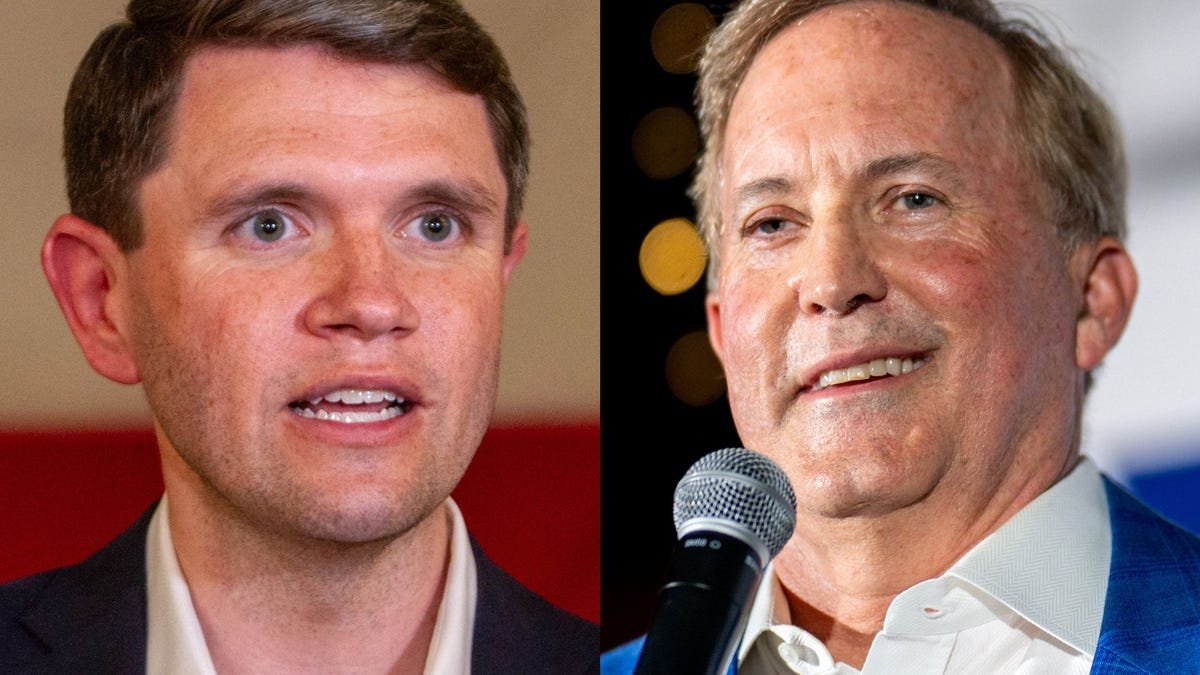
James Talarico’s Lead Over Ken Paxton: What the Numbers Reveal
While Talarico’s 42% to 39% lead falls within the poll’s margin of error, the shift from the June Texas Politics Project poll signals meaningful movement. In that previous survey, Paxton led Talarico by a single percentage point within the margin of error, 43% to 42%, with 84% of Republicans saying they would support Paxton if the election were held then.
The August numbers show Talarico consolidating Democratic support at 91%, while only 79% of Republicans have expressed their commitment to Paxton. Among independents, 37% prefer Talarico, 11% prefer Paxton, and a substantial 43% express no preference — representing a significant undecided bloc that both campaigns will target in the coming weeks.
Paxton, who ousted incumbent Sen. John Cornyn in the Republican primary after receiving former President Trump’s endorsement, faces a stiff challenge from Talarico in what will be one of the most closely watched contests of the election cycle. These Texas poll results reflect a shifting landscape as both parties intensify their efforts. Libertarian Ted Brown sits at 3% in the poll, with 14% of respondents expressing no preference.
The race has drawn national attention as Democrats eye Texas as a potential pickup opportunity, while Republicans work to defend the seat and maintain their Senate majority. Talarico, a progressive state representative known for his educational advocacy and faith-based messaging, has positioned himself as a moderate alternative capable of appealing to suburban voters who have drifted away from the GOP in recent cycles.
Texas Governor’s Race: Abbott Maintains Lead Over Hinojosa
Previous polling showed movement toward Democrats in statewide races, but the Texas Politics Project August poll indicates the trend has reversed, at least in the gubernatorial contest. Abbott leads Hinojosa 45% to 40%, with 3% preferring Libertarian Pat Dixon, 2% choosing an unspecified “someone else,” and 10% unable to express an opinion.
Despite trailing, Hinojosa is keeping the race in single digits, closer than Democrat Beto O’Rourke’s final 11-point loss to Abbott in 2022. The 5-point gap represents a competitive margin that could narrow further as Election Day approaches and voter engagement intensifies.
Hinojosa, a state representative from Austin, has campaigned on education funding, healthcare access, and infrastructure investment, while Abbott has emphasized border security, economic growth, and his record as Texas’ longest-serving governor. The Talarico Paxton race has drawn significant spending from both parties, with outside groups investing heavily in advertising and field operations across the state.
Abbott, who is seeking re-election to a fourth term as Texas governor, maintains strong support among Republican voters while appealing to moderate independents concerned about economic issues. His campaign has highlighted the state’s business-friendly climate and job growth during his tenure.
Down-Ballot Texas Races: GOP Holds Advantage Across Statewide Offices
Beyond the Senate and gubernatorial contests, the Texas Politics Project poll reveals Republican leads in all other statewide offices, though margins vary:
- Lieutenant Governor: Republican Lt. Gov. Dan Patrick (42%) leads Democratic state Rep. Vikki Goodwin (35%) by seven points
- Attorney General: Republican state Sen. Mayes Middleton (40%) leads Democratic state Sen. Nathan Johnson (35%) by five points
- Comptroller: Republican Don Huffines (40%) leads Democratic state Sen. Sarah Eckhardt (34%) by six points
These down-ballot margins reflect the broader partisan dynamics in Texas, where Republicans have dominated statewide elections for decades. However, Democratic candidates have narrowed the gaps in recent cycles, and the 2026 election could see further tightening as demographic shifts and suburban realignment continue to reshape the state’s political landscape.
The lieutenant governor’s race features Patrick, a conservative stalwart known for his social issue advocacy, against Goodwin, a moderate Democrat who has focused on education and healthcare. The attorney general contest pits Middleton against Johnson, with both candidates emphasizing their law enforcement credentials and policy priorities.
Data Centers Unite Texans: Bipartisan Opposition to Local Construction
A majority of Texans, 57%, said they oppose building a data center in their community, while only 30% expressed support and 14% had no opinion, according to the Texas Politics Project August poll. This is the second consecutive poll from the Texas Politics Project to report nearly identical findings, as its June poll showed 29% support and 56% opposition to local data center construction.
The data center opposition crosses partisan lines with notable intensity among Democrats and independents, while Republicans remain divided:
- Republicans remain closely divided: 45% support, 43% oppose
- Democrats strongly oppose: 75% oppose — with 59% saying they strongly oppose, only 15% support
- Independents oppose: 54% oppose, 19% support
Among rural voters, 25% expressed support while 60% opposed — with 44% strongly opposing the construction of data centers. Suburban Texans mirror these same feelings, with opposition consistent across geographic regions. The findings suggest that concerns about water usage, energy consumption, noise pollution, and land use associated with large-scale data centers have resonated across Texas communities.
Texas has become a hub for data center development, driven by the state’s business-friendly regulatory environment, abundant land, and access to energy resources. Major technology companies including Meta, Google, and Amazon have invested billions in Texas data center infrastructure, particularly in the Dallas-Fort Worth metroplex, Austin, and El Paso regions.
The Texas Legislature has considered various proposals to address data center regulation, including measures to streamline permitting processes and address community concerns about environmental impacts. Local governments have also grappled with balancing economic development benefits against resident opposition to large-scale industrial projects.
What Texans Think About Data Centers: Key Poll Findings
The Texas Politics Project poll provides granular insight into voter sentiment on data centers, revealing the depth and breadth of opposition across demographic and geographic categories. Key findings include:
- Overall opposition: 57% oppose building a data center in their community
- Overall support: 30% support data center construction
- No opinion: 14% remain undecided or lack sufficient information
- Intensity of opposition: Among Democrats, 59% strongly oppose; among rural voters, 44% strongly oppose
- Partisan split: Republicans are nearly evenly divided (45% support, 43% oppose), while Democrats overwhelmingly oppose
The consistency of these findings across two consecutive polls suggests that data center opposition is not a fleeting concern but a durable issue that could influence voter behavior in upcoming elections. Candidates at all levels may need to articulate clear positions on data center development, energy policy, and community planning to address voter concerns.
Frequently Asked Questions About the Texas Poll Results
Who conducted the Texas poll on Talarico, Paxton, and data centers?
The University of Texas/Texas Politics Project conducted the poll, surveying 1,200 self-reported registered voters between Aug. 5 and 13. The margin of error is plus or minus 2.83 percentage points (3.47% adjusted for weighting).
How does Talarico lead Paxton in the Texas Senate race?
The August poll shows Talarico at 42% support compared to Paxton’s 39%, with Libertarian Ted Brown at 3% and 14% expressing no preference. While Talarico leads by three points, the margin falls within the poll’s error range, indicating a statistical tie.
What are the governor’s race results in Texas?
Gov. Greg Abbott (R) leads state Rep. Gina Hinojosa (D) by 45% to 40%, with Libertarian Pat Dixon at 3% and 10% unable to express an opinion.
Why do Texans oppose data centers in their communities?
Texans cite concerns about water usage, energy consumption, noise pollution, and land use associated with large-scale data centers. The poll shows 57% opposition overall, with Democrats and independents leading the opposition while Republicans remain closely divided.
How do Republicans and Democrats differ on data center support?
Republicans are closely divided with 45% support and 43% oppose. Democrats strongly oppose at 75%, including 59% who strongly oppose. Independents oppose at 54%.
What are the down-ballot statewide race results in Texas?
Republicans lead all other statewide contests: Lt. Gov. Dan Patrick (R) leads Vikki Goodwin (D) 42-35%, Attorney General Mayes Middleton (R) leads Nathan Johnson (D) 40-35%, and Comptroller Don Huffines (R) leads Sarah Eckhardt (D) 40-34%.