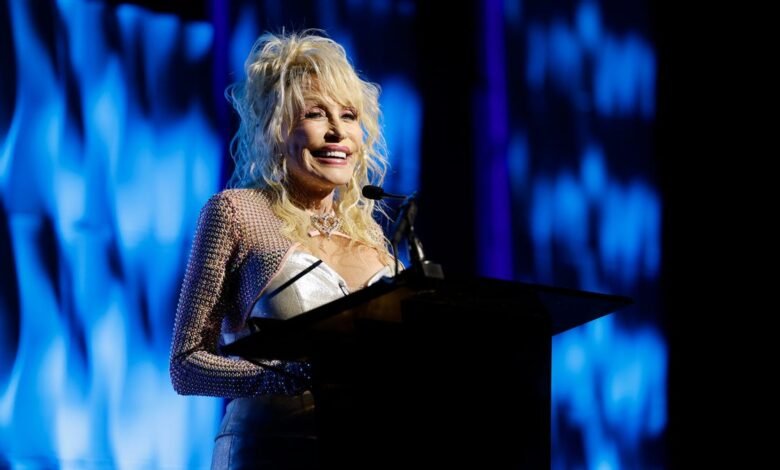
Dolly Parton said it’s a choice why she doesn’t talk about politics, and the Queen of Country maintained that position steadfastly throughout her six-decade career, refusing to pick sides even as she became one of America’s most beloved cultural icons.
- Political Neutrality: Dolly Parton said it’s a choice why she doesn’t talk about politics, explaining she has “as many Republican fans as I do Democrats” and didn’t want to offend anyone
- Medal of Freedom Declined: Parton turned down the Presidential Medal of Freedom three times – twice from Trump, once from Biden – saying she didn’t “deserve” it and feared it would look like “doing politics”
- Bipartisan Tributes: Following her death, tributes poured in from across the political spectrum – from Donald Trump to Hillary Clinton to Bernie Sanders
- Unrivaled Favorability: Parton topped a March 2026 UMass/YouGov poll with a 65% net favorability rating – 70% of Americans viewed her favorably, making her the most beloved public figure in the survey
- Imagination Library: Her book-gifting program has donated over 332 million books to children across five countries, fulfilling a promise to her illiterate father
- Flags at Half-Staff: President Trump ordered American flags flown at half-staff for a full week in Parton’s honor, declaring “there has never been anyone like her”
Parton, who died on Aug. 25 at the age of 80, built her career on music, philanthropy, and a deliberate refusal to engage in partisan battles. “I am not political, and I refuse to get caught up in political things,” Parton told USA TODAY in a 2020 interview. “I don’t like to get involved in politics, because first of all, I have as many Republican fans as I do Democrats. I don’t want to offend anybody, I have a right to myself”.
“Like God gave us free will, America gave us free speech, but you’ve got to be responsible for anything you say and do,” she added, articulating the principle that guided her approach to public life for over 50 years.
Her aversion to political commentary didn’t mean she lacked opinions – it meant she was extraordinarily careful about how she expressed them. “I know whatever I say, people are going to listen, and they’re going to make more of it than maybe what I meant. So I have to be careful,” Parton told PEOPLE in 2021. “Of course I have my opinion, but I’m not an opinionated person as a rule. You’re allowed your own beliefs and your own faith, but you don’t have to use it like a weapon when it could be a tool”.
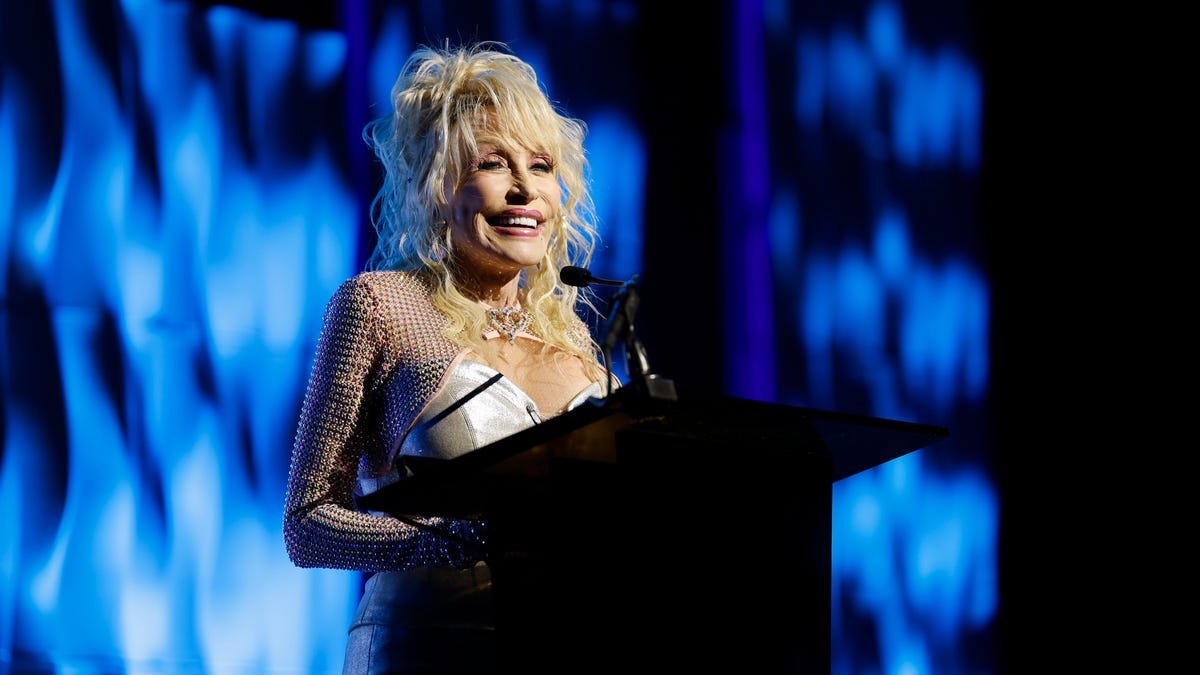
Dolly Parton said it’s a choice – why the Queen of Country refused to pick sides
Dolly Parton said it’s a choice why she doesn’t talk about politics, and she explained that rationale repeatedly across decades of interviews. Her reasoning was consistent and clear: she valued her fans too much to alienate any of them.
“I don’t want to offend anybody, I have a right to myself,” she told USA TODAY. The statement encapsulated her philosophy – that personal beliefs and privacy were not incompatible with public life.
Parton’s approach to navigating partisan waters was famously wry. “My daddy was a Republican, my mama was a Democrat, and I’m a hypocrite!” she often joked, pronouncing “hypocrite” in her iconic Tennessee drawl as “hypo-crat”.
The country legend described the partisan media landscape as “crazy” and “lunacy” in her 2020 interview. “I just look at it, and I just think what I think. I’m just saying, ‘Good Lord, what are these people doing? Crazy. They don’t care about us,'” she said.
During the 2016 presidential election, Parton caused a brief stir when comments about Hillary Clinton were interpreted as an endorsement. She quickly clarified her position, telling The New York Times that Clinton “might make as good a president as anybody ever has” and that she “personally thinks a woman would do a great job” – but she declined to endorse anyone. “I try not to get political but if I am, I might as well just run myself ’cause I’ve got the hair for it, it’s huge, and they could always use more boobs in the race,” she joked.
When a reporter attempted to draw a parallel between Trump and the sexually abusive boss in Parton’s 1980 film “9 to 5,” she refused to engage. “I’m not addressing that,” Parton said. “I learned a long time ago, keep your damn mouth shut if you want to stay in show business. … I’m not in politics, I’m an entertainer”.
Her biographer, Martha Ackmann, told NPR in 2025 that Parton’s philosophy was rooted in faith. “Dolly was raised in her grandfather’s church. She knew the Bible. And one of her favorite verses was judge not, lest you be judged,” Ackmann said. Beneath the big hair and makeup, Ackmann explained, Parton was best described by “decency – that hardcore decency that respects other people and treats others with compassion and openness”.
Dolly Parton said it’s a choice – and poll numbers proved she was right
Dolly Parton said it’s a choice why she doesn’t talk about politics, and the data suggests her strategy worked spectacularly. In a March 2026 survey by the University of Massachusetts Lowell and YouGov, Parton achieved a net favorability rating of +65% – the highest of any global figure polled.
According to the poll, 70% of Americans had a favorable impression of Parton, while only 5% viewed her unfavorably. The person who came in a distant second was former President Barack Obama, with a +14% net favorability rating. Taylor Swift, by comparison, had a +3% net favorability rating.
What made Parton’s numbers particularly remarkable was her bipartisan appeal. She was the only figure in the survey viewed favorably by a majority of Democrats, Republicans, and political independents. Three quarters of both Democrats and Republicans had a favorable opinion of the singer.
This level of cross-party support was virtually unprecedented. Swift, by comparison, was viewed favorably by a majority of Democrats but only a quarter of Republicans had warm feelings about the singer, and independents were about evenly split.
Parton’s popularity wasn’t new. She appeared multiple times on Gallup’s Most Admired Woman list and on similar rankings going back to the 1970s, including a 1978 Roper Organization poll that cited her alongside Barbara Walters, Betty Ford, and Carol Burnett as the most popular women in the country.
“Dolly was the one person who could unite a deeply divided country,” CNN concluded in its analysis of her political neutrality. At a time when no American celebrity seemed immune to partisan division, Parton remained a crossover icon who stayed neutral in the culture wars while still speaking her mind on issues that mattered to her.
The Presidential Medal of Freedom – why Dolly Parton said no three times
Dolly Parton said it’s a choice why she doesn’t talk about politics, and perhaps nowhere was that choice more striking than her repeated refusals to accept the Presidential Medal of Freedom – the nation’s highest civilian honor.
Parton revealed in 2021 that she had declined the medal on three occasions: twice from President Donald Trump and once from President Joe Biden.
“I couldn’t accept it because my husband was ill and then they asked me again about it and I wouldn’t travel because of the COVID,” she explained on NBC’s “Today” show. But her explanation went beyond personal circumstances. “Now I feel like if I take it, I’ll be doing politics, so I’m not sure,” she said.
“But I don’t work for those awards. It’d be nice, but I’m not sure that I even deserve it. But it’s a nice compliment for people to think that I might deserve it,” Parton added.
The irony was not lost on observers that Parton declined the honor from both Republican and Democratic presidents. Barack Obama, who never offered the medal to Parton, acknowledged it was a mistake. “How does Dolly Parton not have a Presidential Medal of Freedom?” comedian Stephen Colbert asked Obama on “The Late Show.” “That’s a mistake. I’m shocked,” Obama replied. “I think I assumed that she’d already got one and that was incorrect. I’m surprised, she deserves one”.
Parton’s decision to decline the medal was consistent with her lifelong philosophy. She didn’t want the honor to be perceived as a political statement, particularly in an era when such recognition had become increasingly politicized.
In a 2021 interview with PEOPLE, Parton expressed a deeper personal humility about the recognition. “I see people I love and appreciate for loving me, but honestly, it kind of frightens me. I do feel pressure when people put me on such a pedestal. I don’t deserve all that,” she said.
“I ask God every day to let Him shine through me. He’s given me that gift to be able to talk to them, and I’m very careful with it. And people don’t really come to see me be me – they come to see me be them, the parts of me they can relate to”.
Bipartisan tributes pour in – Dolly Parton brought both sides together
Dolly Parton said it’s a choice why she doesn’t talk about politics, and her death proved the wisdom of that choice. Tributes poured in from across the political spectrum, uniting figures who rarely agree on anything.
President Donald Trump ordered American flags to be flown at half-staff throughout the country for a full week in Parton’s honor. “There has never been anyone like her, and never will,” Trump wrote on Truth Social.
Former Secretary of State Hillary Clinton, former President Joe Biden, progressive Sen. Bernie Sanders of Vermont, and Republican Sen. Marsha Blackburn of Tennessee all offered tributes. It was a rare moment of bipartisan agreement – a shared appreciation for a woman who had refused to pick sides.
“Finally something Dems and GOP agree on: Dolly was an American legend,” USA TODAY declared. Kentucky Gov. Andy Beshear wrote on X that Parton “was an American icon who brought people together and spread joy,” sharing photos of his family with the singer.
Parton’s legacy extended far beyond music. The Washington Times noted that Trump’s flag order was an extraordinary honor for a private citizen, reflecting the unique place Parton held in American culture.
The tributes reflected what polling had long confirmed: Parton was America’s common ground. Newsweek described her as “America’s last cultural common ground,” noting that in an era when almost every famous person is eventually fed into the country’s partisan sorting machine, Parton was a remarkable exception.
Beyond politics – Dolly Parton’s Imagination Library legacy
Dolly Parton said it’s a choice why she doesn’t talk about politics, but she never stayed silent on what mattered most to her. Her most enduring legacy may not be her music but the Imagination Library, a program that has gifted more than 332 million free books to children across five countries.
Parton established the Imagination Library in 1995, initially serving children in her home county of Sevier County, Tennessee. The program grew from the memory of her father, Robert Lee Parton, who never learned to read or write.
“I knew in my heart his inability to read probably kept him from seeing all his dreams come true,” Parton said. “Inspiring kids to love to read became my mission”.
The program sends an age-appropriate book to registered children every month from birth until age five – at no cost to families, regardless of income. It now serves 1 in 6 children in the U.S. under age five, with programs operating in all 50 states, Canada, the United Kingdom, Ireland, and Australia.
In December 2020, Parton made her 100 millionth book donation from the Imagination Library to the Library of Congress’s collection. The program has since surpassed 332 million books globally, including more than 2 million books to children in Australia.
An international study published in 2025, led by United Way Australia’s head of research Claire Galea, found that children enrolled in the Imagination Library were nine times more likely to be read to four or more days per week compared to children not in the program. The study, which collected data from 86,000 families, found the program significantly helped prevent early literacy gaps.
When Parton donated $1 million to Vanderbilt University Medical Center to help fund Moderna’s COVID-19 vaccine, she deflected praise. “I probably get a lot more credit than I deserve, but I was happy to be part of that and to be able to try to stop something in its tracks that’s really become such a monster for all of us,” she told a UK radio station in 2021.
As a spokesperson for the Dollywood Company confirmed, the Imagination Library will continue sending books to eligible children in Parton’s absence. The organization posted a tribute to its founder: “The work ahead has never felt more meaningful, and we will carry it forward as she lifts us all up. Dolly, we will always love you”.
Parton’s unique position in American culture was perhaps best summarized by her own simple wisdom. “I don’t condemn or criticize. I just accept and love,” she told The Hollywood Reporter when questioned about working with Kid Rock. The philosophy proved remarkably effective. Dolly Parton didn’t just say it was a choice why she doesn’t talk about politics – she lived it, and in doing so, became the one American everyone could love.