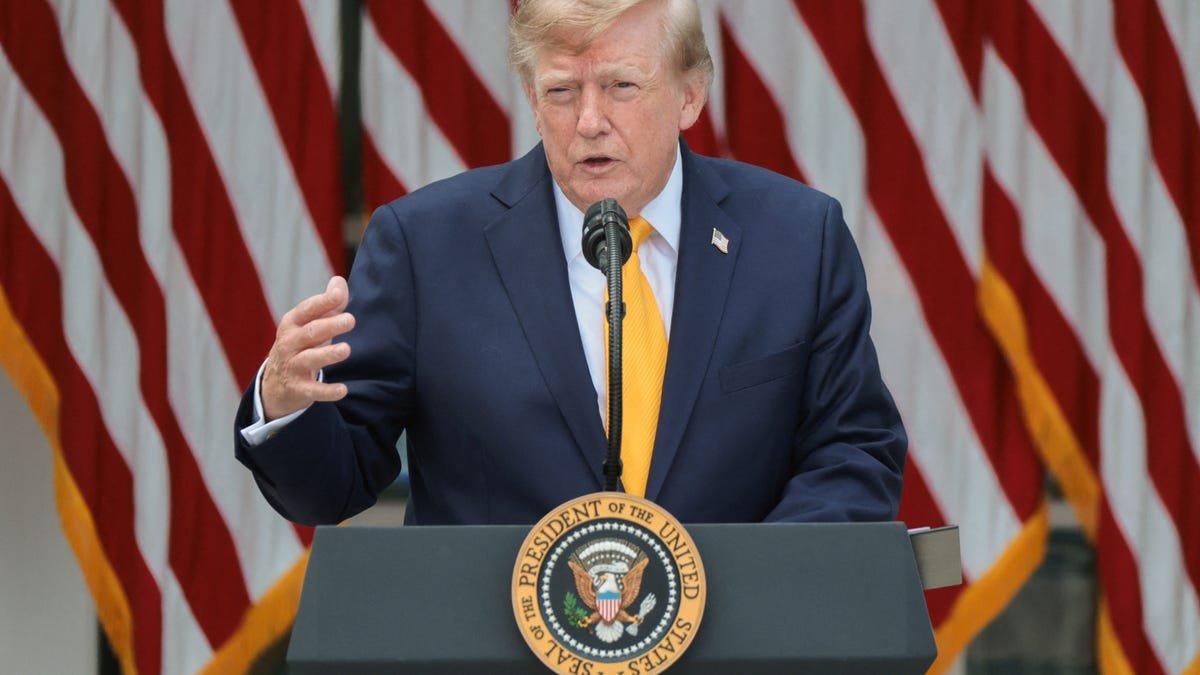
President Donald Trump suggested a connection between childhood vaccines and autism during a White House Rose Garden event, contradicting more than 40 peer-reviewed studies involving over 5.6 million people that have found no link between vaccination and autism spectrum disorder.
- Trump’s Claim: Suggested splitting the MMR vaccine into separate shots could prevent autism, stating “I think you’re going to see a very big difference in the rate of autism” at the August 24 White House event.
- Scientific Consensus: Over 40 peer-reviewed studies across seven countries involving more than 5.6 million people have concluded there is no link between vaccines and autism, according to the American Academy of Pediatrics.
- MMR Safety: The CDC states the MMR vaccine is “very safe” and highly effective, with no published scientific evidence showing any benefit from separating it into individual shots. Individual measles, mumps, and rubella vaccines are not manufactured for regular use in the United States.
- Wakefield Fraud: The vaccine-autism connection originates from a fraudulent 1998 study by Andrew Wakefield that was later retracted by The Lancet, with Wakefield subsequently losing his medical license.
- Executive Order Impact: Trump’s order calls for fewer childhood vaccines and splitting combination shots, but experts warn this decreases vaccination rates, leaves children unprotected longer, and could increase healthcare costs and insurance premiums.
Trump made the remarks while signing an executive order that calls for overhauling childhood vaccine recommendations, including splitting the combined measles, mumps, and rubella (MMR) vaccine into three separate shots administered at different visits. “We’re strongly requesting, even telling people, when you get your shots for your young child – this has to do, we think, with preventing autism – that you go to the doctor for five small shots instead of one, big, massive shot,” Trump told the crowd.
“You do it in five different shots,” Trump continued. “Small little shots where those beautiful little bodies can handle it, and I think you’re going to see a very big difference in the rate of autism.” The president has repeatedly made similar claims, with CNN fact-checker Daniel Dale noting Trump has “said over and over, falsely, that American babies are given vaccine doses the size of a glass or vat.”
Trump also falsely claimed that the prevalence of autism “20 years ago” was “1 in 10,000.” In reality, CDC data shows the known prevalence 20 years ago was 1 in 110, demonstrating an increase in awareness and diagnosis rather than a rise in actual incidence.
CDC Vaccine Safety: Autism and Vaccines – Official CDC resource detailing extensive research showing no association between vaccines and autism.
What Trump Said at the White House Rose Garden Event
During the August 24 education event, Trump framed his vaccine recommendations as a protective measure for American children. “We reformed the vaccine recommendations to protect America’s youth,” Trump told the crowd, positioning the executive order as a significant policy achievement.
“We’re strongly requesting, even telling people, when you get your shots for your young child – this has to do, we think, with preventing autism – that you go to the doctor for five small shots instead of one, big, massive shot,” Trump said. “You do it in five different shots. Small little shots where those beautiful little bodies can handle it, and I think you’re going to see a very big difference in the rate of autism.”
Trump also stated that the MMR vaccine could be “quite lethal,” a characterization that medical experts have uniformly rejected. Dr. Mehmet Oz, head of the Centers for Medicare and Medicaid Services, directly contradicted Trump’s statement during an August 23 interview on CBS’ “Face the Nation,” saying the MMR shot is “not a lethal vaccine.”
The Scientific Consensus: What CDC, WHO, and 100+ Studies Actually Show
The Centers for Disease Control and Prevention has long maintained that extensive research shows no connection between vaccines and autism. The agency’s website has stated that “to date, the studies continue to show that vaccines are not associated with” autism. However, the CDC’s position has become complicated following a November 2025 update to the agency’s website that was driven by RFK Jr.’s directive to change the CDC’s language on autism and vaccines.
The updated page now states that “the claim ‘vaccines do not cause autism’ is not an evidence-based claim because studies have not ruled out the possibility that infant vaccines cause autism.” The American Academy of Pediatrics strongly criticized this change, with President Susan J. Kressly, MD, FAAP, calling it “false information” and noting that independent researchers across seven countries have conducted more than 40 high-quality studies involving over 5.6 million people, all concluding there is no link between vaccines and autism.
The AAP’s statement emphasized: “Anyone repeating this harmful myth is misinformed or intentionally trying to mislead parents.” The Infectious Diseases Society of America also sharply criticized the CDC’s revised language, calling it “deeply troubling because it is false and lacks transparency.”
Dr. Aaron Milstone, professor of pediatrics at the Johns Hopkins University School of Medicine, reaffirmed the scientific consensus: “There’s no new science. All the data say that there’s no association between vaccines and autism. Study after study have continued to show no associations between vaccines and autism.”
WHO: Vaccines and Autism – World Health Organization resource confirming no link between vaccines and autism spectrum disorders.
The 1998 Wakefield Study: How One Retracted Paper Fueled Decades of Misinformation
The notion that vaccines cause autism traces back to a fraudulent 1998 research paper published in The Lancet by British physician Dr. Andrew Wakefield. Wakefield’s case series of 12 children proposed that the MMR vaccine might cause autism, and he recommended that the government stop using the combination vaccine and switch to individual shots given a year apart.
Investigative journalist Brian Deer later exposed that the underlying data had been faked or misrepresented. Five of the 12 children had developmental problems prior to vaccination, many did not have an autism diagnosis, and Wakefield had been hired as a consultant by a lawyer planning to sue MMR manufacturers. Wakefield had also filed a patent on his own measles-only vaccine, which he claimed was “most probably safer.”
The Lancet retracted the paper, and Wakefield subsequently lost his medical license. Despite this, the debunked theory has persisted, fueled by decades of misinformation campaigns that continue to influence public health policy today.
Expert Reactions: Pediatricians and Immunologists Push Back
Medical organizations have uniformly condemned Trump’s executive order and his repeated vaccine-autism suggestions. Dr. Andrew D. Racine, president of the American Academy of Pediatrics, stated: “Today’s executive order is not based on ‘gold-standard science.’ There is no new evidence to justify significant changes to childhood immunization guidance. Dozens of studies involving millions of people show there is no link between vaccines and autism, and yet federal leaders continue to promote this outdated, disproven idea to scare parents.”
The AAP has also expressed concern about the practical implications of splitting vaccines. Separate vaccines for measles, mumps, and rubella are not manufactured for regular use in the United States, meaning the vaccine executive order cannot be implemented as described. Splitting the shot decreases vaccination rates and leaves children unprotected over a longer period, experts say.
Additional shots would also be more time-consuming for families and could increase insurance costs, said Sen. Bill Cassidy, R-Louisiana, a physician who criticized Trump’s vaccine order. “This is inconvenient. It’s going to contribute to an increased loss of income. And by the way, instead of the insurance company paying for two doctor’s visits, they’re paying for six, which is going to ultimately drive up premiums, going after affordability,” Cassidy, who lost reelection after Trump endorsed his opponent, told CNN.
Trump’s Vaccine Evolution: From 2015 Skepticism to Executive Orders
Trump’s stance on vaccines has shifted significantly over the past decade. During the 2015 Republican presidential primary debates, Trump expressed skepticism about vaccines, suggesting a link to autism and criticizing the current vaccine schedule. In a 2015 CNN debate, Trump said: “Autism has become an epidemic. Twenty-five years ago, 1 in 10,000. Now it’s 1 in 68. There is something causing it.”
Throughout his first term, Trump continued to question vaccine safety, though he also oversaw the rapid development of COVID-19 vaccines through Operation Warp Speed. His administration’s handling of the pandemic vaccine rollout represented a complex mix of vaccine promotion and skepticism.
The recent executive order represents a significant escalation of Trump’s vaccine stance, moving from rhetorical skepticism to formal policy changes. The order calls for more vaccine “flexibility,” fewer childhood vaccinations, and splitting combination vaccines. It also states that all childhood vaccines should be spaced out, with each one administered during a separate doctor’s visit “to the maximum extent feasible.”
How Other Developed Nations Handle Childhood Vaccine Schedules
The United States is not alone in recommending combination vaccines. The United Kingdom, Canada, Australia, and most European countries all use the MMR combination vaccine as the standard of care. Research has consistently shown that combination vaccines are safe, effective, and improve vaccination compliance rates.
International health organizations, including the World Health Organization and the European Centre for Disease Prevention and Control, support combination vaccines as the most effective approach to childhood immunization. None of these countries have adopted split vaccine schedules, as experts note there is no scientific evidence supporting such an approach.
The global scientific consensus remains that combination vaccines protect children more effectively by reducing the number of visits and ensuring timely administration of all recommended vaccines.
Fact-Checking Trump’s ‘Reformed Recommendations’ Claims
Several of Trump’s statements about vaccines and autism are contradicted by scientific evidence and practical reality:
- Claim: Splitting vaccines could prevent autism. Fact: No scientific evidence supports this claim. Over 40 studies involving millions of people have found no link between vaccines and autism, regardless of schedule.
- Claim: The MMR vaccine is “quite lethal.” Fact: The CDC states the MMR vaccine is “very safe” and highly effective. Serious side effects are extremely rare.
- Claim: Autism prevalence 20 years ago was “1 in 10,000.” Fact: CDC data shows the known prevalence 20 years ago was 1 in 110, reflecting improved diagnosis and awareness rather than increased incidence.
- Claim: The executive order “reforms” vaccine recommendations. Fact: Separate vaccines for measles, mumps, and rubella are not manufactured for regular use in the United States, making implementation of the split schedule impossible.
Social Media’s Role in Amplifying Vaccine Misinformation
Social media platforms have played a significant role in amplifying vaccine misinformation, including the debunked vaccine-autism connection. Following Trump’s Rose Garden remarks, the claim spread rapidly across platforms including X (formerly Twitter), Facebook, and TikTok.
Research has shown that vaccine misinformation spreads six times faster on social media than accurate health information. A 2024 study published in the journal Vaccine found that exposure to vaccine misinformation on social media significantly increased vaccine hesitancy among parents.
Major platforms have implemented various policies to address vaccine misinformation, including content labeling, reduced algorithmic promotion, and in some cases, removal of posts that violate community guidelines. However, enforcement has been inconsistent, and misinformation continues to circulate widely.
Protecting Your Child: Evidence-Based Vaccination Guidance for Parents
For parents concerned about their child’s vaccination schedule, medical experts offer the following guidance based on decades of scientific research:
- Trust the science: Over 40 peer-reviewed studies involving more than 5.6 million people have found no link between vaccines and autism. The scientific consensus is clear and unequivocal.
- Follow the CDC schedule: The CDC’s recommended childhood vaccine schedule is developed by leading pediatricians and infectious disease experts based on extensive research.
- Discuss concerns with your pediatrician: If you have questions about vaccines, talk to your child’s doctor. They can provide evidence-based information and address any specific concerns.
- Be wary of misinformation: Critically evaluate health information from social media and other sources. Stick to reputable health organizations like the CDC, AAP, and WHO.
- Understand the risks of delaying vaccines: Delaying vaccines leaves children unprotected from serious diseases like measles, mumps, and rubella, which can have severe complications including pneumonia, encephalitis, and death.
Frequently Asked Questions About Vaccines and Autism
Did Donald Trump actually say vaccines cause autism?
Yes. At an August 24 White House Rose Garden event, Trump stated that splitting childhood vaccines into separate shots could “prevent autism” and that he expected to “see a very big difference in the rate of autism” as a result. He has made similar claims repeatedly over the years.
What does the CDC officially say about vaccines and autism?
The CDC has stated that “to date, the studies continue to show that vaccines are not associated with” autism. However, a November 2025 website update introduced confusing language, which the American Academy of Pediatrics and Infectious Diseases Society of America have strongly criticized as false and misleading.
How many scientific studies have found no link between vaccines and autism?
More than 40 high-quality peer-reviewed studies across seven countries involving over 5.6 million people have concluded there is no link between vaccines and autism, according to the American Academy of Pediatrics.
What was the 1998 Wakefield study and why was it retracted?
The 1998 Wakefield study was a fraudulent research paper published in The Lancet that falsely claimed a link between the MMR vaccine and autism. The paper was retracted after investigators found the data had been faked, and Wakefield lost his medical license.
Is the MMR vaccine safe for children?
Yes. The CDC states the MMR vaccine is “very safe” and highly effective. The vaccine protects children from measles, mumps, and rubella, all of which can cause serious complications including pneumonia, encephalitis, and death. Serious side effects are extremely rare.
What is the recommended childhood vaccine schedule?
The CDC recommends that children receive the MMR vaccine in two doses: the first at 12-15 months of age and the second at 4-6 years. This schedule has been extensively studied and found to provide optimal protection against measles, mumps, and rubella.
Has Trump changed his position on vaccines over time?
Trump has consistently expressed skepticism about vaccines since at least 2015, though his approach has varied. He oversaw the rapid development of COVID-19 vaccines through Operation Warp Speed while also questioning vaccine safety and promoting the debunked vaccine-autism connection.
What do pediatricians recommend about vaccination safety?
Pediatricians strongly recommend following the CDC’s vaccination schedule. The American Academy of Pediatrics has stated that the CDC’s revised website language is “false information” and that decades of research show no link between vaccines and autism.