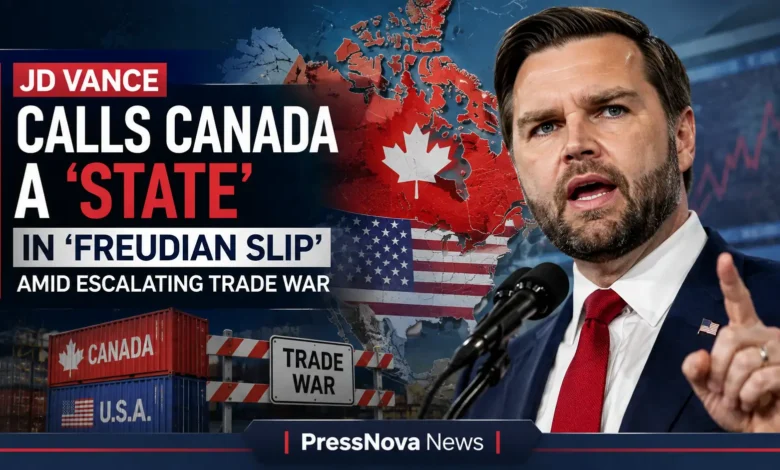
Vice President JD Vance called Canada a state during a rally in Maine on Monday, then quickly dismissed the remark as a “Freudian slip” that came as the United States and Canada are locked in an escalating trade war.
- The Gaffe: “We have to remember Canada is a state — sorry, Freudian slip. That was actually an accident.” — JD Vance in Brewer, Maine.
- Trade Context: The slip occurred hours after President Trump threatened to double tariffs on Canadian automobiles and auto parts to 50%.
- Collapsed Negotiations: Trade talks fell apart on August 22 after last-minute US demands on heavy-duty trucks and trade alliances.
- Tariffs in Effect: 50% US tariffs on $20 billion in Canadian goods took effect August 23.
- Canadian Response: PM Mark Carney vowed “dollar-for-dollar” retaliatory tariffs on $20 billion in US goods starting September 8, covering steel, dairy, appliances, and electronics.
- Local Political Angle: Maine Sen. Susan Collins (R) skipped the Vance rally and has criticized the tariffs as a “mistake.”
The vice president’s comments came during a visit to Compotech, a defense technology manufacturer in Brewer, Maine, where he was rallying support for Sen. Susan Collins (R) and defending the Trump administration’s trade policies. The gaffe quickly became the focal point of the event, drawing laughter from the crowd before he pivoted to criticizing Canada’s military spending.
“We have to remember Canada is a state — sorry, Freudian slip,” Vance said, correcting himself. “That was actually an accident.” He went on to argue that Canada “would get invaded by a foreign country were it not for the umbrella of protection provided by the United States of America.”
Senator Susan Collins, who is facing a tight re-election battle against Democrat Troy Jackson, did not attend the event, citing a prior scheduling commitment. Collins has been the most prominent Republican voice criticizing the administration’s tariffs, warning they will hurt Maine industries and consumers. Vance acknowledged their political differences, calling Collins “the most independent member of the United States Senate” and noting she “sometimes makes my job just a little bit harder.”
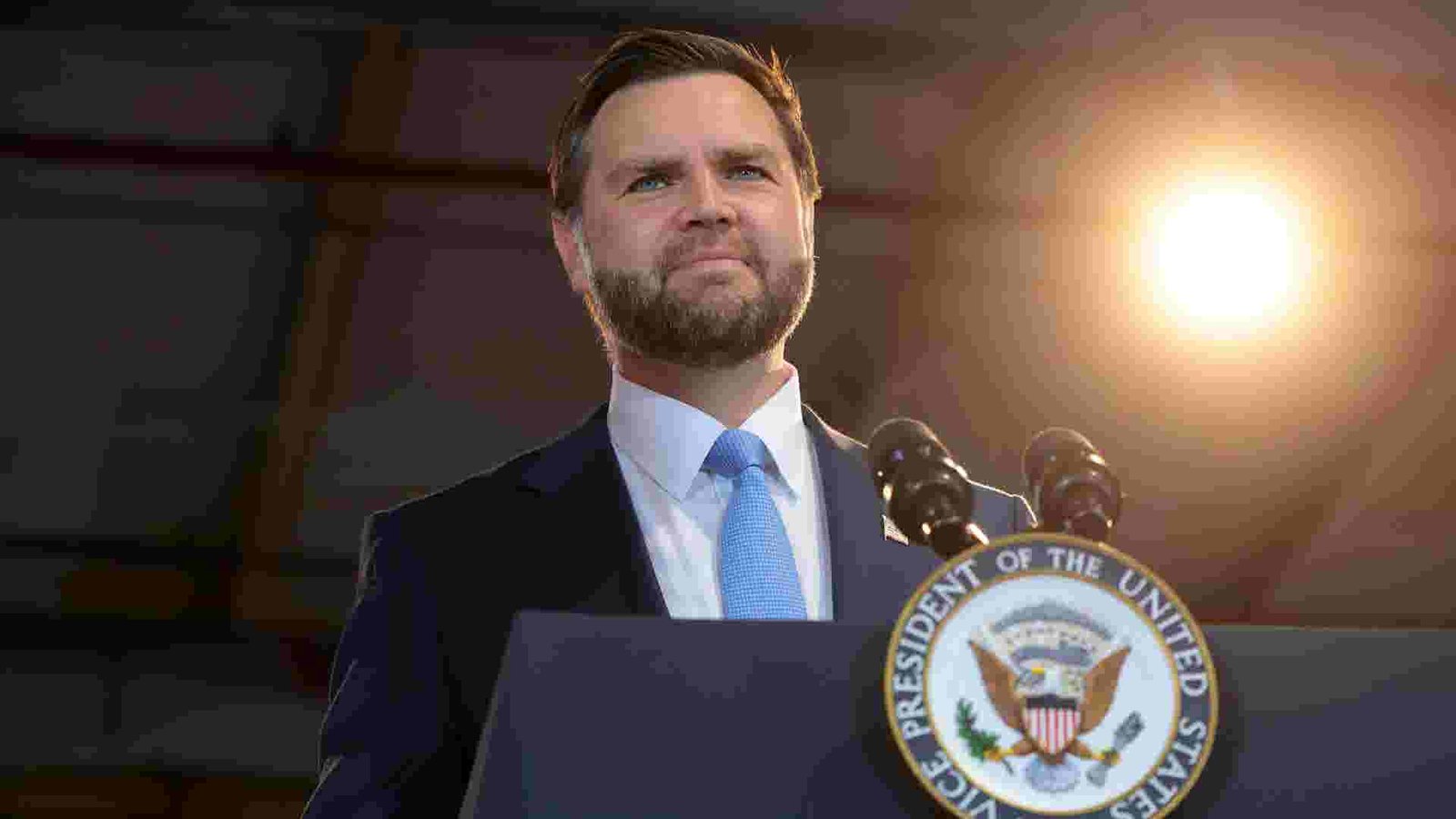
JD Vance’s “Freudian slip” is far from an isolated incident. President Donald Trump has repeatedly referred to Canada as the “51st state” and called Prime Minister Mark Carney the “future Governor of Canada.” When asked by TIME magazine if the statehood idea was a joke, Trump said, “Actually, no, I’m not.” The statehood rhetoric has unfolded alongside the most serious economic dispute between the two countries in decades, bearing similarities to the Vance trade war tariffs approach that has rattled global markets and international partnerships.
Trade War Escalates Following Failed Negotiations
The vice president’s remarks came after a tumultuous weekend that saw the collapse of trade negotiations between the US and Canada, followed by the immediate implementation of 50% tariffs on $20 billion worth of Canadian goods that took effect just after midnight on August 23.
Prime Minister Mark Carney responded by announcing Canada would retaliate with “dollar-for-dollar” tariffs on American goods, set to take effect on September 8. Carney explained that negotiations broke down because the US introduced last-minute changes that were “unfair, uneconomic, and called into question the reliability of any deal.” Canada suspended trade negotiations and recalled its negotiators from Washington.
According to Carney, the 11th-hour US demands included restrictions on Canada’s ability to pursue trade arrangements with other countries and provisions that undermined French language protections and cultural sovereignty. US officials, however, blamed Canada, with U.S. Trade Representative Jamieson Greer telling Fox News, “They’ve always had the best deal, and they still would have an even better deal, but they didn’t want that.”
Trump and Carney Clash Over Sovereignty and Trade
Trump Pressures Canada to ‘Fall in Line’
President Trump has taken a hard line on social media, posting that “without the United States, Canada couldn’t survive” and telling Canadian leaders to “fall in line” or face consequences “far WORSE.” He also mocked Ontario Premier Doug Ford, calling him the “less charismatic, intelligent, and overall unimpressive brother of the late, great, Rob Ford.”
Carney Rejects ‘Subsidiary’ Treatment
Carney has firmly rejected the premise that Canada’s sovereignty is up for debate, stating that “an attitude at the negotiation table that Canada is a subsidiary of the United States” is unacceptable. When asked why Canada was entering a trade dispute, Carney stated flatly: “Because we were attacked.”
“We pursued every opportunity to reach an agreement that protects Canadian workers and their families, that strengthens our economy and that respects Canadian sovereignty,” Carney said. “We take this step reluctantly.”
Canada’s Retaliatory Response: ‘Dollar-for-Dollar’ Tariffs Starting September 8
What Products Are Affected by Canadian Counter-Tariffs?
Carney’s retaliatory tariffs will target approximately $20 billion worth of US goods starting September 8. The measures are designed to protect Canadian companies and reduce US imports, with some products facing duties as high as 50%.
- Steel and aluminum — Canadian duties on US steel and aluminum will match the 50% US tariff level
- Dairy products — One of Canada’s key protected sectors facing retaliatory duties
- Appliances and agricultural equipment — Targeting US manufacturing exports
- Pulp, paper, and electronics — Broad industrial and consumer goods categories
- Furniture, clothing, and seafood — Additional consumer and export categories affected
The tariffs apply to just over 5% of US exports to Canada, totaling approximately $28 billion in affected goods. Exempted items include energy, potash, fish, and critical minerals. The tariffs do not qualify for preferential treatment under the USMCA trade agreement.
Impact of the Tariff War on USMCA Renewal
The rift comes as the United States, Mexico, and Canada are trying to renew the USMCA trade agreement, which Trump negotiated in his first term and once praised as a triumph. The United States has begun formal talks with Mexico to revamp the agreement, but talks with Canada have not yet begun.
On July 1, the United States officially declined to renew the agreement for another 16-year term, triggering an annual review process until the pact expires in 2036. Carney warned that the US’s disregard for existing free trade agreements sends a bad signal to international businesses and is “certainly not good news” for renewing the agreement in the future.
Canadian business leaders have expressed alarm over the collapse in negotiations. Candace Laing, president and CEO of the Canadian Chamber of Commerce, called it a “body blow to North American competitiveness in this self-defeating trade saga.” The Canadian Chamber of Commerce condemned the tariffs, stating they undermine decades of integrated supply chains and economic partnership.
Trump’s History of ’51st State’ Comments and New Provocations
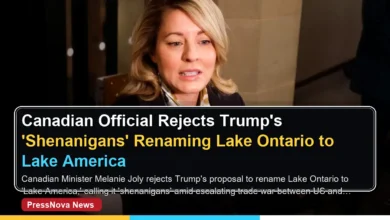
President Trump’s “51st state” rhetoric has escalated alongside the trade conflict. During a recent rally in Georgia, Trump suggested renaming Lake Ontario to “Lake America” as part of his campaign to assert American dominance over North American waters. “We’re going to change the name of Lake Ontario to Lake America, folks,” Trump said. “It sounds better, doesn’t it?”
The comments drew swift condemnation from Canadian officials, with Environment Minister Steven Guilbeault stating, “Lake Ontario is not, and will never be, Lake America. This is unserious rhetoric from a president who should be focused on solving trade disputes, not creating new ones.” The provocations have further strained relations as both countries prepare for what could be a prolonged trade conflict.
Maine Senator Susan Collins Skips Vance Rally Over Tariff Concerns
Senator Collins, a moderate Republican seeking re-election in a blue-leaning state, is a top Democratic target in a race that could determine control of the Senate. Her absence from Vance’s event marks the second time this year she has not joined the vice president during his Maine visits.
“I still think imposing new tariffs on Canada is a mistake,” Collins said on Saturday. She has also opposed new US Postal Service rules that could restrict mail-in voting, saying, “Mail-in ballots are very important to the people of Maine. I do not support restrictions that make it more difficult for seniors to cast votes on Election Day via the mail.”
Collins is the only Republican senator running for re-election in a state that then-Vice President Kamala Harris carried in the 2024 election. By highlighting her differences with the administration, Collins aims to woo independent voters and Democrats while trying to maintain Republican support.
| Date | Event | Details |
|---|---|---|
| July 20 | Trump announces 50% tariffs | Signs three proclamations targeting Canadian goods, citing “discriminatory treatment” |
| August 19 | Tariffs paused | Trump announces three-day pause, says deal is near |
| August 22 | Negotiations collapse | Canada suspends talks; last-minute US demands on heavy-duty trucks and trade alliances derail deal |
| August 23 | 50% US tariffs take effect | Tariffs apply to $20B in Canadian goods; Carney vows retaliation |
| August 24 | Vance’s ‘Freudian slip’ | At Brewer, Maine rally, Vance calls Canada a state |
| September 8 | Canadian retaliation begins | “Dollar-for-dollar” tariffs on US steel, dairy, appliances, electronics take effect |