Ferrari has filed a patent for movable taillights that double as active aerodynamic surfaces, a system that could transform how the brand manages downforce and high-speed stability across its future lineup. The filing, discovered with the United States Patent and Trademark Office (USPTO), describes a rear light assembly that shifts position relative to the rear wing or spoiler to alter the car’s aerodynamic load. While the patent includes technical drawings of a radical mid-engine hypercar concept, it also depicts a production-feasible implementation on the Purosangue SUV.
- Patent Filing: USPTO application #20260242013 describes movable taillights that serve dual purpose as lighting elements and active aerodynamic surfaces.
- Independent Control: The system features separate left and right light housings that can move independently, potentially allowing engineers to adjust aero balance during cornering.
- Three Operating Positions: The light assembly has a normal position, a second position extending rearward and upward to increase downforce, and a third position that obstructs the aerodynamic channel.
- Purosangue Application: A simpler version of the technology for the SUV shows taillights that pivot downward to enhance rear lip spoiler effectiveness.
- Hypercar Concept: The patent depicts an 849 Testarossa-inspired hypercar with an extendable rear wing and integrated light bar that could turn the vehicle into an active “long tail.”
Ferrari’s obsession with bending air to its will has reached a new frontier. The patent, first uncovered by CarBuzz, shows a rear lighting system that in its normal position functions exactly as expected, illuminating the rear of the vehicle. However, the engineering becomes far more sophisticated when the actuators engage, moving the light assembly rearward and upward. The housing exits its aerodynamic channel and extends upward to meet the wing’s downstream flow, effectively becoming another aerodynamic surface that increases rear load generation. A third position is also available, designed to obstruct the aerodynamic channel entirely.
What makes this system particularly innovative is the independent control. Ferrari has designed the light housing as two separate modules, allowing the left and right sides to move independently of each other. This configuration gives engineers the ability to manage airflow at the back of the car asymmetrically, theoretically offering a new tool for adjusting vehicle balance during cornering. The patent explicitly mentions changing the aerodynamic load on only one side of the vehicle, though the specific control algorithms remain undisclosed.
The intellectual property extends beyond low-slung supercars. Secondary illustrations in the filing depict the Purosangue SUV equipped with an adapted version of the technology. On the four-door model, the rear light clusters are engineered to pivot downward on integrated actuators, angling the light housing toward the ground during high-speed driving. This redirects air slipping over the roofline, channeling flow across the rear lip spoiler to increase downforce. Unlike the hypercar concept’s active aerodynamic channel, the Purosangue’s simpler setup lacks this feature, instead simply rotating the taillight assembly rearward and upward to protrude beyond the wing’s trailing edge.
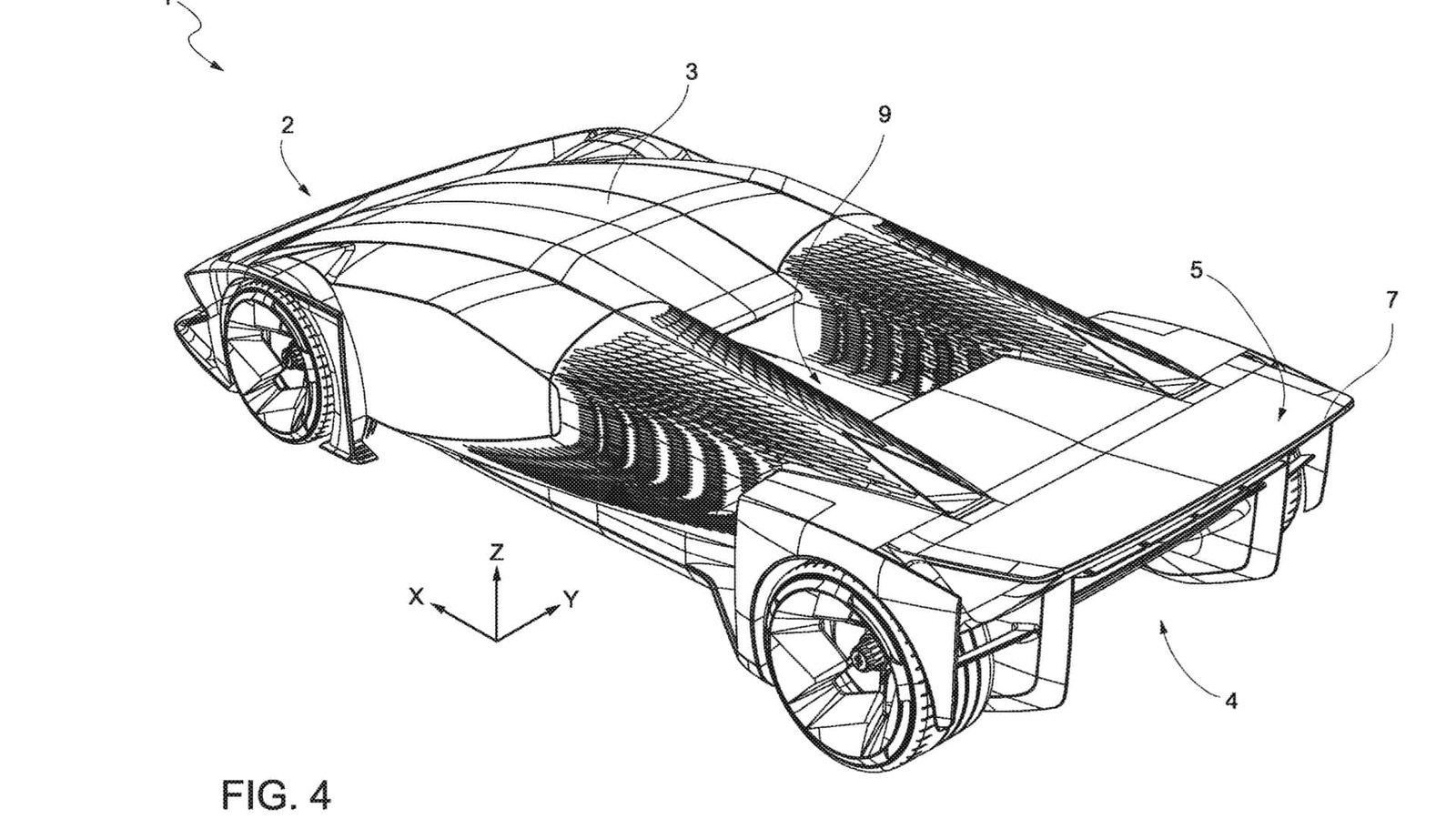
The Hypercar Concept: An Active Longtail Inspired by Le Mans
The patent’s most dramatic drawings depict a mid-engine hypercar unlike anything currently in Ferrari’s showrooms. The front end sits low with a sharp, aggressive profile reminiscent of the 849 Testarossa, while the rear features Formula 1-inspired louvers and vents. The technical drawings show a dynamic rear architecture that transforms the vehicle into a high-speed coda lunga, throwing back to the Ferrari 512S Coda Lunga Le Mans cars from the 1970s.
Rather than relying exclusively on top-mounted wings, Maranello’s design integrates an extendable light bar positioned directly beneath the primary wing assembly. Under hard acceleration or high-speed cruising, the lighting assembly shifts backward to extend the wing’s effective surface area, delaying airflow separation and maximizing ground-effect suction from the massive underbody diffuser. Under braking, the structure reconfigures instantly to add vertical load, providing greater stability and shorter stopping distances.
This approach mirrors the active aero systems seen in Formula 1, and some of the work was surely inspired by the Scuderia’s SF-26, which features active aerodynamic elements on both the front and rear wings. The active longtail concept is Ferrari’s bespoke answer to innovations like the McLaren W1‘s aerodynamic tricks: extend the tail at high speeds to slash drag, then rapidly reconfigure the structure under hard braking to slam downforce onto the rear tires. Ferrari’s dedication to pushing aerodynamic boundaries is further evidenced by a recent patent for a side-exit exhaust system, hinting at even more radical thermal management solutions for future models.
The Purosangue Application: Simpler Tech, Faster to Production
While the hypercar concept captures the imagination, the Purosangue implementation appears far more production-ready. The SUV’s version eliminates the complex aerodynamic channel found on the hypercar, offering a more straightforward setup that simply rotates the taillight assembly rearward and upward. This protruding element alters airflow at the back of the vehicle without requiring fixed aerodynamic upgrades, giving Ferrari engineers more control over the car’s characteristics across different driving conditions.
Ferrari’s approach reflects a pragmatic understanding of what’s feasible. While the company has filed a patent for the hypercar’s radical system, that doesn’t guarantee production plans. If anything, we will see Ferrari implement the simpler version of the patent first before it produces anything as wild as the concept. The Purosangue application represents a logical step in active aero evolution, using existing SUV architecture to test and refine technology that could eventually find its way onto more exotic models.
For the Purosangue, the movable taillights would enhance the effectiveness of the small rear lip spoiler without adding complexity or visual clutter. The system would engage only at higher speeds, remaining invisible during everyday driving where the SUV’s design aesthetic can remain unblemished. This aligns with Ferrari’s philosophy of maintaining clean exterior lines until aerodynamic intervention is explicitly required.
Why This Patent Represents the Next Frontier in Active Aerodynamics
The race for peak horsepower might finally be hitting a ceiling, but the competition for downforce is getting wilder by the day. Ferrari’s movable taillight patent demonstrates a commitment to extracting performance from every surface of the vehicle, even components traditionally seen as purely functional. The system transforms a passive exterior element into a dynamic tool that can adapt in real-time to driving conditions.
What sets this patent apart from conventional active aero systems is its integration of multiple functions. The light housing doesn’t just adjust airflow; it serves as a structural component that can alter the aerodynamic channel’s characteristics in three distinct positions. This multifunctionality represents a shift toward holistic vehicle design, where every component is drafted into physical labor in service of performance.
Ferrari’s evolution toward dynamic exterior surfaces is clear when tracing the lineage from the LaFerrari to the SF90 Stradale and the recent F80. The company is moving beyond basic active flaps toward fully integrated solutions that blur the line between design and engineering. Whether these shapeshifting tails and tilting taillights ever reach the showroom floor remains uncertain, but the patent filing itself signals Ferrari’s direction: the future of performance belongs to cars that refuse to stay in one shape. This forward-thinking philosophy also extends to the company’s electrification efforts, with the upcoming first EV bearing a name inspired by modern design cues, showing that Ferrari’s innovation spans both powertrain and aerodynamic frontiers.
Ferrari’s Broader Active Aero Strategy and Future Models
This patent represents the latest in a series of active aero developments from Maranello. Ferrari has previously filed patents for adjustable body panels and deployable aerodynamic surfaces, and current production models already utilize active spoilers and adjustable elements. However, the movable taillight system distinguishes itself through its integration of lighting and aerodynamic functions, offering a more elegant solution than traditional bolt-on aero parts.
The contrast with Ferrari’s approach on the electric Ferrari Luce is particularly interesting. That model achieved a record low coefficient of drag of 0.254 Cd for a road-going Ferrari, eschewing active aero in favor of a fixed body designed for minimal drag and reduced weight. The new patent shows the opposite direction: on future sports models, even the lighting technology could become a movable aerodynamic element. This dual-track strategy suggests Ferrari will continue developing both passive and active solutions based on each model’s specific mission profile.
As emissions regulations tighten and powertrain choices become more complex, aerodynamics will only grow in importance. Ferrari appears determined to lead in this area, using patents like this one to stake claims on innovative solutions even before production viability is confirmed. Whether the technology reaches production or remains a concept, the filing shows Ferrari has no plans to stop innovating in the pursuit of performance.
Frequently Asked Questions About Ferrari’s Movable Taillight Patent
What is Ferrari’s new patent for movable taillights?
Ferrari’s USPTO patent #20260242013 describes a rear light assembly that can move relative to the rear wing or spoiler to alter aerodynamic load. The system has three positions: normal lighting mode, an extended position that increases downforce, and a third position that obstructs the aerodynamic channel. The housing features independent left and right modules for asymmetric control.
Will Ferrari actually build the hypercar shown in the patent?
Probably not. Ferrari regularly patents radical concepts to protect intellectual property and prevent rivals from using similar technologies. The hypercar depicted in the drawings appears to be a design study rather than a production preview. If anything, Ferrari will likely implement the simpler Purosangue version first before attempting anything as extreme as the concept car.
How does Ferrari’s movable taillight system work?
The system uses actuators to shift the light assembly from its normal position. On the hypercar version, the lights move rearward and upward, exiting an aerodynamic channel and extending to meet the wing’s downstream flow. This effectively makes the light housing an additional aerodynamic surface. On the Purosangue version, the taillights pivot downward to improve the effectiveness of the rear lip spoiler.
What makes this patent different from other active aero systems?
The key innovation is the integration of multiple functions into a single component. The light housing serves as lighting, aerodynamic surface, and channel control device simultaneously. The independent left-right control is also significant, potentially allowing Ferrari engineers to adjust aero balance during cornering, a capability not available in most existing active aero systems.
Will the Purosangue get movable taillights soon?
While Ferrari hasn’t confirmed production plans, the Purosangue implementation appears more feasible than the hypercar concept. The simpler rotating light mechanism could be integrated into the SUV without requiring major structural changes. However, like all patents, there’s no guarantee the technology will reach production, and if it does, timing remains uncertain.
How does this relate to Ferrari’s Formula 1 technology?
Ferrari’s SF-26 Formula 1 car features active aero on both front and rear wings, including the novel rotating “macarena wing”. The patent application shows that some of this F1-derived thinking is influencing Ferrari’s road car development, particularly in how aerodynamic surfaces can adapt in real-time to different driving conditions.