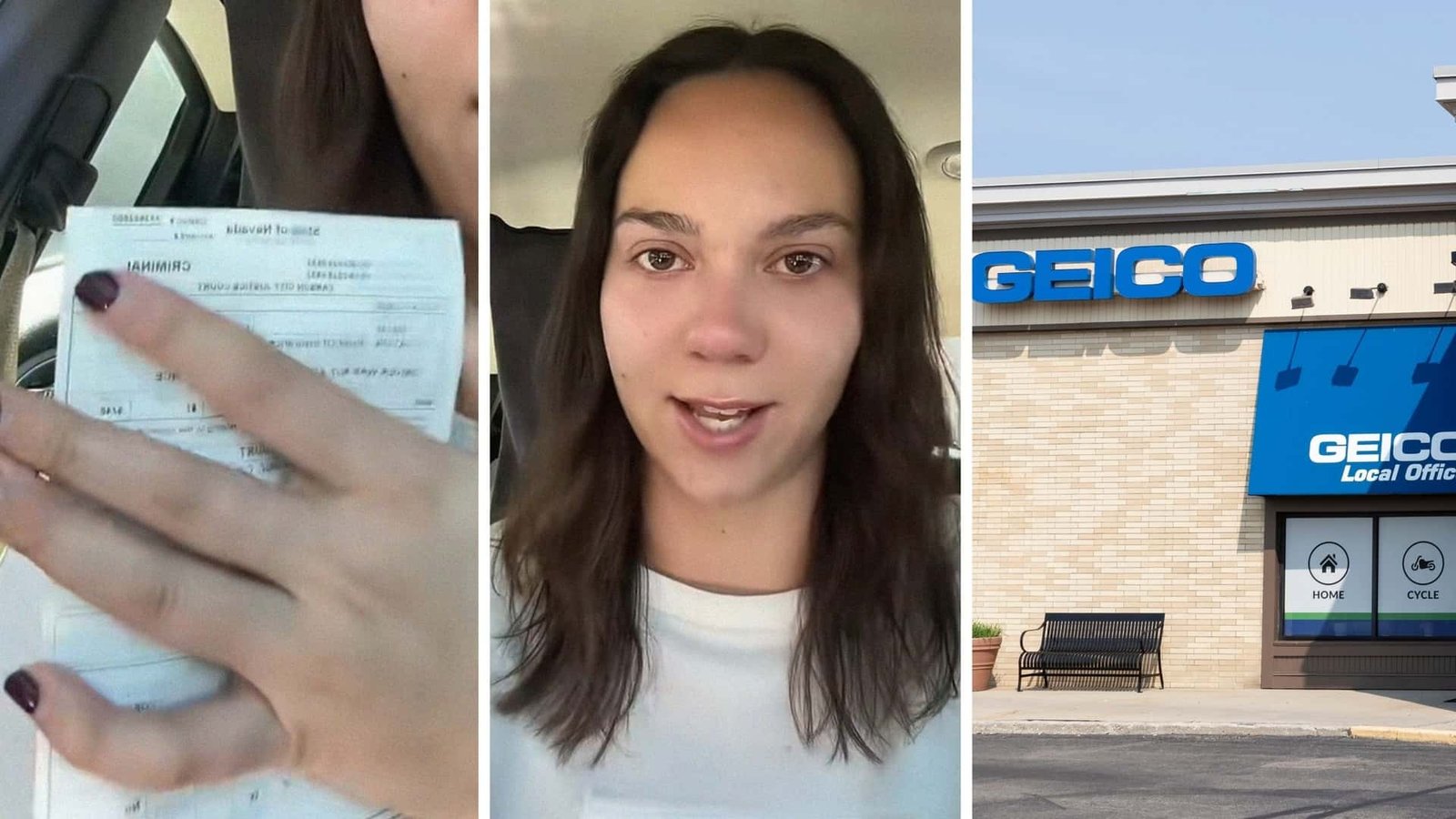
A woman who unknowingly paid Geico insurance for her sister’s car instead of her own was hit with a criminal charge and $740 bail after a Vehicle Identification Number mix-up led to a traffic citation in Carson City, Nevada.
- Incident: TikTok creator Kaley (@kaleythemermaid) received a criminal citation after discovering her Geico policy covered her sister’s vehicle, not her own
- VIN Discrepancy: The Vehicle Identification Number on her car didn’t match the one on her Geico insurance, likely because she and her sister have the same make and model vehicle
- Bail Amount: Kaley faces $740 bail or a court appearance in Carson City, Nevada at the end of August
- Court Update: Kaley confirmed “the court did not find favor with me” in a video caption
- Legal Status: Driving without insurance in Nevada is a misdemeanor, but state law allows charges to be dismissed if proof of valid insurance is presented to the court
- Warrant Threat: Failure to pay bail or appear in court within 90 days could result in an arrest warrant
- Video Reach: Kaley’s TikTok video has amassed over 1.2 million views and thousands of comments since being posted on August 24, 2026
TikTok creator Kaley (@kaleythemermaid) went viral after sharing her predicament with followers, explaining that she was criminally cited for unknowingly paying her sister’s Geico car insurance for an undisclosed period. In her video, posted August 24, 2026, Kaley states, “POV: You just got a criminal charge from the police because this whole time you were insuring your sister’s car … and not [yours].” The clip has since garnered over 1.2 million views, sparking widespread discussion about insurance bureaucracy and legal consequences.
Kaley explained that the Vehicle Identification Number on her car doesn’t match the one listed on her Geico insurance policy. This confusion appears to stem from the fact that she and her sister own identical makes and models of vehicles, leading to the mix-up. “I wonder if she’s insuring my car,” Kaley says in the video. “If I don’t pay bail or show up to court in 90 days, there’s a warrant out for my arrest.” The TikTok creator also mentioned she has reached out to her sister to determine whether the reverse situation occurred—her sister unknowingly insuring Kaley’s vehicle instead of her own.
Holding up what appears to be a traffic citation, Kaley revealed her bail is set at $740. She explained that her court date is scheduled for the end of August in Carson City, Nevada, but she will be traveling and unable to attend in person. “I really hope the Carson City Justice Court finds favor with me when I call them and tell them the issue,” she said. However, in her video caption, she later updated followers: “The court did not find favor with me.” Her first course of action was contacting Geico to correct the VIN situation. Geico has not yet issued a public statement confirming whether the error originated with the company’s data entry or if Kaley provided incorrect information when setting up the policy.
@kaleythemermaid Update: the court did not find favor with me😍 (officer Ramirez was so nice though🫶🏼)
What Nevada Law Says About Driving Without Insurance and VIN Errors
Under Nevada Revised Statutes NRS 485.187, driving without proper insurance is classified as a misdemeanor offense. The law states that any person who operates a motor vehicle without having insurance as required by NRS 485.185 is guilty of a misdemeanor, punishable by a fine of not less than $600 nor more than $1,000 for each violation. However, the statute includes a crucial exception that could help drivers in Kaley’s situation.
According to NRS 485.187(4)(a), a court “shall not find a person guilty or fine a person for a violation” if the individual presents evidence that the required insurance was in effect at the time the demand was made. This means that if Kaley can prove her Geico policy was active when she was cited—even if the VIN was incorrect—the court should dismiss the charge. This provision explains why commenters suggested the situation might be resolved as a “fix-it ticket,” which is the primary path to resolution in such cases.
The Nevada Department of Motor Vehicles also has the authority to suspend driver’s licenses for insurance violations, and driving without a valid policy carries significant consequences beyond fines. The court process for resolving such citations typically takes 30 to 90 days, depending on court scheduling and the complexity of the documentation required. To successfully resolve the matter, drivers like Kaley need to present their insurance declaration page, proof of payment for the policy period in question, and a corrected insurance card showing the proper VIN.
Attorney John Michaels, a Las Vegas-based traffic defense lawyer not affiliated with Kaley’s case, told PressNova News: “Under Nevada law, these VIN discrepancy cases are usually resolved quickly if the driver can show they had active coverage. The key is bringing the correct documentation to court. Most judges understand that administrative errors happen, but the burden is on the driver to prove they were insured at the time of the citation.”
The Legal Reality Behind VIN Mix-Ups and Criminal Charges
While some commenters dismissed Kaley’s situation as “just a ticket” and not a criminal charge, the legal reality is more nuanced. In Nevada, driving without insurance is indeed a misdemeanor criminal offense, not merely a civil infraction. One commenter argued, “Girl, this is not a criminal charge, lmao. It’s a traffic citation,” while another clarified, “This is a fix-it ticket. Show them that you fixed it, explain the mix-up. They should drop the charges.”
Massachusetts news outlet WCVB reported a similar case on June 15, 2023, where incorrect VIN entries on a Geico policy led to police impounding a vehicle and criminal charges. In that case, two errors in the VIN recorded on the registration resulted in the vehicle being stopped, with police believing it wasn’t properly registered or insured. The issue reportedly stemmed from Geico’s side, yet the driver still had to go to court to resolve what constituted a criminal charge under Massachusetts law. Ultimately, a judge dismissed the charges in Case No. 2345-CR-0897, but the family incurred significant legal expenses.
This pattern demonstrates that while these situations can escalate to criminal charges, courts typically show leniency when the driver can prove they had active insurance coverage at the time of the citation, even if a bureaucratic error caused the discrepancy. The “fix-it ticket” mechanism is designed precisely for these scenarios, allowing drivers to resolve the matter by presenting proper documentation without a criminal conviction.
How a VIN Error Can Become an Insurance Nightmare
According to Geico, providing agents with the correct VIN allows them to give you the right price and keeps you in good standing with your state’s DMV. However, as Kaley’s case illustrates, VIN errors can have serious consequences that extend far beyond administrative confusion.
A Foxborough woman experienced a similar ordeal after switching to Geico, where two digits in her VIN were incorrectly recorded. Geico reported the wrong number to the Registry of Motor Vehicles, and when she went to court with her son—because the infraction was criminal—the judge told her he sees such cases “all the time”: an insurance company makes a mistake in reporting information to the RMV, but it’s the driver who ends up paying the price. The judge immediately dismissed the charges, but the woman was left with hundreds of dollars in expenses. Geico reportedly blamed her for the error, claiming she had provided the wrong VIN.
In another incident reported by WCVB, a woman’s son was pulled over while borrowing a vehicle she had insured through Geico. Two errors in the VIN recorded on the registration led police to impound the vehicle, believing it wasn’t registered or insured. Records showed the issue stemmed from Geico’s side, yet the family still had to go to court to resolve what was treated as a criminal charge.
Commenters offered practical advice for Kaley’s situation, with one suggesting, “First, I’d call your sister, because if she’s insuring your car, then you just need to show them that insurance card. Then, I’d call Geico, because if you never gave them her VIN, they looked it up and found the wrong vehicle.” Another viewer noted that providing proof of valid insurance at the time of citation should result in the charges being dropped. Kaley has not confirmed whether her sister has verified which vehicle she has been insuring.
How to Protect Yourself From Insurance VIN Discrepancies
Kaley’s experience highlights several important steps drivers can take to avoid similar legal complications:
- Verify your VIN on every insurance document—Even a single digit error can create legal problems, as seen in cases where only two incorrect VIN digits led to criminal charges.
- Compare your insurance card with your vehicle registration—Ensure the VIN on both documents matches exactly.
- Review your policy documents carefully—Don’t just check the final four digits, as errors often occur earlier in the VIN sequence where they’re harder to spot.
- Check your registration form from the DMV—If your insurance company reports an incorrect VIN to state authorities, it will appear on your registration documents.
- Keep proof of insurance in your vehicle at all times—Nevada law requires drivers to have evidence of insurance available, either physically or electronically.
- If you receive a citation for insurance issues, respond promptly—Failure to appear in court within 90 days can result in an arrest warrant, as Kaley warned in her video. The typical court process takes 30 to 90 days for resolution.
- Gather all required documentation—Bring your insurance declaration page, proof of payment, corrected insurance card, and vehicle registration to any court appearance.
As the Nevada statute makes clear, presenting evidence of valid insurance at the time of citation typically results in dismissal of charges. However, the inconvenience and stress of navigating the legal system can be significant, making prevention the best strategy.
Commenters Debate: Is This Really a Criminal Charge?
Kaley’s TikTok video generated significant debate in the comments section, with viewers divided on the severity of her situation. Some argued she was overreacting to what amounts to a routine traffic citation rather than a genuine criminal matter.
“This is a ticket and it’s not bail,” one viewer commented, while another insisted, “This is a fix-it ticket. Show them that you fixed it, explain the mix-up. They should drop the charges.” The distinction between “bail” and simply paying a fine became a point of contention among commenters who felt Kaley was misrepresenting the legal severity of her situation.
However, under Nevada law, the distinction is less clear-cut. While driving without insurance is a misdemeanor—technically a criminal offense—the statute includes provisions for dismissal when proof of insurance is provided. This means the outcome largely depends on whether Kaley can demonstrate she had active coverage at the time of the citation, regardless of the VIN error.
As of the time of reporting, PressNova News contacted Kaley via TikTok comment and direct message for comment but had not received a response. Geico has also not provided an official statement regarding whether the VIN error originated from their data entry or from information provided by the policyholder.
What the Geico Insurance Mix-Up Means for Drivers Nationwide
Kaley’s situation serves as a cautionary tale about the importance of verifying insurance details and the potential consequences of bureaucratic errors. While the specific citation occurred in Nevada, similar laws exist in most states, meaning VIN discrepancies can lead to legal trouble anywhere.
The case also highlights a troubling pattern: when insurance companies make VIN recording errors, it’s often the policyholder who bears the legal and financial burden. In one Massachusetts case from June 2023, a judge noted he sees this “all the time”—insurance companies reporting incorrect information to the RMV while the driver faces criminal charges.
For drivers in Nevada specifically, the path to resolution is clear under state law. Providing the court with evidence of valid insurance coverage at the time of citation should result in dismissed charges. The statute explicitly states that courts “shall not find a person guilty or fine a person” if proof of insurance is presented.
However, the journey to that resolution—including court appearances, legal fees, and the threat of warrants—can be stressful and costly. Kaley’s experience underscores the value of regularly verifying that your insurance policy correctly identifies your vehicle, particularly if you share a vehicle model with family members.