The morning air in Lower Manhattan was crisp, carrying with it the scent of possibility and the unmistakable hum of a city poised on the brink of change. Outside City Hall, a crowd had gathered, a diverse tapestry of New Yorkers reflecting the very essence of the five boroughs. You could feel the electricity in the air, a palpable blend of hope, curiosity, and a touch of the characteristic NYC skepticism. Today was the day. Today, history would be made as Zohran Mamdani was sworn in as NYC Mayor, ushering in what many believe will be a profoundly new chapter for New York City. It wasn’t just another mayoral inauguration; this felt different, a seismic shift in the political landscape, signaling a fresh direction for urban governance. People craned their necks, jockeying for position, eager to witness this historic moment unfold. “I’ve been waiting for this for so long,” a woman next to me whispered, clutching a homemade sign advocating for affordable housing. Her eyes, like so many others, were fixed on the steps where Mamdani would soon stand, ready to take the oath that would officially make him the leader of this magnificent, complex metropolis. The expectation was immense, the challenges even greater, but for a brief, shining moment, the dominant emotion was pure, unadulterated excitement for what was to come.
A City Holds Its Breath: The Swearing-In Ceremony
The grandeur of the moment was undeniable. Inside City Hall’s historic chambers, packed to capacity, the atmosphere was a mix of solemn tradition and vibrant anticipation. Dignitaries, community leaders, and elected officials mingled, their conversations hushed but animated. Outside, the overflow crowd cheered as news filtered through about the proceedings. The sound of applause rippled through the square as Zohran Mamdani, with a calm demeanor that belied the monumental task he was about to undertake, stepped forward to take the oath of office. He placed his hand on a worn copy of the U.S. Constitution, his family standing proudly beside him. When the words, “I, Zohran Mamdani, do solemnly swear…” echoed through the hall, a collective sigh seemed to sweep across New York City. He finished, “So help me God,” and a thunderous ovation erupted, both inside and out. It was a powerful, emotionally charged scene. “It’s real,” an elderly gentleman, a lifelong Bronx resident, remarked, wiping a tear from his eye. “He’s really done it. We have a mayor who understands us.”
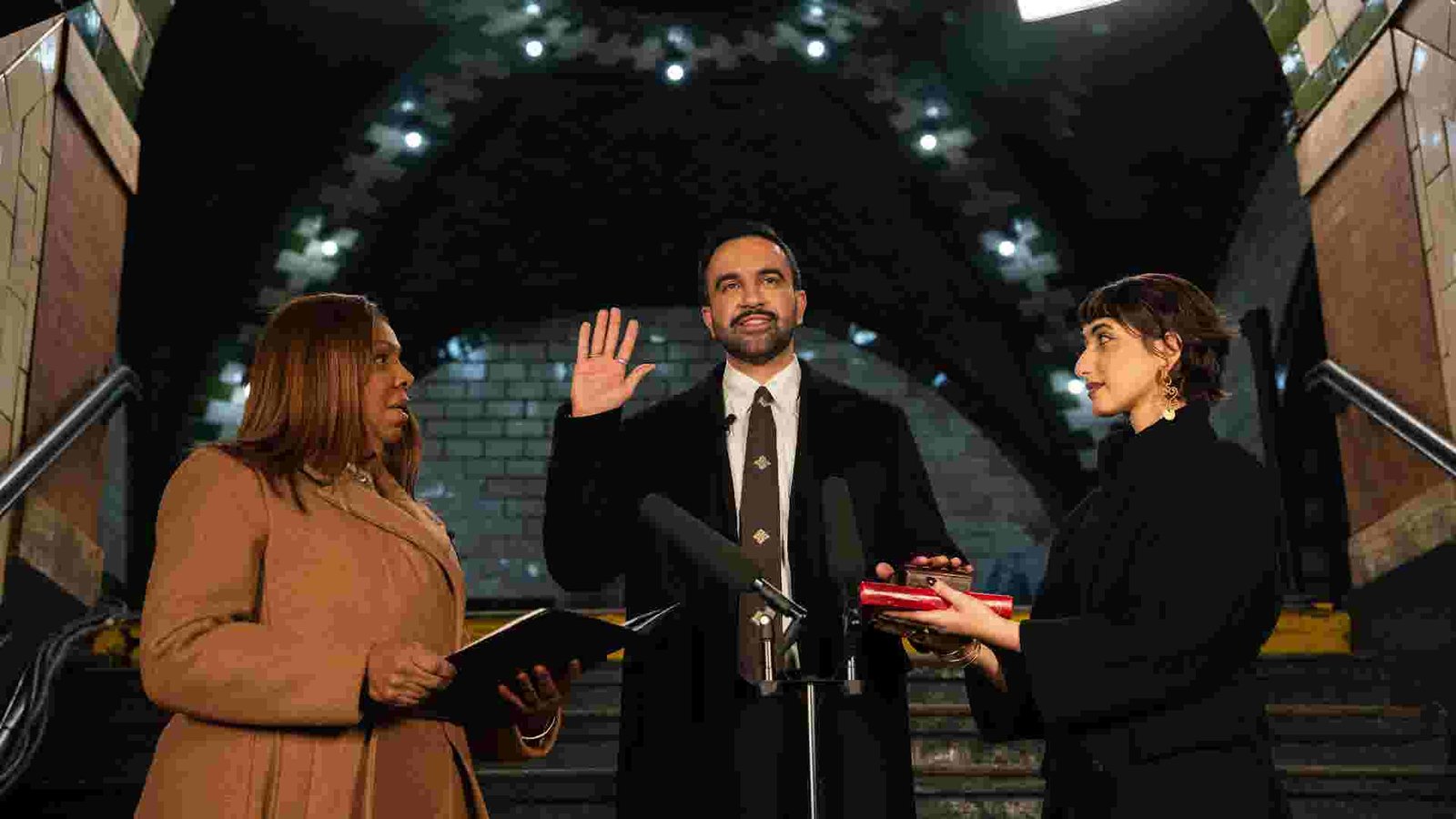
His inaugural address, delivered with passion and conviction, outlined a vision for a more equitable and inclusive New York City. He spoke of the struggles faced by working-class families, the urgency of climate action, and the need to dismantle systemic inequalities. “This isn’t just a victory for me,” he declared, his voice ringing clear, “it’s a victory for every New Yorker who has ever felt unseen, unheard, or unrepresented. We are building a city where everyone has a fair shot, where our streets are safe, our transit is reliable, and our homes are affordable.” The speech was met with enthusiastic applause, punctuated by cheers of “Mamdani! Mamdani!” It was clear that for many, his ascension to the city’s highest office represented a true shift in the focus of New York politics, moving towards a more progressive and community-centered approach.
Who is Zohran Mamdani? Tracing a Journey to City Hall
To understand the significance of this moment, one must first understand the man at its center. Zohran Mamdani is not your typical career politician. Born in Kampala, Uganda, and raised in New York, his background is as diverse as the city he now leads. He is perhaps best known for his previous role as a State Assemblymember for the 36th District, representing Astoria, Queens. During his tenure in the Assembly, Mamdani quickly established himself as a prominent voice for progressive causes, advocating fiercely for tenants’ rights, climate justice, and universal healthcare. His journey into politics was not a conventional one; before entering the political arena, he was a hip-hop artist and organizer, deeply embedded in social justice movements. This unconventional path has given him a unique perspective, one that resonates deeply with a younger generation and diverse communities across New York City.

His campaign for mayor was fueled by grassroots enthusiasm, eschewing traditional big-money donors in favor of small-dollar contributions and volunteer power. This approach allowed him to connect directly with voters, particularly in neighborhoods often overlooked by established political machines. “He actually listens,” said Maria Rodriguez, a community organizer from Bushwick. “He’s not just talking at us; he’s talking with us about what we really need.” His identity as an East African, South Asian, Muslim American also holds profound meaning in a city that prides itself on its multicultural fabric. It signals a shift away from the traditional power structures, representing a more inclusive vision of leadership for New York City. His story is, in many ways, the embodiment of the American dream, reimagined through a lens of social justice and community empowerment. It’s a powerful narrative, especially for the city that never sleeps, always striving for better.
The Progressive Promise: Mamdani’s Vision for NYC
During his campaign, Zohran Mamdani laid out an ambitious, distinctly progressive agenda aimed at tackling some of New York City’s most entrenched problems. His platform wasn’t just a list of talking points; it was a comprehensive blueprint for systemic change, drawing heavily on his experiences as an organizer and legislator. His core promises revolved around making the city more livable, equitable, and sustainable for all residents. He often spoke of a “New York for the many, not the few,” a slogan that captured the imagination of many voters who felt left behind by previous administrations. The sheer audacity of his proposals, from sweeping housing reforms to a complete overhaul of public transit, excited his base and sparked vigorous debate across the city.
Tackling NYC’s Housing Crisis
Perhaps no issue resonated more deeply with New Yorkers than the ongoing housing crisis. Mamdani’s plan is multifaceted and bold. He’s pledged to aggressively expand truly affordable housing programs, going beyond simply market-rate units, and to implement stronger tenant protections, including universal rent control and the right to counsel for all tenants facing eviction. “I’ve seen families torn apart because they can’t afford their rent anymore,” shared Sarah Chen, a mother of two from Queens. “My building just hiked prices again, and it feels like we’re constantly on the edge. Mamdani promised to fight for us, and I really believe he will.” He also aims to convert vacant commercial spaces into residential units, a practical solution to increase housing stock while revitalizing struggling business districts. This isn’t just about building more; it’s about making sure the housing built serves the people who actually live and work in the city.

Reimagining Public Transit and Infrastructure
Another cornerstone of Mamdani’s agenda is a complete rethinking of New York City’s public transit system. He has advocated for vastly improved subway and bus services, pushing for increased funding for the MTA, and exploring options for fare-free public transit for low-income residents. His vision also includes expanding bike lanes, pedestrianizing more streets, and investing heavily in green infrastructure to combat climate change and improve air quality. “The subway is my lifeline, but it’s often a nightmare,” commented David Green, a student commuting from Brooklyn to Manhattan. “If he can actually make it reliable, cleaner, and more accessible, that would be revolutionary.” He envisions a city where sustainable transportation isn’t just an option, but the preferred mode of travel, reducing congestion and carbon emissions simultaneously.
Social Justice and Economic Equity
Beyond housing and transit, Mamdani’s platform is deeply rooted in social justice. He has promised significant reforms to the criminal justice system, advocating for community-led safety initiatives, mental health crisis response teams, and a reduction in police brutality. On economic equity, he aims to strengthen workers’ rights, increase the minimum wage, and support small businesses, particularly those owned by women and minorities. He’s also a proponent of universal childcare and expanding access to quality public education, believing these are fundamental rights, not privileges. These initiatives, if successfully implemented, could fundamentally reshape the daily lives of millions of New Yorkers, fostering a more just and prosperous city for everyone.
Reactions and Expectations: A Divided City?
While the cheers at City Hall were deafening, it’s important to acknowledge that not everyone in New York City greeted Mamdani’s inauguration with the same level of enthusiasm. The city is a mosaic of opinions, and significant segments of the population have expressed reservations or outright concern about his progressive agenda. “I’m worried about what this means for businesses,” stated Michael Thompson, owner of a small manufacturing plant in Staten Island. “His policies sound great on paper, but I fear they could lead to increased taxes and regulations that make it harder to operate here.” This sentiment is echoed by some in the financial sector and real estate, who fear that overly progressive policies could deter investment and lead to an exodus of high-income earners.
On the other hand, unions, grassroots organizations, and a vast majority of the city’s diverse working-class communities have expressed immense hope. “It feels like we finally have a seat at the table,” remarked Elena Petrova, a member of a tenants’ rights group. “For too long, the city has catered to the rich. Now, maybe it’s our turn.” The divide highlights the inherent tension in governing such a vast and varied metropolis, where the interests of different groups often clash. Mamdani will undoubtedly face the challenge of uniting these disparate voices and finding common ground, a task that requires immense political skill and a willingness to compromise without abandoning his core principles. The political landscape of New York politics is notoriously tough, and navigating it will require more than just popular support; it will demand strategic execution and effective diplomacy.
The Road Ahead: Challenges and Opportunities for the New Mayor
The office of NYC Mayor is arguably one of the most demanding political positions in the world. Zohran Mamdani steps into a role laden with immense challenges, from managing a multi-billion dollar budget and addressing persistent crime rates to guiding the city through a complex post-pandemic economic recovery and navigating its intricate relationship with state and federal governments. He will need to build strong coalitions within the City Council, manage powerful special interest groups, and deliver tangible results quickly to maintain the trust and enthusiasm of his base.
| Key Campaign Promise | Potential Challenge |
|---|---|
| Universal Rent Control & Affordable Housing Expansion | Resistance from real estate developers; funding limitations; legal challenges. |
| Improved & Fare-Free Public Transit (for low-income) | MTA budget constraints; state control over MTA; logistical complexities. |
| Reforming Criminal Justice & Community Safety | Public safety concerns; police union resistance; balancing reforms with crime reduction. |
| Green Infrastructure & Climate Action | Significant upfront costs; coordination across multiple agencies; federal policy changes. |
Despite the formidable obstacles, Mamdani’s inauguration also presents unprecedented opportunities. His fresh perspective and deep connection to grassroots movements could foster innovative solutions to long-standing problems. He has the chance to redefine urban leadership, proving that a progressive vision can be both idealistic and pragmatic. If he can successfully navigate the political complexities and deliver on his promises, he could set a new standard for how cities address inequality, climate change, and public welfare. The eyes of the nation, and indeed the world, will be watching New York City, eager to see if this new era of leadership can truly transform the lives of its diverse population. It won’t be easy, but the energy he brings is undeniable, and that alone could be a powerful force for change.
The day Zohran Mamdani was sworn in as NYC Mayor will undoubtedly be remembered as a pivotal moment in the city’s rich history. It represents a bold experiment, a testament to the power of grassroots movements, and a clear signal that New York City is ready to embrace a new kind of leadership. From the initial buzz of the crowd outside City Hall to the resonant words of his inaugural address, the air was thick with both profound hope and the daunting weight of expectation. Only time will tell the full story of his tenure, how his progressive vision will translate into tangible change, and what legacy he will forge for the millions of New Yorkers he now serves. But one thing is certain: a new chapter has begun, and the greatest city in the world is watching, eager to see what this new era brings under the leadership of its new, dynamic mayor.
Frequently Asked Questions
| What is the significance of Zohran Mamdani being sworn in as NYC Mayor? | Zohran Mamdani’s swearing-in as NYC Mayor is a historic moment signifying a major shift in New York City’s political landscape towards a more progressive and community-centered approach. His background as a former State Assemblymember, hip-hop artist, and organizer, coupled with his East African, South Asian, Muslim American identity, represents a more diverse and inclusive vision of leadership for the city. |
| What are the primary benefits New Yorkers anticipate from Mayor Mamdani’s administration? | New Yorkers anticipate benefits such as expanded affordable housing, stronger tenant protections including universal rent control, significantly improved public transportation with potential fare-free options for low-income residents, reforms to the criminal justice system focused on community-led safety, and robust investments in green infrastructure and climate action. These policies aim to create a more equitable, livable, and sustainable city for all residents. |
| How does Mayor Mamdani plan to implement his progressive agenda in a complex city like NYC? | Mayor Mamdani plans to implement his agenda through a combination of aggressive legislative action, increased funding for social programs, community engagement, and strategic partnerships. His approach emphasizes grassroots support, advocating for policies that directly address the needs of working-class families and marginalized communities, while also seeking to convert vacant commercial spaces for housing and overhauling existing transit systems. |
| What are the main challenges Zohran Mamdani is expected to face as the new NYC Mayor? | Major challenges include managing New York City’s complex multi-billion dollar budget, addressing persistent crime rates, guiding post-pandemic economic recovery, navigating intricate relationships with state and federal governments, and overcoming potential resistance from powerful interest groups such as real estate developers and some business sectors. He will also need to unite a politically diverse city and deliver tangible results amidst high expectations. |
| How might Zohran Mamdani’s leadership shape the future political landscape of New York City? | Zohran Mamdani’s leadership could significantly reshape New York City’s political landscape by cementing a progressive shift, empowering grassroots movements, and promoting a more diverse and inclusive model of governance. His tenure might inspire a new generation of leaders and set precedents for urban policy addressing inequality, climate change, and social justice, potentially influencing national urban political discourse. |
Important Notice
This FAQ section addresses the most common inquiries regarding the topic.