The incident on July 13, 2024, shocked the nation and the world. But Trump’s reaction—a blend of defiance, showmanship, and an acute awareness of the camera’s gaze—transformed a moment of terror into a powerful, defining image of his political career. Karl’s reporting pulls back the curtain on those critical minutes, showing a man whose decades in the spotlight have conditioned him to view every event, no matter how dire, as a performance to be managed.
A “Treasure Trove” of Shocking Details
Jonathan Karl, in promoting his book, described gaining access to a “treasure trove” of source material, including Secret Service transcripts, internal communications, and firsthand accounts from those who were with Trump in the immediate aftermath. This allowed him to piece together a minute-by-minute timeline of the Trump assassination attempt reaction, revealing a story that is more complex and calculated than what the public saw on their screens.
The attack was carried out by 20-year-old Thomas Matthew Crooks, who fired an AR-15-style rifle from a nearby rooftop before being neutralized by a Secret Service counter-assault team sniper. The bullet struck Trump’s upper right ear, sending him ducking for cover as agents swarmed the stage. In the ensuing panic, one rally attendee was killed and two others were seriously wounded. Yet, as he was being rushed to safety, Trump was already processing the event through the lens of political theater, understanding that the next few moments would forge a lasting narrative.
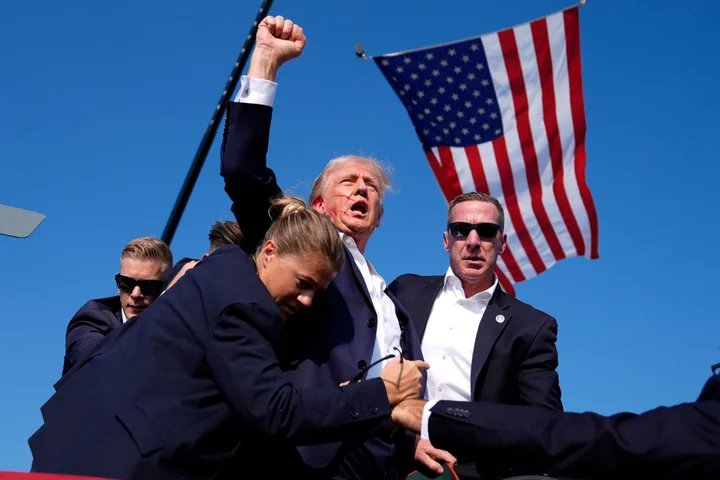
Defying Protocol: The Iconic Fist Pump
What happened next became the indelible image of the campaign. Against the frantic advice of his security detail, who were trained to evacuate and secure a protected individual at all costs, Trump resisted being confined to his armored vehicle. He reportedly felt an overwhelming need to re-engage with the crowd and the cameras. He wanted to project strength, not victimhood. This decision led to one of the most memorable moments in modern political history.
Ignoring urgent commands to stay down and inside the vehicle, Trump emerged, blood visible on his face and ear, and raised a defiant fist into the air, shouting “Fight!” to his energized supporters. This act of calculated defiance was a direct violation of Secret Service protocol but was a masterstroke of political branding. It instantly became a symbol of resilience for his followers and a moment of disbelief for his critics, who saw it as reckless grandstanding. As Karl notes, Trump’s instincts as a showman completely overrode the life-or-death procedures designed to protect him.
| Event Sequence | Trump’s Reaction | Secret Service Protocol |
|---|---|---|
| Shooter Opens Fire | Ducks, then stands firm after being hit | Immediate “cover and evacuate” procedure |
| Evacuation to SUV | Initially complies but then resists inside | Secure the principal inside the armored vehicle |
| Re-emergence from Vehicle | Exits against orders, raises fist, shouts “Fight!” | Strictly prohibit re-exposure to threat |
| En Route to Hospital | Asks aides, “How does it look on TV?” | Monitor principal’s condition and secure route |
“He understands the power of imagery better than any politician I’ve ever covered. In that moment of crisis, his mind went straight to the television audience. It was about controlling the narrative before anyone else could.”
The Political Aftermath and Media Legacy
The image of the bloodied but defiant Trump with his fist in the air was politically priceless. It dominated news cycles for days and became a powerful symbol used in campaign ads, social media memes, and merchandise. For his base, it was definitive proof of his strength and fearlessness—a leader who literally took a bullet for them and refused to back down. The Trump fist pump at the Butler rally became a modern-day political Rorschach test: supporters saw a hero, while opponents saw a dangerously narcissistic performer willing to risk his life for a photo-op.
Political analysts widely agree that Trump’s immediate focus on Trump TV optics was not just instinctual but strategic. In an age of hyper-mediated politics, the visual narrative often becomes more powerful than the factual one. He knew that his response would be replayed endlessly, and he seized the opportunity to frame it on his own terms: as a moment of triumph over adversity, not terror or weakness. Jonathan Karl’s reporting confirms that this was not a man in shock; this was a seasoned media professional managing a crisis as if it were a prime-time television special.
The event fundamentally reshaped the dynamics of the 2024 presidential race, galvanizing his supporters and creating a powerful new symbol for his campaign. His ability to turn a near-death experience into a display of political dominance is a case study in modern media manipulation.
- Image Over Injury: Trump’s primary concern was how the event was being perceived by the public on television.
- Calculated Defiance: His decision to emerge from the SUV was a deliberate act of political theater, not an impulsive reaction.
- A Defining Campaign Symbol: The “fist pump” instantly became one of the most enduring and powerful images of his 2024 campaign.
- Persona Over Protocol: He prioritized his public persona as a “fighter” over the strict safety protocols of the Secret Service.
Frequently Asked Questions
Frequently Asked Questions
What were Trump’s first words after the attempt?
According to Jonathan Karl, he asked, “How is it playing? How does it look on TV?”
Who revealed these details?
ABC News journalist Jonathan Karl in his book “Retribution.”
What was the Secret Service’s reaction to his fist pump?
They viewed it as a severe violation of safety protocols designed to protect him.
Who was the shooter?
Thomas Matthew Crooks, 20, who was killed by the Secret Service.
Did the attempt affect his poll numbers?
Yes, he experienced a noticeable increase in support and favorability ratings afterward.
Final Thoughts
The 2024 assassination attempt was more than just a security failure or a moment of national trauma; it was a defining test of persona, politics, and perception. Donald Trump’s reaction demonstrated an unparalleled fusion of survival instinct and media savvy. Whether his actions are viewed as courageous leadership or reckless narcissism, one thing is undeniable: in the critical moments between chaos and control, he crafted an image of defiance that will be studied in the annals of political communication for decades to come.