The news broke like a sudden, unexpected crack of thunder on a seemingly calm political day. It was late afternoon, the kind of Tuesday where you expect minor committee wrangling or perhaps a new poll result, but certainly not a seismic shift. Then came the alerts, flashing across screens in newsrooms and on smartphones across the nation: Marjorie Taylor Greene had resigned from a prominent position within a key conservative caucus. (Honestly, my first thought was, “Well, what now?”) The air immediately thickened with speculation, hushed whispers giving way to urgent phone calls and rapid-fire emails. Capitol Hill buzzed with an unusual energy, a mixture of shock and a palpable sense of anticipation. Everyone, and I mean everyone, knew that one particular voice would soon weigh in, and that voice rarely minced words, especially when a former ally made an unexpected move. This wasn’t just another political announcement; it was a detonation in the already fractured landscape of the Republican Party, a move that promised to test the very definition of loyalty within the MAGA base. People started refreshing their feeds almost instinctively, waiting for the inevitable, wondering how Donald Trump would react to Greene’s resignation. Would he offer support, a nod to past alliances? Or would he unleash the characteristic barrage of insults he reserves for those he perceives as disloyal or weak? The suspense was thick enough to cut with a knife, setting the stage for yet another dramatic chapter in American politics.
The Political Earthquake: Marjorie Taylor Greene’s Departure
The formal announcement of Marjorie Taylor Greene’s resignation from her leadership role within the House Freedom Caucus came with an unexpected quietude, considering the firebrand nature of the Georgia congresswoman herself. It was less of a roar and more of a strategic retreat, at least initially. Sources close to Greene’s office indicated a desire to focus more on specific legislative priorities and less on the internal wrangling that often characterizes such influential, albeit sometimes fractious, groups. “She felt it was time to redirect her energy,” explained one aide, who spoke on condition of anonymity, “to be more effective in her district and for the conservative movement at large, rather than getting bogged down in procedural battles.”
But beneath the surface of this official narrative, a different story began to emerge. Whispers of escalating internal conflicts within the caucus, disagreements over strategy, and clashes of personality painted a picture of a more turbulent departure. “There had been growing tensions for weeks, honestly,” revealed a long-time Republican strategist, sipping coffee in a quiet D.C. cafe, “especially regarding her sometimes confrontational approach. The Freedom Caucus is known for being feisty, but even they have a line.” This resignation, from a position where Greene wielded significant influence among the party’s far-right flank, wasn’t just a reshuffle; it felt like a deliberate withdrawal from a battleground where she perhaps felt her impact was waning, or worse, that she was being sidelined. Her departure immediately sent ripples through the GOP, prompting questions about the cohesion of the conservative wing and who, if anyone, could fill the vacuum she left behind.
Trump Unleashes His Fury: Doubling Down on Insults
The political world held its breath for only a short while. True to form, it wasn’t long before the former President, Donald Trump, broke his silence on Truth Social, the platform often favored for his most unfiltered thoughts. And when he did, the reaction was vintage Trump: swift, brutal, and utterly without the expected niceties one might extend to a former staunch ally. He didn’t just criticize; he doubled down on insults.
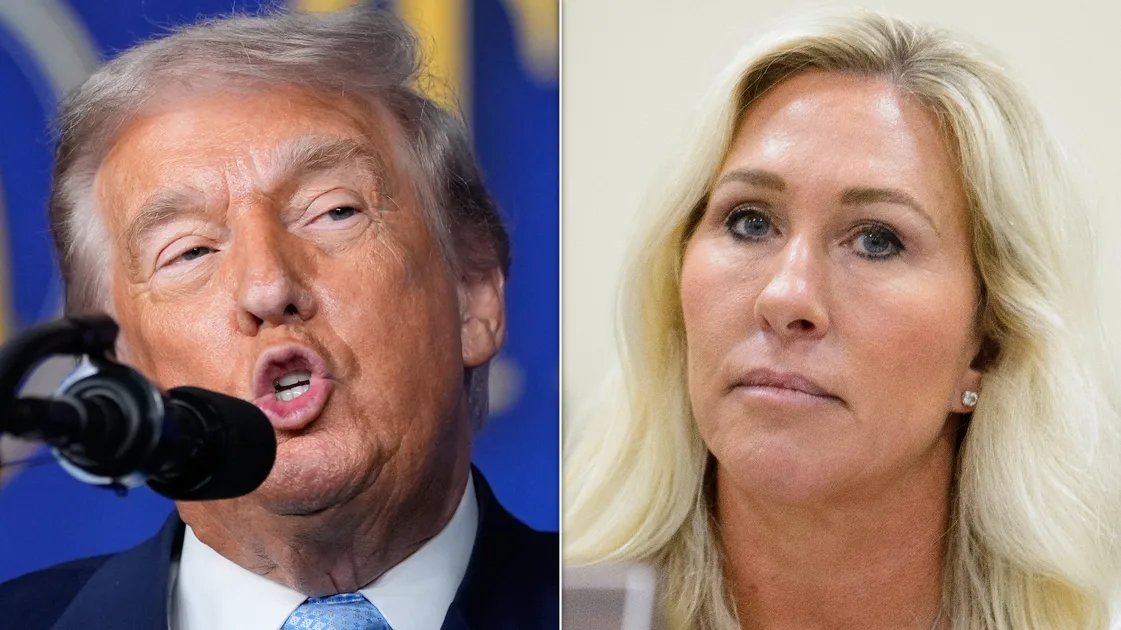
In a series of blistering posts, Trump accused Greene of lacking “true loyalty” and of being “easily influenced by the swamp creatures she once claimed to fight.” He went on to label her decision a “mistake” that demonstrated “weakness,” suggesting she was “not built for the real fight.” (Ouch. Talk about a public dressing-down!) This wasn’t the measured disapproval you sometimes see from political figures; this was a scorched-earth broadside against a woman who, for years, had been one of his most vocal and aggressive defenders on Capitol Hill. It was a stark reminder of Trump’s transactional approach to alliances, where past service seems to count for little the moment he perceives a deviation from his agenda or a challenge to his perceived dominance. The very speed and severity of his remarks caught many off guard, prompting a fresh wave of discussion about the nature of loyalty in Trump’s orbit.
Unpacking the Strategy: Why Did Trump Attack?
The immediate question that sprang to everyone’s lips was, “Why?” Why would Donald Trump so vehemently attack Marjorie Taylor Greene, an individual who had demonstrated unwavering support, often at significant political cost? The answer, many political observers suggest, lies in a complex blend of self-preservation, brand management, and an unyielding demand for absolute loyalty.
“This is classic Trump,” remarked Dr. Evelyn Reed, a political science professor at Georgetown University, during a phone interview. “He cannot tolerate any perceived dissent or independent action from those he considers ‘his people.’ Her resignation, no matter the stated reasons, could be interpreted by him as a move away from his sphere of influence, or even worse, a sign of weakness that reflects poorly on *his* movement.” It’s a powerful, albeit brutal, way of sending a message to others within the conservative movement: stray too far, make a move he doesn’t sanction, and you too could face the full force of his public condemnation.

Another theory posits that Trump might be using Greene’s resignation as an opportunity to distance himself from some of her more controversial past statements or actions, especially if he feels they could become a liability as he navigates future political endeavors. It’s a calculated move to prune perceived weaknesses from his political tree, ensuring that his brand remains unblemished by association, even if that means sacrificing a formerly steadfast ally. “It’s all about control,” offered a former White House staffer who requested anonymity, “and maintaining the narrative that *he* is the undisputed leader. Anyone who steps out of line, no matter how loyal they’ve been, risks being cut loose.” This public lashing serves as a very public warning, a theatrical display of political dominance designed to reinforce his position at the apex of the Republican Party.
The Ripples Across the GOP: Reactions and Divisions
Trump’s reaction to Marjorie Taylor Greene’s resignation didn’t just make headlines; it sent shockwaves through the already strained fabric of the Republican Party. The immediate aftermath saw a spectrum of reactions, from quiet discomfort to outright condemnation, highlighting the deep ideological and strategic fault lines running through the GOP.
Some of Greene’s former colleagues in the House Freedom Caucus expressed a mix of regret and understanding regarding her departure, carefully sidestepping direct comments on Trump’s tirade. “Marjorie is a force, and she’ll continue to be,” stated one conservative congressman, choosing his words carefully. “We respect her decision to focus her energies elsewhere.” Noticeably absent were strong defenses of Greene against Trump’s attacks, a testament to the lingering fear of incurring the former President’s wrath. This silence, in itself, speaks volumes about the power Trump still wields over party members, even those who might privately disagree with his tactics.
Meanwhile, more establishment-aligned Republicans likely viewed the public spat with a mixture of exasperation and perhaps a touch of schadenfreude. For years, Greene represented a controversial fringe that many in the party struggled to reconcile with their broader messaging. Her resignation, followed by Trump’s insults, presented a chaotic scene that further complicated the party’s efforts to project unity and electability. “It’s just another distraction,” sighed a veteran Republican senator, who declined to be named, “another internal squabble playing out in public, drawing attention away from the real issues that matter to the American people.” The episode further underscores the significant challenge the Republican Party faces in consolidating its various factions, especially when Donald Trump’s influence remains so potent and unpredictable.
Public Perception and the Media’s Magnifying Glass
The drama unfolding between Trump and Greene wasn’t confined to the halls of power; it spilled out into the public square, amplified by an ever-present media and the relentless churn of social media. On cable news, pundits from across the political spectrum dissected every word of Trump’s posts, offering a dizzying array of interpretations. Conservative outlets grappled with how to frame the fallout, some downplaying the significance, others subtly shifting away from outright defense of Greene. Liberal media, predictably, highlighted the discord as further evidence of chaos within the Republican Party.
I remember scrolling through my own feed that evening, seeing headline after headline. One moment it was “Greene Resigns,” the next, “Trump Slams Greene.” It was a whirlwind, and you could almost feel the collective sigh of a public grown accustomed to this particular brand of political spectacle. “It’s exhausting, frankly,” commented Sarah Chen, a voter from Ohio, in a local news vox pop. “You see someone who was so loyal, and then Trump just turns on them. It makes you wonder what ‘loyalty’ even means in politics anymore.” This sentiment reflects a broader public fatigue with the constant internal feuds, often overshadowing substantive policy debates. The episode serves as a powerful reminder of how quickly political narratives can pivot, driven not by policy, but by personality and the brutal calculus of power.
A History of Shifting Allegiances: Trump’s Political Calculus
To understand Donald Trump’s reaction to Marjorie Taylor Greene’s resignation, it’s helpful to look at his broader history of political alliances. His tenure, both as a candidate and as President, was characterized by an often transactional approach to relationships, where loyalty was demanded but not always reciprocated beyond immediate utility. Figures who once stood firmly by his side have, at various points, found themselves on the receiving end of his public scorn.
Think about the myriad of former aides, cabinet members, and political allies who, after serving him faithfully, were unceremoniously dismissed or publicly ridiculed. From Jeff Sessions to Rex Tillerson, and even former Vice President Mike Pence in the aftermath of January 6th, the list is extensive. Trump’s political strategy often involves a test of absolute fealty, and any perceived deviation, no matter how small or strategically motivated by the individual, can be met with swift and decisive condemnation. It’s a method designed to maintain control, prevent dissenting voices from gaining traction, and reinforce his image as the sole, indispensable leader of his movement. This pattern reveals that Greene’s public shaming, while perhaps surprising to some given her past fervent support, is entirely consistent with Trump’s long-established method of managing his political ecosystem. It’s a harsh lesson in the ephemeral nature of political alliances within his orbit.
The Loyalty Test: What Does This Mean for the GOP?
This latest skirmish between Trump and Marjorie Taylor Greene is more than just a personal feud; it’s a profound loyalty test for the entire Republican Party. It forces individuals within the conservative movement to confront questions about their allegiance: Is it to the party’s principles, to their constituents, or unequivocally to Donald Trump himself? The implications for GOP unity, especially heading into future election cycles, are significant. If even a figure as ardently pro-Trump as Greene can be so publicly castigated, what message does that send to others who might consider independent action or a different strategic path? It creates an environment where fear of reprisal can stifle dissent and critical thinking, potentially narrowing the party’s appeal and hindering its ability to adapt.
This dynamic could lead to a further polarization within the Republican ranks, with a shrinking circle of unyielding loyalists and a growing contingent of those who, while still conservative, are increasingly wary of the demands of Trump’s brand of politics. It’s a challenging tightrope walk for many Republicans, balancing the need to appeal to Trump’s base with the desire to attract broader support. The long-term health and direction of the Republican Party will undoubtedly be shaped by how its members navigate these intricate loyalty tests.
Conclusion
The swift, uncompromising manner in which Donald Trump reacted to Marjorie Taylor Greene’s resignation serves as a potent reminder of the unique, often brutal, dynamics that define the modern Republican Party. It wasn’t merely a political disagreement; it was a public execution of an alliance, delivered with Trump’s signature blend of personal insults and accusations of disloyalty. This episode isn’t just about two prominent figures; it’s a magnifying glass on the fissures within the conservative movement and the unyielding demands of allegiance that permeate Trump’s political orbit.
What we witnessed was a stark lesson in political survival and the transactional nature of power. For Greene, it’s a moment that will redefine her standing within the party, forcing her to chart a potentially new course. For the GOP, it further complicates their already precarious quest for unity, reminding everyone that even the staunchest allies are not immune to the former President’s wrath if they deviate from his perceived path. As the dust settles, one thing remains clear: the shadow of Donald Trump continues to loom large over the Republican landscape, dictating terms and testing the very boundaries of loyalty, leaving us to wonder who might be next to face his unsparing judgment. The political drama, it seems, is far from over.
Frequently Asked Questions
| What prompted Trump’s reaction to Marjorie Taylor Greene’s resignation? | Trump’s strong reaction, characterized by insults and accusations of disloyalty, was prompted by Marjorie Taylor Greene’s resignation from a significant leadership role within a conservative caucus. His response aligns with his historical pattern of demanding absolute loyalty from allies and publicly condemning anyone he perceives as deviating from his agenda or showing weakness. |
| What are the potential implications of Trump’s insults for the Republican Party? | Trump’s insults deepen the existing divisions within the Republican Party, highlighting a significant loyalty test for its members. This public condemnation of a staunch ally could deter others from independent action or critical thought, potentially narrowing the party’s appeal and complicating efforts to achieve unity ahead of future elections. It reinforces the idea that fealty to Trump is paramount for political survival within his sphere. |
| What was Marjorie Taylor Greene’s official reason for her resignation? | Officially, Marjorie Taylor Greene’s team stated that her resignation was motivated by a desire to refocus her energy on specific legislative priorities and to be more effective for her constituents and the broader conservative movement, rather than getting entangled in internal caucus wrangling. |
| How does this incident reflect Trump’s past political relationships? | This incident is consistent with Trump’s long-established transactional approach to political alliances. Throughout his career, many former aides and allies who served him faithfully have faced public criticism or dismissal once he perceived a deviation from his interests or a challenge to his authority. This pattern underscores his demand for unwavering loyalty and his willingness to sacrifice alliances for his brand or perceived control. |
| What might be the long-term impact on the conservative movement? | The long-term impact on the conservative movement could be significant. It may lead to further consolidation of power around Donald Trump, potentially stifling diverse viewpoints or strategic approaches within the movement. It could also force a re-evaluation of what constitutes ‘conservative’ loyalty, potentially alienating some who prioritize principles over unwavering support for a single figure, thus shaping the movement’s direction for years to come. |
Important Notice
This FAQ section addresses the most common inquiries regarding the topic.