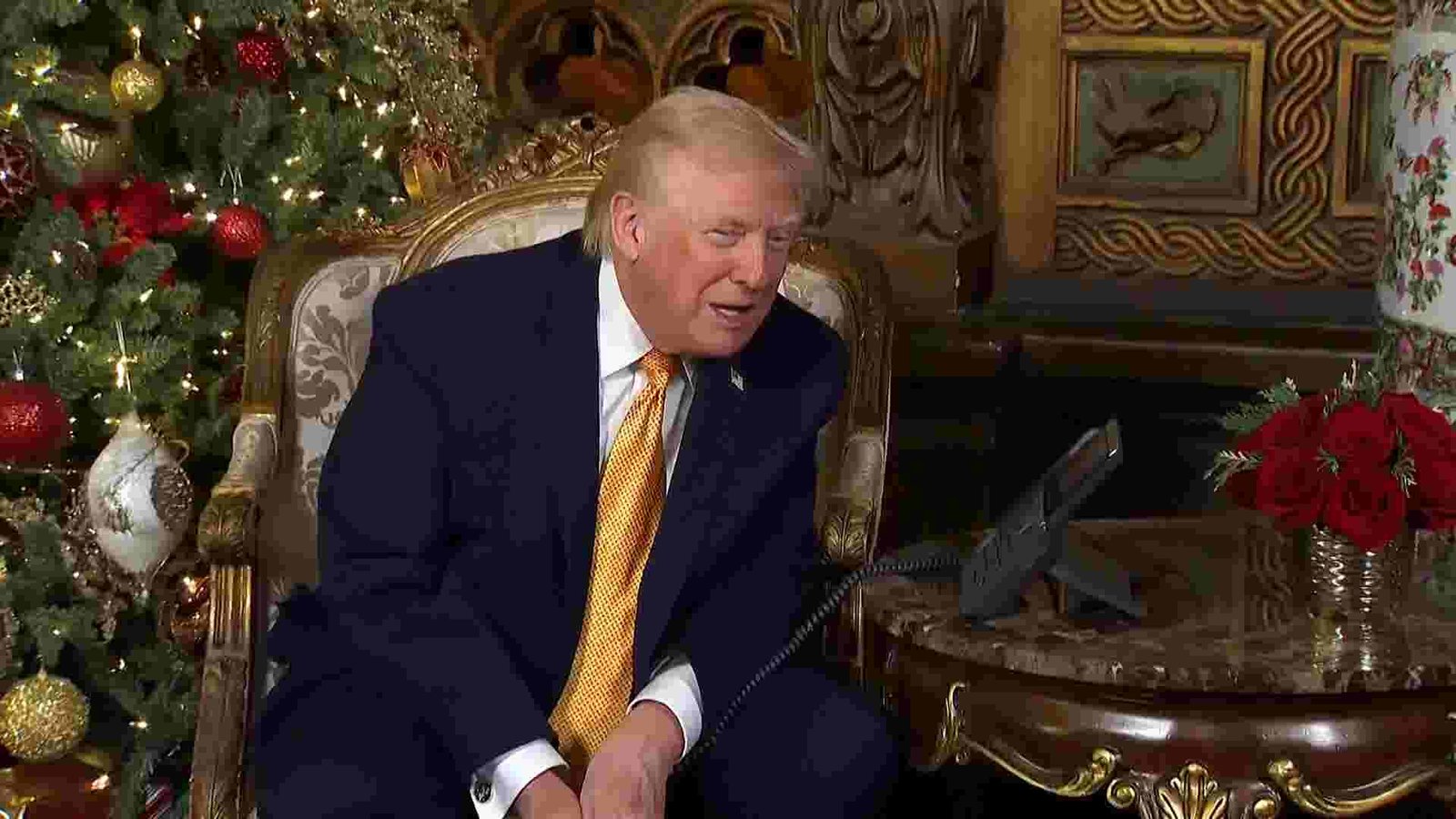
It was a brisk December evening, the kind where holiday lights twinkled a little brighter against the early dark, and the air carried the faint scent of pine and anticipation. Families were gathering, children were writing letters, and the world, for a brief moment, seemed to settle into a familiar, festive rhythm. Then, the news alerts started pinging, shattering the seasonal calm with a jolt of political electricity. Donald Trump, ever the master of unexpected turns of phrase, had just delivered a line that would quickly become a defining moment in the pre-holiday news cycle: comparing a political figure to a “bad Santa.” (Who could’ve seen that coming, really? But with Trump, always expect the unexpected.) This wasn’t just a casual remark; it was a carefully crafted, or perhaps spontaneously brilliant, jab designed to cut through the noise and immediately grab attention. The phrase, Trump’s ‘bad Santa’ comments, began trending almost instantly, sparking a firestorm of reactions across social media, cable news, and dinner tables nationwide. It felt like the political equivalent of finding coal in your stocking, only much, much louder. The comment wasn’t just about the immediate target; it was about the broader implications for political rhetoric during a time typically associated with goodwill and peace. One might wonder, what was the former president truly aiming for with such an evocative, if somewhat jarring, metaphor? Was it a stroke of genius in populist messaging, or a further erosion of traditional decorum in public discourse? The ensuing debate was anything but quiet, pulling everyone into a conversation about the power of words and the surprising ways they can shape perceptions, especially around the holiday season.
The immediate reaction was a mix of bewilderment, amusement, and outrage. For some, it was just another classic Trump moment, a rhetorical flourish that energized his base and baffled his critics. For others, it was an unwelcome intrusion of harsh political sparring into the usually sacred festive period. You could almost hear the collective gasp, followed by the rapid-fire clicks of keyboards as pundits and citizens alike rushed to dissect the meaning and impact of referring to a political opponent as a “bad Santa.” It’s moments like these that truly reveal the raw, often unvarnished, nature of modern political communication.
The Genesis of a Provocative Metaphor
So, where did this intriguing, if divisive, comparison originate? The “bad Santa” comment wasn’t plucked from thin air; it was delivered during a rally, a setting where Trump often tests and refines his most potent lines. The specific target, while not always explicitly named by Trump himself in every iteration of the comment, was broadly understood to be a figure or entity perceived by his base as obstructing their interests or failing to deliver on promises. Think of Santa as the giver of gifts, the benevolent figure. A “bad Santa,” then, is the antithesis – someone who promises much but delivers little, or worse, delivers only disappointment.
“He was talking about the legislative failures, the promises that weren’t kept,” explained a former campaign aide, speaking anonymously due to ongoing political affiliations. “For the president, it’s always about painting a clear picture for his supporters, and what’s clearer than a Santa who doesn’t bring toys, but takes them away?” This perspective highlights the strategic intent behind the phrase: to simplify complex policy debates into a relatable, almost childlike narrative of good versus bad, giver versus taker. It’s a classic populist move, making the political personal and easily digestible.
The Art of the Nickname: Trump’s Rhetorical Toolkit
Donald Trump has a long, well-documented history of using nicknames and pithy phrases to define his opponents and rally his base. From “Crooked Hillary” to “Sleepy Joe,” these epithets are not mere insults; they are carefully chosen labels designed to stick in the public consciousness and encapsulate an entire critique in just a few words. The “bad Santa” comment fits perfectly into this established rhetorical pattern.
“It’s brilliant, really, if you’re looking at it from a pure communications standpoint,” noted Dr. Evelyn Reed, a communications professor at a Midwestern university. “He knows how to tap into cultural archetypes. Everyone knows Santa. Everyone understands the disappointment of a ‘bad’ Santa. It immediately conjures an image of betrayal or failure, without needing to explain complex policy details.” This strategy works because it bypasses rational argument and appeals directly to emotion and shared cultural understanding. It’s less about policy and more about perception, creating an antagonist everyone can immediately grasp.
Immediate Fallout and Public Reactions
The moment Trump’s ‘bad Santa’ comments hit the airwaves, the reaction was swift and multifaceted. On the one hand, his supporters found it amusing and insightful, another example of Trump’s unique ability to articulate their frustrations. “He just says what we’re all thinking!” exclaimed Brenda Maxwell, a retired teacher from Florida, interviewed at a local diner. “They promise us everything, then we get nothing. So yeah, they’re bad Santas alright.” This sentiment resonated with many who felt a disconnect between political promises and tangible results.
On the other hand, critics were quick to condemn the remark as disrespectful, childish, and further evidence of the erosion of civility in political discourse. “It’s just another example of how he diminishes serious debate,” argued Senator Patricia Lee, a Democrat, during a cable news appearance. “To reduce complex issues to a ‘bad Santa’ caricature during the holidays, it just shows a lack of respect for the office and for the people he claims to represent.” The timing, right before Christmas, amplified these criticisms, with many decrying the politicization of a traditionally unifying and joyful period.
Social media, as expected, became a battleground. Hashtags related to ‘bad Santa’ quickly trended, filled with memes, satirical cartoons, and heated exchanges. One Twitter user posted, “Guess my Christmas list just got shorter by one political figure! #BadSanta,” showcasing the lighter, albeit still politically charged, side of the reactions. Meanwhile, others expressed genuine concern about the state of American politics, lamenting that even Santa wasn’t safe from partisan jabs.
Historical Precedents of Political Holiday Rhetoric
While Trump’s “bad Santa” comment felt particularly jarring due to its specific cultural reference and timing, the politicization of holidays is by no means a new phenomenon. Throughout history, politicians have leveraged festive periods to deliver messages, both unifying and divisive. Think of wartime leaders giving Christmas addresses, or protest movements using holiday imagery to highlight social injustices.
* Abraham Lincoln’s Thanksgiving Proclamation (1863): During the Civil War, Lincoln established Thanksgiving as a national holiday, using the occasion to call for unity and healing, even amidst profound national division.
* FDR’s Fireside Chats during Christmas: Franklin D. Roosevelt often used the holiday season for his fireside chats, aiming to reassure a nation grappling with economic depression and, later, war, wrapping his messages in a blanket of seasonal warmth.
* Modern Political Ads: Contemporary campaigns frequently release holiday-themed ads, attempting to connect with voters on an emotional level, often portraying opponents as Grinches or Scrooges, though rarely as explicitly as a “bad Santa.”
What makes Trump’s comment stand out is its direct, almost childish, accusation aimed at a specific political opponent, leveraging a universally recognized symbol of generosity and benevolence for a partisan attack. It strips away the veneer of civility that often, however thin, still clings to holiday-themed political messages.
The Broader Implications for Political Discourse
The deeper impact of Trump’s ‘bad Santa’ comments lies in what they signify for the future of political discourse. Is this just another example of Trump’s unique brand of communication, or does it represent a more widespread trend towards increasingly confrontational and simplistic rhetoric?
“We’re seeing a continuous push towards emotional appeals over reasoned arguments,” observed Dr. Mark Jensen, a political sociologist. “When you brand someone as a ‘bad Santa,’ you’re not inviting debate; you’re shutting it down. You’re telling your audience, ‘This person is fundamentally flawed, a deceiver.’ It’s a very effective way to polarize and demonize, but it comes at the cost of genuine dialogue.”
This kind of rhetoric can make it harder for the public to engage with complex policy issues, reducing political discourse to a series of easily digestible, often negative, characterizations. The danger, many argue, is that it breeds cynicism and disengagement among those who crave substantive debate. It also normalizes a level of confrontational language that might make future political figures feel compelled to follow suit to remain competitive.
Analyzing the Strategic Intent
From a purely strategic viewpoint, the “bad Santa” comment serves several purposes for Trump and his campaign:
- Rallying the Base: It provides a clear, memorable slogan that resonates with supporters who feel let down by current leadership.
- Framing the Opposition: It immediately casts opponents in a negative, untrustworthy light, associating them with disappointment.
- Media Attention: It’s guaranteed to generate headlines and discussion, keeping Trump in the news cycle, even during a traditionally slower period.
- Simplicity: It boils down complex grievances into a simple, emotional narrative that is easy to understand and repeat.
It’s a testament to the power of a well-placed, if controversial, metaphor. And let’s be honest, it’s hard to ignore. The image of a “bad Santa” is quite vivid, isn’t it? It makes you think.
Expert Analysis and Media Interpretation
The media’s role in interpreting and amplifying such comments is crucial. When Trump’s ‘bad Santa’ comments first emerged, news outlets across the spectrum reacted predictably. Conservative media often framed it as a witty, accurate critique, while liberal outlets largely condemned it as offensive and trivializing.
“The way the media covers these soundbites reinforces the polarization,” commented Sarah Chen, a veteran political journalist. “Each side reports it through their own lens, often confirming the biases of their respective audiences. It becomes less about the comment itself and more about what it represents for each political camp.” She’s right, you know. It’s a vicious cycle.
Political strategists, too, weighed in with varied opinions. “It’s a double-edged sword,” said one Republican strategist, requesting anonymity. “It fires up the base, no doubt. But it can also alienate swing voters who might be turned off by the perceived lack of seriousness, especially during the holidays. You risk sounding petty when you should be sounding presidential.” Conversely, a Democratic strategist argued, “It’s a distraction technique. He throws out something outrageous, and everyone focuses on that, rather than the actual policy failures or legislative challenges.”
| Perspective | Interpretation of “Bad Santa” | Perceived Impact |
| Trump Supporters | Witty, accurate critique of failed promises. | Energizes base, clarifies opposition’s shortcomings. |
| Trump Critics | Childish, disrespectful, trivializes debate. | Erodes civility, distracts from substantive issues. |
| Political Analysts | Populist rhetoric, emotional appeal over reason. | Polarizes discourse, effective for niche audiences. |
| General Public (Divided) | Amusing, relatable, or offensive, out-of-place. | Mixed, reinforces existing political views. |
Table: Varied Interpretations and Impacts of the “Bad Santa” Comments
This table vividly illustrates the chasm in interpretation, showing how a single phrase can be perceived in wildly different ways depending on one’s political leanings and overall perspective. It’s not just a comment; it’s a political Rorschach test.
Conclusion
So, what are we left with after the dust settles on Trump’s ‘bad Santa’ comments? Perhaps it’s a stark reminder of how deeply ingrained political polarization has become, reaching even into the festive traditions we once held sacred. It highlights Donald Trump’s undeniable skill in wielding language as a weapon and a rallying cry, often blurring the lines between political critique and cultural commentary.
For me, personally, I found myself shaking my head but also, grudgingly, acknowledging the raw power of the phrase. It cuts. It resonates. It gets people talking, for better or worse. It’s a political tactic that might make you wince, but you can’t deny its effectiveness in piercing through the daily din of news. Whether you see it as a clever piece of political theater or a lamentable sign of our times, the “bad Santa” comment is more than just a passing remark; it’s a microcosm of modern American politics – bold, divisive, and utterly unforgettable. And as we move forward, it raises an important question: what other cultural icons will become fair game in the ongoing political arena? It feels like we’re just getting started.
Frequently Asked Questions
| What were Trump’s ‘bad Santa’ comments about? | Donald Trump’s ‘bad Santa’ comments were a rhetorical jab at a political opponent or entity, characterizing them as someone who fails to deliver on promises or brings disappointment, much like a Santa who doesn’t bring gifts but instead takes them away. It was a populist metaphor used to simplify complex policy failures into an easily understandable, negative image. |
| What are the benefits of using such rhetorical devices in politics? | Such rhetorical devices, like the ‘bad Santa’ comment, can be highly effective in rallying a political base, framing opponents in a negative light, generating significant media attention, and simplifying complex issues into memorable, emotionally resonant narratives. They cut through noise and can create strong, immediate impressions. |
| How did the public react to these comments? | Public reaction was sharply divided. Supporters often found the comments amusing and insightful, seeing them as an accurate reflection of their frustrations. Critics, however, condemned them as disrespectful, childish, and a further erosion of civility in political discourse, particularly given the holiday timing. |
| What challenges does this type of rhetoric pose for political discourse? | This type of rhetoric can reduce complex policy debates to simplistic, emotional appeals, making it harder for the public to engage with substantive issues. It can foster polarization, demonize opponents, and contribute to cynicism, potentially eroding genuine dialogue and civil political engagement. |
| What does this incident suggest about the future of political communication? | This incident suggests a continued trend towards highly confrontational and populist communication, where cultural archetypes and emotional appeals are leveraged for political gain. It indicates that politicians may increasingly use vivid, often provocative, metaphors to capture public attention and define their adversaries, even at the risk of further polarizing the electorate and diminishing traditional decorum. |
Important Notice
This FAQ section addresses the most common inquiries regarding the topic.