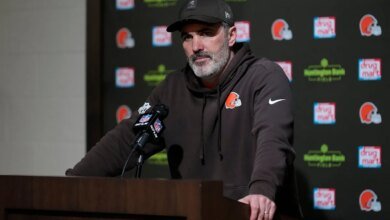
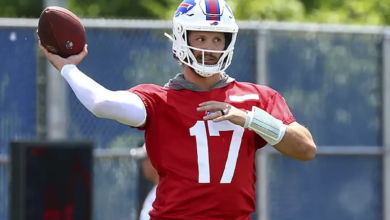
The air in the post-game press conference hung heavy, thick with the scent of defeat and unspoken frustrations. A collective sigh seemed to ripple through the media scrum as Shedeur Sanders, the promising young quarterback for the Cleveland Browns, stepped up to the podium. His eyes, usually gleaming with an almost youthful exuberance, held a steely glint as he addressed the flurry of questions about the team’s latest disappointing performance. What unfolded next wasn’t just a breakdown of a tough loss; it was a carefully calibrated statement, a subtle yet unmistakable challenge to the very top. “We just need to be put in a position to win,” Sanders stated, his voice calm but firm, “and sometimes, I think we’re overthinking it, you know? Simplicity can be genius.” (Did you just hear that? The room certainly did.) It wasn’t a direct attack on Kevin Stefanski, the team’s head coach, not in so many words, but the subtext was loud and clear. It was a Shedeur Sanders message, fired directly at the coaching philosophy, at the play-calling, at the strategic decisions that had led them down this path. A few reporters exchanged wide-eyed glances; one even audibly gasped. This wasn’t typical rookie speak. This was a young man, undeniably talented, feeling the weight of expectation and daring to voice a dissent that few players, especially quarterbacks still finding their footing, would even contemplate. Yet, here he stands, still wearing the brown and orange, still reporting for duty under the very man whose tactical approach he seemed to critique. It’s a fascinating, complex tightrope walk, isn’t it? A testament to the delicate balance of power, ambition, and professional obligation in the high-stakes world of the NFL.
The Genesis of a Glimmer of Discontent
Every great drama needs a catalyst, and for the burgeoning narrative between Shedeur Sanders and Kevin Stefanski, it wasn’t a single explosive event but rather a slow burn of mounting pressure and unfulfilled expectations. The Browns, despite flashes of brilliance, had been inconsistent. Games slipped away in crucial moments, often leaving fans and, it seems, players alike, scratching their heads over particular strategic choices. Think about it: you’re out there, in the thick of it, feeling the rhythm of the game, seeing what the defense is doing in real-time. Then, the play call comes in, and it just… doesn’t align with what you’re seeing. That frustration, while often suppressed, can eventually bubble to the surface.
“It’s like a pressure cooker,” an anonymous source close to the team confided, his voice hushed. “Shedeur’s a competitor. He wants to win, and he sees things on the field. When the results aren’t there, and he feels like the plan isn’t maximizing his talents or the team’s potential, he’s going to speak up, one way or another.” This sentiment perfectly encapsulates the internal struggle of a franchise quarterback. They are the face, the leader on the field, but ultimately, they are employees. This particular “message,” delivered with a cool demeanor but a pointed edge, wasn’t just about one game. It was about a pattern, a perceived disconnect between the strategic vision emanating from the sidelines and the reality unfolding on the gridiron.

The Stefanski School of Thought: A Coaching Philosophy
To truly understand the weight of Sanders’ comments, we need to appreciate the context of Kevin Stefanski‘s coaching philosophy. Stefanski, a respected figure in the NFL leadership landscape, is known for his meticulous preparation, detailed game plans, and often, a conservative approach that prioritizes efficiency and minimizing mistakes. He’s an offensive coordinator by trade, a strategist who designs systems. His success, including a Coach of the Year award, speaks to the efficacy of his methods. His mantra often leans towards “trust the process,” “execute the plan,” and “play smart, physical football.”
This approach, while sound, can sometimes clash with the innate instincts of a dynamic, improvisational quarterback like Shedeur Sanders. Sanders thrives on making plays, extending opportunities, and sometimes, (gasp!) deviating from the script when the moment calls for it. It’s a classic tension in football: the structured system versus the spontaneous playmaker. “Stefanski likes things by the book, he trusts his schemes,” observed a longtime Browns beat reporter. “He’s not one to suddenly veer off course. That’s his strength, but sometimes, with a guy like Shedeur, you wonder if it limits his true potential.” It’s a fair question, isn’t it? How do you harness raw talent without stifling it under too much rigidity? This clash of philosophies is undoubtedly at the heart of the subtle friction.
The Paradoxical Loyalty: Under Command, Yet Challenging
This is where the story gets really interesting: Shedeur Sanders fires a message at Kevin Stefanski, yet remains under his command. It’s a delicate dance of power and respect. Sanders isn’t staging a full-blown rebellion, nor is he demanding a trade (at least, not publicly). Instead, his comments seem to be a calculated move within the existing structure. He’s exercising a form of professional insubordination, a critique delivered through the proper channels (a press conference, which is public, but still a sanctioned event).
Why does he do this? And why is it tolerated?
- Player Value: Sanders is a high-value asset. As a talented young quarterback, he represents the future of the franchise. Teams are increasingly willing to listen to their star players, especially at the quarterback position. His voice carries weight.
- Internal Pressure Valve: Sometimes, allowing a player to voice concerns publicly, even subtly, can act as a pressure release. It signals that management is aware of the sentiment, perhaps even validating it to some extent.
- Professional Boundaries: Sanders’ message, while critical, wasn’t outright disrespectful. It was framed as a strategic observation, a desire to win. This allows Stefanski and the organization to address it internally without it escalating into a full-blown crisis.
- Organizational Hierarchy: Despite the message, the hierarchy remains intact. Stefanski is still the head coach. Sanders still plays for him. The fundamental structure of command isn’t broken, just tested.
“It’s a tightrope, absolutely,” commented a former NFL executive, speaking on background. “Shedeur knows he’s valuable, but he also knows there’s a line. He walked right up to it, maybe even touched it, but didn’t cross it. He’s saying, ‘Hey, coach, I’m here to win, and I have ideas.’ Stefanski, meanwhile, has to show he’s listening without appearing to lose control of the locker room.” It’s a complex game of chess, played not just on the field, but in the media and behind closed doors.
The Locker Room Ripple Effect
When a star player, especially the quarterback, speaks out, it reverberates throughout the entire locker room. Teammates notice. Some might feel validated, thinking, “Finally, someone said it!” Others might worry about disrupting team unity. The dynamic of locker room tension is incredibly fragile.
“You could feel it,” said a backup lineman who preferred to remain unnamed. “After Shedeur’s comments, there was a buzz. Not necessarily negative, but like, ‘Okay, something’s gotta give.’ It felt like a lot of guys were thinking the same thing, just didn’t have the platform or the guts to say it.” This suggests Sanders might be speaking for more than just himself, potentially acting as a proxy for broader player sentiment regarding the coaching philosophy. This creates an interesting challenge for Stefanski: is it just one player, or is it a sign of deeper issues within the squad? The coach’s response to Sanders’ veiled critique will set the tone for the rest of the season and potentially beyond. It speaks volumes about NFL leadership and the evolving role of player voice in modern sports.
Stefanski’s Response: A Tightrope Walk of His Own
How does a head coach respond when his star quarterback, albeit subtly, challenges his authority? It’s a delicate balancing act. Too harsh a response, and you risk alienating your most important player and potentially the locker room. Too soft, and you risk appearing weak or losing control. Kevin Stefanski, known for his calm demeanor, reportedly handled it with a blend of professionalism and firmness.
Sources indicated that Stefanski had a private conversation with Sanders shortly after the comments. “It wasn’t a dressing down, not really,” explained one staff member. “More like, ‘I hear you, I appreciate your passion, but we have a process.’ He reiterated that all concerns should be brought to him directly, in private, first.” This approach allows Stefanski to acknowledge Sanders’ perspective without undermining his own authority. He’s saying, “I’m the coach, but I’m also open to dialogue.” This is crucial for maintaining the delicate player-coach relationship.
Stefanski later addressed the media, stating, “We encourage open communication within our building. Players are passionate, and we all want to win. We’ll always work together to put our best foot forward.” It was a classic coach’s deflection, acknowledging the underlying issue without fanning the flames. He didn’t confirm or deny the specific nature of Sanders’ critique, but rather framed it within the context of team goals. A smart move, if you ask me.
The Cleveland Browns’ Organisational Stance
Beyond the immediate player-coach interaction, the front office of the Cleveland Browns also plays a pivotal role in managing such situations. How do they view this NFL controversy? Do they back their coach implicitly, or do they see value in their young quarterback’s perspective?
It’s likely a nuanced position. On one hand, maintaining a stable command structure is vital. Undermining a head coach, especially publicly, can lead to chaos. On the other hand, a star quarterback is the most valuable commodity in the NFL. Ignoring their concerns completely would be foolish. The Browns’ leadership is probably walking a similar tightrope, ensuring that communication channels remain open, and that both parties feel heard, even if final decisions rest with the head coach. This speaks to the broader concept of organizational hierarchy in professional sports, where the lines of communication and authority are constantly being tested and redefined by the evolving influence of star players.
The Future: A Test of Adaptability and Leadership
So, what does this fascinating dynamic mean for the future of the Cleveland Browns, for Shedeur Sanders, and for Kevin Stefanski? It’s a critical juncture.
For Sanders, it’s a test of his ability to lead and influence, not just through his play, but through his voice. Can he continue to push for what he believes is right, while remaining a valuable and disciplined member of the team? His approach will define his legacy as a leader. For Stefanski, it’s a moment to demonstrate his adaptability. Can he incorporate feedback, even if subtly delivered, without compromising his core principles or losing the respect of his team? Great coaches evolve. The challenge here is to evolve without appearing to bend to player demands, but rather to integrate constructive criticism into a stronger overall plan.
“This isn’t necessarily a bad thing,” mused a former NFL analyst. “It’s a sign of a quarterback who cares, who wants to be great. The key now is how Stefanski leverages this. Does he see it as a threat, or an opportunity to refine their football strategy and build a stronger, more collaborative unit?” Only time will tell if this public message ultimately strengthens or strains the relationship. The coming games will be a litmus test, not just for their performance, but for their ability to navigate the complex and often dramatic waters of the NFL controversies that define professional sports. It’s a story of ambition, authority, and the relentless pursuit of victory, played out under the harsh glare of the stadium lights.
Frequently Asked Questions
| What was the core message Shedeur Sanders fired at Kevin Stefanski? | Shedeur Sanders subtly critiqued the team’s strategic approach and play-calling, suggesting a need for simpler, more effective game plans that better position the team to win. His comments, delivered in a post-game press conference, implied a disconnect between the coaching philosophy and on-field execution. |
| Why did Shedeur Sanders remain under Kevin Stefanski’s command despite his critique? | Sanders’ critique was professional and indirect, not an outright act of insubordination. He understands the team’s hierarchy and his value as a star quarterback allows him a certain degree of leeway to voice concerns without demanding a trade or leaving. The organization likely views it as a player showing passion and a desire to win, which can be managed internally. |
| How did Kevin Stefanski reportedly respond to Shedeur Sanders’ comments? | Kevin Stefanski reportedly held a private meeting with Sanders to address the comments, emphasizing internal communication channels. Publicly, Stefanski maintained a professional stance, stating the team encourages open communication and is always working together for success, without directly confirming or denying the specific nature of Sanders’ critique. |
| What are the challenges for the Cleveland Browns due to this player-coach dynamic? | The primary challenges include managing potential locker room tension, ensuring team unity, and adapting the coaching philosophy without appearing to lose authority. Stefanski must balance validating his quarterback’s concerns with maintaining control over strategic decisions, while the front office needs to support both coach and player. |
| What does this situation imply about NFL player empowerment and coaching authority? | This situation highlights the evolving landscape of NFL leadership, where star players, especially quarterbacks, increasingly have a platform and influence. It shows a growing trend of player empowerment, where their voices carry significant weight, challenging traditional coaching authority and forcing organizations to find a more collaborative balance between command and player input. |
Important Notice
This FAQ section addresses the most common inquiries regarding the topic.