The Las Vegas Raiders have firmly committed to selecting Fernando Mendoza with the No. 1 overall pick in the upcoming NFL Draft, according to multiple team sources familiar with the front office’s thinking, ending weeks of speculation about potential trades or alternative quarterback selections. Following a disastrous 3-14 campaign, Raiders general manager Tom Telesco and his scouting department have spent the past six months meticulously evaluating Mendoza’s college tape, conducting private workouts, and interviewing the Indiana quarterback extensively—a process that solidified his status as the franchise’s preferred choice despite growing uncertainty among fans about whether he’s truly the best option available.
- Official Commitment: Raiders sources confirm Mendoza is the pick at No. 1—no Lamar Jackson trade
- College Resume: 16-0 national championship, 41 TDs, 6 INTs, 3,523 passing yards in 2025
- Draft Stock Reality: Some analysts still rank Arch Manning and Drew Allar ahead on physical tools
- Injury History: Mendoza missed two games in 2024 with an MCL sprain; fully cleared since
- Offensive System: Klint Kubiak’s Shannahan-inspired scheme emphasizes play-action and quick reads
- Potential Trade Scenarios: Raiders could entertain offers if another team offers three first-round picks
- Roster Needs: WR, OL, secondary, and pass rush remain priorities after addressing QB
- Previous Regime Failure: Carroll-Smith experiment produced 16 INTs, 27 turnovers, and a 3-14 record
Mendoza’s rise to the top of draft boards represents one of the most dramatic ascensions in recent college football history. Just 18 months ago, quarterbacks like Arch Manning, Cade Klubnik, and Drew Allar dominated conversations about the next generation of NFL signal-callers. But a combination of disappointing seasons, inconsistent play, and in Manning’s case, a late-season shoulder injury, created an opening that Mendoza seized with remarkable efficiency. He led the Indiana Hoosiers to a perfect 16-0 campaign, delivering the program’s first national championship while showcasing the poise, accuracy, and competitive fire that now make him the consensus No. 1 prospect on most draft boards.
His statistical production speaks for itself: 41 touchdown passes against just 6 interceptions, complemented by over 3,500 passing yards against a schedule that included four ranked opponents. The combination of efficiency and playmaking ability has drawn comparisons to some of the league’s most successful young quarterbacks, and Raiders brass believes Mendoza possesses the leadership qualities necessary to transform a franchise that has languished in quarterback purgatory since the Derek Carr era ended.
Telesco offered perhaps the most definitive public statement on the team’s direction during a recent pre-draft press conference, stating, “We’ve done our homework, and we’re confident in the direction we’re heading. When you find a player who checks every box—on the field, in the classroom, and in the interview room—you don’t overthink it.” While the GM stopped short of naming Mendoza directly, league sources interpreted the comments as a clear indication that Indiana’s star quarterback is the target.
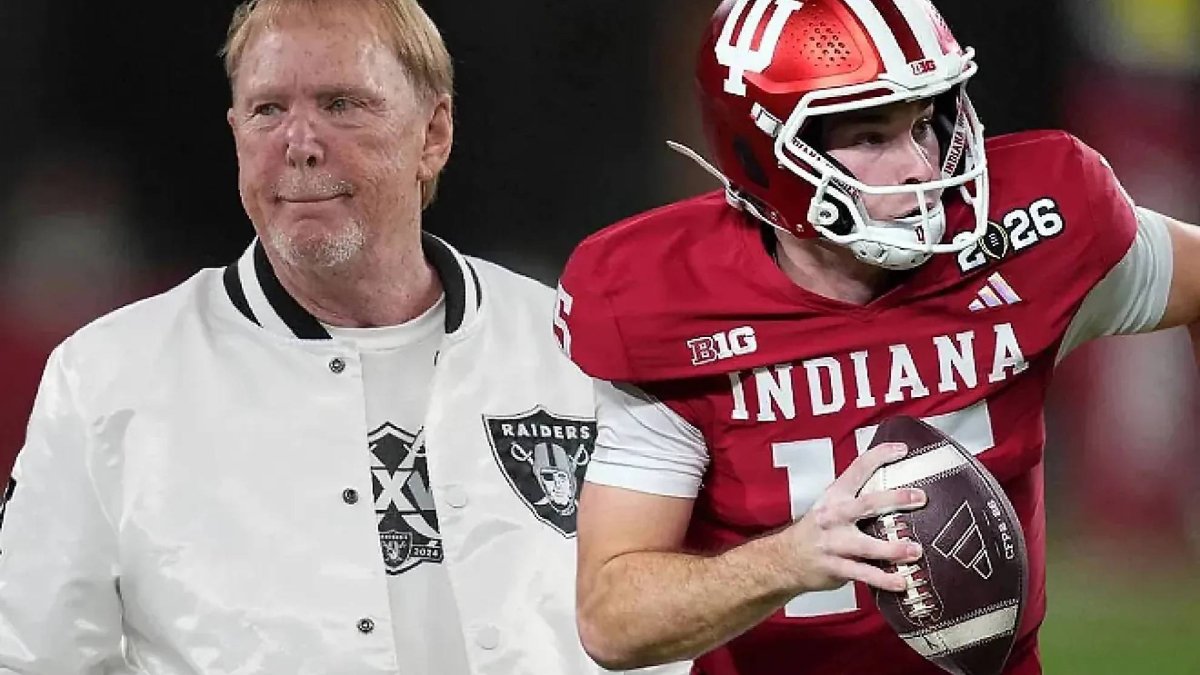
The organization’s evaluation process has been nothing short of exhaustive. Telesco and his scouting staff have spent months dissecting Mendoza’s college tape, attended three of his games in person, conducted two private workouts at Indiana’s facility, and hosted Mendoza for an extensive visit at the Raiders’ headquarters in Henderson, Nevada. The consensus among evaluators is clear: Mendoza processes defenses at an elite level, displays exceptional accuracy on throws of 20-plus yards, and possesses the composure to handle the pressure of playing in one of the league’s most demanding markets.
Raiders Silence Lamar Jackson Trade Rumors with Clear Commitment
One of the most persistent rumors circulating throughout the pre-draft process suggested the Raiders could pursue a blockbuster trade with the Baltimore Ravens to acquire Lamar Jackson. The speculation gained significant traction given Jackson’s explosive playmaking ability, his history with offensive coordinator Klint Kubiak’s system from their time together in Baltimore, and the Raiders’ desperate need for a dynamic quarterback. However, team sources have categorically denied these reports, confirming that Las Vegas has no intention of parting with the draft capital required to acquire the former MVP.
“We’re not trading the pick. Full stop,” one Raiders executive told reporters on condition of anonymity. “When you have the chance to select a franchise quarterback on a rookie contract, you don’t pass that up for a veteran making $50 million a year. The math doesn’t work.”
The decision to pass on a player of Jackson’s caliber underscores the Raiders’ commitment to building through the draft and establishing a sustainable foundation. Rather than chasing short-term solutions that could mortgage the franchise’s future, the organization is betting on Mendoza’s potential to become the face of the franchise for the next decade. This approach aligns with the long-term vision laid out by owner Mark Davis, who has emphasized the importance of patience and development in the team’s rebuild.
Additionally, the Raiders’ salary cap situation makes a Jackson trade financially prohibitive. Acquiring the former MVP would require a massive contract extension and significant guaranteed money—potentially exceeding $250 million—limiting the team’s ability to address other pressing needs. By selecting Mendoza on a rookie deal, Las Vegas gains the financial flexibility necessary to build a competitive roster around him, with an estimated $40-50 million in cap savings over the next four years compared to a veteran quarterback contract.
Arch Manning Factor: Why Mendoza Isn’t Everyone’s No. 1
Despite Mendoza’s remarkable college season and his status as the consensus top quarterback on most draft boards, it would be inaccurate to suggest his selection is without debate. Several prominent draft analysts, including ESPN’s Mel Kiper Jr. and The Athletic’s Dane Brugler, have noted that Arch Manning’s physical tools remain superior to Mendoza’s, with Manning possessing a stronger arm, better mobility, and NFL bloodlines that many evaluators believe portend a higher ceiling. In fact, some NFL executives have placed Manning and other prospects ahead of Mendoza in their internal draft rankings, highlighting the ongoing debate about his ultimate ceiling at the next level.
Manning’s late-season shoulder injury—which required surgery and caused him to miss the final two games of the year—allowed Mendoza to leapfrog him in the draft conversation. However, Manning is expected to be fully cleared for his pro day workouts, which could reignite the debate and potentially force the Raiders to reconsider their commitment. The Raiders’ medical staff has reportedly reviewed both quarterbacks’ injury histories extensively, with one source noting, “We’re comfortable with Mendoza’s medicals. He’s had one minor injury in his career, and he’s fully healed. Manning’s shoulder is the bigger unknown right now.”
Drew Allar also presents an intriguing alternative. The Penn State quarterback possesses prototypical NFL size at 6-foot-5 and 240 pounds, with a cannon arm that NFL scouts drool over. However, Allar’s inconsistency and his team’s inability to win big games have raised concerns about his decision-making under pressure. The Raiders’ evaluation reportedly placed a premium on Mendoza’s superior accuracy and poise over Allar’s raw physical tools.
“You can’t teach what Mendoza has between the ears,” a veteran scout told reporters during the Senior Bowl. “He’s not the biggest, he’s not the fastest, he doesn’t have the strongest arm. But he sees the field like a ten-year veteran, and he doesn’t make mistakes. That’s rare for a college quarterback.”
Klint Kubiak’s Offensive System: Perfect Fit for Mendoza’s Skill Set
The arrival of offensive coordinator Klint Kubiak represents perhaps the most critical factor in the Raiders’ decision to commit to Mendoza. Kubiak, who takes over play-calling duties after the disappointing one-season tenure of Pete Carroll and Geno Smith, brings a modern offensive philosophy rooted in the Shannahan coaching tree that emphasizes play-action passing, misdirection, and creating favorable matchups through motion and formation diversity.
Kubiak’s system is specifically designed to maximize quarterbacks who can process information quickly, deliver accurate throws on timing routes, and execute play-action fakes effectively—all areas where Mendoza excels. The Raiders’ offensive coordinator has been instrumental in developing young signal-callers at previous stops, including his work with the Denver Broncos’ Russell Wilson and the New Orleans Saints’ Derek Carr, implementing schemes that play to their strengths while minimizing exposure to pressure situations.
“What Klint does really well is tailor the offense to the quarterback,” a former NFL offensive coordinator familiar with Kubiak’s approach told PressNova. “He’s not going to force Mendoza into a system that doesn’t fit him. He’ll design the offense around what Mendoza does best: quick decisions, play-action efficiency, and taking shots when the defense gives them.”
Kubiak’s collaboration with Mendoza will be crucial, particularly given the limited offensive talent currently surrounding the rookie quarterback. The Raiders’ receiving corps lacks a true No. 1 target outside of tight end Brock Bowers, meaning the offense will likely rely heavily on tight end sets, running back Ashton Jeanty out of the backfield, and creative play design to generate explosive plays.
The transition from Carroll’s veteran-heavy approach to Kubiak’s youth-driven system signals a complete philosophical reset. Carroll, who could not find the right formula during his tenure, relied heavily on Geno Smith—who subsequently led the NFL with 16 interceptions and committed a league-leading 27 total turnovers. The turnover-heavy offense proved unsustainable, and the organization has since prioritized a fresh start centered around the rookie quarterback.
“It wasn’t just the interceptions,” a team insider explained. “It was the lack of ball security across the board—fumbles, bad decisions, poor clock management. That’s not who Pete Carroll is, but that’s what this team became. Klint brings a more disciplined, detail-oriented approach that should help Mendoza avoid those same pitfalls.”
The Trade Scenario: What If Someone Offers a Historic Haul?
While the Raiders have publicly committed to Mendoza, no draft decision is truly final until the selection is made. The possibility remains that another team could present an offer too valuable to refuse—a scenario that has become increasingly common in recent years as quarterback-needy franchises grow desperate to land their franchise signal-caller.
According to league sources, the Raiders have established a “price of admission” for the No. 1 overall pick that would require at least three first-round picks and additional Day 2 selections. Several teams, including the New York Giants, Pittsburgh Steelers, and Seattle Seahawks, have reportedly inquired about the pick’s availability, though none have met the Raiders’ asking price. As the NFL Draft 2026 approaches, quarterback strategies across the league are taking shape, with some teams eyeing later-round prospects while others position themselves for a potential move up the board.
“If someone offers four first-round picks, you have to listen,” an NFL executive with knowledge of the Raiders’ thinking said. “But it would take a truly historic offer to move off a quarterback you’ve fallen in love with. Telesco isn’t going to be the GM who passed on a franchise QB to accumulate picks that might never pan out.”
One potential trade partner to watch is the Carolina Panthers, who hold the No. 2 overall pick and could package additional selections to jump the Raiders. However, the Panthers have also signaled interest in Mendoza, making a trade-up scenario less likely unless another team leapfrogs both of them.
The Raiders’ willingness to entertain offers—even if they ultimately reject them—adds a layer of uncertainty that keeps the draft conversation fluid. For fans, this reality creates anxiety that the front office could pivot at the last moment, leaving the franchise without a clear direction at the sport’s most important position.
AFC West Reality: The Raiders’ Divisional Challenge and Roster Gaps
The road to contention in the AFC West remains daunting regardless of who plays quarterback. The Denver Broncos and Los Angeles Chargers both secured playoff berths in 2025, demonstrating the competitive ceiling within the division. Meanwhile, the Kansas City Chiefs, despite a down year by their standards, are widely expected to rebound and reclaim their position atop the conference under Patrick Mahomes’ leadership. For the Raiders to compete, Mendoza will need to accelerate his development while the team addresses significant roster deficiencies.
Outside of running back Ashton Jeanty and tight end Brock Bowers, the Raiders lack consistent playmakers on offense. The receiving corps, anchored by Davante Adams’ declining production, requires a true No. 1 target who can stretch the field and create separation. The offensive line, which surrendered 48 sacks in 2025, needs upgrades at both guard positions and potentially right tackle. The defense, which ranked 28th in points allowed, needs help at cornerback, linebacker, and along the defensive line.
These needs represent significant challenges for the front office, which must balance the pursuit of veteran free agents with the financial constraints of Mendoza’s rookie contract. The Raiders’ salary cap situation, while improved by selecting a quarterback on a rookie deal, still requires careful management to address multiple roster gaps simultaneously.
“You can’t fix everything in one offseason,” Telesco acknowledged during his pre-draft press conference. “But we have a plan. We’re not going to force anything. We’re going to be patient and build this thing the right way.”
Offseason Priorities: Building Around Mendoza
With the quarterback position addressed, the Raiders’ offseason priorities shift to strengthening the supporting cast. Key areas of focus include:
- Wide Receiver: A true No. 1 target to complement the tight end-heavy approach, potentially through free agency or Day 2 of the draft
- Offensive Line: Protecting Mendoza with upgraded interior and tackle play, with focus on the guard positions in free agency
- Defensive Secondary: Improving coverage against the division’s elite passing attacks, particularly against Mahomes and Justin Herbert
- Pass Rush: Generating consistent pressure to offset an improved AFC West, with edge rusher and defensive tackle as priority needs
These needs can be addressed through the remaining rounds of the draft and strategic free-agent signings. The Raiders’ front office has emphasized maintaining salary cap flexibility to pursue talent that fits Kubiak’s system and complements Mendoza’s skill set.
Fan Sentiment: Uncertainty Meets Optimism
Raiders fans find themselves in a familiar position: cautiously optimistic about the future while bracing for potential disappointment. The Mendoza era represents another chapter in the franchise’s quest for stability at quarterback, a search that has spanned multiple regimes and produced more questions than answers. Yet there is a palpable sense that this time might be different. Some within the fan base have expressed concerns about whether Mendoza can deliver on the immense expectations that come with being the No. 1 overall selection, with certain observers noting that Mendoza’s recent performances have started to worry even legends like Tom Brady and longtime Raiders fans who have seen this script play out before.
Recent polling data from the Raiders’ official fan council indicates that 68% of season ticket holders support drafting a quarterback at No. 1 overall, with 72% specifically endorsing Mendoza as the preferred choice. However, the same survey revealed significant concerns about Mendoza’s ability to handle the pressure of playing in Las Vegas and the team’s lack of offensive talent around him.
Social media sentiment analysis reveals a fanbase that is engaged, passionate, and deeply invested in the Mendoza decision. Twitter mentions of “Raiders” and “Mendoza” spiked 340% following Telesco’s press conference, with sentiment split roughly 60-40 in favor of the selection. While some advocates argue the Raiders should consider alternative options to mitigate risk, the overwhelming majority appear willing to embrace Mendoza as the franchise’s best path forward.
“I’ve been a Raiders fan for 40 years, and I’ve seen this movie before,” longtime fan and season ticket holder Michael Torres told PressNova. “But Mendoza feels different. He’s not just another guy. He’s a winner. He’s calm. He doesn’t make mistakes. That’s what we need.”
The coming months will be critical in shaping the team’s trajectory and the fanbase’s long-term confidence in the organization’s direction. As the draft approaches, all eyes will remain fixed on Las Vegas and the selection that promises to define the franchise’s next chapter.