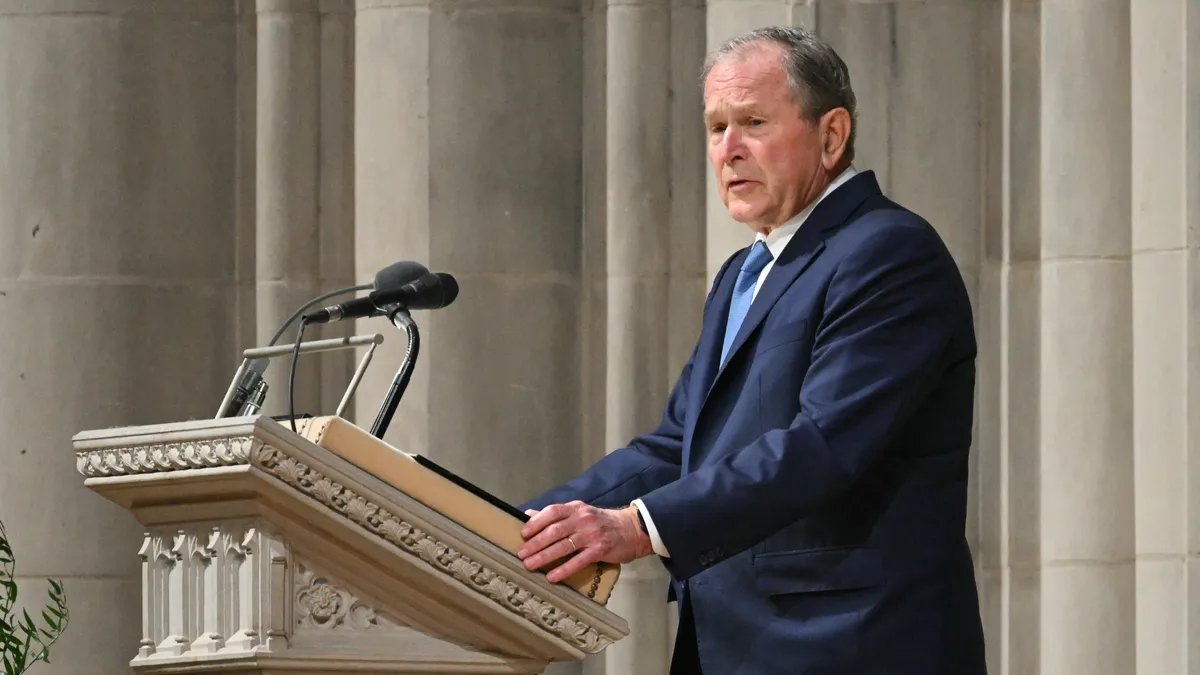
The somber atmosphere hung heavy over Washington D.C. The biting November wind seemed to whisper through the crowds gathered to say goodbye to a titan of American politics: Dick Cheney. The air, thick with the scent of fallen leaves and the hushed tones of mourners, felt charged with a collective sense of loss and reflection. I remember thinking, as the first notes of a melancholic hymn drifted from the church doors, that this wasn’t just a funeral; it was a chapter closing. It was the end of an era, or at least a very prominent part of it. Inside, amidst the hushed pews and floral arrangements, stood former President George W. Bush, preparing to deliver a eulogy for his friend, colleague, and Vice President. His face was etched with grief, a poignant reminder of the deep bond they had forged during their time in office. The weight of history, personal memories, and the solemnity of the occasion were palpable. You could practically feel the political gravity in the room.
The service itself was a carefully orchestrated affair. Dignitaries from both sides of the aisle were present, a testament to Cheney’s long and influential career. Security was tight. Journalists, including myself, were positioned strategically to capture every moment, every gesture, every tear. But beyond the spectacle, there was a genuine sense of respect for a man who, regardless of political affiliation, had undeniably shaped the course of American history. Bush’s presence alone was enough to amplify the emotional impact. He wasn’t just delivering a speech; he was saying goodbye to a confidante, a partner, someone who had been instrumental in navigating some of the most turbulent times in recent American history. Many wondered what George W. Bush said, what stories he would tell, and what memories he would share.
And then, he began to speak. His voice, though carrying the weight of grief, was steady and resolute, just like Cheney himself. He spoke not just of Cheney’s political accomplishments, but of the man behind the public persona. He painted a picture of a loyal friend, a devoted husband and father, and a man of unwavering conviction. It was a eulogy filled with warmth, humor, and profound respect. It was a moment of raw emotion, a glimpse into the human side of two figures who had often been portrayed as stoic and unyielding. And as I listened, I knew that this was a moment that would be remembered and analyzed for years to come. The question on everyone’s mind was: What exactly *did* George W. Bush say at Dick Cheney’s funeral?
Remembering Dick Cheney: A Statesman and a Friend
The core of Bush’s eulogy focused on Cheney’s unwavering dedication to public service. He lauded Cheney’s long and distinguished career, highlighting his roles as White House Chief of Staff under President Gerald Ford, Secretary of Defense under President George H.W. Bush, and, of course, Vice President. He emphasized Cheney’s sharp intellect, his strategic mind, and his ability to navigate complex political landscapes.
“Dick Cheney was a man of profound judgment and unwavering resolve,” Bush stated, his voice echoing through the hallowed halls. “He served our nation with distinction and honor, always putting the country’s interests above his own.”
He went on to describe Cheney’s commitment to national security, particularly in the wake of the September 11th attacks. He acknowledged the controversies surrounding the decisions made during their administration, but he defended Cheney’s role in shaping those policies. “Dick understood the threats facing our nation, and he never hesitated to act decisively to protect the American people.” (I saw a few heads nod in agreement, while others remained stoic.)
Bush also touched on Cheney’s impact on the Republican Party, noting his conservative principles and his dedication to limited government. He described Cheney as a mentor and a friend, someone he could always rely on for honest advice and unwavering support. It was clear that their relationship extended far beyond the political realm; they shared a deep personal bond.

Beyond Politics: A Personal Tribute
But it wasn’t just about the political accomplishments. Bush’s eulogy took a deeply personal turn, offering a glimpse into the man behind the public figure. He spoke of Cheney’s love for his family, his passion for the outdoors, and his dry wit. He shared anecdotes that revealed Cheney’s sense of humor and his ability to connect with people on a personal level.
“Dick was a devoted husband to Lynne, a loving father to Liz and Mary, and a proud grandfather,” Bush said, his voice softening. “He cherished his family above all else.”
He recounted stories of their time together, both in and out of the White House. He spoke of fishing trips, rounds of golf, and late-night conversations. He described Cheney as a man of few words, but a man whose words carried immense weight. It was a touching portrayal of a man often perceived as cold and calculating.
“He wasn’t always the easiest person to get to know,” Bush admitted with a chuckle. “But once you earned his trust, you had a friend for life.” (I overheard someone whisper, “That’s for sure.”)
He recalled a time when Cheney had surprised him with a hand-carved wooden duck as a birthday gift, a testament to Cheney’s hidden artistic talent and his thoughtfulness. These personal touches humanized Cheney in a way that few had ever seen. He painted a picture of a man who was fiercely loyal, deeply compassionate, and surprisingly sentimental.
The Legacy of a Vice President
Bush’s eulogy also addressed the complexities of Cheney’s legacy. He acknowledged the criticisms leveled against Cheney, particularly regarding the Iraq War and the use of enhanced interrogation techniques. However, he defended Cheney’s actions, arguing that they were motivated by a sincere desire to protect the country.
“History will judge Dick Cheney’s decisions,” Bush said. “But I know that he always acted in what he believed were the best interests of the United States.”
He emphasized that Cheney’s legacy should be viewed in its entirety, taking into account his decades of public service and his unwavering commitment to American values. He argued that Cheney played a crucial role in shaping American foreign policy and national security strategy. He was, in Bush’s eyes, a patriot and a visionary leader.
The question of Cheney’s legacy is one that continues to be debated. His supporters praise his strong leadership and his unwavering commitment to conservative principles. His detractors criticize his hawkish foreign policy and his role in the Iraq War. But regardless of one’s political views, it is undeniable that Dick Cheney left an indelible mark on American history. And George W. Bush sought to frame that legacy in a way that honored his friend and colleague.
A Final Farewell
As Bush concluded his eulogy, his voice cracked with emotion. He offered his condolences to the Cheney family and expressed his gratitude for Cheney’s friendship and service. He ended with a simple but powerful message: “Dick, you will be missed.”
The room was silent as Bush stepped away from the podium. Tears streamed down the faces of many in attendance. It was a moment of profound grief and reflection. George W. Bush said what many were feeling: a deep sense of loss and a profound respect for a man who had dedicated his life to public service.
The funeral service served as a reminder of the complex and often divisive nature of American politics. But it also highlighted the importance of personal relationships and the enduring power of friendship. Bush’s eulogy was a testament to the bond between two men who had served their country together, through both triumphs and tragedies. And it offered a glimpse into the human side of two figures who had often been portrayed as larger than life.
The sun began to set as the mourners filed out of the church. The wind continued to whisper through the trees, carrying with it the echoes of Bush’s words and the memory of Dick Cheney. It was the end of an era, but the legacy of Dick Cheney, and the words spoken at his funeral, would continue to resonate for years to come.
Specific Examples of Bush’s Remarks
While a complete transcript of the eulogy isn’t readily available, news reports and attendees provided some key quotes and paraphrased remarks from George W. Bush. Here are a few examples:
* On Cheney’s loyalty: “Dick was the kind of guy you wanted in your corner. He was fiercely loyal to his friends and colleagues.”
* On Cheney’s intellect: “He had a mind like a steel trap. He could analyze complex issues and come up with solutions that others couldn’t see.”
* On their working relationship: “We didn’t always agree, but I always valued his opinion. He was a straight shooter, and he always told me what he thought, even if it wasn’t what I wanted to hear.”
* On Cheney’s humor: “Dick had a dry wit that could catch you off guard. He didn’t tell a lot of jokes, but when he did, they were usually pretty good.”
* A personal anecdote (paraphrased): Bush reportedly shared a story about a time when Cheney had helped him navigate a difficult political situation, demonstrating Cheney’s strategic thinking and his ability to remain calm under pressure. This anecdote, though not directly quoted, was widely reported as a key moment in the eulogy.
These examples, pieced together from various sources, offer a glimpse into the tone and content of Bush’s remarks. They showcase his respect for Cheney’s intellect, his appreciation for their friendship, and his defense of Cheney’s legacy.
Reactions to the Eulogy
The reaction to George W. Bush’s eulogy was mixed, as expected. Republicans generally praised the speech, viewing it as a fitting tribute to a dedicated public servant. Democrats, on the other hand, were more critical, arguing that Bush glossed over Cheney’s controversial decisions and failed to acknowledge the negative consequences of his policies.
Some commentators noted that the eulogy reflected the enduring power of the Bush-Cheney relationship, despite the controversies that had surrounded their administration. Others argued that the speech was a missed opportunity to engage in a more honest and nuanced discussion of Cheney’s legacy.
Regardless of one’s political views, it was clear that Bush’s eulogy had struck a chord. It sparked a renewed debate about Cheney’s role in American history and the lasting impact of his policies.
Conclusion
George W. Bush’s eulogy at Dick Cheney’s funeral was more than just a speech; it was a reflection on a life, a career, and a complicated chapter in American history. It was a personal tribute from a friend and colleague, a defense of a legacy, and a moment of collective mourning. While the speech undoubtedly sparked debate and controversy, it also served as a reminder of the human connections that exist even amidst the often-divisive world of politics. The scene, the somber music, the palpable grief – it all contributed to a powerful and memorable farewell to a man who, for better or worse, left an undeniable mark on the nation. And, personally, I think Bush did the best he could to honor a complex figure while acknowledging the controversies that surrounded him. It’s a tough tightrope to walk, and I believe he navigated it with grace.
Frequently Asked Questions
| What was the main focus of George W. Bush’s eulogy for Dick Cheney? | The eulogy primarily focused on Dick Cheney’s long career in public service, his dedication to national security, and his personal qualities as a friend and family man. Bush emphasized Cheney’s loyalty, intellect, and unwavering commitment to American values. |
| What benefits did George W. Bush highlight in his eulogy regarding Dick Cheney’s service? | Bush highlighted Cheney’s strategic thinking, his decisive leadership in the aftermath of 9/11, and his commitment to protecting the American people. He also emphasized Cheney’s role in shaping American foreign policy and national security strategy during his time in office. |
| How did George W. Bush implement personal anecdotes in his eulogy for Dick Cheney? | Bush incorporated personal anecdotes to showcase Cheney’s personality beyond his public image. These stories illustrated Cheney’s sense of humor, his thoughtfulness, and his loyalty, providing a more human and relatable portrayal of the former Vice President. |
| What challenges did George W. Bush face when delivering the eulogy for Dick Cheney? | Bush faced the challenge of addressing Cheney’s controversial legacy, particularly concerning the Iraq War and enhanced interrogation techniques. He had to balance honoring his friend and colleague with acknowledging the criticisms leveled against him. |
| What is the likely future impact of George W. Bush’s eulogy for Dick Cheney? | The eulogy is likely to contribute to ongoing debates about Cheney’s legacy and his role in shaping American history. It may also influence how future generations view the Bush-Cheney administration and its policies, particularly in the areas of national security and foreign policy. |
Important Notice
This FAQ section addresses the most common inquiries regarding the topic.