The dust, hot and unforgiving, swirled around Maria and her two children as they waited, their eyes fixed on the distant gate. It was another dawn at the US-Mexico border, and with it, another day of agonizing hope and crushing uncertainty. For weeks, they had been part of a growing, desperate throng, all hoping to present themselves for `asylum`, only to be told, day after day, that they had reached the invisible limit. This is the grim reality of the `metering policy`, a controversial `border policy` that dictates how many `asylum seekers` US officials will process daily, effectively turning a legal right into a lottery. Imagine leaving everything behind, trekking thousands of miles through unimaginable dangers, only to be met with a closed sign, not because you lack a valid claim, but because the daily quota has been met. It’s a gut-wrenching situation, fueling frustration and despair among those fleeing violence and persecution. Now, the `Supreme Court` has decided to step into this highly charged debate, agreeing to review the legality of this very `metering` practice. This isn’t just a legal technicality; it’s a decision that will profoundly impact countless lives, challenging the fundamental tenets of `US immigration law` and our nation’s commitment to `constitutional rights` and international humanitarian obligations. The anticipation is palpable, a mix of apprehension from those who fear a further tightening of the border, and a cautious optimism from advocates who believe this policy is a clear violation of `due process` and basic human dignity.
Unpacking the Metering Policy: A Gateway to Limbo
What exactly is this `metering policy` that has garnered so much attention? In simple terms, it’s a practice where US Customs and Border Protection (CBP) officers at ports of entry limit the number of `asylum seekers` they allow to enter and process each day. Instead of accepting everyone who presents themselves to claim asylum, which is their right under both US and international law, officials turn away individuals once a predetermined, often opaque, daily quota is reached. Picture a line stretching for miles, people carrying their meager possessions, children clinging to parents, all waiting for a chance that might not come today, or tomorrow, or even next week. “It’s like being in purgatory,” remarked Jorge, a father from Honduras who spent three months sleeping on the streets of Tijuana, waiting for his turn. “Every morning, the hope rises, and every evening, it dies a little more.”
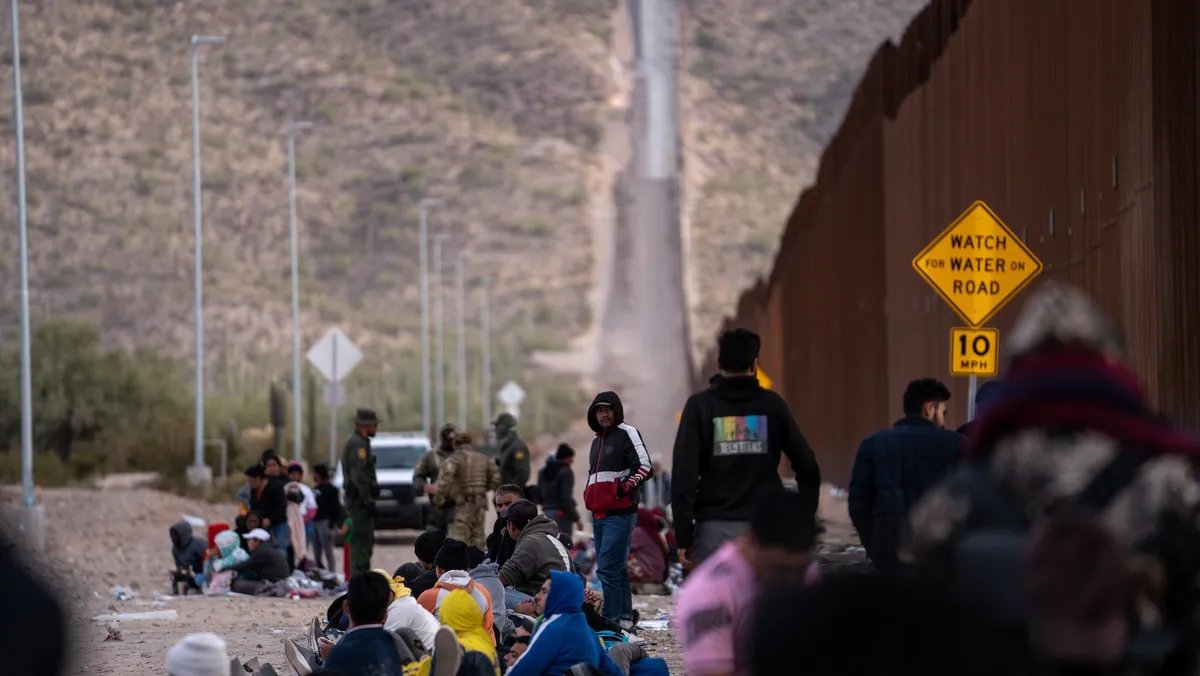
This practice didn’t just appear overnight; it has roots in various administrations’ efforts to manage perceived surges at the `US-Mexico border`. While not explicitly codified in law, it has been justified by officials as a necessary measure to ensure orderly processing and prevent overwhelming resources. However, critics vehemently argue that it directly violates Section 235(b)(1) of the Immigration and Nationality Act, which states that any noncitizen “who arrives in the United States… shall be inspected by an immigration officer.” By turning people away, proponents of the lawsuit argue that the government is failing to inspect them, effectively denying them their legal right to seek `asylum`. This isn’t just a bureaucratic hurdle; it’s a policy that often forces vulnerable individuals, including families and unaccompanied minors, to remain in dangerous border towns for extended periods, exposed to extortion, kidnapping, and violence.
The Legal Gauntlet: From District Courts to the High Court
The journey of the `metering policy` through the US legal system has been long and winding. The primary legal challenge against this policy was brought forth by advocacy groups, notably the American Civil Liberties Union (ACLU), who argued that `metering` unlawfully prevents `asylum seekers` from accessing the asylum process. Their central claim is that federal law requires prompt processing of individuals who arrive at a port of entry and express a fear of persecution. The government, they contend, cannot simply cap the number of people it processes, especially when it results in people being turned back to dangerous situations.
Initially, a federal district court sided with the plaintiffs, ruling that the `metering policy` was indeed illegal and ordering the government to cease the practice. This was a significant victory for `refugee rights` advocates. However, the government appealed this decision to the `Fifth Circuit Court of Appeals`, a jurisdiction known for its conservative leanings on immigration matters. The `Fifth Circuit` ultimately reversed the district court’s ruling, essentially upholding the government’s right to implement `metering`. This reversal sent shockwaves through the human rights community, signaling a potential green light for stricter `border policies`. It felt like a punch to the gut for many who had pinned their hopes on legal remedies.
It was this split decision that paved the way for the case to reach the nation’s highest judicial body. The `Supreme Court’s` decision to grant certiorari – meaning they will hear the case – signifies the profound legal and constitutional questions at stake. It’s not a guarantee of how they will rule, but it does mean they recognize the national importance of clarifying the extent of the government’s power to limit `asylum processing` at the border. “This is not just about a quota; it’s about whether our laws mean what they say when it comes to fundamental human rights,” stated Lee Gelernt, a lawyer with the ACLU, expressing a sentiment shared by many legal experts.
Balancing Act: Arguments For and Against Metering
The debate surrounding `metering` is complex, with passionate arguments on both sides. Proponents of the policy, primarily government officials and some lawmakers, often emphasize the challenges of managing large numbers of arrivals. They argue that `metering` is a practical necessity for:
* Orderly Processing: It allows border agents to process individuals thoroughly, ensuring security checks are not rushed and resources are not overwhelmed. “We can’t just throw open the doors,” an anonymous CBP official once told a reporter. “There has to be some control, some way to ensure we can do our jobs effectively and safely for everyone involved.”
* Resource Management: Processing `asylum seekers` requires significant resources, including interpreters, legal aid, and temporary housing. Limiting daily intake, they contend, prevents the system from collapsing under strain.
* National Security: Without `metering`, the argument goes, there could be a higher risk of individuals with malicious intent slipping through the system amidst chaos.
* Deterrent Effect: Some believe that the policy discourages frivolous `asylum claims`, though this is a highly contentious point.
On the other hand, critics, including human rights organizations, legal experts, and advocates for `asylum seekers`, argue that the policy is morally indefensible and legally dubious. Their arguments typically center on:
* Violation of Asylum Law: They contend that US law, and international treaties like the Refugee Convention, guarantee the right to seek `asylum` at a port of entry regardless of numerical quotas. The government has an obligation to process these claims.
* Humanitarian Crisis: `Metering` forces `asylum seekers` to wait for extended periods in dangerous conditions in Mexico, exposing them to violence, exploitation, and inadequate humanitarian support. “I’ve seen mothers with infants sleeping on cardboard, terrified, just inches from the border they hope to cross,” shared Elena Rodriguez, a volunteer at a migrant shelter in Ciudad Juárez. “This policy isn’t managing a crisis; it’s creating one.”
* Denial of Due Process: By turning people away, the government is denying individuals the opportunity to present their case, a fundamental aspect of `due process`.
* Ineffectiveness as a Deterrent: Critics argue that `metering` doesn’t deter people fleeing for their lives; it simply creates a backlog and pushes people toward more dangerous, irregular border crossings.
The Broader Canvas: Asylum Law and Shifting Border Dynamics
To truly understand the stakes of the `Supreme Court’s` review, we must place `metering` within the broader context of `asylum law` and the ever-evolving `border dynamics`. `Asylum law` in the United States is rooted in the principle that individuals fleeing persecution based on race, religion, nationality, political opinion, or membership in a particular social group have a right to seek protection. This is a bedrock principle, often called `non-refoulement`, meaning a country cannot return a person to a place where they would face persecution.
The `metering policy` has often been implemented alongside, or in conjunction with, other restrictive `border policies`. For instance, during the pandemic, the `Title 42` public health order was widely used to expel `asylum seekers` without allowing them to make a claim, effectively bypassing `metering` and the entire `asylum process`. The legal battles over `Title 42` have also reached the `Supreme Court`, highlighting the consistent tension between public health or security concerns and `asylum law` obligations. The `Remain in Mexico` policy, which required `asylum seekers` to wait in Mexico for their court dates, further complicated matters, creating a sprawling, often chaotic system at the `US-Mexico border`.
The individuals arriving at the border are not coming on a whim; they are often fleeing unimaginable circumstances—gang violence, political instability, economic collapse, and climate-induced disasters in their home countries, particularly in Central and South America. These powerful push factors mean that restrictive policies like `metering`, while aiming to control the flow, often only succeed in creating more desperate and dangerous situations for those seeking safety. The strain on `border communities` in both the US and Mexico is immense, as they struggle to provide humanitarian aid, shelter, and basic necessities to thousands of people stuck in limbo.
Possible Outcomes and the Future of US Immigration Policy
The `Supreme Court’s` review of the `metering policy` carries immense weight, and the potential outcomes are diverse, each with profound implications for `asylum seekers` and the future of `US immigration policy`.
1. Upholding Metering: If the `Supreme Court` sides with the government and upholds the `Fifth Circuit’s` decision, it would essentially legitimize the `metering policy`. This would be a significant blow to `asylum rights` advocates, potentially allowing future administrations to continue or even expand such limitations. It could set a precedent that prioritizes border management and resource control over the individual’s right to seek `asylum`, possibly leading to an even more restrictive `US-Mexico border`. The humanitarian concerns would undoubtedly intensify, as more people would be stuck in precarious situations.
2. Striking Down Metering: A ruling against `metering` would be a monumental victory for `asylum seekers` and human rights groups. It would compel the government to process individuals who present themselves at ports of entry, regardless of a daily cap. The immediate impact would likely be an increase in the number of `asylum seekers` able to enter the US to pursue their claims. However, this wouldn’t solve all `border challenges`. It would necessitate a significant increase in resources for processing, housing, and legal services, potentially straining existing infrastructure. As political analyst Dr. Clara Ramirez noted, “A ruling against `metering` would restore a fundamental right, but it would also present a new set of operational challenges that any administration would need to address swiftly and humanely.”
3. Remanding the Case: The Court could also choose a middle ground, remanding the case back to lower courts for further consideration or providing specific guidelines that the `metering policy` must adhere to to be considered lawful. This outcome would prolong the legal uncertainty but might force the government to implement `metering` with clearer, more transparent, and potentially more humane guidelines.
Regardless of the outcome, this decision will undoubtedly shape the legal landscape for `asylum seekers` for years to come. It will redefine the balance between a nation’s sovereign right to control its borders and its international and domestic legal obligations to those seeking refuge. This case is not just about a policy; it’s about the kind of country we aspire to be—one that upholds its laws and humanitarian values even in the face of complex challenges.
The `Supreme Court’s` review of the `metering border policy` represents a pivotal moment in the ongoing debate over `US immigration law` and humanitarian responsibilities. It forces us to confront difficult questions about how we treat those most vulnerable, seeking safety and a new life. While the challenges at the `US-Mexico border` are undeniably complex, involving immense logistical, political, and social hurdles, we must never lose sight of the human stories at the heart of every policy decision. Maria, Jorge, and countless others are not just statistics; they are individuals with legitimate fears and an undeniable right to seek refuge. As the justices deliberate, one can only hope that their decision will reflect not just legal precedent, but also a profound understanding of the human cost involved and a commitment to upholding the core values that define our legal system and our society. It’s a moment for reflection, for compassion, and for ensuring that the promise of asylum remains a beacon, not an illusion, for those in desperate need.
Frequently Asked Questions
| What is the “metering” border policy the Supreme Court is reviewing? | The “metering” policy is a practice by US Customs and Border Protection (CBP) that limits the number of asylum seekers processed daily at ports of entry, effectively creating a quota system. This often forces individuals fleeing persecution to wait in dangerous conditions in Mexico for extended periods before they can present their asylum claims. |
| What are the arguments made by proponents of the metering policy? | Proponents, primarily government officials, argue that metering is necessary for orderly processing, managing limited resources, ensuring national security by allowing thorough vetting, and preventing the overwhelming of the asylum system. They suggest it helps maintain control at the border. |
| How does the metering policy affect asylum seekers at the border? | Metering significantly delays the ability of asylum seekers to present their claims, sometimes for weeks or months. This leaves them vulnerable to violence, extortion, and harsh living conditions in border towns in Mexico, often without adequate access to shelter, food, or medical care. |
| What are the main legal and humanitarian challenges against metering? | Legal challenges argue that metering violates US and international asylum law, which guarantees the right to seek asylum at a port of entry. Critics also claim it denies asylum seekers due process and creates a humanitarian crisis by forcing vulnerable individuals into dangerous situations, thus violating principles of non-refoulement. |
| What are the potential outcomes if the Supreme Court rules against the metering policy? | If the Supreme Court rules against metering, the government would likely be compelled to process all asylum seekers who present themselves at ports of entry without daily caps. This would be a significant victory for asylum rights, though it would also necessitate increased resources for processing, housing, and legal services to manage the potential increase in arrivals. |
Important Notice
This FAQ section addresses the most common inquiries regarding the topic.