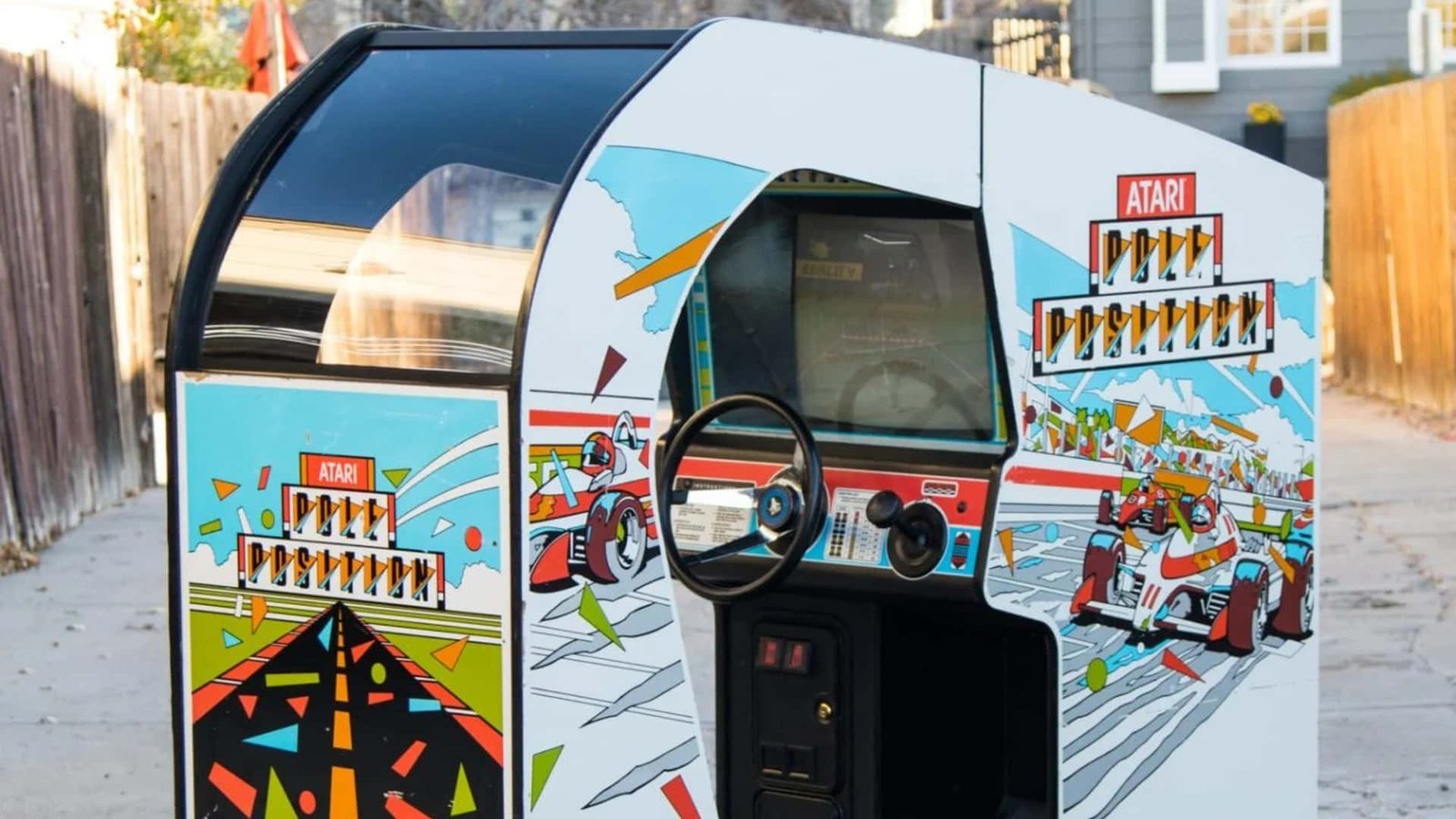
The hum of fluorescent lights, the scent of popcorn and lingering cigarette smoke, the cacophony of bleeps, bloops, and synthesized voices – these are the ghost memories of a truly legendary era, the Golden Age of the arcade. Among the flashing lights and booming sounds, one particular cabinet often drew the biggest crowd, a beacon of automotive glory that promised speed, skill, and bragging rights: the Atari Pole Position. Remember the sheer exhilaration of sliding into that cockpit, gripping the wheel, and feeling the rumble of the engine as you pressed the accelerator pedal? It wasn’t just a game; it was an event, a pilgrimage to the altar of pixels and pure adrenaline. Today, that very same experience is not just a relic of the past; it’s a vibrant, living piece of gaming history, perfectly poised to become the undisputed star of your modern game room. Imagine the envious glances, the immediate conversations, the irresistible urge for anyone walking into your space to take a seat and try to beat your high score. (Because let’s be honest, you’ve been practicing, haven’t you?) This isn’t merely about owning an old game; it’s about curating an atmosphere, a personal museum of interactive art, and a powerful portal back to a time when digital dreams were just beginning to take shape.
For many of us, the Atari Pole Position arcade was more than just another game on the circuit. It was a cultural touchstone, a technological marvel that pushed the boundaries of what video games could be. The groundbreaking pseudo-3D graphics, the vibrant F1 race tracks, the iconic voice samples (“Prepare to Qualify!”), and the intuitive, immersive controls made it an instant classic. It captured the imagination of millions, making us believe we were genuine race car drivers, even if only for a few precious minutes. Bringing this legendary machine into your home isn’t just about satisfying a craving for nostalgia; it’s about owning a significant piece of entertainment history that continues to enchant and challenge players decades later. Think about it: a full-sized, authentic Atari Pole Position cabinet, gleaming in your dedicated gaming space. Pure bliss, isn’t it?
It’s a rare moment when a piece of technology transcends its original purpose and becomes a timeless icon, but Pole Position did exactly that. It solidified Atari‘s reputation as an innovator and set the stage for countless racing games that followed. The game’s design, from its vibrant cabinet art to its unique sit-down or stand-up configurations, was engineered to captivate. You didn’t just play Pole Position; you entered its world, even if just for a quarter at a time. The simple yet profound joy of navigating those pixelated turns, avoiding opponents, and hitting the finish line before time ran out is an experience that modern games, despite all their graphical fidelity, sometimes struggle to replicate. It’s that raw, unadulterated fun that makes this specific arcade machine so incredibly compelling for any serious collector or enthusiast looking to elevate their home gaming setup.
The Irresistible Allure of Atari Pole Position
What made Atari Pole Position so groundbreaking back in 1982? It wasn’t just one thing; it was a symphony of innovation. The game was one of the first to feature a racing circuit based on a real-world track, Fuji Speedway, complete with recognizable landmarks. This gave players a sense of immersion previously unseen in arcade racers. The “pseudo-3D” effect, achieved by scaling sprites and clever background scrolling, created a convincing illusion of depth and speed. It was a technical marvel that left players’ jaws on the floor.
“I remember seeing Pole Position for the first time at the arcade,” recounted Mark Jenson, a lifelong arcade enthusiast and collector from Seattle. “I’d played other racing games, but nothing felt like this. The steering wheel, the pedal, the way the track seemed to come at you – it was revolutionary. It felt like you were actually driving! I must have spent hundreds of dollars on that game over the years.” That kind of personal connection, that shared memory, is precisely what makes owning a piece of this history so special. The tactile feedback of the steering wheel, the satisfying clunk of the gear shifter, and the pressure of the accelerator pedal all combine to create an experience that simply can’t be replicated by a modern console controller. It’s a full-body engagement, a true test of reflexes and strategic driving, demanding precision and anticipation.
Beyond the Screen: The Cabinet Itself
While the game inside was phenomenal, the physical presence of the Pole Position cabinet was equally iconic. Atari understood that the arcade experience was as much about the environment as the gameplay. The cabinet design, with its distinctive artwork featuring the F1 car and track, instantly drew attention. Most famously, there was the sit-down version, a fiberglass cockpit that truly immersed players, making them feel like they were strapped into a Formula 1 car. Then there was the stand-up version, offering a classic arcade stance but still featuring the dedicated steering wheel and accelerator. Both versions are highly sought after today, each offering a slightly different flavor of the quintessential Atari Pole Position experience.
“The cabinet itself is a work of art,” says Sarah Chen, an interior designer specializing in themed home entertainment spaces. “It’s not just a game; it’s a sculptural piece. The bright colors, the bold graphics – it tells a story even when it’s off. For a game room, it’s not just an activity; it’s a statement piece, a conversation starter that anchors the entire aesthetic.” She’s absolutely right. The moment you introduce an original Atari Pole Position arcade machine into your space, it stops being just a room and starts becoming an experience, a destination for fun and nostalgia.
Bringing the Arcade Home: Why Now is the Time
The idea of a home game room has evolved dramatically over the years. What once might have been a spare bedroom with a console and a TV has transformed into a sophisticated, multi-faceted entertainment hub. And in this evolution, the full-sized arcade machine has found its rightful place. Why now? Because people are yearning for authentic experiences, for connections to the past that digital emulators, while convenient, simply cannot provide. There’s a tangible difference between playing a ROM on a flat screen and gripping that original steering wheel, feeling the mechanical clicks, and hearing the true, unrestored audio of a Pole Position arcade.

This isn’t just about reliving your own youth; it’s about sharing that magic with new generations. Imagine your kids or grandkids experiencing the same thrill you did, understanding a piece of gaming history firsthand. “My nephew, who’s used to hyper-realistic racing sims, was absolutely blown away by our Atari Pole Position,” shared David Miller, a collector from upstate New York. “He said it was ‘retro cool’ and ‘way harder than it looks!’ It’s awesome seeing them connect with something from my past.” It creates a unique focal point for family gatherings, turning a casual evening into a competitive, laughter-filled event. Who can get the best lap time? Who can qualify for the main race? These are the friendly challenges that build lasting memories.
Finding Your Own Classic: What to Look For
Acquiring an original Atari Pole Position arcade machine can be a rewarding quest. These machines are increasingly sought after, and their condition can vary wildly. When you’re on the hunt, here are a few things to consider:
- Condition of the Cabinet: Look for intact artwork, minimal scuffs, and no significant water damage. A clean cabinet often indicates better overall care.
- Working Condition: Is the game fully functional? Does it power on, display correctly, and respond to controls? Sometimes, a non-working machine can be a great restoration project if you’re handy, but expect additional costs.
- Originality: Are the internal components, monitor, and control panel original? Fully original machines, especially those in good working order, command higher prices.
- Sit-down vs. Stand-up: Decide which form factor best suits your space and preference. The sit-down version offers unparalleled immersion but requires more floor space.
- Price: Be prepared for a range. A project machine might be a few hundred dollars, while a fully restored, pristine example could run into the thousands.
“Don’t rush into the first one you see,” advises vintage arcade restorer, Lisa Tran. “Do your homework. Ask for videos of it running, detailed photos, and always factor in shipping costs if you can’t pick it up yourself. The joy is in the hunt, but the true satisfaction comes from finding the right machine for you.” She stresses patience and due diligence, warning against common pitfalls like faulty monitors or corroded boards that can be costly to repair.
More Than Just a Game: A Piece of History
The significance of Atari Pole Position extends far beyond its gameplay. It was a pivotal moment in video game development, demonstrating the potential for sophisticated driving simulations and laying crucial groundwork for genres to come. It wasn’t just a fun diversion; it was a technological statement, a bold step into the future of interactive entertainment. The game’s influence can be seen in countless racing titles that followed, from early console games to the hyper-realistic simulations of today. Its pioneering use of a dedicated steering wheel and pedal setup set a standard for immersive control schemes.
The early 1980s were a vibrant time for arcade culture, and Pole Position was at the forefront. It wasn’t uncommon to find lines forming behind the cabinet, each player eagerly awaiting their turn to conquer the track. The competition was fierce, the bragging rights immense. This collective experience, the shared excitement in a dimly lit arcade, forged bonds and created memories that have lasted decades. When you bring an Atari Pole Position into your home, you’re not just acquiring a machine; you’re preserving a slice of that golden era, giving new life to a cultural artifact that shaped a generation. It’s a tangible link to a simpler time, a period of pure, unadulterated fun where pixels were king and skill was everything.
The Unforgettable Gameplay Loop
The core gameplay loop of Pole Position is deceptively simple but incredibly addictive. You start with a qualifying lap, a solo dash against the clock to secure the best possible starting position. This initial sprint is where you learn the track, master the braking points, and discover the optimal lines. Then, the main race begins. A thrilling countdown, the roar of the engine, and you’re off, weaving through slower competitors, battling against a relentless timer. The game constantly pushes you to improve, to shave off those precious milliseconds, to perfect your turns, and to avoid crashing into the roadside obstacles or other cars. The iconic digitized voice announcing “Prepare to Qualify!” or “Checkered Flag!” still sends shivers down the spines of seasoned players. It’s a continuous cycle of challenge and reward, making it endlessly replayable.
The sense of progression, even within a single game, is what keeps players coming back. Each successful lap feels like a victory, each qualified position a testament to your growing skill. And the high score table? That’s where legends are made. It’s not just about winning the race; it’s about dominating the leaderboard, etching your initials into the digital hall of fame. This potent mix of immediate gratification and long-term mastery is a hallmark of classic arcade design, and Pole Position executes it flawlessly.
Integrating Pole Position into Your Modern Game Room
So, you’re convinced. You need this piece of retro brilliance. Now, how do you integrate an Atari Pole Position arcade machine into your contemporary game room?
First, consider the space. These cabinets are substantial. A sit-down version needs ample room for the player to get in and out comfortably, plus clearance for the cabinet itself. A stand-up version is taller but generally has a smaller footprint. Measure your space carefully, ensuring you have enough room for the machine to breathe and for people to gather around it.
Next, think about placement. Will it be the focal point, perhaps centered on a wall? Or will it be part of a larger arcade collection? Strategically placing it near a comfortable seating area or a bar can enhance the social aspect. Lighting is also key. While the machine’s own lights are part of its charm, adding some subtle, perhaps color-changing LED strips around the cabinet or in the room can create a fantastic ambiance that complements the retro glow. Don’t forget the power requirements; ensure you have a dedicated outlet or a robust power strip.
Finally, consider the décor. Surrounding your Atari Pole Position with other vintage gaming memorabilia, framed posters, or even some era-appropriate furniture can truly complete the arcade aesthetic. Imagine a neon sign, a small vintage coin changer, or even some period-accurate sound effects playing subtly in the background. It’s all about creating an immersive environment that transports you and your guests back to those glorious arcade days, making your game room not just a place to play, but a place to experience. It’s your personal time machine, a portal to joy.
In a world increasingly dominated by virtual reality and hyper-realistic graphics, there’s an undeniable charm and magnetic pull to the raw, unfiltered experience of a classic arcade machine. The Atari Pole Position arcade isn’t just a game; it’s a testament to a bygone era of innovation, a tangible piece of gaming history, and an absolute powerhouse of pure, unadulterated fun. It’s more than a mere addition to your game room; it’s a declaration, a conversation starter, and a commitment to preserving the joy of retro gaming. So, go on, embrace the nostalgia. Find your perfect cabinet, dust it off, fire it up, and prepare to qualify for endless hours of driving exhilaration. Your game room, and your inner child, will thank you.
Frequently Asked Questions
| What makes the Atari Pole Position arcade machine a must-have for a game room? | The Atari Pole Position arcade machine is a must-have due to its iconic status, groundbreaking gameplay, and immersive experience. It offers genuine nostalgia, serves as a stunning centerpiece, and provides a unique, tactile racing experience that modern games often lack. Its historical significance and vibrant cabinet art also make it a valuable collectible. |
| What are the key benefits of owning an original Atari Pole Position cabinet? | Owning an original cabinet brings several benefits: an authentic retro gaming experience, a unique conversation piece for guests, a tangible connection to gaming history, and the potential for appreciation in value as collector’s items. It also provides a hands-on, competitive activity for family and friends, fostering shared enjoyment and memories. |
| How difficult is it to maintain an old Pole Position arcade machine? | Maintaining an old Pole Position machine can range from relatively easy to moderately challenging, depending on its initial condition. Common maintenance includes cleaning, checking electrical connections, and replacing worn-out components like joysticks, buttons, or power supply capacitors. While some repairs might require technical knowledge, many resources and communities exist to assist owners. |
| What are the common challenges when acquiring or restoring an Atari Pole Position arcade? | Challenges often include finding machines in good working order, sourcing original replacement parts (especially monitors), and managing the cost of shipping and professional restoration if needed. Electrical issues, faded cabinet art, and worn controls are common problems. Patience and a willingness to learn or invest in professional help are key. |
| Will classic arcade machines like Pole Position continue to appreciate in value? | Generally, well-maintained and original classic arcade machines like Atari Pole Position have shown a steady appreciation in value, particularly for iconic titles from the Golden Age of Arcades. Their increasing rarity, combined with growing nostalgia and collector interest, suggests they will likely continue to be sought after, making them a worthwhile investment for enthusiasts. |
Important Notice
This FAQ section addresses the most common inquiries regarding the topic.