You know that feeling, right? The moment an engine note changes from a growl to a scream, reaching a crescendo that vibrates through your chest and makes the hairs on your arms stand up. It’s an almost primal connection to raw mechanical power. Now, imagine that sound, but amplified, stretched, and pushed to a frequency that most road cars can only dream of. We’re talking about a Honda S2000, a car already legendary for its high-revving nature, but taken to an absolutely ludicrous extreme. This isn’t just a stock S2000 hitting its factory 9,000 RPM redline; oh no, this is a meticulously crafted beast that confidently, reliably, and breathtakingly revs all the way to a mind-bending 10,000 RPM. (Honestly, who even thought that was possible on a street-driven car? My jaw dropped when I first heard about it.) The sheer audacity, the engineering brilliance, the unwavering dedication required to achieve such a feat is nothing short of astonishing. It makes you wonder what kind of wizardry goes into a build like this, transforming an already iconic chassis and its phenomenal F20C engine into something truly otherworldly. This isn’t just about speed; it’s about pushing the boundaries of internal combustion, a testament to what happens when passion meets precision, creating a symphony of mechanical perfection that leaves you utterly speechless.
The Legend of the S2000: A High-Revving Icon
Before we dive into the insane specifics of a 10,000 RPM S2000, let’s take a moment to appreciate the donor car itself. The Honda S2000, launched in 1999 to celebrate Honda’s 50th anniversary, was a marvel of engineering. It wasn’t just another roadster; it was a statement. At its heart lay the F20C engine (later F22C1 in some markets), a naturally aspirated, DOHC, VTEC-equipped four-cylinder that produced a stunning 240 horsepower from just 2.0 liters. What truly set it apart, though, was its redline. A glorious 9,000 RPM in the AP1 (F20C) model, making it the highest-revving production engine of its time. (Think about that for a second – most modern sports cars barely hit 7,000 RPM.) This engine wasn’t just powerful; it was an experience. It demanded to be revved, coming alive in a way few other cars could replicate. The gear changes were short, precise, and addictive, making every drive an event.
The chassis was equally impressive – a rigid X-bone frame, perfect 50:50 weight distribution, and a double-wishbone suspension at all four corners. It was a driver’s car, pure and unadulterated. Many enthusiasts consider it one of the best sports cars ever made, especially for its blend of reliability, performance, and the sheer joy of driving. “The S2000 was Honda’s love letter to driving,” remarked one long-time owner, Sarah Chen. “It taught you how to drive properly, how to manage revs, and how to appreciate a truly balanced car. And that engine note? Unforgettable.” So, when someone decides to take an icon like this and push its defining characteristic – the rev limit – even further, it’s not just a modification; it’s a testament to a deep understanding and reverence for the original design, combined with an insatiable hunger for more.
The Audacious Quest: Building for 10,000 RPM
The idea of taking an F20C engine past its factory redline isn’t new, but doing it reliably and without instantly turning it into a collection of shrapnel is where the real challenge lies. The forces at play within an engine spinning at 10,000 revolutions per minute are absolutely immense. Think about it: each piston, connecting rod, and valve is changing direction thousands of times a second. It’s a ballet of precision and violent energy. The builder of this particular Honda S2000, a dedicated enthusiast named Kenji Tanaka (who prefers to stay somewhat anonymous about the exact details, citing proprietary knowledge), embarked on this journey with a clear vision: extract every last ounce of naturally aspirated power while maintaining street driveability. “It wasn’t about forced induction,” Kenji explained in a brief chat. “It was about perfecting the F20C’s natural characteristics, making it sing even higher. Turbochargers are easy power; making a NA engine rev like this, that’s art.”
His goal was to create a truly special machine, one that would redefine what people thought possible from a Honda S2000. This wasn’t a quick bolt-on job; it involved countless hours of research, mathematical calculations, custom fabrication, and meticulous assembly. He wasn’t just aiming for a dyno queen; he wanted a car that could be driven hard, whether on a canyon road or a track day, without fear of catastrophic failure. The core of the challenge lay in understanding the limitations of the stock components and then systematically upgrading them to withstand forces they were never designed to endure. It’s a delicate balance of reducing mass, increasing strength, and ensuring every component works in perfect harmony under extreme stress.
Engine Modifications: The Heart of the Beast
Achieving a reliable 10,000 RPM redline in an F20C engine requires a complete overhaul of its internal components. The stock engine is fantastic, but it wasn’t designed for sustained five-digit revs.
Lightweight Internals and Enhanced Durability
The first and most critical step is addressing the rotating assembly. Stock pistons and connecting rods, while robust for 9,000 RPM, become liabilities at 10,000 RPM.
- Pistons: Custom-forged pistons, often from companies like CP or JE, are essential. They are significantly lighter than stock, reducing inertia, and made from stronger alloys to handle higher combustion pressures and temperatures. The skirt design is optimized for minimal friction.
- Connecting Rods: Aftermarket forged connecting rods, typically H-beam or I-beam designs from manufacturers like Carillo or Brian Crower, replace the stock units. These rods are not only stronger but also often lighter, further reducing the strain on the crankshaft. “Every gram saved on a piston or rod translates to less stress at high RPMs,” noted a seasoned engine builder we spoke with, Mark Johnson. “It’s exponential.”
- Crankshaft: While some builders use a custom billet crankshaft, many highly-tuned F20C engines can retain the stock forged crankshaft, provided it’s meticulously balanced and possibly nitrided for added surface hardness. The F20C’s short stroke (84mm) is a natural advantage, as it means lower piston speeds for a given RPM compared to longer-stroke engines.

The Valvetrain: A Symphony of Precision
The valvetrain is another critical area. At 10,000 RPM, valve float becomes an enormous concern. If a valve doesn’t close fast enough, it can collide with the piston, leading to catastrophic engine failure.
- Valve Springs: Stiffer, high-performance dual valve springs are installed to ensure valves return to their seats quickly and reliably.
- Retainers: Titanium valve retainers replace the heavier steel stock units, dramatically reducing valvetrain mass.
- Valves: Stronger, often oversized, valves made from materials like Inconel (for exhaust valves, due to high heat) are used.
- Camshafts: Aggressive aftermarket camshafts are crucial for making power at such high RPMs. These cams have higher lift and longer duration, allowing more air to enter and exit the cylinders. This is where the engine’s breathing characteristics are truly optimized for peak power delivery in the upper rev range.
- Oil Pump: A high-volume, high-pressure oil pump is a non-negotiable upgrade to ensure adequate lubrication and oil pressure at extreme RPMs. This often involves modifying the oil pan with baffling to prevent oil starvation during aggressive cornering.
Fuel, Ignition, and Electronics
With more air and higher revs comes the need for more fuel and precise spark.
- Fuel System: Upgraded fuel injectors, a higher-flow fuel pump, and an adjustable fuel pressure regulator are installed to supply the necessary fuel.
- ECU Tuning: This is arguably the most crucial aspect of the entire build. A standalone Engine Control Unit (ECU) like a Haltech, AEM, or MoTeC is used. This allows for incredibly fine-tuned control over fuel delivery, ignition timing, and VTEC engagement points across the entire rev range. “The ECU is the brain,” Kenji stated. “Without perfect mapping, all the hardware is useless. It took hundreds of hours on the dyno, meticulously adjusting every parameter.”
- Ignition System: High-output ignition coils are often employed to ensure a strong, consistent spark at these extreme engine speeds.
Intake and Exhaust: Breathing Freely
To make power at 10,000 RPM, the engine needs to breathe as freely as possible.
- Intake Manifold: A ported or aftermarket intake manifold designed for high-RPM flow is usually fitted. Often, a larger throttle body accompanies this.
- Air Intake: A high-flow cold air intake system ensures the engine is fed cool, dense air.
- Exhaust System: A full custom exhaust system, typically a header, high-flow catalytic converter (if street legal is a concern), and a free-flowing cat-back system, is designed to minimize back pressure and optimize exhaust scavenging. The sound, as you can imagine, is truly glorious.
Supporting Modifications: Beyond the Engine
An engine capable of 10,000 RPM is fantastic, but it needs a chassis that can handle the power and the performance envelope. This S2000 build isn’t just an engine; it’s a complete package.
Chassis and Suspension
A stiffer chassis improves handling and allows the suspension to work more effectively.
- Chassis Reinforcement: Roll cages or strategically placed chassis bracing (like tower bars and subframe braces) enhance rigidity.
- Coilover Suspension: High-performance coilovers with adjustable damping, rebound, and ride height are installed. These allow for precise tuning of the car’s handling characteristics for track or street use.
- Bushings: Upgraded polyurethane or spherical bearings replace rubber bushings throughout the suspension, reducing deflection and improving feedback.
- Alignment: A custom alignment tailored to the car’s intended use (track vs. street) optimizes tire contact patches.
Braking and Aerodynamics
More speed demands better stopping power, and higher speeds necessitate aerodynamic stability.
- Big Brake Kit (BBK): Larger rotors, multi-piston calipers (e.g., Brembo, StopTech, AP Racing), and aggressive brake pads are essential for stopping reliably from high speeds. Stainless steel brake lines provide a firmer pedal feel. “Stopping is just as important as going,” remarked a track day marshal, peering at the S2000. “Without confidence in your brakes, you’ll never truly push the limits.”
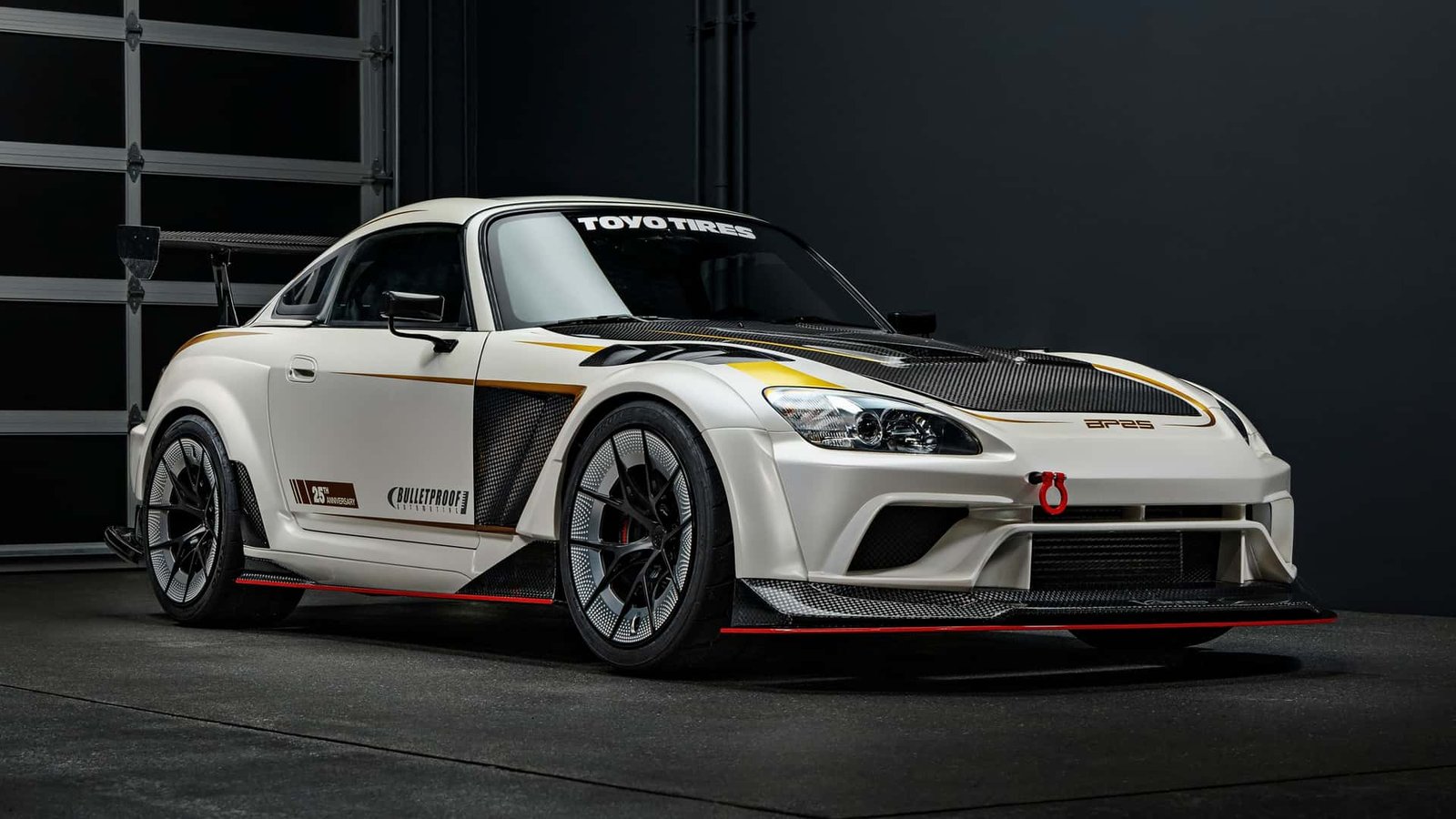
- Aerodynamics: This particular build features a functional aerodynamic package. This often includes a front splitter, side skirts, and a large, adjustable rear wing (like a Voltex or J’s Racing wing). These components generate downforce, improving stability and grip at higher speeds. They also contribute to the aggressive, purposeful look of the car.
Drivetrain Considerations
Transferring 10,000 RPM power to the wheels reliably requires attention to the drivetrain.
- Clutch and Flywheel: A heavy-duty, multi-plate clutch and a lightweight flywheel are necessary to handle the increased power and allow for quick, precise shifts at high revs.
- Differential: While the S2000’s Torsen limited-slip differential is good, some builders opt for a more aggressive clutch-type LSD for better traction out of corners. Upgraded differential mounts are also common.
The Driving Experience: A Sensory Overload
Imagine slipping into the driver’s seat of this 10,000 RPM Honda S2000. The interior, while still recognizably S2000, might feature a few performance-oriented upgrades: a racing seat, perhaps a suede steering wheel, and definitely a custom digital dash displaying all the critical engine parameters. You turn the key, and the modified F20C barks to life with a deeper, more aggressive idle than stock. It’s an immediate hint of the monster within.
As you pull away, the car feels tight, purposeful. The exhaust note is already more pronounced, a constant promise of what’s to come. But it’s when you hit an open stretch of road, or better yet, a winding track, that the true magic unfolds. You push the accelerator, and the engine rips through the revs. The factory 9,000 RPM redline is just a waypoint now. The tachometer needle sweeps past it, climbing relentlessly towards the five-digit mark.
The sound is utterly intoxicating. It’s not just loud; it’s a precise, mechanical shriek that pierces the air. You feel the surge of power, the frantic urgency of every component working in perfect sync. The VTEC crossover, already dramatic in a stock S2000, becomes an even more aggressive kick, launching you into the stratosphere of the rev range. “It’s like riding a superbike, but on four wheels,” a test driver for a prominent tuning shop once told me after a session with a similar build. “The immediacy, the sheer violence of the top-end pull, it’s unlike anything else. You have to be totally focused, but the reward is pure exhilaration.” The world blurs past, the shifts are lightning-quick, and each gear pulls with an insatiable hunger for the next, until you’re just a blur of sound and speed, the engine howling its glorious 10,000 RPM song. It’s a truly visceral, unforgettable experience that connects you directly to the machine in a way few modern cars can.
The Philosophy Behind the Build: Passion Over Practicality
Why go through all this trouble? Why invest countless hours and significant financial resources to chase an extra 1,000 RPM beyond what Honda engineers deemed the limit? For Kenji Tanaka and others like him, it’s not simply about bragging rights or raw speed (though those are certainly perks). It’s about a deep-seated passion for engineering, a desire to explore the absolute limits of mechanical possibility. “This isn’t practical, no,” Kenji admitted with a chuckle. “A stock S2000 is already brilliant. But this… this is a statement. It’s about pushing boundaries, learning, and creating something truly unique.”
It’s a philosophy shared by many in the enthusiast community: the pursuit of perfection, the joy of creation, and the thrill of mastering a complex craft. The Honda S2000 provides an ideal platform for such endeavors due to its already robust and well-designed engine. The builder’s journey is often one of trial and error, celebrating small victories, and learning from setbacks. It’s a labor of love, a dedication to the craft that goes far beyond what most people would understand. The result is more than just a car; it’s a rolling piece of art, a testament to human ingenuity and an enduring love affair with the internal combustion engine. In an era where electric vehicles are rapidly gaining traction, builds like this serve as a powerful reminder of the raw, emotional appeal of a finely tuned, high-revving petrol engine. They are loud, unapologetic, and utterly magnificent.
In the end, this Honda S2000 build that screams to 10,000 RPM is more than just a car; it’s a legend in the making. It embodies the spirit of innovation, the thrill of pushing limits, and the unyielding passion of enthusiasts who dare to dream bigger. It’s a beautiful machine, yes, but its true beauty lies in the meticulous craftsmanship and the audacious vision that brought it to life, allowing it to sing a song that few others ever will.
Frequently Asked Questions
| What makes this Honda S2000 build capable of 10,000 RPM? | Achieving a reliable 10,000 RPM redline requires a comprehensive overhaul of the F20C engine. Key modifications include lightweight forged pistons and connecting rods, stronger valvetrain components like dual valve springs and titanium retainers, aggressive aftermarket camshafts, a high-volume oil pump, and a standalone ECU for precise tuning of fuel and ignition timing. |
| What are the advantages of a high-revving engine like this? | The primary advantage is increased horsepower, especially at the top end of the rev range, which translates to exhilarating acceleration and a thrilling driving experience. High-revving naturally aspirated engines also offer incredibly sharp throttle response and a unique, intoxicating engine note, often described as a mechanical shriek. |
| What are the key modifications required to achieve such high RPMs? | Beyond the engine internals (pistons, rods, valvetrain), critical modifications include a high-flow intake and exhaust system for optimal breathing, an upgraded fuel system to support increased fuel demands, a robust ignition system, and most importantly, a standalone ECU expertly tuned to manage the engine’s parameters across the extended rev range. |
| What are the primary challenges in building a 10,000 RPM engine? | The main challenges involve managing the extreme forces on engine components, preventing valve float and piston-to-valve contact, ensuring adequate lubrication and cooling, and achieving reliable power delivery without sacrificing durability. Meticulous balancing of rotating assemblies and precise ECU tuning are crucial to prevent catastrophic failure. |
| What does the future hold for extreme S2000 builds? | Despite the shift towards electric vehicles, the passion for high-performance internal combustion engines like the S2000’s F20C remains strong. Builders will likely continue to refine these extreme naturally aspirated builds, focusing on lightweight materials, advanced engine management, and pushing the boundaries of what’s possible, ensuring the S2000’s legacy as a high-revving icon endures. |
Important Notice
This FAQ section addresses the most common inquiries regarding the topic.