There’s a certain unmistakable growl that echoes through the Eifel mountains, a sound that sends shivers down the spine of any petrolhead within earshot. It’s a deep, guttural roar, punctuated by the whine of a supercharger and the explosive crackle of an exhaust on overrun. And if you’ve been following the automotive world even casually, you’ll know exactly what that means: something truly special is back at the Nürburgring Nordschleife. We’re talking, of course, about the Ford Mustang GTD. Just when we thought we’d seen it push its limits, the beast has returned to the notorious ‘Green Hell,’ and it’s stirring up a frenzy of speculation. (Seriously, I heard a rumor from a local cafe owner that they saw it being unloaded under a shroud of secrecy again, very early in the morning.)
The sight of the Mustang GTD, a vehicle designed to blur the lines between a road car and a GT3 race machine, carving through corners like the iconic Flugplatz or the daunting Karussell, isn’t just a spectacle; it’s a declaration. This isn’t just another track day. No, this feels different. The air around the track, even through the lens of grainy spy shots and hushed whispers, carries an undeniable tension. You can almost taste the ambition. Ford isn’t just testing components or collecting data anymore; they’re clearly refining, pushing, and perhaps, preparing for something monumental. Every single pass, every scream of its supercharged V8, every flash of its aggressive carbon fiber bodywork, suggests a singular, audacious goal. Is it possible that the Ford Mustang GTD is gunning for the Nürburgring record? The sheer thought sends a jolt of excitement through the enthusiast community, myself included.
This isn’t merely about bragging rights for Ford; it’s about cementing the Mustang GTD‘s legacy as a true performance titan, an American supercar capable of challenging the established European elite on their home turf. The Nürburgring, with its 12.9 miles and 73 corners of unforgiving tarmac, is the ultimate crucible, the definitive proving ground for any vehicle claiming serious performance credentials. To conquer it, to set a competitive lap time, is to earn a hallowed place in automotive history. And right now, the signs are all pointing towards Ford making a very serious bid for that glory. (I mean, who would put that much effort into a return trip if not for something truly significant?) Let’s dive into what makes this return so compelling and why the prospect of a record attempt is far from a pipe dream.
The Green Hell’s Familiar Embrace: Why the GTD is Back
The Nürburgring Nordschleife has a magnetic pull for performance car manufacturers, and it seems the Ford Mustang GTD can’t stay away. Its initial outings were undoubtedly for development and tuning, but a return trip, especially with the kind of intensity being reported, speaks volumes. Imagine the scene: a cool, perhaps slightly overcast morning, the track still damp in places from an overnight shower, yet the air is thick with anticipation. The GTD, looking menacing even at a standstill, pulls onto the asphalt. Its wide stance, aggressive aero, and exposed carbon fiber scream business. “They’re not just here for a casual drive,” remarked Klaus Richter, a veteran Nürburgring photographer who’s seen it all. “This car looks more dialed in, more focused than before. Every detail, from the tire pressures being meticulously checked to the way the crew communicates, suggests a mission.”
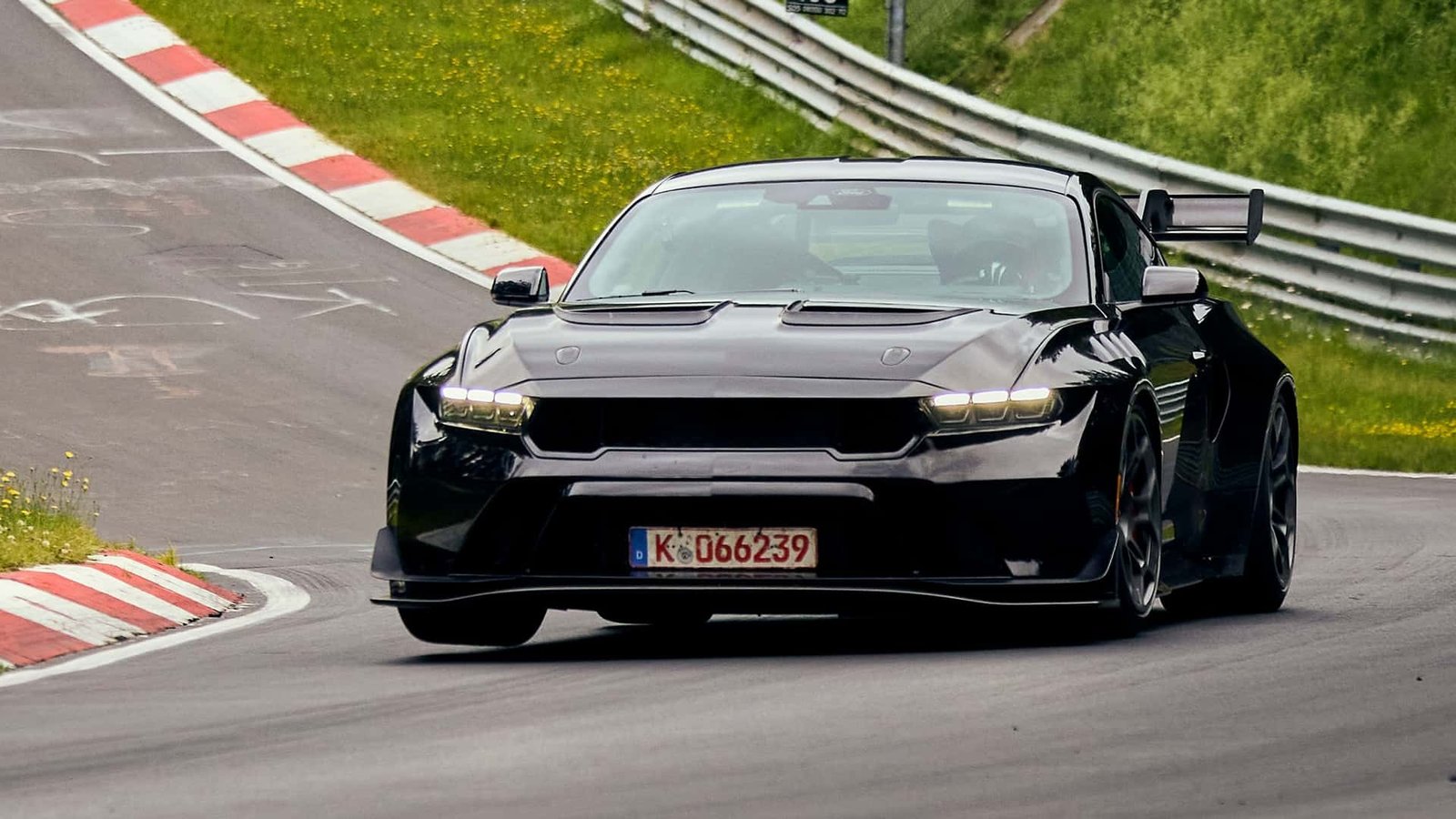
The truth is, setting a competitive lap time at the Nürburgring isn’t a one-and-done affair. It requires countless hours of testing, data acquisition, and driver feedback. Every bump, every camber change, every slight variation in track temperature can impact a lap time. For the Ford Mustang GTD, a car that aims to be Ford’s ultimate road-legal track machine, this iterative process is crucial. Ford Performance engineers are likely fine-tuning everything from suspension damping and active aerodynamics to engine mapping and brake bias. They’re chasing milliseconds, and the only place to find them is on the track itself. This repeated presence underscores a commitment that goes beyond mere marketing; it’s about engineering perfection.
Unpacking the GTD’s Arsenal: What Makes It a Contender?
So, what exactly makes the Ford Mustang GTD such a potent force for a potential record attempt? It’s not just a fancy Mustang; it’s a completely re-engineered, track-devouring monster. Let’s break down its key features:
- Supercharged 5.2-liter V8 Engine: Pumping out an astonishing 800+ horsepower, this powerplant provides the brute force needed to rocket down the Nordschleife’s straights. The sound alone is enough to intimidate.
- Advanced Active Aerodynamics: This is a game-changer. With a hydraulically controlled active rear wing and underbody elements, the GTD can adjust its downforce on the fly, optimizing grip for corners and reducing drag for top speed runs. “The aero package on that car is insane,” shared an anonymous engineer who previously worked on a rival supercar project. “It’s truly race-car level technology for the road.”
- Sophisticated Suspension System: Featuring a semi-active suspension with a trick multi-link rear setup and inboard coil-over shocks, the GTD offers exceptional control and adaptability. It can squat down at high speeds, lowering its center of gravity and further enhancing stability.
- Carbon Fiber Construction: Extensive use of carbon fiber for body panels, driveshaft, and other components keeps the weight down, improving power-to-weight ratio and agility. Every gram saved translates to a faster lap.
- Transaxle Transmission: Moving the 8-speed dual-clutch transmission to the rear helps achieve a near 50/50 weight distribution, crucial for balanced handling on a demanding track like the Nürburgring.
These aren’t just buzzwords; they are meticulously engineered components working in harmony to create a vehicle capable of extraordinary feats. When you combine this hardware with a seasoned test driver, you have a recipe for serious speed. It’s a testament to Ford’s ambition, pushing the boundaries of what a Mustang can be.
The Record Hunt: What Time Are They Chasing?
If the Ford Mustang GTD is indeed chasing a Nürburgring record, what kind of time are we talking about? The current production car lap record is held by the Mercedes-AMG One, which clocked an incredible 6:35.183. That’s a hybrid hypercar with F1 technology. Then there are other notable times, like the Porsche 911 GT2 RS (6:43.300) and the Lamborghini Aventador SVJ (6:44.97). These are elite machines, and for an American muscle car, even one as thoroughly re-engineered as the GTD, to enter this conversation is a monumental undertaking.
However, it’s important to differentiate. The GTD isn’t a hypercar, nor is it a hybrid. It’s a front-engine, supercharged V8 beast. Its most direct competitors in terms of layout and philosophy might be cars like the Mercedes-AMG GT Black Series (6:43.616) or even the Corvette Z06 (around 7:00). Ford might not be aiming to beat the AMG One, but perhaps target the sub-7-minute barrier, or even specifically challenge the fastest front-engine production car records. A time under 6 minutes and 50 seconds would be absolutely phenomenal and would send shockwaves through the performance car world. That would put it firmly in the supercar territory, making a statement that would resonate for years.
One trackside observer, a retired engineer named Gunther, who has watched hundreds of record attempts over the decades, shared his thoughts. “I’ve seen cars come and go. Many try, few succeed in making a real mark. But the way this Mustang moves, the sound it makes… it has that special something. It doesn’t look like it’s fighting the track; it looks like it’s dancing with it. If they can put together a clean lap with good conditions, who knows? The potential is there for something truly special.”
The Stakes are High: More Than Just a Number
For Ford, a successful Nürburgring lap record with the Mustang GTD would be far more than just a number on a leaderboard. It would be a powerful marketing tool, a testament to American engineering prowess, and a significant boost to the Mustang brand’s global prestige. It would definitively prove that Ford can build a track weapon capable of competing with the very best Europe has to offer, shattering any lingering stereotypes about American muscle cars being just straight-line specialists.
Think about the headlines, the social media buzz, the instant credibility that comes with a top-tier Nordschleife time. It validates the immense investment in development, the radical design choices, and the bold vision behind the GTD. It tells buyers that this isn’t just a poser; it’s a genuine, no-compromise performance machine engineered for the most demanding environments on Earth. And for enthusiasts, it’s a source of immense pride, seeing a legendary nameplate like Mustang redefine what’s possible.
The Human Element: Driver, Team, and the Pressure Cooker
While the car itself is a marvel of engineering, let’s not forget the human element. The driver pushing the Mustang GTD to its absolute limits around the Green Hell carries an immense burden. This isn’t a game; it’s a high-stakes endeavor demanding unparalleled skill, precision, and nerve. One wrong move, one lapse in concentration, and a potential record attempt can end in disaster. The Nordschleife is unforgiving.
Behind the wheel, it’s likely a seasoned factory test driver, someone with thousands of laps under their belt, intimately familiar with every twist and turn, every elevation change. They work in tandem with a dedicated team of engineers and mechanics, analyzing telemetry, adjusting settings, and constantly seeking marginal gains. The pressure to perform, to extract every ounce of performance from the machine, is immense. “It’s not just about raw speed,” an insider close to Ford’s motorsports operations shared, preferring to remain unnamed. “It’s about consistency, about finding that flow, that perfect rhythm lap after lap. And on the Nürburgring, that’s incredibly difficult. It takes a special kind of driver and a special kind of car to pull it off.” This return to the track suggests they’ve found that driver and are very close to finding that perfect rhythm.
When Could We See a Record Attempt?
The biggest question now is: when will Ford officially unleash the Mustang GTD for a timed lap? Track availability, weather conditions, and the readiness of the car and driver are all critical factors. Manufacturers often book “Industry Pool” sessions at the Nürburgring, which are private testing days, perfect for these high-stakes attempts. With the GTD being spotted repeatedly, it suggests they are in the final stages of optimization.
It could happen any day now, during one of these private sessions, perhaps even with little fanfare until the official announcement. Or, they might wait for a specific window of perfect weather—cool, dry, minimal wind—to maximize their chances. My gut feeling is that they are waiting for the ideal moment, the stars to align, before making that definitive run. And when they do, the automotive world will hold its breath. It’s going to be an exhilarating watch, whether we see it live or through the inevitable record-breaking video. I, for one, will be glued to my screen, waiting for the news.
Conclusion: The Mustang GTD’s Roar Echoes Ambition
The unmistakable reappearance of the Ford Mustang GTD at the Nürburgring is more than just a fleeting visit; it’s a powerful statement of intent. Ford isn’t just dipping its toes into the high-performance pond; it’s diving in headfirst, aiming to make a monumental splash. With its radical engineering, ferocious power, and relentless pursuit of perfection, the GTD is undoubtedly designed for greatness on the world’s most challenging circuit. The whispers of a lap record aren’t merely speculative; they feel like an almost inevitable conclusion to this chapter of its development. While the Nürburgring is a brutal mistress, demanding respect and precision, the Ford Mustang GTD appears to be an equally formidable challenger, armed with the technology and ambition to etch its name into the hallowed asphalt. We’re on the cusp of witnessing history, and I believe the Green Hell is about to feel the full force of American muscle, redefined and unleashed. Keep your eyes peeled and your ears open; the thunder from the Eifel mountains might just be the sound of a new record falling.
Frequently Asked Questions
| Why is the Ford Mustang GTD repeatedly testing at the Nürburgring? | The Ford Mustang GTD is repeatedly testing at the Nürburgring Nordschleife to fine-tune its performance, optimize its advanced active aerodynamics, suspension, and engine mapping, and gather crucial data for a potential lap record attempt. The Nürburgring is the ultimate proving ground for performance vehicles, and repeated testing ensures the car is perfectly dialed in for its challenging conditions. |
| What advantages does the Mustang GTD possess for a Nürburgring record attempt? | The Mustang GTD boasts several key advantages: a supercharged 5.2-liter V8 producing over 800 hp, sophisticated active aerodynamics for optimized downforce, a race-derived semi-active suspension system, extensive carbon fiber construction for weight reduction, and a transaxle transmission for ideal weight distribution. These features collectively make it a formidable contender. |
| How does Ford prepare a vehicle like the GTD for a serious Nürburgring lap record? | Preparation involves extensive engineering and testing. Ford Performance engineers meticulously adjust every aspect, from suspension damping and tire compounds to aerodynamic settings and engine calibration. A highly experienced test driver spends countless hours learning the track’s nuances, providing feedback, while the team analyzes telemetry to shave off milliseconds. Ideal track and weather conditions are also crucial for the actual record run. |
| What are the biggest challenges the Mustang GTD faces in setting a Nürburgring record? | The Nürburgring Nordschleife is notoriously challenging due to its length, diverse corners, elevation changes, and unpredictable surface conditions. The GTD faces stiff competition from established European supercars and hypercars with specific performance advantages. Achieving a perfect, clean lap requires immense driver skill, consistency, and optimal vehicle setup, all while battling the track’s inherent risks and the pressure of a high-stakes attempt. |
| What would a Nürburgring record mean for the Ford Mustang GTD and Ford Performance? | A Nürburgring record would be a monumental achievement for the Ford Mustang GTD and Ford Performance. It would validate the GTD’s status as a world-class track weapon, significantly enhance the Mustang brand’s global prestige, and serve as a powerful marketing tool. It would firmly establish Ford’s engineering prowess, demonstrating that an American muscle car can compete at the highest echelons of global performance car manufacturing. |
Important Notice
This FAQ section addresses the most common inquiries regarding the topic.