Imagine this: you’re settling in for a quiet night, maybe scrolling through your feed, when you stumble upon a clip. It’s grainy, shaky, and instantly gripping. The perspective is from a police officer’s bodycam, not some slick Hollywood production. You see the familiar glow of blue and red lights reflecting off wet asphalt, hear the crackle of a radio, and the heavy breathing of someone who clearly wishes they were anywhere else. This isn’t your typical police drama, though. Oh no. This is where the mundane, often gritty reality of law enforcement collides head-on with something utterly inexplicable, something that chills you to the bone. It’s the burgeoning subgenre where police versus the paranormal becomes a terrifying, immersive experience, reminiscent of the raw, unsettling dread that The Blair Witch Project so masterfully evoked. You’re not just watching a story unfold; you’re right there, strapped to an officer’s chest, peering through the lens of their fear as they confront shadows that shouldn’t exist. It’s an ingenious blend, isn’t it? Taking the visceral, immediate perspective of a bodycam and throwing it into a nightmare scenario, where every creak, every whispered sound, could be the prelude to something truly terrifying. It taps into our deepest anxieties about authority, about the unknown, and about what happens when the protectors themselves become prey. This isn’t just a gimmick; it’s a game-changer for found-footage horror, offering a fresh, terrifying ride-along into the supernatural unknown.
The beauty of this concept lies in its inherent realism, or at least, the illusion of it. We’ve all seen real bodycam footage – it’s a staple of news cycles and viral videos. It’s often chaotic, unpolished, and intensely personal, showing events from a uniquely human perspective. Now, inject that into a horror narrative, where the camera isn’t just an observer but practically another character, a silent, unblinking witness to escalating dread. It elevates the tension instantly. You’re not just watching a film; you’re witnessing “actual” events unfold, making the chills feel far more authentic, far more immediate. It’s less about jump scares (though those certainly have their place) and more about a creeping sense of unease that slowly but surely tightens its grip. Think about it: a patrol car idling on a desolate street, the rhythmic sweep of its wipers against a torrential downpour, then a faint, almost imperceptible sound from an abandoned house. Your heart starts to race right along with the officer’s, doesn’t it? That’s the power here, making the audience an unwilling participant in a descent into the terrifying unknown, where the rules of the natural world simply don’t apply anymore.
This isn’t just another ghost story; it’s a redefinition of how we experience horror. The bodycam perspective forces us into a very specific, limited viewpoint, mirroring the isolation and vulnerability an officer might feel in an unfamiliar, dangerous situation. You can’t see what’s behind them, what might be lurking just outside the frame. Every sudden movement, every unexpected sound, is amplified, because your entire world is narrowed to that small, often shaky lens. It’s a claustrophobic kind of fear, born from restriction rather than vastness. And when that restriction is breached by something unnatural, something that defies explanation, the impact is profoundly disturbing. It strips away the comfort of omniscient narration, of knowing the full picture. Instead, you’re left with fragmented glimpses, whispered warnings, and the terrifying realization that even those sworn to protect us are utterly powerless against certain forces. It truly feels like you’re on a ride-along into a nightmare, an unsettling journey where the line between duty and sheer terror blurs into oblivion.
The Unfiltered Horror of the Bodycam Lens
There’s something uniquely unsettling about seeing horror through a bodycam lens. It’s raw, it’s immediate, and it bypasses all the usual cinematic conventions that often reassure us we’re merely watching a story. This isn’t a director carefully framing a shot for maximum dramatic effect; this is a recording device strapped to a person, capturing whatever happens to be in their field of vision, often with jarring movements and sudden cuts. It mirrors the chaos and unpredictability of real life, making the supernatural encounters feel horrifyingly tangible. Imagine an officer responding to a seemingly routine call – a noise complaint, a potential break-in – only for the footage to devolve into something truly monstrous. “The shaky cam works wonders here,” commented Elias Thorne, a veteran horror film critic, in a recent online forum. “It’s not just an aesthetic choice; it’s intrinsically tied to the fear. You feel the officer’s panic in every jolt and blur.”
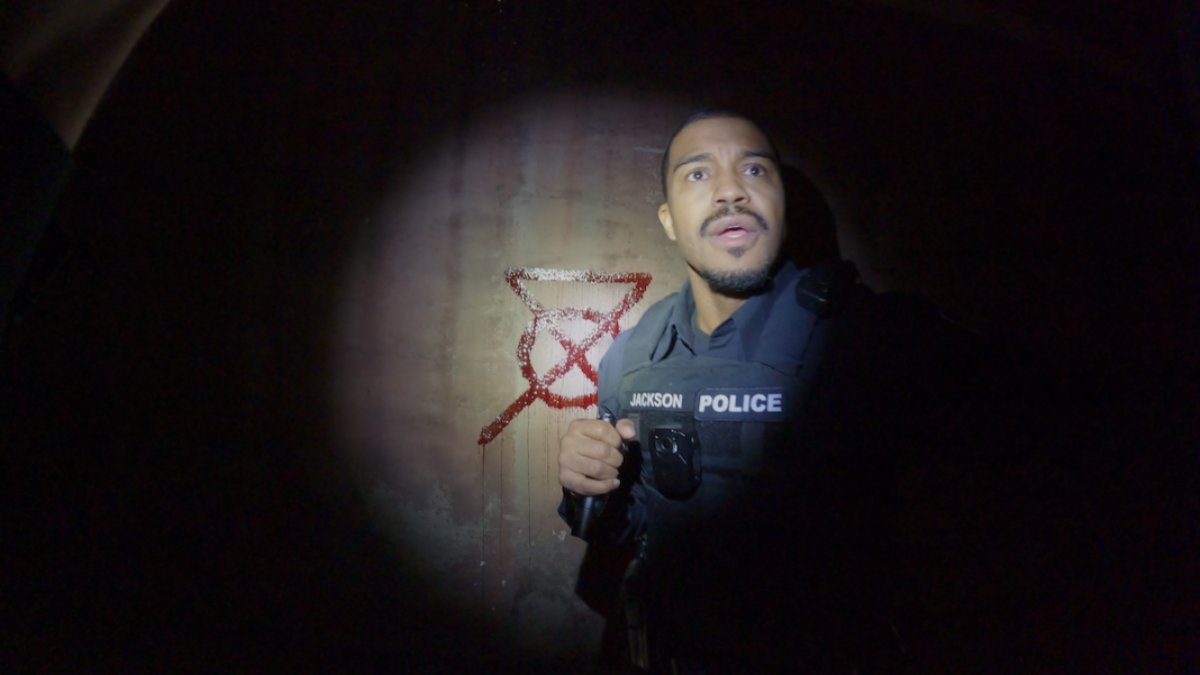
This perspective transforms the familiar into something alien and terrifying. A dark corridor in an abandoned factory, usually just a backdrop, becomes a suffocating tunnel of dread when seen through the bodycam. The mundane details – a flickering light, the sound of crickets, the rustle of leaves – become harbingers of terror. You’re constantly scanning the edges of the frame, anticipating what might lurch into view. It’s a deliberate, excruciating build-up of suspense that found-footage fans absolutely adore. This approach truly allows the audience to immerse themselves in the officer’s deteriorating state of mind, making the horror deeply personal and psychologically impactful. It’s not just about what you see, but what you think you see, what you fear you might see just beyond the limited scope of the camera. The mind starts playing tricks, and suddenly, every shadow has a shape, every sound a sinister intent.
Beyond the Badge: Officers as Vulnerable Protagonists
We typically view police officers as figures of authority, trained to handle crises, equipped to face danger head-on. But what happens when the danger isn’t something they can arrest, reason with, or even understand? This is where the “Bodycam” concept truly shines. It strips away that protective veneer, revealing the human underneath the uniform – a human who is just as susceptible to fear, confusion, and panic as anyone else. When a seasoned officer, someone who has faced down armed criminals and terrifying accidents, begins to show genuine terror at something unseen, it amplifies the horror tenfold. “Seeing Officer Ramirez, who usually has an iron poker for a spine, visibly shaking? That’s when I knew things were really bad,” remarked a viewer, ‘NightOwl_87’, on a discussion board. “It makes you think, if they’re scared, what hope do we have?”
The Psychological Toll of the Unexplainable
The constant exposure to disturbing, unexplainable phenomena takes a profound psychological toll. This isn’t just about jump scares; it’s about the erosion of sanity, the questioning of reality. The bodycam footage often captures these moments of internal struggle: the officer’s hushed whispers to themselves, the desperate attempts to rationalize the irrational, the gradual descent into disbelief and then terror. It’s a compelling exploration of mental resilience in the face of absolute chaos. What would you do if everything you believed about the world was suddenly shattered by an encounter caught on your own camera? The narrative often doesn’t just focus on the monster; it focuses on the monster’s effect on the human mind, which is often far more disturbing. It’s a slow burn of dread, where the biggest enemy isn’t the ghost, but the creeping madness it induces.
- Isolation: Often, officers are alone or in pairs, limiting their support system.
- Credibility Crisis: Who would believe them if they reported a ghost or demon?
- Duty vs. Survival: The conflict between their oath to protect and their primal instinct to flee.
- Desensitization Backlash: Used to gruesome scenes, but unprepared for the supernatural.
The “Blair Witch” Connection: A Masterclass in Immersive Fear
The comparison to The Blair Witch Project isn’t just hyperbole; it’s a testament to the effectiveness of the bodycam format in generating genuine fear. Both rely heavily on the found-footage aesthetic, prioritizing immersion over conventional storytelling. Blair Witch made us believe we were watching actual recovered footage of doomed filmmakers, and the bodycam paranormal genre aims for that same level of unsettling authenticity. We see what the characters see, hear what they hear, and often, what we don’t see is far more terrifying than what we do. The power is in the suggestion, the implication, the brief, disorienting glimpse of something that shouldn’t be there.
Think about the rustling leaves, the distant screams, the subtle shifts in the environment that made Blair Witch so iconic. Now translate that to a police context: the sudden static on the radio, the unexplained cold spot in a room, the sound of footsteps in an otherwise empty building, captured solely by the officer’s mic. It’s about building atmosphere, slowly ratcheting up the tension until the audience is practically vibrating with anticipation. “It’s the ultimate ‘what if?’ scenario,” explains Dr. Lena Hanson, a psychologist specializing in trauma response. “The bodycam’s limited view and often obscured audio force the viewer to actively engage, to fill in the blanks, which makes the experience far more personal and terrifying than passive observation.”
Genre Fusion: Police Procedural Meets Supernatural Thriller
The brilliant aspect of this genre is how seamlessly it blends two seemingly disparate worlds: the grounded, reality-based police procedural with the fantastical, terrifying realm of the supernatural. It’s not just a horror film with cops; it’s a horror film that leverages the very nature of police work for its scares. The initial setup is always familiar: a call comes in, officers respond, they follow protocols. But then, things deviate dramatically. The tools of their trade – flashlights, radios, tasers – become almost useless against an invisible entity. Their training goes out the window when faced with something that defies logic and physics. This juxtaposition creates a unique tension. We expect them to solve the crime, to restore order, but here, order itself is being fundamentally challenged by forces beyond human comprehension.
Consider the narrative possibilities: an officer investigating a series of inexplicable disappearances in a small town, only to find ancient curses at play. Or a SWAT team clearing a building, expecting armed resistance, but instead finding themselves hunted by something far more ancient and malevolent. The procedural elements – the interviews, the evidence collection, the reliance on logic and facts – act as a perfect foil for the encroaching madness of the paranormal. It grounds the supernatural in a world we understand, only to pull the rug out from under us with chilling precision. This fusion isn’t just clever; it’s a potent cocktail for sustained terror.
Hypothetical Scenarios and Their Impact
Let’s play with some ideas to see how potent this fusion can be:
- The Haunted Evidence Locker: Officers discover items from old cases are exhibiting strange phenomena, leading to a full-blown spiritual haunting within their own precinct. Imagine the internal struggle for an officer trying to document evidence of a ghost!
- Suburban Exorcism Gone Wrong: Responding to a domestic disturbance, officers find themselves in the middle of a DIY exorcism, with the ‘demon’ latching onto one of them, visible only through the bodycam’s night vision.
- The Abandoned Hospital: A classic horror trope, but with officers systematically clearing each floor, their bodycams capturing decaying medical equipment shifting on its own, spectral apparitions in patient rooms, and whispers echoing from the intercom system.
- Traffic Stop Terror: A seemingly routine traffic stop on a deserted road escalates when the suspect’s car appears to be driven by an unseen force, or the officer witnesses their passenger being pulled into the darkness.
Each of these scenarios, viewed through the immediate and unfiltered lens of a bodycam, would be absolutely horrifying. The element of trained professionals facing something they simply cannot comprehend makes for incredible storytelling.
The Future of Found-Footage and Bodycam Horror
It’s clear that the bodycam paranormal subgenre has immense potential, carving out a niche that feels both fresh and deeply familiar to fans of found-footage horror. We’ve seen iterations of this before, of course, from police-centric found footage like REC to the broader supernatural investigations in films like Paranormal Activity. But the specific focus on the police bodycam offers a unique texture and narrative constraint. It naturally provides a reason for the camera to be present, to keep rolling, even when sanity dictates it should be dropped. It’s an organic justification for the “found” aspect, which can sometimes be the weakest link in other found-footage narratives. “It legitimizes the camera’s presence,” noted film studies lecturer Dr. Amelia Chen. “You don’t question why it’s there; you just accept it, which allows you to suspend disbelief far more easily.”
As technology evolves, imagine the possibilities. What about drone footage from a police perimeter, capturing something impossibly vast and ancient in the distance? Or dashcam footage suddenly picking up an anomaly in the rearview mirror? The beauty is in the constraints and the inherent realism. This genre isn’t just about showing us ghosts; it’s about showing us how terrifying it is when the people we trust to protect us are utterly helpless against the things that go bump in the night. It’s a ride-along into pure, unadulterated fear, and frankly, I’m ready to buckle up for more.
In conclusion, the ‘Bodycam‘ review of police versus the paranormal isn’t just a clever concept; it’s a truly brilliant evolution of the found-footage horror genre. By blending the immediate, unfiltered perspective of a police bodycam with the chilling terror of supernatural encounters, it creates an immersive, psychological ride that feels incredibly real and deeply unsettling. It takes the familiar comfort of law enforcement and shatters it with the inexplicable, leaving us with protagonists who are vulnerable and audiences who are utterly gripped. Much like The Blair Witch Project redefined horror for a generation, this subgenre has the power to do the same, proving that sometimes, the most terrifying stories are the ones that feel like they could actually be true. So next time you see that blue light in your rearview mirror, perhaps you’ll wonder not just about the officer, but about what they might have seen, what chilling secret their bodycam might have unwillingly captured.
Frequently Asked Questions
| What makes ‘Bodycam’ paranormal horror so effective? | Its effectiveness comes from the raw, immersive found-footage perspective of a police bodycam, which lends an unsettling realism to supernatural encounters. It bypasses traditional cinematic reassurances, making the horror feel more immediate and personal, akin to witnessing actual events. |
| How does it compare to ‘The Blair Witch Project’? | Like ‘The Blair Witch Project’, this genre relies heavily on the found-footage aesthetic to create deep immersion and psychological dread. Both excel at suggesting terror rather than explicitly showing it, using limited perspectives and sound design to build intense atmosphere and fear in the audience. |
| Why are police officers good protagonists for this genre? | Police officers, typically figures of authority and competence, become highly vulnerable when faced with the inexplicable. Seeing their training and tools become useless against the supernatural amplifies the horror, highlighting the human element and their psychological struggle, which makes their fear more relatable and impactful. |
| What unique challenges does the bodycam format present for storytelling? | The bodycam format inherently imposes a limited, often shaky field of view and restricts narrative omniscience. While this creates intense immersion and suspense, it requires clever storytelling to convey necessary information and ensure the audience isn’t constantly disoriented, balancing realism with narrative clarity. |
| What is the potential future for this subgenre in horror? | The future is bright, with potential for innovation beyond traditional bodycams to include dashcams, drone footage, or even police K9 cams. Its ability to organically justify the “found” aspect and its powerful blend of grounded procedural drama with terrifying supernatural elements positions it as a significant evolution in immersive horror. |
Important Notice
This FAQ section addresses the most common inquiries regarding the topic.