The air in Maranello has always hummed with a particular kind of electricity, a visceral thrum of powerful V8s and V12s being meticulously crafted, tested, and unleashed upon the world. But now, there’s a new kind of charge in the atmosphere, one that speaks of a different future, an all-electric one. Imagine, if you will, the hushed anticipation, the quiet murmurs across the hallowed halls of Ferrari as the legendary marque prepares to unveil something truly monumental: its very first fully electric vehicle. It’s a seismic shift, a moment many have awaited with bated breath, wondering how the custodians of unparalleled performance and passionate combustion would embrace the silent, instant torque of an EV. Well, the wait is almost over, and the rumors are swirling faster than a F1 car on a hot lap. Not only has this groundbreaking machine reportedly received a codename – ‘F244’ – but the gossip column inches are absolutely overflowing with tantalizing details about its interior, a design philosophy so revolutionary for Ferrari that it’s being described as profoundly Apple-inspired. Can you even picture it? A Prancing Horse, typically dripping in tactile buttons and motorsport-derived ergonomics, now embracing the sleek, minimalist, and ultra-intuitive aesthetic of Cupertino’s finest. It’s a design philosophy that promises to redefine the luxury supercar experience, blending Italian passion with Californian innovation. This isn’t just another EV; this is Ferrari rewriting its own rulebook, preparing for an electrified era while, hopefully, retaining every ounce of its iconic soul.
This pivotal moment in Ferrari’s illustrious history isn’t just about launching an electric car; it’s about navigating a delicate balance between preserving an unmatched heritage and boldly embracing the future. For decades, the roar of a Ferrari engine has been as integral to its identity as its sculpted lines and the famous Cavallino Rampante badge. To many purists, the idea of a silent Ferrari, devoid of that glorious symphony, bordered on sacrilege. Yet, the world is changing, and even the most revered automotive titans must adapt. The move towards electrification isn’t merely a nod to environmental regulations; it’s a strategic pivot towards sustained relevance and performance supremacy in an evolving market. It’s fascinating, isn’t it, to witness such a storied brand wrestle with its own traditions while simultaneously striving to lead the charge into uncharted territory? The ‘F244’ isn’t just a car; it’s a declaration, a statement that Ferrari intends to define the future of luxury performance, not merely follow it.
The journey to this point has been long, marked by years of research, development, and, no doubt, intense internal debates. Remember when Luca di Montezemolo famously said Ferrari would “never” make an SUV? Well, we now have the Purosangue, a testament to the brand’s willingness to evolve while staying true to its core values. The same goes for the electric vehicle. The decision to commit to a fully electric model signifies more than just compliance; it reflects a deep understanding that electric powertrains offer unprecedented opportunities for performance, agility, and a new kind of driving exhilaration. The challenge, of course, is to translate that raw electric power into a distinctly Ferrari experience, one that excites the senses and stirs the soul, even without the traditional engine note.
A Bold New Chapter: Ferrari’s Electric Leap
It’s truly a watershed moment. For so long, the symphony of a Ferrari engine was the very heart of its identity, a visceral connection that defined the driving experience. Now, we stand on the precipice of a new era, one where the Prancing Horse will gallop forward powered by electrons rather than combustion. This isn’t just an incremental update; it’s a fundamental reimagining of what a Ferrari can be. “The commitment is to deliver a Ferrari that’s just as exciting, if not more so, than our current lineup, regardless of the powertrain,” a senior engineer, who preferred to remain anonymous, confided during a recent industry event. “We know the expectations are immense, and we are pushing boundaries in every conceivable way to meet them.” The decision to build a completely new factory specifically for electric vehicles and hybrids in Maranello speaks volumes about the brand’s long-term commitment. This isn’t a side project; it’s the future.
The Shift to Electrification: Why Now?
The push towards electrification isn’t a sudden whim; it’s a carefully calculated strategy. Global emissions regulations are tightening, and consumer preferences are evolving rapidly. Luxury car buyers, particularly in affluent markets, are increasingly seeking sustainable options without compromising on performance or exclusivity. Ferrari, ever the visionary, recognized this shift early. While they’ve experimented with hybrid technology in the LaFerrari and SF90 Stradale, a full electric Ferrari is a different beast entirely. It represents a complete embrace of the technological revolution reshaping the automotive landscape. It’s about securing Ferrari’s position at the pinnacle of automotive engineering for generations to come. “We see this not as a limitation, but as an opportunity,” commented a marketing executive at the firm. “The instant torque, the potential for incredible acceleration – these are qualities perfectly aligned with the Ferrari ethos. Our task is to amplify them, to make them uniquely Ferrari.”
Maranello’s Vision for a Sustainable Future
Ferrari’s vision extends beyond just building fast cars. It encompasses a broader commitment to sustainability, from manufacturing processes to the end product. The new ‘E-Building’ in Maranello, which will assemble the electric vehicle, is designed with state-of-the-art renewable energy systems. This holistic approach signals a conscious effort to align Ferrari with global environmental goals while continuing to produce dream cars. It’s a challenging tightrope walk, balancing the passion of performance with the responsibility of sustainability, but one that Ferrari seems determined to master.
Whispers from Maranello: The ‘F244’ Emerges
The excitement around Maranello is palpable, almost a low hum that vibrates through the cobblestone streets. Everyone is talking about the upcoming EV, and the internal codename ‘F244’ has slipped out, sending ripples of speculation across the automotive world. It’s a name that, while perhaps not as romantic as ‘Testarossa’ or ‘Daytona’, carries the weight of a monumental undertaking. This vehicle isn’t just a derivative; it’s a clean-sheet design, purpose-built from the ground up to be an electric Ferrari. I heard a local barista, pouring espresso with practiced ease, muse, “F244? Sounds like a fighter jet. But will it sing like a Ferrari?” It’s a question on everyone’s lips.
Decoding the Name: More Than Just a Codename?
Typically, Ferrari’s internal codenames are alphanumeric sequences that hint at the project’s lineage or internal designation. ‘F244’ is likely a placeholder, but it does suggest a distinct break from existing models, signifying a new platform and architecture. Will the final name be something evocative, tied to Italian cities or legendary races, or will Ferrari adopt a more futuristic moniker for its electric supercar? Only time will tell, but the choice will undoubtedly be scrutinized by enthusiasts worldwide. It’s a name that will carry the weight of a legacy into an entirely new dimension.

Performance Expectations: Can an EV be a True Ferrari?
This is the million-dollar question. Can an electric powertrain truly deliver the raw emotion, the blistering acceleration, and the track-honed dynamics that define a Ferrari? The answer, according to those within Maranello, is a resounding yes. Electric motors offer instant torque delivery, which can translate into mind-bending acceleration figures. We’re talking 0-60 mph times that could shame some hypercars. The challenge isn’t just speed, though. It’s about how that speed feels, how the car communicates with the driver, and how it handles on the limit. “It’s not enough to be fast,” one test driver reportedly remarked. “It has to feel like a Ferrari, every single nanosecond of the drive. The steering, the braking, the way it corners – it all needs to sing the same tune, albeit a quieter one.” This means advanced torque vectoring, sophisticated suspension systems, and cutting-edge battery technology designed not just for range, but for sustained high-performance output. Imagine the possibilities for a lower center of gravity, thanks to floor-mounted batteries, potentially leading to unparalleled handling dynamics.
The Interior Revolution: Apple’s Influence on a Prancing Horse
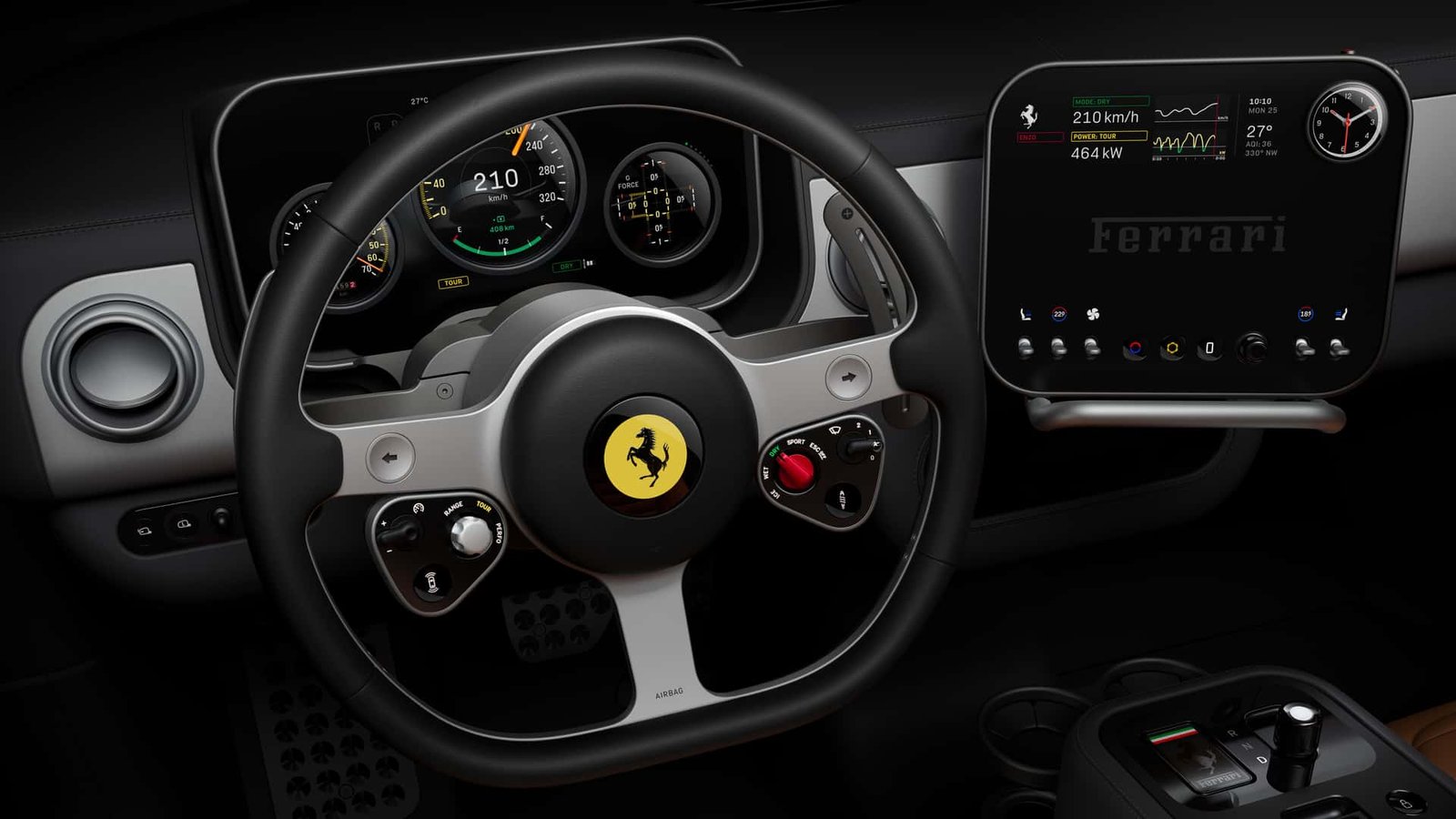
Now, let’s talk about the interior – because this is where the ‘F244’ is rumored to truly break new ground for the brand. The phrase “Apple-inspired interior design” has been whispered through the industry grapevine, and it immediately conjures images of sleek minimalism, intuitive interfaces, and a profound sense of digital integration. For a brand that has traditionally celebrated tactile controls and driver-focused cockpits, this represents a significant philosophical shift. It makes you wonder, doesn’t it, how that iconic Italian flair will blend with Cupertino’s cool, calculated aesthetic?
Minimalism Meets Luxury: A Paradigm Shift
Think about Apple products: clean lines, premium materials, and an almost invisible user interface that simply works. Now, picture that ethos applied to a Ferrari cockpit. This suggests a significant reduction in physical buttons, fewer extraneous design elements, and a greater reliance on large, high-resolution digital displays for controlling various functions. It’s about decluttering the space, allowing the driver to focus on the road and the sheer joy of driving, while still having access to every conceivable piece of information and control at their fingertips. This isn’t just about aesthetics; it’s about user experience, making the complex simple, and the powerful accessible. “I saw some early concepts,” an anonymous source close to the project shared, “and they were breathtaking. It was unmistakably Ferrari, with all the exquisite materials, but the sense of calm and clarity in the cabin was something entirely new for them. It felt incredibly modern, yet still bespoke.”
User Experience First: Intuitive Design and Connectivity
Apple’s strength lies in its ability to create highly intuitive interfaces that users can pick up and understand almost immediately. This focus on user experience (UX) is reportedly a core tenet of the ‘F244’ interior. Expect seamless connectivity, perhaps even deep integration with personal devices, and an infotainment system that feels as fluid and responsive as your smartphone. Voice control, gesture recognition, and haptic feedback could all play a significant role in how drivers interact with the car. The goal is likely to reduce distraction while enhancing the feeling of being in command, making every interaction feel natural and effortless. Imagine a system so intuitive it almost anticipates your needs. That’s the promise of an Apple-inspired interior.
Comparing Notes: How Apple’s Ethos Translates to Supercars
It’s not about slapping an iPad onto the dashboard. It’s about adopting Apple’s fundamental design principles:
- Simplicity: Eliminating clutter, focusing on essential functions.
- Clarity: Information presented clearly and legibly on high-resolution screens.
- Functionality: Controls that are easy to understand and operate.
- Elegance: A refined aesthetic that uses premium materials to convey luxury.
- Integration: Seamless connection between hardware and software.
Ferrari has always championed driving purity. An Apple-inspired interior aims to enhance that purity by making the technological aspects fade into the background, becoming tools rather than distractions. It’s a fascinating cross-pollination of design philosophies that could genuinely set a new benchmark for luxury electric vehicles.
Beyond the Dashboard: Design Philosophy and Craftsmanship
Of course, the interior of a Ferrari is never just about screens and buttons. It’s about the entire sensory experience. The smell of the leather, the feel of cold metal, the perfect weighting of a switch – these are the hallmarks of Maranello’s meticulous craftsmanship. An Apple-inspired approach doesn’t mean sacrificing these elements; it means integrating them into a cohesive, modern whole. “The materials chosen are still paramount,” a source emphasized. “You will still have that incredible tactile experience, but it will be presented in a way that feels utterly contemporary. It’s about elevating craftsmanship through thoughtful design, not replacing it.”
Materials and Ergonomics: The Ferrari Touch
While the digital interface might be minimalist, the materials will undoubtedly be exquisite. Expect sumptuous leathers, Alcantara, carbon fiber, and precision-machined metals, all finished to Ferrari’s exacting standards. The ergonomics will still be driver-focused, with the steering wheel and pedals positioned for optimal control and feedback. The ‘F244’ will likely blend the best of both worlds: advanced digital interfaces for infotainment and auxiliary controls, while retaining crucial, tactile physical controls for performance-critical functions, perhaps customizable by the driver. This hybrid approach allows for the best of both the digital and analog worlds, offering familiarity to loyalists while enticing a new generation of tech-savvy buyers.
The Sound of Silence (and Speed): Engineering the EV Experience
One of the biggest hurdles for an electric Ferrari is the absence of that glorious engine note. For many, it’s an irreplaceable part of the experience. Ferrari engineers are reportedly working on innovative solutions, perhaps synthetic sounds that evoke the brand’s heritage or a completely new sonic identity that celebrates the unique characteristics of an electric powertrain. Imagine a soundscape that reacts dynamically to acceleration and speed, creating a futuristic yet emotionally resonant experience. It’s a huge challenge, but if anyone can engineer emotion into a silent powertrain, it’s Ferrari.
The Road Ahead: Challenges and Opportunities
Ferrari’s foray into the luxury EV market is not without its significant challenges, but it also presents unparalleled opportunities. The stakes are incredibly high for a brand built on tradition, performance, and exclusivity.
Balancing Heritage with Innovation
This is perhaps the greatest tightrope walk. How do you introduce a silent, electric powertrain and a minimalist, tech-forward interior without alienating the purists who cherish every raw, analog aspect of a traditional Ferrari? The key will be ensuring that the core values – uncompromising performance, breathtaking design, and an unparalleled driving experience – remain intact. It’s not about abandoning the past, but about building on it. “We’re not forgetting our roots,” stated a designer. “We’re simply using new tools to express them in a modern context. The DNA is still undeniably Ferrari.”
Market Reception: Will Purists Embrace the Electric Prancing Horse?
The automotive world, and particularly the Ferrari faithful, will be watching closely. Will the ‘F244’ convert skeptics and attract a new generation of buyers who prioritize cutting-edge technology and sustainability? Or will it divide opinion, creating a schism between old and new guard? The success of the Purosangue, despite initial apprehension about an SUV, suggests that Ferrari has a unique ability to define its own segments and persuade its audience. The power of the Prancing Horse badge, combined with groundbreaking innovation, might just be enough to win hearts and minds.
Production and Exclusivity: Maintaining the Mystique
Ferrari has always maintained an aura of exclusivity through limited production numbers. This approach will undoubtedly continue with the ‘F244’. While the new E-Building expands production capacity, Ferrari will carefully control output to preserve the brand’s premium status. The goal isn’t mass production; it’s about crafting highly desirable, state-of-the-art machines for a select clientele. This scarcity will only heighten its allure, making the Ferrari EV an even more coveted prize.
What This Means for the Future of Supercars
The launch of the Ferrari EV, with its rumored name ‘F244’ and Apple-inspired interior design, is more than just a new model; it’s a powerful statement that will resonate across the entire luxury supercar market. It signals a definitive shift towards electrification at the very highest echelons of automotive performance. Competitors will undoubtedly take note, and we can expect to see an acceleration of EV development from other exotic brands. Ferrari is, once again, setting a benchmark, not just for speed, but for the integration of technology, design, and sustainable performance. It suggests a future where luxury and environmental consciousness are not mutually exclusive, but rather intertwined to create something truly extraordinary. For enthusiasts, it’s a thrilling, slightly nerve-wracking, but ultimately exciting prospect – witnessing a legend reinvent itself for the electric age. It makes you wonder what other surprises Maranello has in store for us, doesn’t it? The quiet hum of electric motors is about to become the new symphony of speed.
Frequently Asked Questions
| What is known about Ferrari’s first electric vehicle? | Ferrari’s inaugural all-electric vehicle, rumored to be codenamed ‘F244’, is set to redefine the luxury EV segment. While official details are scarce, it’s expected to deliver unparalleled performance, true to the Ferrari legacy, and introduce a revolutionary Apple-inspired interior design philosophy that emphasizes minimalism and intuitive user experience. |
| What are the expected benefits of Ferrari’s Apple-inspired interior design? | The Apple-inspired interior is anticipated to offer significant benefits, including a decluttered, aesthetically pleasing cabin, enhanced driver focus through intuitive controls, seamless digital integration, and a luxurious yet highly functional user interface. This approach aims to make the high-performance EV accessible and enjoyable for a broader range of drivers, blending cutting-edge tech with Ferrari’s traditional craftsmanship. |
| How will Ferrari integrate Apple’s design principles without losing its identity? | Ferrari’s challenge lies in adopting Apple’s minimalist and user-centric design principles while retaining its distinctive Italian flair and driver-focused ethos. This will likely involve using premium materials, exquisite craftsmanship, and bespoke software that reflects Ferrari’s brand, ensuring that while the interface is intuitive, the overall feel remains unequivocally Ferrari, not just a generic tech-laden cabin. |
| What challenges does Ferrari face with its first EV, especially regarding its interior? | Significant challenges include meeting the sky-high performance expectations of Ferrari enthusiasts, managing battery weight and range, and ensuring the electric powertrain delivers the emotional connection synonymous with the brand. For the interior, the challenge is to strike the right balance between digital sophistication and tactile luxury, satisfying both tech-savvy buyers and traditionalists who value physical controls and bespoke finishes. |
| How will Ferrari’s EV strategy impact the luxury supercar market? | Ferrari’s entry into the EV market, especially with a distinct design approach like the Apple-inspired interior, is expected to send ripples through the entire luxury supercar segment. It will likely push competitors to accelerate their own electrification plans and innovate further in terms of interior design and user experience, ultimately raising the bar for what an ultra-luxury electric performance vehicle can be. |
Important Notice
This FAQ section addresses the most common inquiries regarding the topic.