The Audacious Operation Unfolds: Details Emerge
The fog of war, or in this case, the fog of a pre-dawn special operation, is slowly beginning to lift, revealing tantalizing details of how the US seized Venezuela’s Maduro. According to initial reports from both Washington and anonymous sources within the Venezuelan military—who, understandably, wish to remain unnamed for their own safety—the operation was executed with breathtaking precision. It involved a contingent of highly trained US Special Operations forces, deployed from a staging area that remains undisclosed but is widely speculated to be a neighboring country or a US naval vessel in international waters. Imagine the scene: the rhythmic thud of rotor blades slicing through the humid Caracas air, the city still largely asleep, oblivious to the drama unfolding.
“It was like something out of a movie,” one Miraflores Palace staffer, who claimed to have been on duty, later recounted to an independent journalist via encrypted messaging. “Suddenly, there were flashes, shouts, and then figures in dark gear moving with incredible speed. We were completely overwhelmed. President Maduro’s security detail… they didn’t stand a chance, really. It was too fast, too organized.” This account, while unconfirmed by official channels, paints a vivid picture of a swift, decisive strike designed to minimize resistance and casualties, directly targeting the Venezuelan president. The objective was clear: capture Nicolas Maduro, wanted by the US on charges of narco-terrorism, and bring him to justice.
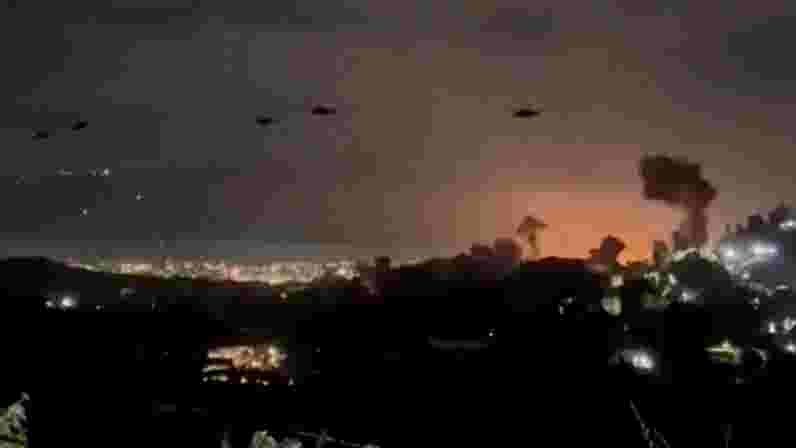
The raid culminated in the successful apprehension of Nicolas Maduro, who, sources suggest, was taken into custody without significant injury. Photos, purportedly leaked from within the operation, show a visibly disheveled Maduro being led away, his usual defiant demeanor replaced by a look of shock and perhaps resignation. (Can you even imagine the feeling? To go from leading a nation, however controversially, to being a captive in a matter of hours.) The US government confirmed the operation hours later in a terse statement from the White House, asserting that Maduro was now in US custody and would face justice for his alleged crimes. This swift confirmation, rather than attempting to deny or obfuscate, underscores the deliberate and calculated nature of this high-risk maneuver, an overnight attack designed to alter the course of Venezuelan history.
International Fallout: A World Divided
The global reaction to the news that the US seizes Venezuela’s Maduro has been nothing short of explosive. The world, it seems, has been instantly cleaved into factions, each responding with a mix of condemnation, cautious support, or strategic silence. It’s a truly remarkable moment in international diplomacy, isn’t it?
Immediate Condemnation from Allies of Venezuela
Unsurprisingly, nations traditionally aligned with Maduro’s regime were quick to denounce the operation as a flagrant violation of international law and Venezuelan sovereignty. Russia’s Foreign Ministry issued a scathing statement, calling the act “an unprecedented act of state terrorism” and a “criminal breach of all norms.” China echoed similar sentiments, urging respect for national sovereignty and non-interference in internal affairs, expressing “deep concern” over regional stability. Cuba, a steadfast ally, declared the seizure a “barbaric act of aggression” and rallied its own citizens in protests. “This sets a dangerous precedent for every sovereign nation,” declared a fiery spokesperson for the Russian UN mission, adding, “Today it is Venezuela, tomorrow it could be anyone.”
Mixed Reactions and Cautious Support
In contrast, several Latin American nations, many of whom had previously recognized Juan Guaidó as Venezuela’s legitimate interim president, offered a more nuanced response. Colombia, often at odds with Maduro, called for calm but hinted at a potential path towards democracy. Brazil’s government expressed hope that the development could pave the way for a democratic transition and an end to the humanitarian crisis. The Organization of American States (OAS) Secretary-General issued a statement emphasizing the need for a peaceful transition, carefully avoiding outright endorsement or condemnation of the US action, a tightrope walk reflecting the deep divisions within the organization. You can almost feel the tension in those diplomatic chambers, can’t you? Everyone’s holding their breath, trying to figure out their next move.
European Union nations, while having previously imposed sanctions on Maduro’s government, have largely reacted with a mixture of concern and a call for adherence to international law. A spokesperson for the EU’s foreign policy chief stated, “We are monitoring the situation closely and call on all parties to exercise restraint and uphold the rule of law.” The cautious tone highlights the immense complexities and potential destabilizing effects of such a dramatic intervention.
What Led to This Moment? A History of Tensions
To truly grasp the magnitude of the recent events, we need to rewind a bit and understand the long, fraught history that set the stage for the US to seize Venezuela’s Maduro. This wasn’t an isolated incident; it was the culmination of years of escalating tensions, economic collapse, and a deeply entrenched political stalemate.
The Rise of Chavismo and US Opposition
Venezuela’s turbulent relationship with the United States took a sharp turn with the rise of Hugo Chávez in 1999. His “Bolivarian Revolution,” characterized by socialist policies and a fiercely anti-American stance, put him on a collision course with Washington. Chávez accused the US of imperialism, while the US viewed Chávez as an authoritarian threat to regional stability and a challenge to its geopolitical interests, particularly concerning Venezuela’s vast oil reserves. This ideological clash only intensified when Nicolas Maduro, Chávez’s handpicked successor, took power in 2013 after Chávez’s death. Maduro continued many of Chávez’s policies, but also presided over an unprecedented economic collapse.
Economic Devastation and Humanitarian Crisis
Under Maduro’s leadership, Venezuela spiraled into a devastating economic crisis. Hyperinflation rendered the national currency worthless, basic goods became scarce, and millions fled the country, creating one of the largest refugee crises in modern history. I remember seeing heartbreaking reports from the Colombian border, families crossing with nothing but the clothes on their backs. It was truly harrowing. The US and many international bodies blamed Maduro’s socialist policies, corruption, and mismanagement for the humanitarian catastrophe.
The US Pressure Campaign: Sanctions and Recognition of Guaidó
In response to the deteriorating situation, the US intensified its pressure campaign. This included:
* Economic Sanctions: A wide array of sanctions targeting Venezuela’s oil industry, financial institutions, and key individuals within Maduro’s government. The aim was to cripple the regime financially and force a change in leadership.
* Recognition of Juan Guaidó: In 2019, the US, along with dozens of other nations, recognized opposition leader Juan Guaidó as the legitimate interim president of Venezuela, arguing that Maduro’s 2018 re-election was fraudulent. This created a dual power structure, intensifying the political crisis.
* Drug Trafficking Indictments: Perhaps most significantly, in March 2020, the US Justice Department indicted Maduro and several top Venezuelan officials on charges of narco-terrorism, accusing them of collaborating with Colombian FARC rebels to flood the US with cocaine. A bounty of 15 million dollars was placed on Maduro’s head, effectively turning him into a wanted man. This indictment, more than any other action, set the legal predicate for an eventual “capture,” paving the way for the audacious overnight attack we’ve just witnessed.
The Legal and Moral Quagmire of Intervention
The successful operation where the US seizes Venezuela’s Maduro has immediately plunged the international community into a deep legal and moral quagmire. Questions are flying from every corner of the globe about the legitimacy, legality, and ethics of such a direct intervention. This isn’t just about geopolitics; it’s about the very foundations of international law, isn’t it?
Sovereignty vs. Universal Jurisdiction
At the heart of the debate lies the principle of national sovereignty. Under international law, a state generally has exclusive jurisdiction over its own territory and internal affairs. The US operation, conducted on Venezuelan soil without the express consent of the recognized government (even if the US doesn’t recognize Maduro’s legitimacy), is a clear breach of this principle. “This is a dangerous precedent,” argues Dr. Anya Sharma, a professor of international law at the University of London. “While one can debate the legitimacy of the Maduro regime, an uninvited military incursion into sovereign territory, even to apprehend an indicted individual, is a slippery slope. Where does it end?”
However, the US argues its actions fall under the principle of universal jurisdiction, especially concerning crimes like narco-terrorism, which are considered egregious enough to allow any state to prosecute, regardless of where the crime occurred or the nationality of the perpetrator. The 15 million dollar bounty on Maduro’s head, issued after his indictment, further underscored Washington’s intent to bring him to justice. “We did not invade Venezuela; we executed a lawful arrest warrant on a wanted international criminal who happened to be squatting in the presidential palace,” a senior State Department official anonymously told a major news outlet, trying to justify the operation. This official, clearly aware of the controversy, added, “This wasn’t about regime change, per se, it was about justice.” A subtle distinction, perhaps, but one they’ll undoubtedly lean heavily on.
Ethical Considerations and Precedent
Beyond the legal arguments, the ethical implications are profound. Critics worry that this operation could embolden other powerful nations to undertake similar actions against leaders they deem undesirable, potentially leading to greater instability and conflict. What if Russia decided to seize a leader they disliked, or China? It really opens up Pandora’s Box, doesn’t it? The precedent set by this overnight attack is a major concern for many international relations experts.
Supporters of the US action, however, point to the dire humanitarian situation in Venezuela and Maduro’s alleged crimes against his own people and the international community. They argue that sometimes, extraordinary measures are necessary when conventional diplomatic and economic pressures fail to dislodge an oppressive regime or bring criminals to justice. “Millions of Venezuelans have suffered for years under this man,” commented a Venezuelan opposition figure living in exile in Miami. “If this is what it took to free them from his tyranny, then so be it. The world stood by for too long.”
Ultimately, the legality and morality of the operation will likely be debated for years, if not decades, in international forums and academic circles. What’s undeniable is that the landscape of international relations has been irrevocably altered.
Venezuela’s Future: A Path Forward Amidst Uncertainty
With Nicolas Maduro now in US custody, Venezuela stands at a critical, incredibly uncertain crossroads. The future feels like a blank page, waiting to be written, but with so many hands reaching for the pen. What happens next after the US seizes Venezuela’s Maduro? That’s the question everyone is asking, from the streets of Caracas to the halls of the UN.
The Immediate Power Vacuum and Potential for Unrest
The most immediate concern is the power vacuum. Who takes charge? While Juan Guaidó is recognized by many nations as the interim president, his authority within Venezuela was always tenuous, reliant largely on international backing and limited domestic support. Will the Venezuelan military, long seen as the ultimate arbiter of power, now align with Guaidó, or will factions emerge, potentially leading to internal strife? A quick glance at history tells us that such transitions are rarely smooth.
“We are urging all parties to act responsibly,” stated a representative from the UN Secretary-General’s office, expressing deep concern over the potential for violence. “The last thing Venezuela needs now is a civil conflict.” Indeed, the memory of previous coup attempts and street protests, often met with brutal force, looms large. Will the remaining elements of the Chavista government attempt to resist? Or will they see this as an opportunity for a fresh start, however reluctantly? It’s impossible to predict with certainty.
Towards an Interim Government and Elections?
The US and its allies are likely to push for a swift establishment of an interim government, led by Guaidó or another consensus figure, with the stated goal of holding free and fair elections as soon as practicable. This would be a monumental undertaking. Venezuela’s electoral system has been widely criticized for lacking transparency and fairness. Rebuilding democratic institutions, ensuring independent oversight, and allowing for the safe return of exiles and opposition figures would be enormous challenges.
Consider the complexity:
* Institutional Reform: Overhauling the National Electoral Council and other state institutions perceived as loyal to Maduro.
* Economic Reconstruction: Tackling hyperinflation, rebuilding infrastructure, and revitalizing the oil industry. This will require significant international aid and investment.
* Social Reconciliation: Healing the deep political and social divisions that have plagued the country for decades. This is perhaps the hardest part, isn’t it? Bridging those ideological chasms.
“This is not a magic bullet,” cautioned a seasoned diplomat specializing in Latin America. “Removing Maduro doesn’t automatically solve Venezuela’s problems. It merely removes a major obstacle. The real work, the nation-building, begins now, and it will be incredibly difficult and fraught with peril.”
The Role of the International Community
The international community, particularly the US, will face immense pressure to support a stable transition and avoid further destabilization. This could involve:
* Providing humanitarian aid on an even larger scale.
* Offering economic assistance packages.
* Supporting electoral monitoring missions.
* Potentially, peacekeeping forces if stability seriously deteriorates.
The question of whether this overnight attack will usher in a new era of hope or plunge Venezuela into deeper chaos remains tragically open. The stakes couldn’t be higher, and the world watches, mesmerized and anxious, as this unfolding drama continues to write itself.
Frequently Asked Questions
| What exactly happened when the US seized Venezuela’s Maduro? | In a dramatic pre-dawn operation, US Special Operations forces reportedly conducted a raid on Miraflores Palace in Caracas, successfully apprehending Venezuelan President Nicolas Maduro. This overnight attack was reportedly executed with precision, culminating in Maduro’s capture without significant injury, bringing him into US custody to face charges of narco-terrorism. |
| What are the immediate international reactions to this event? | The international community is sharply divided. Allies of Venezuela like Russia, China, and Cuba have vehemently condemned the operation as a violation of sovereignty. Many Latin American nations and European countries have expressed concern, calling for restraint and adherence to international law, while some US allies cautiously view it as a potential step towards democracy for Venezuela. |
| What is the legal justification cited by the US for this operation? | The US has justified the operation by citing an indictment against Nicolas Maduro on charges of narco-terrorism and a 15-million-dollar bounty for his capture. They argue the action was an execution of a lawful arrest warrant on an internationally wanted criminal, rather than an invasion, relying on principles of universal jurisdiction for such egregious crimes. |
| What are the potential challenges for Venezuela’s future after Maduro’s capture? | Venezuela faces significant challenges including an immediate power vacuum, potential for civil unrest, and the immense task of establishing a stable interim government. There’s also the need for comprehensive institutional reform, economic reconstruction to address hyperinflation and poverty, and social reconciliation to heal deep political divisions, all under intense international scrutiny. |
| How might this event impact geopolitical stability in Latin America? | This unprecedented operation has profound implications for geopolitical stability. It could set a controversial precedent for international intervention, intensify regional tensions between pro-US and anti-US blocs, and lead to increased volatility. The long-term impact will depend heavily on the subsequent actions of the US, the reactions of Venezuela’s military, and the ability of the international community to facilitate a peaceful and democratic transition. |
Important Notice
This FAQ section addresses the most common inquiries regarding the topic.