The world of scientific achievement and political aspiration collided spectacularly this week, resulting in what critics are widely labeling an “Absolutely Embarrassing New Nobel Boast.” Former U.S. President Donald Trump, known for his long-standing desire for recognition, particularly the Nobel Peace Prize, shifted gears dramatically on Thursday by appearing to claim credit for the 2025 Nobel Prize in Physics—an award granted for foundational work completed decades before his tenure in national leadership.
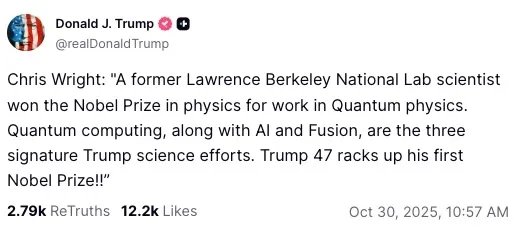
The astonishing claim was broadcast via a quote posted to Truth Social, attributed to Energy Secretary Chris Wright, a former executive in the energy sector. This quote asserted that the Nobel Prize, given for landmark advancements in quantum physics, was, by extension, an award reflecting positively on Trump’s scientific priorities.
“Quantum computing, along with artificial intelligence and Fusion, are the three signature Trump science efforts,” the message attributed to Wright read. “Trump 47 racks up his first Nobel Prize!!” This bold declaration immediately sparked intense mockery and scrutiny from scientists, political adversaries, and general observers who pointed out glaring chronological and thematic inconsistencies.
The 2025 prize was rightfully awarded to John Clarke, Michel H. Devoret, and John M. Martinis. The Nobel Foundation recognized the trio for “the discovery of macroscopic quantum mechanical tunnelling and energy quantisation in an electric circuit.” This pioneering research represents a crucial step in understanding quantum mechanics at the macroscopic level—work that lays the groundwork for technologies like quantum computing.
The Chronological Chasm Behind the Absolutely Embarrassing New Nobel Boast
The primary source of confusion and derision lies squarely in the timeline. The trio’s groundbreaking success occurred while they were collaborating at the prestigious Lawrence Berkeley National Laboratory during 1984 and 1985. To put this into perspective, this timeline precedes Trump’s first presidency, which began in 2017, by over three decades. Attributing a Nobel Prize for pre-Internet era physics breakthroughs to a president whose focus on these fields began much later strained credulity across the board.

In fact, the irony deepened when considering the fate of the institution where the Nobel-winning work was performed. The Daily Californian reported that the very lab responsible for the prize-winning discovery recently had to lay off 15-20% of its research staff. This downsizing was reportedly due to reductions in federal financial backing for research, cuts that critics claim were implemented during the period of reduced governmental focus on specific scientific funding.
Great things in business are never done by one person. They’re done by a team of people. Steve Jobs
The spectacle of the former President leveraging the historic achievement of scientists—work that long predates his involvement—highlights a pattern of attempting to appropriate success where direct connection is tenuous or nonexistent. This effort to claim an award designed to honor individual scientific merit for policy achievements sparked immediate backlash.
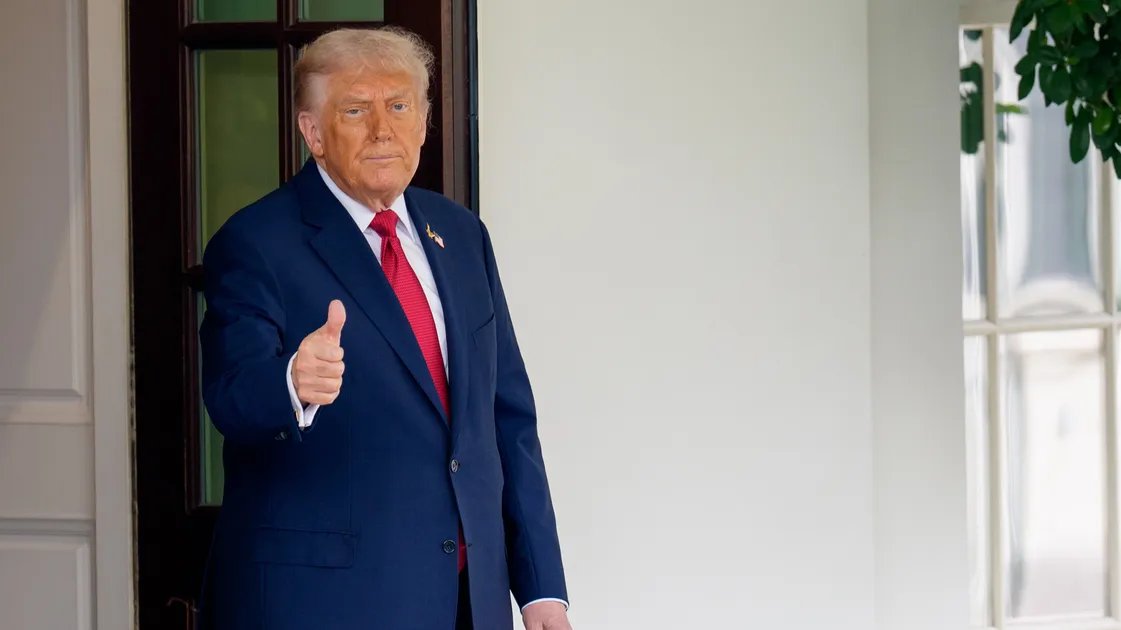
The President has never been shy about his desire for Nobel recognition, though his usual focus has been the Peace Prize. For years, he has vocalized frustrations over not receiving the award, insisting he deserved “four or five” Nobels, often drawing unfavorable comparisons to former President Barack Obama, who received the Peace Prize early in his term.
The pivot to claiming a physics prize, a field generally requiring highly specialized knowledge, was baffling to many. One common line of criticism suggested the former leader would struggle to explain the basic concepts of quantum computing, let alone claim responsibility for its foundational discovery. This move, characterized as desperation by opponents, further fueled the narrative surrounding the **Absolutely Embarrassing New Nobel Boast**.
Doing the best at this moment puts you in the best place for the next moment! Oprah Winfrey
The claim that quantum computing is one of the “three signature Trump science efforts” while ignoring the decades of global academic and governmental investment that preceded it, minimizes the profound legacy of scientists who dedicated their lives to abstract theoretical and experimental physics. The underlying work that won the Nobel prize required specialized public funding and intellectual freedom, resources that some critics argue were not prioritized or protected consistently during the administration in question.
This attempt to claim a Nobel Prize in physics, a sphere where the criteria for attribution are remarkably stringent, shifts the debate from geopolitical achievements to scientific credit. This move, however, merely invited deeper scrutiny into the administration’s actual contributions to fundamental research, exposing the hollowness of the statement made on Truth Social.
Success is largely a matter of holding on after others have let go.
Analyzing the Critics’ Rebuttal: The Quantum Leap of Logic
The immediate political and scientific response was swift and dismissive. Governor Gavin Newsom took to social media, asserting that the motivation was rooted in political failure:
“The President of the United States is so upset about his failed political drive for a Nobel Prize that he’s now trying to claim someone else’s prize as his own. Pathetic.”
Other commenters honed in on the technical absurdity. One observer quipped, “I’d love to hear Trump try to explain quantum computing. ‘MAGNETS!'” highlighting the perceived gap between the claim and any demonstrable understanding of the subject matter. The consensus among critics was that this move represented an unprecedented attempt to steal honors and accomplishments that were entirely unconnected to his policy directives or personal efforts.
The specific mention of Chris Wright complicated the matter further. Wright, as the current Energy Secretary, was supposedly the source lending credibility to the claim, yet he himself was not the prize winner. The whole scenario was described by one pundit as “even more incoherent than it looks,” noting that the former President was simply quoting his secretary giving him credit for work done by three physicists decades ago.
The Persistent Pursuit of Nobel Glory
The fixation on the Nobel Prize is not merely a recent development; it has been a core component of the former leader’s public identity for years. While he usually focused on the Nobel Peace Prize, citing various geopolitical successes, the failure to secure that honor seems to have driven this latest, highly unconventional claim regarding the physics prize. This highlights a persistent quest for validation through highly prestigious, yet perhaps misapplied, international awards.
- A year from now you may wish you had started today.
- The question isn’t who is going to let me; it’s who is going to stop me.
- Success is the sum of small efforts, repeated day-in and day-out.
- I find that the harder I work, the more luck I seem to have.
- If people did not do silly things, nothing intelligent would ever get done.
- Before anything else, preparation is the key to success.
The entire incident serves as a peculiar example of political messaging attempting to retrofit history to fit current narratives. By attempting to link decades-old foundational research in quantum mechanics to contemporary political initiatives, the move sought to imbue the administration with an undeserved legacy of scientific foresight and accomplishment. This type of claim, however, tends to backfire spectacularly, especially in specialized fields like physics where facts and dates are immutable.
 Action is the foundational key to all success
 Action is the foundational key to all success
In life, the road to true success often involves acknowledging the efforts of predecessors. The three Nobel laureates—Clarke, Devoret, and Martinis—represent decades of quiet, rigorous scientific dedication. Their work required precise measurements and theoretical breakthroughs in the 1980s, enabling our modern understanding of how quantum phenomena manifest at the macroscopic scale. The attempt to co-opt this legacy undermines the very spirit of the Nobel award, which celebrates independent, pivotal discovery.
The response from the scientific community has been one of deep disappointment mixed with incredulity. The fact that the Lawrence Berkeley National Laboratory, the birthplace of this Nobel-winning research, faced severe funding cuts during the period in question creates a devastating contrast to the current boast. This juxtaposition makes the assertion that quantum computing is a “signature Trump science effort” nearly impossible to defend without significant factual gymnastics.
Success is how high you bounce when you hit bottom
The persistence of the former leader’s desire for accolades, whether for peace or physics, remains a constant theme in political commentary. However, this particular maneuver has set a new benchmark for perceived political overreach in claiming scientific achievement. By attempting to take credit for the painstaking work of others, critics argue the administration has only succeeded in magnifying the distance between rhetoric and reality.
The widespread ridicule—or “clowning,” as the title suggests—underscores the failure of the move to resonate with either the scientific community or politically engaged observers. The attempt to equate governmental funding initiatives (even if retrospective) with the initial creative and intellectual act of discovery that wins a Nobel Prize is a flawed logical premise.
Ultimately, the saga of the **Absolutely Embarrassing New Nobel Boast** serves as a potent reminder that scientific honors are earned over time through verifiable, foundational achievements, regardless of subsequent political affiliation or policy. The focus should remain on celebrating the laureates who dedicated their lives to expanding human knowledge, not on the political figures attempting to bask in their reflection.
Great things in business are never done by one person. They’re done by a team of people. Steve Jobs
In conclusion, the effort to claim a share of the 2025 Nobel Prize in Physics for work done four decades earlier has been met with universal scorn. The claim, propagated through a quote attributed to the Energy Secretary, attempted to link quantum physics breakthroughs to signature policy efforts. Instead of garnering praise, this move has only amplified the voices of critics who deem the maneuver “pathetic,” solidifying the narrative surrounding the most **Absolutely Embarrassing New Nobel Boast** in recent memory.
The episode highlights a fundamental disconnect between political self-promotion and the rigorous, verifiable standards required for international scientific recognition. The history of quantum mechanics cannot simply be rewritten to fit a political narrative; the facts regarding the 1984–1985 discoveries stand firm, decades removed from the political environment now attempting to co-opt them.