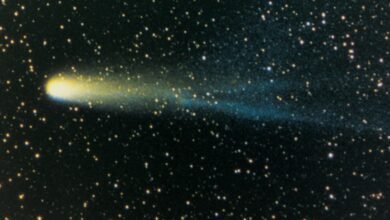
The swirling dust of the cosmos, captured in pixels. That’s what NASA’s HiRISE camera attempted when it turned its gaze towards the interstellar comet 3I/ATLAS. But the resulting image? It sparked a firestorm. “Looks like a smudge,” some said. “A potato,” others quipped online. The backlash was swift, and frankly, brutal. But hold on. Before you dismiss the image entirely, consider the immense challenges involved in photographing something that’s not only incredibly far away but also moving at breakneck speed through space. (Imagine trying to photograph a hummingbird from across a football field, at night, with a shaky camera). That’s where Oxford astrophysicist Jake Taylor enters the fray, offering a robust defense of NASA’s efforts.
It’s not just about the pretty pictures, though those are nice too. It’s about the science. The data. The sheer audacity of trying to understand the universe, one pixel at a time. Taylor, a rising star in the field of astrophysics, argues that the HiRISE image, despite its perceived imperfections, holds valuable information about the comet’s composition and trajectory. He emphasizes the complexities of image processing, especially when dealing with faint and distant objects. He’s seen these types of reactions before. “People expect Hubble-quality images from everything,” he told us, “but they don’t realize the limitations we’re working with. It’s like complaining that a doctor can’t perform brain surgery with a butter knife.”
And he has a point. Think about it. This is an object from *another* solar system, hurtling through *our* solar system. We’re trying to get a glimpse, a snapshot, of something truly alien. It’s ambitious, to say the least. And while the image may not be the most visually stunning, it represents a significant achievement in our ongoing quest to explore the cosmos. So, let’s dive deeper and understand why Taylor believes this much-maligned image is actually a triumph of space exploration. And why the criticism might be missing the bigger picture.
Understanding the HiRISE Image and the Controversy
The High Resolution Imaging Science Experiment (HiRISE) camera, mounted on NASA’s Mars Reconnaissance Orbiter, is renowned for capturing incredibly detailed images of the Martian surface. Using it to image a comet, especially an interstellar one, presents a unique set of challenges. The distance is vast, the comet is relatively small, and it’s moving at an incredible speed. These factors all contribute to the difficulty in obtaining a clear, sharp image.
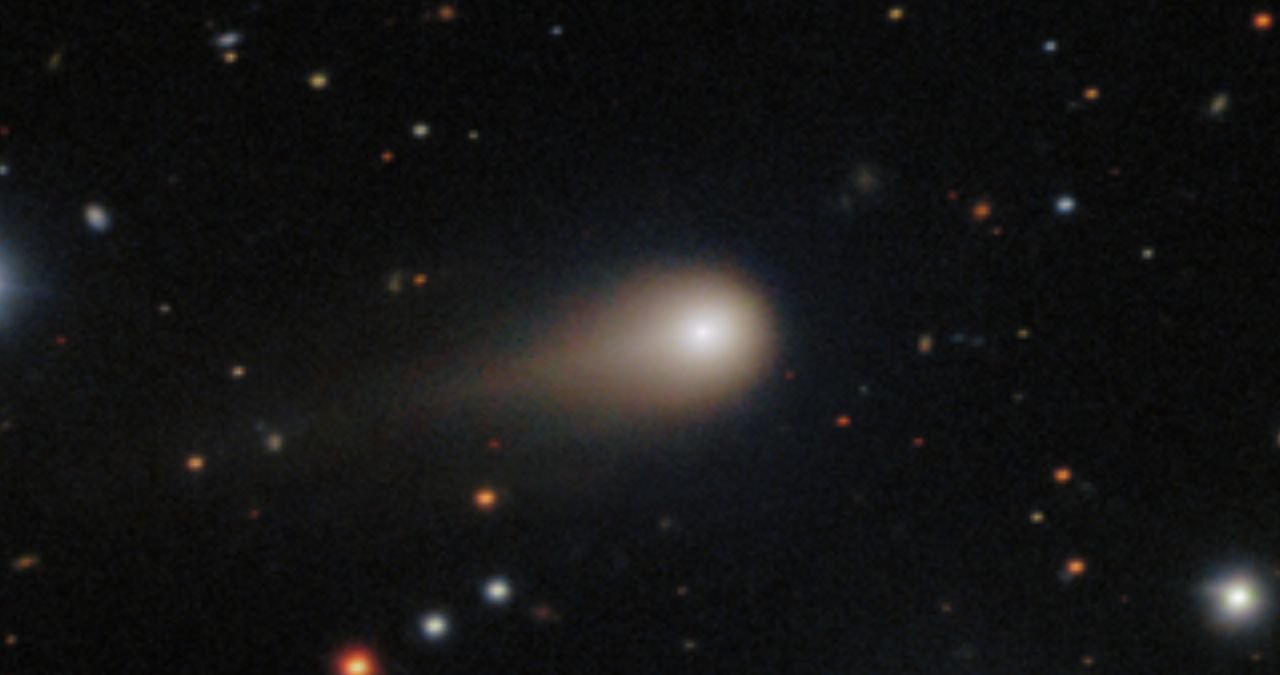
The resulting image of 3I/ATLAS, released by NASA, appeared as a somewhat blurry, elongated object. Many online commentators were quick to mock the image, comparing it unfavorably to the stunning images produced by the Hubble Space Telescope. Some even questioned whether it was a genuine image of a comet at all. This immediate and often harsh backlash caught many in the scientific community by surprise. The speed and intensity of the online criticism highlighted the public’s high expectations for space imagery, shaped in part by decades of breathtaking pictures from Hubble and other advanced telescopes.
“I think people underestimate the sheer difficulty of what NASA is trying to achieve,” said Emily Carter, a space enthusiast who follows NASA’s missions closely. “They’re pushing the boundaries of technology and science, and sometimes the results aren’t perfect. But that doesn’t mean they’re not valuable.”
Jake Taylor’s Defense: Context and Scientific Value
Jake Taylor’s defense of the HiRISE image centers on two key arguments: context and scientific value. He emphasizes that HiRISE was not designed to image comets and that using it for this purpose required significant ingenuity and adaptation. Furthermore, he argues that even a seemingly “imperfect” image can provide valuable scientific data.
“It’s crucial to remember that HiRISE is a Martian surface imager,” Taylor explains. “It’s optimized for capturing high-resolution details of a relatively nearby object – Mars. Imaging something as small and distant as 3I/ATLAS requires a completely different approach.”
He points out that the image, despite its blurriness, provides valuable information about the comet’s size, shape, and coma (the cloud of gas and dust surrounding the nucleus). This data can be used to estimate the comet’s composition, its rate of sublimation (the process by which ice turns directly into gas), and its trajectory.

Image Processing Techniques and Challenges
Taylor elaborates on the complex image processing techniques required to extract meaningful data from the HiRISE image. He describes the challenges of removing noise, correcting for distortions, and enhancing the contrast of the faint signal from the comet. He notes that these techniques can sometimes introduce artifacts or distortions that contribute to the perceived “imperfections” of the image.
“Image processing is not just about making pretty pictures,” Taylor says. “It’s about extracting the maximum amount of scientific information from the raw data. Sometimes, that means sacrificing visual appeal for scientific accuracy.”
For instance, the elongation of the comet in the image could be due to the comet’s motion during the exposure time. This effect, known as “motion blur,” can be difficult to correct for, especially when dealing with a faint and rapidly moving object.
Comparing HiRISE to Other Imaging Systems
A key part of Taylor’s defense involves comparing HiRISE to other imaging systems, such as the Hubble Space Telescope. He emphasizes that Hubble is specifically designed for deep-space imaging and has a much larger aperture and more sensitive detectors than HiRISE. This allows Hubble to capture much sharper and more detailed images of distant objects.
Here’s a comparison table:
| Feature | Hubble Space Telescope | HiRISE (Mars Reconnaissance Orbiter) |
|———————-|————————–|—————————————-|
| Primary Purpose | Deep-space imaging | Martian surface imaging |
| Aperture | 2.4 meters | 0.5 meters |
| Location | Earth orbit | Mars orbit |
| Optimized For | Distant, faint objects | High-resolution surface details |
| Cost (approximate) | $10 billion | Included in MRO’s $720 million cost |
“It’s simply not fair to compare HiRISE to Hubble,” Taylor argues. “They’re different instruments designed for different purposes. Expecting HiRISE to produce Hubble-quality images of a comet is like expecting a bicycle to perform like a Formula 1 race car.”
The Broader Implications: Public Perception and Scientific Communication
The backlash against the HiRISE image also raises broader questions about public perception of science and the challenges of scientific communication. In an age of instant information and high-resolution imagery, the public often expects visually stunning results from scientific endeavors. When those expectations are not met, it can lead to disappointment and even distrust.
“Scientists need to do a better job of communicating the complexities and limitations of their work,” says Dr. Anya Sharma, a science communication expert. “We need to explain why some images may not be as visually appealing as others, but still contain valuable scientific information.”
She suggests that NASA and other scientific organizations should focus on providing more context and explanation when releasing images, highlighting the challenges involved and the scientific insights gained. This could help to manage public expectations and foster a greater appreciation for the scientific process.

The Importance of Interdisciplinary Collaboration
Successfully capturing and interpreting images of interstellar objects like 3I/ATLAS requires collaboration across multiple scientific disciplines. Astronomers, physicists, engineers, and computer scientists must work together to design and operate the instruments, process the data, and interpret the results. This interdisciplinary approach is essential for pushing the boundaries of scientific knowledge.
“It’s not just about taking a picture,” Taylor emphasizes. “It’s about understanding the physics of the comet, the optics of the instrument, and the algorithms used to process the data. It’s a team effort.”
He also highlights the importance of open-source software and data sharing in facilitating scientific collaboration. By making data and tools freely available, scientists can build on each other’s work and accelerate the pace of discovery.
The Future of Comet Imaging and Interstellar Exploration
Despite the challenges, the future of comet imaging and interstellar exploration is bright. New telescopes and instruments are being developed that will provide even more detailed and informative images of comets and other celestial objects. Advances in image processing techniques are also improving our ability to extract meaningful data from noisy and imperfect images.
Some upcoming missions, like the Comet Interceptor mission planned by the European Space Agency (ESA), are specifically designed to study interstellar comets and other small bodies in our solar system. These missions will provide valuable insights into the composition and origin of these objects, helping us to understand the formation and evolution of our solar system and the universe as a whole.
“We’re on the cusp of a new era in comet exploration,” Taylor says. “With the next generation of telescopes and missions, we’ll be able to learn more about these fascinating objects than ever before.”
The ongoing debate surrounding the HiRISE image of 3I/ATLAS serves as a reminder that scientific progress is not always linear or visually spectacular. It is a process of constant refinement, adaptation, and collaboration. While the image may not have met everyone’s expectations, it represents a valuable step forward in our understanding of the cosmos and the challenges of space exploration. It is also a reminder that the beauty of science often lies not in the perfect picture, but in the story it tells and the knowledge it reveals.
In the end, it’s not just about the image itself, but what we learn from it. And perhaps, that’s the most important picture of all.
Frequently Asked Questions
| Why was NASA’s HiRISE image of 3I/ATLAS criticized? | The image was criticized because it appeared blurry and lacked the visual appeal expected from space imagery, especially when compared to images from telescopes like Hubble. |
| What are the benefits of the HiRISE image despite its perceived flaws? | Despite its blurriness, the image provides valuable scientific data about the comet’s size, shape, and coma, which can be used to estimate its composition, rate of sublimation, and trajectory. |
| How is image processing used to analyze the HiRISE image? | Image processing techniques are used to remove noise, correct for distortions, and enhance the contrast of the faint signal from the comet, allowing scientists to extract meaningful data from the raw image. |
| What are the challenges in capturing images of interstellar comets? | The challenges include the vast distance, the relatively small size of the comet, its rapid movement, and the need to adapt instruments designed for other purposes, such as Martian surface imaging. |
| What is the future of comet imaging and interstellar exploration? | The future involves the development of new telescopes and instruments, advances in image processing techniques, and dedicated missions like ESA’s Comet Interceptor, which will provide more detailed and informative images and data about comets and other celestial objects. |
Important Notice
This FAQ section addresses the most common inquiries regarding the topic.